Choline and TMAO: The Heart-Health Question Behind High Choline Intake
Roon Team
Choline and TMAO: The Heart-Health Question Behind High Choline Intake
Choline is one of the few nutrients that earns near-universal praise. Your brain runs on it. Your liver needs it. Pregnancy demands more of it. So the logic of the supplement aisle kicks in: if some is good, a megadose must be better.
The science on choline TMAO says otherwise. When you flood your gut with choline, the bacteria living there turn part of it into a compound that has been tied to clotting, inflammation, and cardiovascular risk. The dose is the whole story.
This is not an argument against choline. It is an argument against treating it like a substance with no ceiling.
Key Takeaways
- Choline is essential for memory, mood, and liver function, but your gut bacteria convert excess choline into trimethylamine N-oxide (TMAO), a marker linked to heart disease.
- High-dose choline supplements raise TMAO and platelet reactivity far more than whole-food sources like eggs.
- Raised TMAO is associated with higher all-cause mortality and cardiovascular events in large meta-analyses.
- The fix is not avoidance. It is hitting your needs (around 425 to 550 mg per day) without overshooting into megadose territory.
What TMAO Actually Is
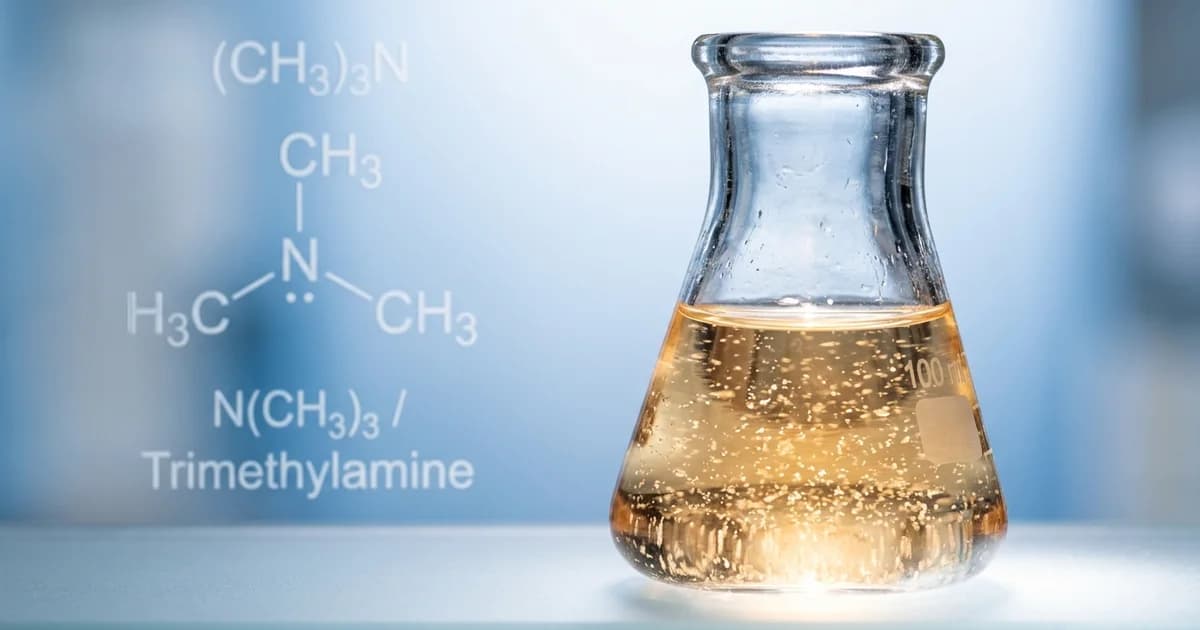
TMAO stands for trimethylamine N-oxide. It is not something you eat. It is something your body builds in two steps.
First, gut bacteria break down dietary compounds like choline, L-carnitine, and betaine into a gas called trimethylamine (TMA). Then your liver oxidizes that gas into TMAO, which circulates in your blood.
The compound caught researchers' attention because it tracks so cleanly with cardiovascular outcomes. TMAO is a microbial metabolite that has been associated with cardiovascular disease and mortality. A dose-response meta-analysis in the European Heart Journal found that high TMAO plasma levels were associated with increased incidence of all-cause mortality, with a hazard ratio of 1.91.
That is not a rounding error. It is the kind of signal that makes cardiologists pay attention.
The Choline TMAO Connection, Explained
Here is the uncomfortable part for anyone stacking choline capsules. The more choline you feed your gut microbes, the more raw material they have to make TMA, and the more TMAO your liver produces downstream.
A randomized clinical trial published in The American Journal of Medicine put real numbers on this. Choline bitartrate supplements providing comparable total choline raised both TMAO and platelet reactivity, demonstrating that the form and source of dietary choline differentially contributes to systemic TMAO levels and platelet function.
Translation: the same amount of choline behaves differently depending on where it comes from. The supplement form drove TMAO up. Whole eggs did not move it nearly as much.
Cleveland Clinic researchers were among the first to map this in humans. In their interventional work published in Circulation, both groups showed at least a 10-fold increase in plasma levels of trimethylamine N-oxide after choline supplementation, as well as an increase in platelet responsiveness, a risk factor for clotting.
A 10-fold jump from a supplement most people take to sharpen focus. That is the cost of ignoring the dose.
Why Supplements Hit Harder Than Eggs
Choline bitartrate is free choline. It arrives in your gut fast and largely intact, giving bacteria an easy meal. Phosphatidylcholine, the form found in eggs and whole foods, is bound up in fat and protein, so more of it gets absorbed before the microbes can touch it. In controlled feeding work, whole eggs barely moved TMAO while the isolated supplement form pushed it up. The package matters as much as the molecule.
Choline Cardiovascular Risk: How Worried Should You Be?
The honest answer is nuanced, and the nuance matters. TMAO is a strong marker of choline cardiovascular risk, but a marker is not a verdict.
Some of the association is muddied by reverse causation. People with impaired kidney function clear TMAO poorly, so their levels run high regardless of diet. Kidney disease itself raises cardiovascular risk, which can inflate the apparent link between TMAO and heart problems.
Still, the prospective data is hard to wave away. A systematic review in Cardiorenal Medicine found that high TMAO was positively associated with all-cause mortality with a hazard ratio of 1.38, as well as adverse cardiovascular events.
So the reasonable stance is not panic. It is restraint. There is no upside to deliberately spiking a biomarker tied to clotting and mortality when your actual choline needs are modest.
Carnitine, TMAO, and the Red Meat Angle
Choline is not the only trimethylamine N-oxide supplement input worth knowing about. L-carnitine, popular among lifters and endurance athletes, feeds the same pathway.
The landmark carnitine TMAO research came out of Cleveland Clinic in 2013. The team showed that intestinal microbiota metabolism of L-carnitine, a nutrient in red meat, promotes atherosclerosis.
This is why TMAO keeps surfacing in conversations about red meat and heart disease. It is also why a carnitine megadose deserves the same skepticism as a choline megadose. Both are gut-bacteria fuel for the same end product.
How Much Choline Do You Actually Need?
Less than the supplement marketing implies. The established Adequate Intake covers the vast majority of people without pushing them into TMAO territory.
According to the Harvard T.H. Chan School of Public Health Nutrition Source, the Adequate Intake for choline for men and women ages 19 and older is 550 mg and 425 mg daily, respectively. That guideline, the Tufts Health & Nutrition Letter notes, comes from the Food and Nutrition Board of the National Academy of Medicine, at 550 milligrams per day for adult men and 425 mg per day for adult women.
Most omnivores get close to this from food. The primary sources of choline are animal-based products such as meat, poultry, fish, dairy and eggs.
Choline Sources, Compared
| Source | Choline form | Approx. choline | TMAO impact |
|---|---|---|---|
| Whole eggs | Phosphatidylcholine | ~150 mg per 2 eggs | Low in trials |
| Beef, poultry, fish | Mixed, food-bound | 70 to 110 mg per serving | Moderate, food-bound |
| Choline bitartrate supplement | Free choline | 250 to 500+ mg per dose | Raises TMAO and platelet reactivity |
| L-carnitine supplement | Carnitine precursor | N/A | Feeds same TMA pathway |
The pattern is consistent. Food-bound choline behaves; isolated megadoses do not.
Is Choline Safe? The Measured Answer
Yes, at sensible intakes choline is safe and necessary. The question "is choline safe" only gets complicated when people abandon the dose-response curve. Meeting your Adequate Intake supports memory, liver function, and cell membrane structure with no meaningful TMAO penalty. Doubling or tripling that through free-choline supplements is where the risk-to-benefit math turns against you.
The smart move is to treat choline like any potent nutrient. Cover the floor, respect the ceiling, and stop assuming more equals better.
The Bottom Line on More Versus Better
Choline earns its reputation as a brain and liver nutrient, and most people should make sure they hit their daily target. The trouble starts at the top of the dose curve, where free-choline supplements hand your gut bacteria the fuel to make TMAO, a compound tied to clotting and cardiovascular risk in large studies.
Whole foods give you the benefit without the spike. Isolated megadoses give you the spike without much extra benefit. The biology rewards precision, not enthusiasm. "Essential" and "limitless" are not the same word.
Frequently Asked Questions
Does taking choline raise TMAO?
High-dose choline supplements do. In a randomized clinical trial, choline bitartrate raised both fasting TMAO and platelet reactivity, while the same amount of choline from whole eggs had a much smaller effect. The free-choline form in many supplements is easy for gut bacteria to convert, which drives TMAO up. Meeting your needs through food rarely produces that kind of spike.
Is TMAO definitely bad for your heart?
TMAO is a strong risk marker, not a confirmed standalone cause. Meta-analyses link high TMAO to greater all-cause mortality and cardiovascular events. Some of that association reflects kidney function, since impaired kidneys clear TMAO slowly. The practical takeaway holds either way: there is no benefit to deliberately raising it.
How much choline should I take per day?
The Adequate Intake is 550 mg per day for adult men and 425 mg for adult women, set by the National Academy of Medicine. Most people who eat eggs, fish, poultry, or meat get close to this from food alone. Supplementing beyond your needs offers little extra upside and feeds the TMAO pathway.
Do eggs raise TMAO like supplements do?
Not to the same degree. Eggs deliver choline as phosphatidylcholine, which is bound in fat and protein and absorbed before gut bacteria can fully process it. Controlled trials found little TMAO change from whole eggs compared with isolated choline bitartrate. The form and food matrix matter as much as the milligram count.
Does L-carnitine also produce TMAO?
Yes. L-carnitine, common in pre-workout and red meat, is metabolized by gut bacteria into trimethylamine, the precursor to TMAO. Cleveland Clinic research showed this carnitine pathway promotes atherosclerosis in animal models. If you are already mindful of choline dosing, carnitine megadoses deserve the same caution.
Should I stop taking choline supplements entirely?
Not necessarily. If your diet is low in eggs, fish, and meat, a modest choline supplement can help you reach your Adequate Intake. The goal is to fill a gap, not to megadose. Match the supplement to what your diet is missing rather than stacking grams for an imagined extra benefit.
Why Measured Doses Beat Megadoses
This whole topic is a clean case study in a principle that gets lost in the supplement world. The compounds that help you at one dose can work against you at five times that dose. Choline is essential. Flooding your gut with free choline is not the way to honor that.
The same logic guides how we built Roon. Instead of stacking the biggest numbers on a label, our sublingual pouch uses a tight four-ingredient formula: 80 mg caffeine, 60 mg L-theanine, 25 mg methylliberine (Dynamine), and 5 mg theacrine (TeaCrine). Doses chosen to work together, not to win a megadose contest. The result is a 5 to 10 minute onset and 6 to 8 hours of focus with no jitters, no crash, and no tolerance buildup.
To be clear, Roon is not a choline product and not a substitute for a balanced diet or your doctor's guidance on heart health. It is a focus tool built on the same belief this article makes the case for: the right dose, delivered well, beats the biggest dose every time. If that philosophy fits how you think about your body, give Roon a try.
Written by Roon Team