Anxiety Without Sedation: The Neuroscience of Calm Focus
Roon Team
Anxiety Without Sedation: The Neuroscience of Calm Focus
Most people think the price of feeling calm is feeling slow. Take the edge off, and you lose the edge entirely. That tradeoff is real for a lot of compounds, but it is not a law of biology.
The brain has separate circuits for "stop panicking" and "stop thinking," and an anxiolytic without sedation is any agent that engages the first without dragging down the second. Your nervous system can quiet the threat response while your attention stays sharp. Neuroscientists call the result relaxed alertness, and it is a specific, measurable brain state, not a marketing phrase.
This matters because the calm most people reach for comes with a sedative tax. There is a better target.
Key Takeaways
- Calm and drowsy are controlled by different receptor systems, so you can dampen one without the other.
- The classic anxiolytics (benzodiazepines) hit the α1 GABA-A subtype tied to sedation, which is why they make you foggy.
- L-theanine raises alpha brain wave activity, the EEG signature of calm but alert states like meditation.
- Pairing L-theanine with caffeine produces measurable gains in attention and reaction time, the cleanest example of calm focus without drowsiness.
Why Most "Calm" Comes With a Crash
The default chemistry of relaxation runs through GABA, your brain's main inhibitory neurotransmitter. More GABA signaling means less neuronal firing, which reads as "settle down." The problem is that not all GABA signaling is the same.
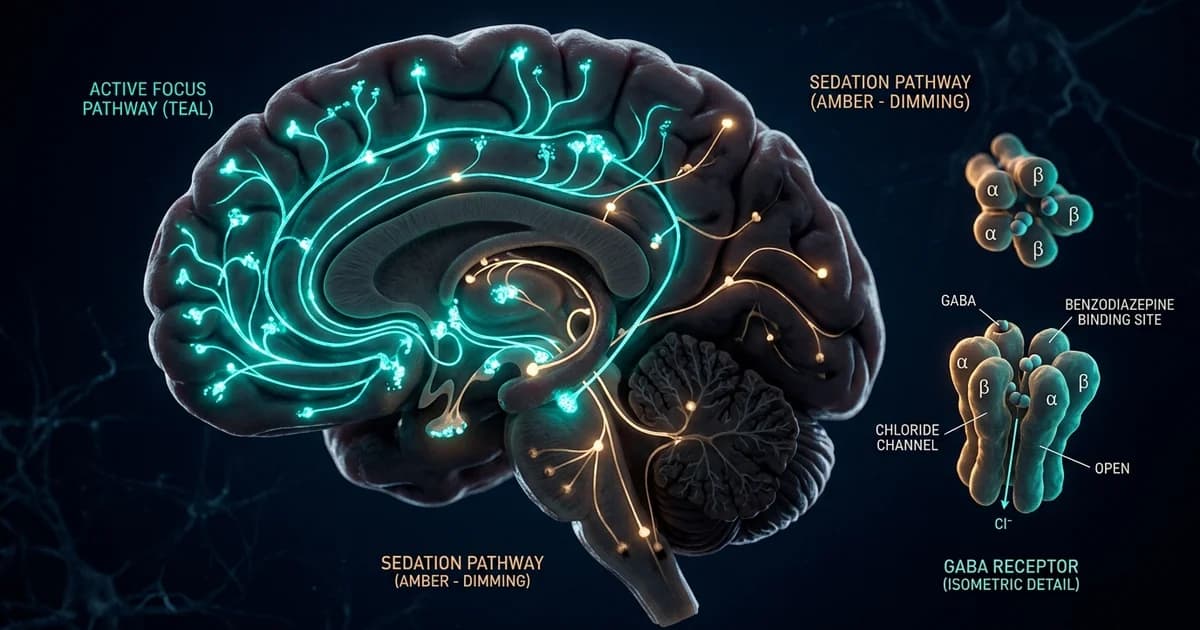
GABA-A receptors come in subtypes, and they do different jobs. Benzodiazepine receptor ligands with high activity at the α1 and/or α5 subunits tend to be more associated with sedation, ataxia and amnesia, whereas those with higher activity at GABA-A receptors containing α2 and/or α3 subunits generally have greater anxiolytic effects. In plain terms, one set of receptors makes you sleepy. A different set makes you calm.
Classic anxiety medications do not discriminate well. Recent molecular genetic and pharmacological data point to α1-containing GABA-A receptors as the "sedative" and α2- and/or α3-containing receptors as the "anxiolytic" subtype. Most older benzodiazepines bind broadly, so you get the anxiolytic benefit and the sedation as a package deal. That is the fog, the slowed reaction time, the "I took the edge off but now I cannot work" feeling.
The lesson from this research is structural. Calm and sedation are dissociable. The goal of non sedating anxiety relief is to push on the anxiolytic circuits while leaving the sedative ones alone.
What "Relaxed Alertness" Actually Looks Like in the Brain
Relaxed alertness has a brainwave fingerprint, and it is alpha activity. Your brain runs on electrical oscillations grouped by frequency, and each band maps to a mental state.
Alpha waves at 8 to 12 Hz are associated with a calm, relaxed waking state, such as during meditation, while beta waves at 12 to 30 Hz reflect focused attention and active thinking. Alpha is the band you want. It is the state of someone who is settled but switched on, the opposite of both anxious overdrive and sedated shutdown.
This is where the science gets useful. Several EEG studies have observed increased alpha brain wave activity following L-theanine intake, with the effect particularly noted in individuals with higher baseline anxiety. L-theanine, an amino acid from tea, nudges the brain toward the alpha state without flipping the off switch.
One sleep-research review put the distinction clearly. This creates a state of relaxed alertness or "calm attention," rather than acting as a direct sedative. That phrase is the whole point. You are not trading focus for calm. You are getting both.
How L-Theanine Pulls This Off
L-theanine does not work through a single lever. It modulates several systems at once, which is part of why its calm feels different from a sedative's calm.
The mechanisms break down like this:
- Glutamate dampening. L-theanine's first observed mechanism of action was antagonistic binding to NMDA, AMPA and kainate subtypes of ionotropic glutamate receptors. Glutamate is your excitatory signal, so trimming it quiets overexcitation.
- Alpha-wave promotion. Much like GABA itself, L-theanine increases the generation of alpha waves.
- Monoamine modulation. L-theanine also shifts serotonin and dopamine in several brain regions, which contributes to its mood effects without the heavy hand of a pharmaceutical agent.
A Roon explainer on the L-theanine mechanism of action makes the contrast explicit: the calm comes without the sedation you would get from a pharmaceutical GABA agonist like a benzodiazepine. Same destination, different road.
The Caffeine Plus L-Theanine Pairing: Calm Focus Without Drowsiness
The cleanest real-world model of an anxiolytic without sedation is not a drug. It is the combination of L-theanine and caffeine, the two compounds that make a cup of green tea feel different from a cup of coffee.
On their own, each has a flaw. Caffeine sharpens you but can crank up the jitters and a racing pulse. L-theanine smooths you out but does nothing for drive. Together, they cover each other's weaknesses.
The research backs this up specifically. A double-blind, placebo-controlled crossover study found that the combination of L-theanine and caffeine improved attention on a switch task compared to placebo. Attention switching is the cognitive skill anxiety wrecks first, so improving it is exactly the win you want.
The effects show up fast and measurably. A systematic review reports that L-theanine and the L-theanine-caffeine combination improved reaction times for visual color discrimination by 27.8 and 26.7 milliseconds, respectively. That is faster thinking, not slower. This is the data behind "calm but alert supplement" formulations, and it is why the pairing has become the reference point for relaxed alertness.
Ingredient Comparison: Calm Without the Fog
Here is how common approaches to calm stack up on the one question that matters: do they let you keep working?
| Approach | Calming effect | Keeps you alert? | Onset | Main drawback |
|---|---|---|---|---|
| Benzodiazepines | Strong | No, sedating | 30 to 60 min | α1 sedation, fog, dependence risk |
| Caffeine alone | None (raises arousal) | Yes | 30 to 45 min | Jitters, anxiety spike, crash |
| L-theanine alone | Moderate | Yes, mild | 30 to 60 min | No drive on its own |
| Caffeine + L-theanine | Smooths caffeine's edge | Yes, sharply | Fast | Needs the right ratio |
| Roon (sublingual pouch) | Files off jitters, keeps alpha calm | Yes | 5 to 10 min | Not a sedative or anxiety treatment |
The pattern is obvious. The only options that deliver anxiety relief without feeling tired are the ones that leave the alertness systems alone and target arousal instead.
Who Actually Needs This
Anxiety symptoms are common, and the people reporting them are usually trying to function, not lie down. Most recent 2024 CDC data shows that 19 percent, or about one in five U.S. adults, were ever told by a health professional that they had any type of anxiety disorder. That is a large group, much of it working, studying, parenting, and performing.
For everyday stress that does not rise to a clinical level, the numbers are bigger still. During 2022, about one in five adults age 18 and older experienced any symptoms of anxiety in the past two weeks. These are the moments where a sedative is the wrong tool. You do not want to be knocked out before a meeting. You want the static to drop while the signal stays.
That is the entire case for non sedating anxiety relief. The goal is a quieter floor, not a lower ceiling.
Conclusion
Calm and drowsiness feel related, but in the brain they are separate signals running on different receptors. The α1 GABA-A circuit that puts you to sleep is not the α2 and α3 circuitry that takes the edge off anxiety, which is why true calm focus without drowsiness is biologically possible rather than wishful thinking.
The clearest path to that state is not heavier sedation. It is raising alpha-wave activity, dampening glutamate overexcitation, and pairing a calming agent with a clean source of drive so attention and reaction time stay intact. The L-theanine and caffeine pairing is the most studied example, and the data shows faster reactions and better attention switching, not a tradeoff.
Relaxed alertness is the target. The science says you can hit it without paying in mental fog.
Frequently Asked Questions
What is an anxiolytic without sedation?
It is any compound that reduces anxiety while leaving alertness and reaction speed intact. The brain separates these functions at the receptor level. The α2 and α3 GABA-A subtypes drive the anxiolytic effect, while the α1 subtype drives sedation. Agents that act narrowly, or that work through alpha-wave promotion like L-theanine, can calm you without the drowsiness, fog, or slowed thinking that comes with broad sedatives.
Does L-theanine make you sleepy?
No, not on its own at typical doses. L-theanine raises alpha brain wave activity, the EEG pattern of relaxed, wakeful states like meditation rather than sleep. Research describes the result as "calm attention" rather than sedation. It can support better sleep indirectly by easing anxiety at night, but during the day it promotes a settled, alert state instead of drowsiness.
Why does caffeine and L-theanine work better than caffeine alone?
Caffeine raises arousal and alertness but can add jitters and a racing feeling. L-theanine smooths that edge while preserving the focus. In controlled studies the combination improved attention on switch tasks and sped up reaction times versus placebo, results neither compound matches as cleanly alone. The pairing gives you drive and calm at the same time, which is the basis of relaxed alertness.
How is this different from a benzodiazepine?
Benzodiazepines bind broadly across GABA-A subtypes, including the α1 receptors tied to sedation, ataxia, and memory effects. That is why they cause fog and slowed thinking. A non sedating approach targets anxiety arousal while avoiding the α1 sedation pathway, often by raising alpha waves and trimming glutamate overexcitation instead of blanket central nervous system depression. The aim is a quieter mind that can still work.
Can you get calm focus without drowsiness from a supplement?
Yes, when the formula targets arousal rather than sedation. The L-theanine and caffeine pairing is the most studied model, with data showing improved attention and faster reaction times. The key is the ratio and a clean source of drive, so the calming ingredient files off the jitters without dimming alertness. This is what people mean by a calm but alert supplement.
What does relaxed alertness feel like?
Settled but switched on. Your heart rate is not racing, your thoughts are not spiraling, but you can still focus, switch tasks, and react quickly. In the brain it shows up as increased alpha-wave activity layered with the attention systems staying active. It is the opposite of both anxious overdrive and sedated shutdown, and it is a measurable state, not just a vibe.
Where Calm Focus Stops Being a Tradeoff
Everything above points to one design problem: how do you quiet the noise without dimming the lights? That is the exact gap Roon was built to fill. The formula uses caffeine for drive, L-theanine to file off the jitters and hold that alpha-wave calm, plus methylliberine (Dynamine) and theacrine (TeaCrine) to extend the window without the spike-and-crash pattern.
Each pouch carries 80 mg caffeine, 60 mg L-theanine, 25 mg Dynamine, and 5 mg TeaCrine, delivered sublingually so onset lands in 5 to 10 minutes and holds for 6 to 8 hours with no jitters and no crash. The point is relaxed alertness on demand, the calm-but-alert state this article is about.
To be clear about what it is not: Roon is a cognitive performance supplement, not a treatment for clinical anxiety or a replacement for care from a professional. If anxiety is disrupting your life, talk to a clinician. If you just want the static to drop while your focus stays sharp, that is the problem Roon is made for. Try it on a day you need to stay calm and get things done.
Written by Roon Team