The Synapse-Building Trio: Uridine, Choline, and DHA
Roon Team
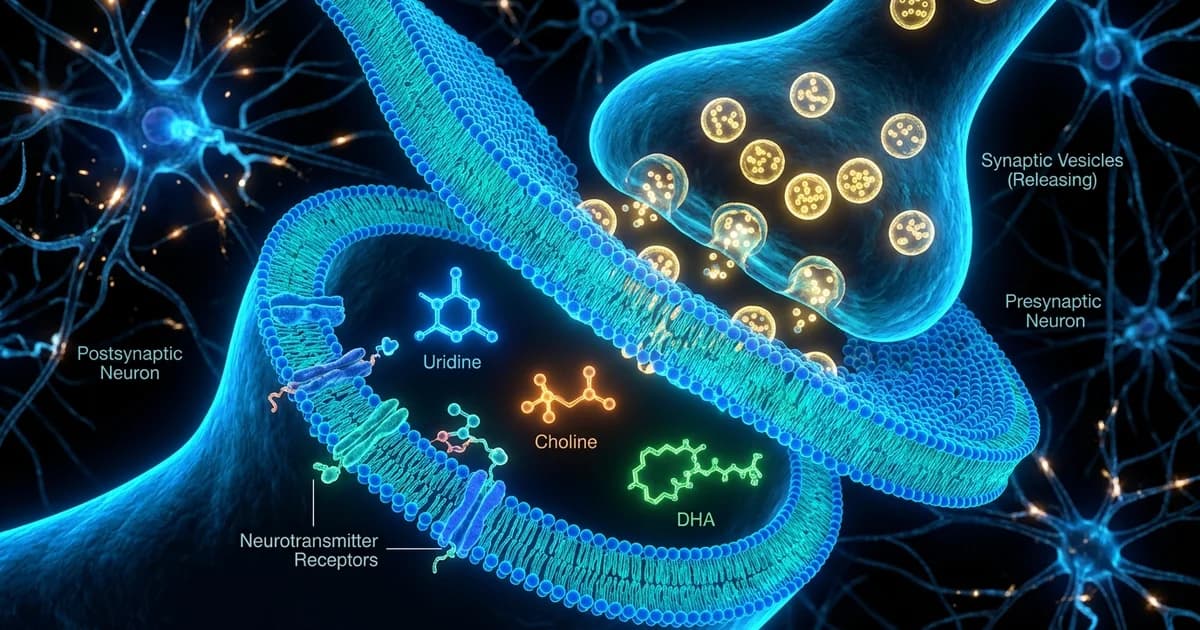
The Synapse-Building Trio: Uridine, Choline, and DHA
Your brain builds roughly half its dry weight out of fat. Most of that fat sits in cell membranes, and the busiest membranes belong to your synapses, the junctions where one neuron talks to the next. To grow a new synapse, a neuron has to manufacture fresh membrane, and that requires raw material.
This is where the uridine choline DHA combination enters the picture. These three compounds are the circulating precursors your brain pulls from the bloodstream to build the phospholipids that make up synaptic membranes. Give a neuron more of all three at once, and it can assemble more membrane, more dendritic spines, and more functional connections.
That claim is not marketing. It traces back to two decades of work from the late MIT neuroscientist Richard Wurtman, and to a multinutrient drink that has been tested in dementia patients across Europe.
Key Takeaways
- Uridine, choline, and DHA are the three substrates of brain phosphatide synthesis. Your neurons combine them through the Kennedy cycle to build synaptic membrane.
- They work as a set, not solo. Supplying all three together increased synaptic markers and dendritic spines in animal studies far more than any single one.
- This is structural, not stimulant. The trio supports membrane building over weeks and months. It does nothing for acute focus in the next ten minutes.
- Human clinical data exists through the Souvenaid formula and the LipiDiDiet trial, mostly in early Alzheimer's, not in healthy high performers.
Why Synapses Need Raw Material
A synapse is mostly membrane. That membrane is built largely from phosphatides, with phosphatidylcholine as the dominant species. To make phosphatidylcholine, a neuron needs a choline backbone, a fatty acid tail, and a molecular tag delivered by uridine.
When a neuron grows or repairs a connection, it ramps up membrane production. The rate of that production depends on how saturated the relevant enzymes are with their substrates. In other words, supply can be the bottleneck.
Wurtman's group framed this directly. According to their review in Nutrition Reviews, brain phosphatide synthesis requires three circulating compounds: docosahexaenoic acid, uridine, and choline. Each one feeds a different step. Run any of them low, and the assembly line slows.
How Uridine, Choline, and DHA Run the Kennedy Cycle
The trio converges on a single biochemical pathway called the Kennedy cycle, the main route neurons use to make phosphatidylcholine. This is the engine that turns three loose precursors into finished synaptic membrane.
Here is the rough sequence, simplified.
- Choline gets phosphorylated to phosphocholine.
- Uridine, after conversion to UTP and then CTP, activates that phosphocholine into CDP-choline, the cycle's rate-limited intermediate.
- DHA supplies the polyunsaturated fatty acid tail that gets attached to the diacylglycerol backbone, producing a DHA-rich phosphatidylcholine.
The reason uridine matters so much is that it controls the CTP supply. CTP is often the limiting reagent in this Kennedy cycle synthesis, so raising uridine raises the ceiling on how fast the whole cycle can run.
There is direct evidence for this. A study in gerbils found that oral uridine monophosphate increased brain CDP-choline levels, confirming that dietary uridine actually pushes more substrate into the pathway rather than getting stuck in the gut.
The Wurtman Synapse Hypothesis
The clearest single statement of this idea came in a 2009 paper. Wurtman and colleagues titled it almost like a headline: synapse formation is enhanced by oral administration of uridine and DHA, the circulating precursors of brain phosphatides.
Their conclusion was specific. Uridine and DHA act in part by increasing the substrate-saturation of the enzymes that build phosphatidylcholine, which then drives more membrane synthesis. This is the core of what people now call the Wurtman synapse model.
The animal work backs it up in a way single-nutrient studies rarely do. When rodents received choline, uridine, and DHA together, their brains showed higher levels of phosphatides and synaptic proteins per brain cell, plus more dendritic spines on hippocampal neurons, as summarized in this PMC review.
One detail is worth flagging. The same body of research found that arachidonic acid, another common membrane fatty acid, did not reproduce DHA's effects. The benefit was specific to DHA, not just any omega fatty acid.
Uridine and Acetylcholine: A Second Job
Uridine does more than feed the membrane line. It also appears to support acetylcholine, the neurotransmitter tied to memory and attention.
In aged rats, dietary uridine monophosphate raised acetylcholine levels and release in the striatum. The proposed reason connects back to the membrane story. More membrane phospholipid can mean more neurite outgrowth and more synaptic terminals, and those terminals are where acetylcholine gets packaged and fired.
So the phosphatide precursors are not only structural. By building better-equipped neurons, they may indirectly support the chemistry of signaling too.
What the Human Data Actually Shows
The trio left the lab as a medical food. The formula, known as Fortasyn Connect and sold as Souvenaid, combines uridine monophosphate, choline, and DHA with EPA, B vitamins, vitamin E, vitamin C, selenium, and phospholipids.
The largest test was the LipiDiDiet trial, a randomized, double-blind, placebo-controlled study in people with prodromal Alzheimer's disease. Over 36 months, the Maastricht University publication reported reductions in clinical decline, including a 45% smaller worsening on a dementia rating scale and a 76% smaller decline on memory, alongside less brain atrophy, with small-to-medium effect sizes.
Two caveats keep this honest. First, the effects mostly emerged after long-term use, not in the early months. Second, this was a patient population with early Alzheimer's, not healthy adults chasing sharper focus.
That distinction matters. The science here is about slowing structural decline and supporting membrane building over years. It is not evidence that a healthy 30-year-old will feel anything from a single dose.
Comparing Cognitive Approaches
Different tools solve different problems. The synapse-building trio works on a long horizon. Other approaches, including daily focus products, work on the scale of hours. They are not competitors so much as different layers.
| Approach | What it targets | Time horizon | Felt effect? |
|---|---|---|---|
| Uridine + Choline + DHA | Synaptic membrane synthesis (Kennedy cycle) | Weeks to months | Usually none acute |
| Souvenaid / Fortasyn Connect | Multinutrient membrane support, studied in early Alzheimer's | Months to years | Clinical, not subjective |
| Standalone DHA (fish oil) | One of three precursors only | Weeks to months | Subtle |
| Roon pouch | Acute focus and alertness | 5 to 10 minutes onset, 6 to 8 hours | Yes, same session |
Notice the trio and an acute focus tool sit at opposite ends of the table. One builds the hardware slowly. The other tunes performance today.
Conclusion
Uridine, choline, and DHA matter because synapses are made of membrane, and membrane is made of phosphatides. Supply all three precursors at once and you raise the ceiling on the Kennedy cycle, the pathway that turns these substrates into the phosphatidylcholine that builds new connections.
The strongest evidence sits in animal models and in dementia patients, where long-term use tracks with slower decline and more synaptic material. The honest read is that this is a structural, slow-acting foundation, not a same-day cognitive switch. If you are looking to support the physical machinery of your brain over years, the precursor approach has real science behind it. If you want to feel sharper this afternoon, that is a separate question with a separate answer.
Frequently Asked Questions
What is the uridine, choline, and DHA combination used for?
The combination supplies the three circulating precursors your brain uses to build synaptic membrane. Research from Richard Wurtman's group at MIT showed that giving all three together increased phosphatide synthesis, synaptic proteins, and dendritic spines in animal models. In humans, the same formula has been studied mainly in early Alzheimer's disease for supporting cognition and slowing structural decline, rather than for acute focus in healthy adults.
Why are all three needed instead of just one?
Because each one feeds a different step of the same assembly line. Choline forms the backbone, uridine supplies the activating tag through CTP, and DHA provides the fatty acid tail. The Kennedy cycle runs fastest when all three substrates are abundant at the same time. Animal studies found that single nutrients produced far smaller effects than the full set, and that arachidonic acid could not substitute for DHA.
What is the Wurtman synapse hypothesis?
It is the idea that synapse formation can be limited by the supply of membrane precursors, and that providing uridine, choline, and DHA together can raise that ceiling. Wurtman's team showed these compounds increase the substrate-saturation of the enzymes that build phosphatidylcholine, which drives membrane synthesis. Their 2009 paper stated this directly, linking oral precursors to enhanced synapse formation in experimental models.
Does Souvenaid actually work?
Souvenaid, built on the Fortasyn Connect formula, has been tested in the LipiDiDiet trial in people with prodromal Alzheimer's. Over 36 months it was associated with reduced clinical decline and less brain atrophy, with small-to-medium effect sizes. The benefits mostly appeared after long-term use. It is studied as a medical food for early-stage decline, not as a focus aid for healthy people, and it is not a treatment or cure.
How long before the trio does anything?
This is a structural approach measured in weeks to months, not minutes. The mechanism is membrane synthesis, which is slow and cumulative. The clearest human outcomes in the LipiDiDiet trial emerged only after long-term intervention. You should not expect a noticeable same-day effect the way you would from a caffeine-based product.
Is this the same as taking a focus supplement?
No. Precursors build the physical structure of synapses over time and usually produce no acute sensation. A focus supplement works on neurotransmitter signaling and alertness within minutes. They address different layers of cognition, so people sometimes use a long-horizon foundation and a daily focus tool for different reasons.
Are uridine, choline, and DHA safe?
These are food-derived compounds, and the combined formula has been used in multi-year human trials. That said, doses, interactions, and individual health conditions vary. Anyone with a medical condition, on medication, or pregnant should talk to a clinician before starting. None of this is a substitute for medical advice or for treatment of any diagnosed condition.
Where Structure Ends and Daily Focus Begins
The trio above is a foundation play. It builds synaptic hardware slowly, over weeks and years, and the people who benefit most in the research were managing early cognitive decline. That is a real and worthwhile goal, and it has nothing to do with how clear-headed you feel during a 2 p.m. work block.
Roon lives on the other end of that timeline. It is a sublingual pouch built for the acute side of focus, with 80 mg caffeine, 60 mg L-theanine, 25 mg methylliberine (Dynamine), and 5 mg theacrine (TeaCrine). It absorbs in 5 to 10 minutes and is designed for 6 to 8 hours of steady focus with no jitters, no crash, and no tolerance buildup.
To be clear about what it is not: Roon is not a synapse-building stack, and it will not do the slow structural work that uridine, choline, and DHA do. Think of the precursor trio as long-term maintenance and Roon as the tool for the work in front of you today. If your goal is sharper focus this afternoon rather than membrane synthesis over the next year, try Roon for the sessions that actually matter.
Written by Roon Team