Turkey Tail, Your Gut, and Your Brain: The Gut-Brain Axis Story
Most articles about turkey tail mushroom benefits skip the most interesting part. They tell you it supports immunity, list a few polysaccharides, and stop. The mechanism gets lost.
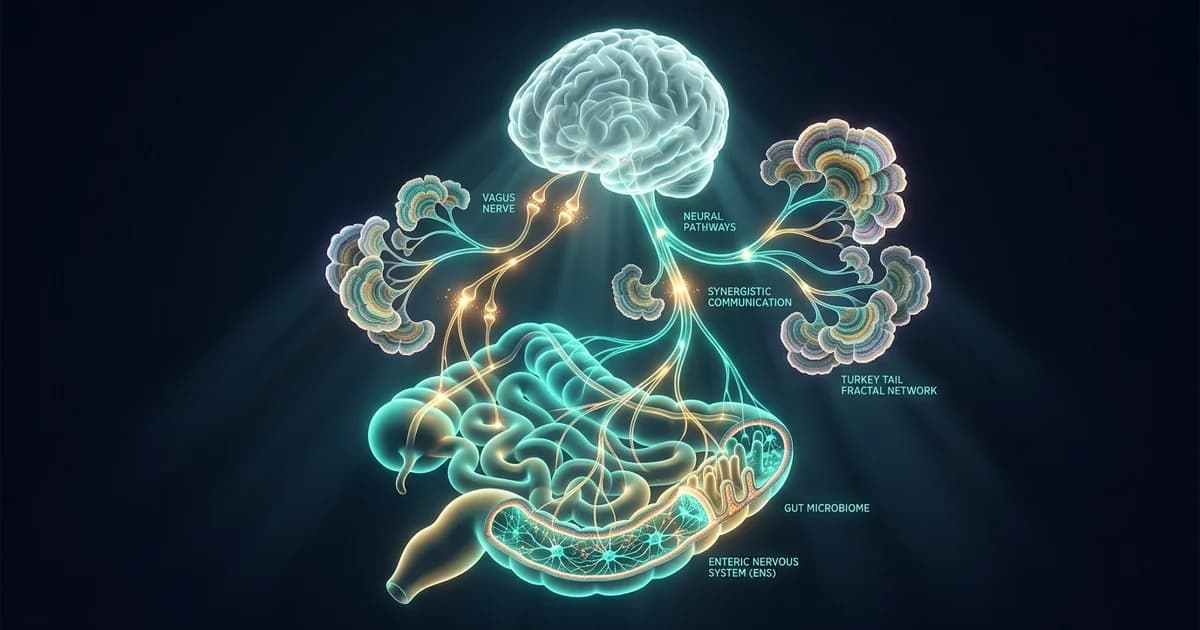
Here is the part worth your attention. Turkey tail does not appear to act on your brain directly. It works on your gut bacteria first, and your gut talks to your brain through a well-mapped communication system called the gut-brain axis. The brain effect, if there is one, is downstream.
That distinction matters, and most supplement marketing blurs it. Let's keep it honest and trace the actual chain of events.
Key Takeaways
- Turkey tail (Trametes versicolor) is a wood-decay fungus rich in two studied compounds: PSP (polysaccharopeptide) and PSK (polysaccharide-K, also called Krestin).
- A randomized clinical trial found PSP behaves like a prebiotic, feeding beneficial gut bacteria such as Bifidobacterium and Lactobacillus.
- Those bacteria ferment fiber into short-chain fatty acids, the molecules that carry signals along the gut-brain axis.
- Any cognitive effect from turkey tail is indirect, routed through the microbiome, not a direct hit on neurons.
What Turkey Tail Actually Is
Turkey tail is a common bracket fungus that grows in fan-shaped, banded layers on dead wood. Its Latin name, Trametes versicolor, points to those many-colored rings. You have almost certainly walked past it on a fallen log.
The interesting chemistry sits in two protein-bound polysaccharides. PSK is extracted from the mycelium and standardized into a compound called Krestin. According to Medical News Today, PSK is an approved adjuvant cancer treatment in Japan and has been studied for its ability to stimulate the immune system, especially alongside other anticancer treatments.
PSP is the close cousin most relevant to gut research. Both are large molecules your body cannot fully break down on its own. That last point is the key to the whole story.
Turkey Tail Gut Health: The Prebiotic Mechanism
Here is the direct answer: turkey tail supports gut health by acting as a prebiotic, meaning it feeds beneficial bacteria rather than killing harmful ones the way an antibiotic does.
The strongest human evidence comes from a randomized clinical trial published in the journal Gut Microbes. Researchers gave 24 healthy volunteers either PSP, the antibiotic amoxicillin, or no treatment, then tracked stool samples over eight weeks. The full study reported that PSP produced clear, consistent shifts in the microbiome consistent with prebiotic activity.
In the lab portion of the same work, the team cultured human fecal bacteria with PSP. As described in the PubMed record, PSP raised levels of Bifidobacterium and Lactobacillus while reducing less desirable genera such as Clostridium and Staphylococcus.
That is the textbook signature of a prebiotic. You eat the fiber-like compound, your bacteria eat it, and the helpful populations grow. This is the foundation of the turkey tail prebiotic claim, and unlike a lot of mushroom marketing, it rests on an actual trial in people.
The Gut-Brain Axis, Explained Without the Hype
The gut-brain axis is a two-way signaling network linking your digestive tract to your central nervous system. It runs along three main roads: the vagus nerve, the immune system, and a set of chemical messengers made by your gut bacteria.
The chemical messengers are where turkey tail enters the brain conversation. When gut bacteria ferment fibers and prebiotic compounds, they produce short-chain fatty acids (SCFAs), mainly acetate, propionate, and butyrate.
A 2023 review in Frontiers in Neuroscience describes SCFAs as messengers that connect the gut and brain, with butyrate in particular linked to anti-inflammatory effects and to the regulation of colonic serotonin, a neurotransmitter involved in mood.
The mechanism goes deeper than mood. A separate review in Frontiers in Endocrinology explains that SCFAs influence microglia maturation in the brain and help regulate the enzymes that produce serotonin, dopamine, and noradrenaline.
So the logic is clean. Feed the bacteria, the bacteria make more SCFAs, and SCFAs are documented participants in brain signaling.
Turkey Tail Cognition: Where the Evidence Stops
Now the honest part. There is no human trial showing that turkey tail sharpens memory or speeds up your thinking.
What we have is a chain of plausible links: turkey tail feeds bacteria, bacteria make SCFAs, SCFAs participate in the turkey tail gut brain axis. Each link is supported. The full chain, from a turkey tail capsule to a measurable cognitive result, has not been tested head to head in people.
That is not a reason to dismiss it. It is a reason to describe it accurately. Turkey tail cognition is a hypothesis built on solid mechanistic ground, not a proven outcome.
Anyone selling turkey tail as a focus pill is getting ahead of the data. The gut health story is strong. The brain story is indirect and still forming.
How Turkey Tail Compares to Other Cognitive Inputs
If your real goal is mental performance, it helps to see where a gut-acting prebiotic sits next to ingredients that act on the brain more directly. The table below positions turkey tail honestly against other common options.
| Input | Primary Mechanism | Onset | Direct Brain Effect | Best Use |
|---|---|---|---|---|
| Turkey tail (PSP/PSK) | Prebiotic, feeds gut bacteria | Weeks | Indirect, via SCFAs | Long-term gut and immune support |
| Dietary fiber (inulin, FOS) | Prebiotic, SCFA production | Weeks | Indirect, via SCFAs | Microbiome health |
| L-theanine | Modulates alpha brain waves, calm focus | 30-60 min | Direct | Smoothing stimulant edge |
| Caffeine | Adenosine receptor blockade | 30-45 min (oral) | Direct | Acute alertness |
| Roon pouch (caffeine + L-theanine + Dynamine + TeaCrine) | Sublingual stimulant and amino acid stack | 5-10 min | Direct | Fast, sustained focus without a crash |
The point is not that one beats the others. They operate on different timescales and different systems. Turkey tail is a slow, foundational input. A Roon pouch is an acute, direct one. They answer different questions.
Frequently Asked Questions
Does turkey tail mushroom directly improve brain function?
No human study has shown a direct cognitive benefit from turkey tail. The proposed link runs through the gut. Turkey tail feeds beneficial bacteria, those bacteria produce short-chain fatty acids, and short-chain fatty acids are documented participants in gut-brain signaling. That makes the brain connection plausible and indirect, not a demonstrated, direct effect on neurons.
What is the difference between PSP and PSK?
Both are protein-bound polysaccharides from Trametes versicolor. PSK (Krestin) is typically sourced from a specific fungal strain and is the version used in Japanese cancer research for decades. PSP is a close relative most studied for its prebiotic effect on the human gut microbiome. They overlap heavily in structure and function but come from slightly different extraction sources.
Is turkey tail a prebiotic?
Yes, the human evidence supports that. A randomized clinical trial published in Gut Microbes found that PSP from turkey tail produced microbiome changes consistent with prebiotic activity, raising beneficial bacteria like Bifidobacterium and Lactobacillus. A prebiotic feeds your existing good bacteria, which is different from a probiotic, which adds live bacteria directly.
How long does turkey tail take to work?
Gut and immune effects from polysaccharides like PSP and PSK are cumulative, not immediate. Most sources describe building effects over several weeks of consistent daily use rather than same-day results. This is the opposite of a fast-acting stimulant. If you want next-morning gut comfort or quick focus, turkey tail is the wrong tool for the job.
Can turkey tail replace fiber in my diet?
No. Turkey tail behaves like a prebiotic, but it is a supplement, not a substitute for the variety of fibers in whole foods. Your microbiome thrives on diversity, and different bacteria prefer different fibers. Think of turkey tail as one possible addition to a fiber-rich diet, not a replacement for vegetables, legumes, and whole grains.
Are there side effects?
Turkey tail is generally well tolerated. The most commonly reported issue is mild digestive upset when first starting, which often settles within a week or two. Anyone who is pregnant, nursing, immunocompromised, or undergoing medical treatment should talk to a clinician first, since turkey tail interacts with immune pathways.
The Bigger Lesson in the Gut-Brain Story
Turkey tail teaches a useful rule for reading any supplement claim. Trace the mechanism, and notice where it stops. The gut evidence is strong and human-tested. The brain evidence is a logical chain that has not been completed in a clinical trial.
That is a perfectly good place for a supplement to live. It just is not the same as a proven cognitive aid, and pretending otherwise does the science a disservice. Real understanding comes from following the pathway honestly, even when the most interesting link is the one we cannot yet confirm.
Why We Explain the Indirect Links, Not Just the Flattering Ones
Most cognitive brands would have stopped at the headline and sold you turkey tail as a focus mushroom. We will not do that, because the brain link here is real but indirect, and you deserve to know which is which.
That is the standard we hold ourselves to at Roon. When an ingredient acts directly on attention, we say so and show the dose. When it works through a longer pathway like the gut-brain axis, we draw the map instead of skipping the gaps. Our own pouch is built on four direct-acting ingredients, 80 mg caffeine, 60 mg L-theanine, 25 mg methylliberine (Dynamine), and 5 mg theacrine (TeaCrine), designed for a 5-to-10-minute onset and 6 to 8 hours of focus without the jitters or the crash.
Roon is not a gut supplement, and it will not replace a fiber-rich diet or a good night's sleep. If you want clear, mechanism-first writing on what actually moves cognition, read more from Roon and decide for yourself.
Written by Roon Team