Chaga and the Brain: Antioxidants, Oxidative Stress
Roon Team
Chaga and the Brain: Antioxidants, Oxidative Stress, and an Honest Look at the Evidence
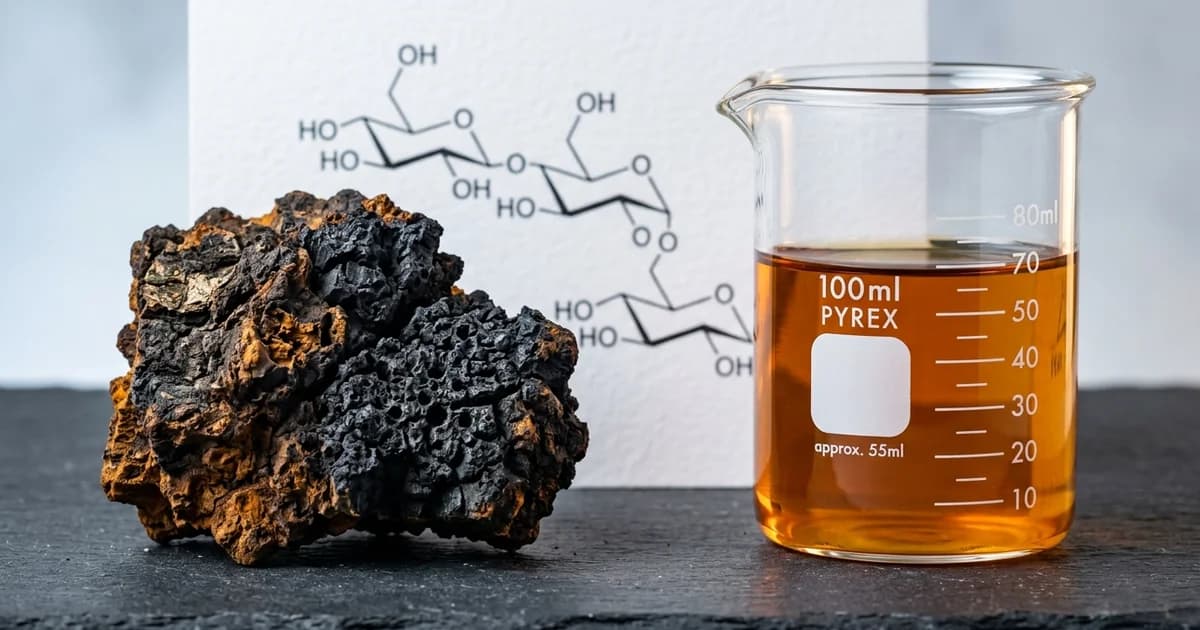
Chaga is a slow-growing fungus that looks like burnt charcoal clinging to a birch tree. It has been brewed into tea across Siberia and Northern Europe for centuries, and lately it shows up in coffee blends, gummies, and "brain" stacks. Most of the chaga benefits people repeat online trace back to one idea: this mushroom is loaded with antioxidants that fight the kind of cellular damage linked to aging brains.
That claim is interesting. It is also where the honesty has to start.
The science on Inonotus obliquus, chaga's botanical name, is real and worth understanding. But almost all of it lives in petri dishes and rodents, not people. Here is what the research actually shows, where it stops, and why that gap matters.
Key Takeaways
- Chaga is genuinely high in antioxidants, including phenolic compounds and melanin that neutralize free radicals in lab settings.
- The strongest chaga brain research is preclinical: cell cultures and mice, including recent Alzheimer's-model work.
- There are no published human trials measuring chaga cognition or memory in healthy adults.
- Chaga carries real safety considerations, especially its high oxalate content for anyone with kidney concerns.
- "Antioxidant-rich" does not automatically mean "improves focus." Those are separate claims with separate evidence.
What Chaga Actually Is
The chaga mushroom is a parasitic fungus, Inonotus obliquus, that grows mostly on birch trees in cold climates. The part people harvest is the sterile conk, a hard black mass that breaks off the trunk. Its dark color comes partly from melanin, the same pigment family that gives the mushroom much of its antioxidant punch.
Inside that black mass sits a dense mix of compounds. Polysaccharides, triterpenes, polyphenols, and a phenolic molecule called 3,4-dihydroxybenzalacetone get the most attention in the lab. According to a 2020 review in the Chinese Journal of Natural Medicines via ScienceDirect, flavan derivatives, polysaccharides, and that phenolic compound have shown neuroprotective activity in models of Alzheimer's and Parkinson's disease.
That word, models, is doing heavy lifting. Hold onto it.
The Chaga Benefits Built on Antioxidants
Chaga is one of the more antioxidant-dense functional mushrooms studied, and that is the foundation of nearly every brain claim made about it. Oxidative stress, the imbalance between free radicals and your body's ability to clear them, is tied to neuronal aging and inflammation. Antioxidants neutralize those reactive molecules before they damage cells.
Chaga's polyphenols and melanin do this efficiently in test tubes. The logic that follows sounds clean: the brain is vulnerable to oxidative damage, chaga fights oxidative damage, so chaga should protect the brain.
Biology rarely respects clean logic. An antioxidant that performs in a beaker has to survive digestion, reach the bloodstream at a useful dose, and cross the blood-brain barrier before it can do anything for a single neuron. Most antioxidants fail at one of those steps. So the chaga antioxidant story is a strong starting hypothesis, not a finished conclusion.
What the Chaga Brain Research Shows
The most cited chaga brain studies are preclinical, and several are genuinely encouraging. They just have not graduated to humans.
Three lines of evidence come up repeatedly:
-
Oxidative protection in neurons. A phenolic compound isolated from chaga, 3,4-dihydroxybenzalacetone, protected PC12 nerve-like cells from hydrogen-peroxide-induced oxidative stress in research summarized on ResearchGate. This is a cell-culture finding.
-
Memory in chemically impaired mice. A 2011 study in Food & Function (RSC Publishing) reported that chaga extract eased scopolamine-induced cognitive dysfunction and oxidative stress in mice. Scopolamine is a drug used to artificially block memory in animals, so the model tests recovery from damage, not enhancement in a healthy brain.
-
Amyloid and aging models. A 2021 study in the International Journal of Medicinal Mushrooms found that chaga extract raised the viability of β-amyloid-exposed PC12 cells and reduced amyloid plaque levels in the hippocampus of aging rats. A more recent 2025 paper in the International Journal of Molecular Sciences reported that a standardized chaga extract called INO10 eased Alzheimer's-related pathology and cognitive deficits in a 3xTg-AD mouse line.
Read those together and a pattern appears. The work is consistent, it spans cells and animals, and it points in a hopeful direction for chaga neuroprotection. None of it involved human participants performing cognitive tasks.
The Honest Gap: No Human Cognition Data
As of 2026, there are no published clinical trials showing that chaga improves memory, focus, or any cognitive measure in healthy people. That sentence is the most important one in this article.
This is not a knock on chaga. It is a description of where the field sits. Mouse and cell data are how serious research begins, and the mushroom has earned its place in early pipelines. But the leap from "reduced amyloid in a 3xTg-AD mouse" to "sharper focus at your desk" is enormous, and nobody has measured it.
Dose is another open question. The amounts used in animal studies, adjusted for body weight, often dwarf what you would get from a cup of chaga tea or a capsule. Bioavailability in humans is poorly mapped. So when a label promises chaga cognition support, treat it as extrapolation from rodents, not proof in people.
Chaga vs. Other "Brain" Ingredients
Here is how chaga stacks against ingredients that have actually been tested in humans for acute focus or cognition. The point is not that chaga is bad. It is that the evidence tiers are very different.
| Ingredient | Primary mechanism | Best human evidence for cognition | Acute focus effect |
|---|---|---|---|
| Chaga (Inonotus obliquus) | Antioxidant, anti-amyloid (preclinical) | None in healthy humans | Not established |
| Caffeine | Adenosine antagonist | Extensive human trials | Strong, fast |
| L-theanine | Modulates alpha brain waves | Multiple human trials, often with caffeine | Smooths focus, reduces jitter |
| Lion's mane | Nerve growth factor support | A few small human trials | Subtle, slow |
| Roon (caffeine + L-theanine + Dynamine + TeaCrine pouch) | Stimulant plus calming amino acid, sublingual delivery | Built on human-studied actives | Fast, 6 to 8 hours, no crash |
Chaga sits in the "promising but preclinical" tier. Caffeine and L-theanine sit in the "proven in people" tier. If your goal is antioxidant support and long-term wellness curiosity, chaga is reasonable. If your goal is reliable focus this afternoon, the evidence points elsewhere.
How People Use Chaga
Most people drink chaga as a tea or take it as an extract powder or capsule. Dual-extracted powders, processed with both hot water and alcohol, aim to pull out both the water-soluble polysaccharides and the alcohol-soluble triterpenes.
A few practical notes:
- Mind the oxalates. Chaga is high in oxalates, which can stress the kidneys at high or chronic doses. People with kidney issues or a history of kidney stones should be cautious. WebMD and Cleveland Clinic both flag this.
- Watch blood-sugar and clotting interactions. Chaga may affect blood sugar and may interact with blood thinners and diabetes medication.
- Talk to a clinician if you take prescription drugs or have a chronic condition. Chaga is a supplement, not a treatment.
None of this makes chaga dangerous for most healthy adults at sensible doses. It just means "natural" is not a synonym for "consequence-free."
Conclusion
Chaga is a real antioxidant heavyweight with a coherent preclinical story for protecting neurons under oxidative and amyloid stress. The mushroom is high in polyphenols and melanin, and studies in cells and mice consistently point toward neuroprotective potential.
The story stops at the species barrier. There is no human trial showing chaga sharpens memory, focus, or cognition in healthy people, and the doses used in animals are hard to translate. The accurate read is that chaga is a promising research subject and a reasonable wellness antioxidant, not a proven cognitive enhancer. Anyone selling it as the latter is selling ahead of the data.
Frequently Asked Questions
Does chaga improve memory or focus in humans?
There is no published clinical trial showing that chaga improves memory or focus in healthy people. The encouraging results come from cell cultures and rodent studies, including scopolamine-impaired mice and Alzheimer's-model mice. Those findings justify more research, but they do not prove a benefit for human cognition. If you want a measurable focus effect today, ingredients with human trials behind them are a safer bet than chaga.
What makes chaga such a strong antioxidant?
Chaga is dense in polyphenols, triterpenes, and melanin, the dark pigment that gives the conk its charcoal color. These compounds neutralize free radicals efficiently in lab tests. The open question is whether enough of those antioxidants survive digestion, reach the bloodstream, and cross into the brain at useful doses in humans. Antioxidant activity in a test tube does not guarantee an effect inside your skull.
Is chaga safe to take every day?
For most healthy adults, moderate chaga use is generally well tolerated. The main concern is its high oxalate content, which can stress the kidneys with heavy or long-term use. Chaga may also affect blood sugar and interact with blood thinners and diabetes medication. If you have kidney issues, take prescription drugs, or have a chronic condition, check with a clinician before using it daily.
What is the difference between chaga and lion's mane for the brain?
Both are functional mushrooms studied for brain health, but their mechanisms differ. Chaga works mainly through antioxidant and anti-amyloid pathways in preclinical models. Lion's mane is studied for supporting nerve growth factor and has a handful of small human trials. Neither produces a fast, noticeable focus boost. They are long-game wellness ingredients, not acute cognitive tools.
Why do so many products claim chaga boosts cognition?
The claims lean on real preclinical data and on the broad appeal of the word "antioxidant." Marketing often compresses "reduced amyloid in a mouse model" into "supports brain health," which skips the missing human evidence. That shortcut is common across the supplement industry. The science is genuine; the extrapolation to human cognition is the part that outruns the data.
Does chaga contain caffeine?
No. Chaga is naturally caffeine-free, which is why some people drink it as a coffee alternative. It will not give you the alertness or acute focus that caffeine does. If you are using chaga and expecting a stimulant effect, you will be disappointed. Its proposed value is long-term antioxidant support, not immediate energy.
Where Antioxidant Promise Meets Proven Focus
This article makes one argument: chaga's brain story is strong in the lab and silent in humans. We hold the ingredients in our own product to the opposite standard.
Roon is a zero-nicotine sublingual pouch built on four actives that have been studied in people, not just mice: 80 mg caffeine, 60 mg L-theanine, 25 mg methylliberine (Dynamine), and 5 mg theacrine (TeaCrine). The caffeine and L-theanine pairing is one of the most human-tested combinations in cognitive science, delivered sublingually for a 5 to 10 minute onset and 6 to 8 hours of focus with no jitters and no crash.
Roon is not a medicine, and it is not a substitute for sleep, training, or a clinician's advice. It also is not pretending chaga-style preclinical hints are the same as human evidence. If you want focus you can feel, backed by actives tested in people, try Roon and judge it by the same evidence-first standard we just applied to a mushroom.
Written by Roon Team