Slow-Release Caffeine vs Layered Stimulants
Roon Team
Slow-Release Caffeine vs Layered Stimulants: Two Ways to Build All-Day Energy
You drink coffee at 8 a.m. By 11, you are flat. So you brew another cup, ride it for two hours, then hit the wall again at 3 p.m. when the crash arrives in full.
That sawtooth pattern is the real problem most people are trying to solve. The goal is sustained energy without crash, a smooth line instead of a series of spikes and drops. There are two legitimate engineering routes to get there, and they work in completely different ways.
The first slows down how fast a single stimulant releases into your blood. The second stacks several stimulants with different timelines so one hands off to the next. This article breaks down both, with the actual pharmacology behind each, so you can tell marketing from mechanism.
Key Takeaways
- A standard dose of caffeine peaks fast and then declines on a roughly 5-hour half-life, which is why the afternoon dip feels so sharp.
- Slow-release caffeine flattens the curve by slowing absorption of one molecule, trading a sharp peak for a longer, lower plateau.
- Layered stimulants use two or more compounds with different onset and duration profiles, so a fast molecule covers the front end and a slow one covers the back end.
- The layered route also lets you add L-theanine for smoothness and theacrine for duration, which a single caffeine salt cannot do.
Why a Single Cup of Coffee Always Crashes
Caffeine works by blocking adenosine, the molecule that builds up in your brain across the day and makes you feel tired. Block it, and you feel alert. The catch is what happens when the caffeine clears.
The average half-life of caffeine is about five hours, though reported ranges run from 1.5 to 9.5 hours depending on genetics, age, and liver function. About 10% of people are slow metabolizers with half-lives past seven hours, while fast metabolizers burn through it in a couple of hours.
A standard cup absorbs quickly and peaks within 30 to 60 minutes. Then the blood level falls. As caffeine drops, all that backed-up adenosine floods the receptors you just unblocked, and the slump hits harder than baseline. That rebound is the crash.
So the engineering question is simple. How do you keep alertness high for six to eight hours without that single sharp peak and the drop that follows?
Route One: Slow-Release Caffeine
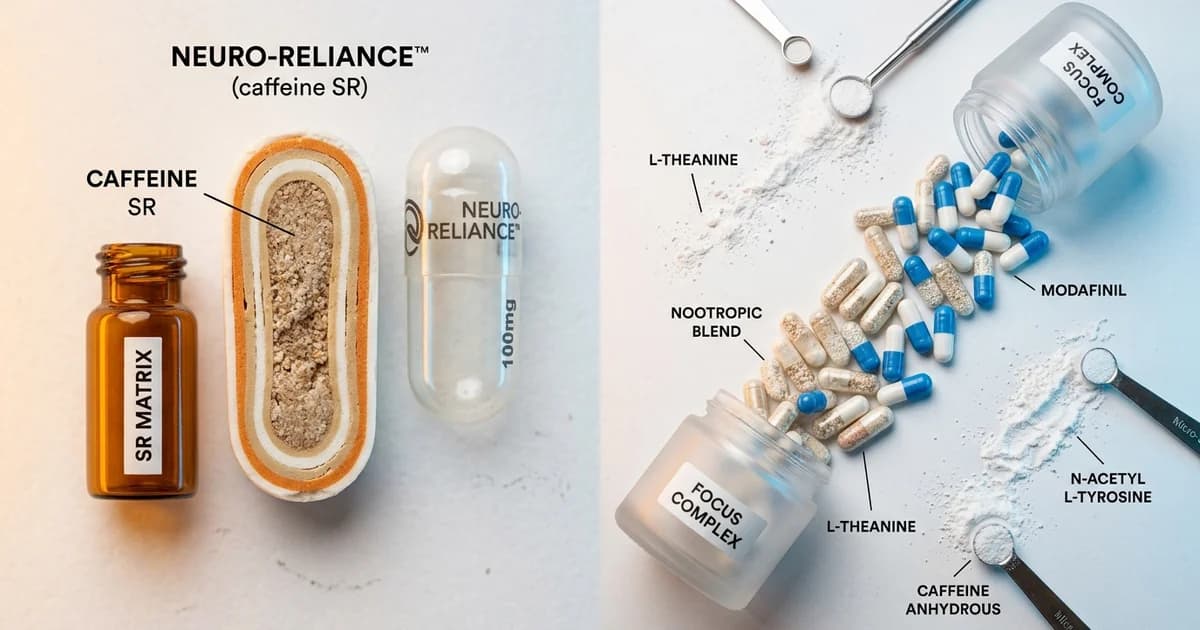
Slow-release caffeine solves the curve problem with one molecule by slowing how fast it enters your bloodstream. Instead of dumping the full dose at once, a polymer matrix or coating meters it out over hours, trading the tall peak for a longer, flatter plateau.
The appeal is real. A controlled-release format can keep blood caffeine in a useful window for longer than an immediate-release dose, which smooths the early afternoon dip for many people.
But the slow release caffeine vs stacking debate exposes the limits of the single-molecule approach. You are still relying on one compound with one mechanism. If you metabolize caffeine fast, the plateau ends sooner than the label suggests. If you metabolize it slowly, that same extended tail can keep you wired into the evening and wreck your sleep.
There is also a front-end cost. Slowing absorption means you wait longer to feel anything. You trade a quick start for a gentle one, which is the opposite of what most people want at 8 a.m.
Route Two: Layered Stimulants With Different Half-Lives
Layering stacks two or more stimulants with staggered onset and duration so the fast ones cover the start and the slow ones cover the finish. This is the no crash energy science that most premium focus formulas now build around.
Think of it as a relay instead of a single runner. Fast-acting caffeine handles the first leg. A longer-acting compound takes the baton before caffeine fades, so there is no gap where adenosine floods back in.
The standout partner here is theacrine, the molecule branded as TeaCrine. Research from its manufacturer notes that theacrine's half-life is longer than caffeine's and that the two are complementary, with caffeine actually increasing theacrine's bioavailability in humans. It also acts on dopamine and adenosine pathways without the same fade.
Theacrine has another property caffeine lacks. In a study of 60 healthy adults, theacrine showed non-habituating effects over eight weeks of daily use at doses up to 300 mg, with no sign of the rapid tolerance that defines caffeine. That matters for anyone using a focus formula five days a week.
Where Methylliberine Fits
Methylliberine, sold as Dynamine, is theacrine's faster cousin. It is structurally similar but kicks in sooner and clears faster, which makes it a useful front-end and mid-range player in a caffeine theacrine methylliberine stack.
The logic of the layered half life stimulants approach is to chain these timelines. Caffeine and methylliberine for the quick start. Theacrine for the long tail. The handoffs overlap, so the felt experience is one continuous line of focus rather than three separate bumps.
The Smoothing Agent: L-Theanine
Layering also lets you add a non-stimulant that fixes caffeine's worst trait: the jitters. L-theanine, an amino acid from tea, takes the edge off without sedating you.
Paired with caffeine, L-theanine modulates alpha brain activity and supports attention in EEG studies. The practical effect is calm, clean focus instead of a buzzy, anxious one. A single slow-release caffeine pill cannot do this, because there is nothing in it but caffeine.
Slow-Release Caffeine vs Layered Stimulants: A Direct Comparison
Here is how the two routes stack up across the metrics that decide whether you feel good all day.
| Factor | Slow-Release Caffeine | Layered Stimulant Stack |
|---|---|---|
| Active compounds | One (caffeine) | Two to four (caffeine, methylliberine, theacrine, L-theanine) |
| Onset | Slow by design | Fast front end, sustained back end |
| Duration | Tied to your caffeine metabolism | Extended by longer-acting theacrine |
| Crash risk | Lower than immediate-release, but still single-molecule | Low, due to staggered handoffs |
| Jitter control | None built in | L-theanine smooths it |
| Tolerance | Full caffeine tolerance applies | Theacrine resists habituation |
| Weak point | Front-end delay and metabolism variability | Requires correct dosing of each compound |
The honest read is that slow-release caffeine is a clean upgrade over a regular cup if all you want is a flatter curve from one familiar molecule. The layered route is the better tool for an all day focus formula, because it controls onset, duration, smoothness, and tolerance independently instead of forcing one molecule to do everything.
How to Choose Between Them
Pick slow-release caffeine if you are sensitive to anything new, prefer a single known ingredient, and mostly want to avoid the mid-morning dip. It is simple and predictable.
Pick a layered stack if you want a fast start, a long finish, and protection against both jitters and the afternoon crash. The cost is complexity. A good layered product has to dose each compound correctly, which is exactly where cheap stacks fall apart.
One rule applies to both. Stop dosing at least eight hours before bed, because even a smooth curve has a tail, and sleep debt undoes any focus gain you bought during the day.
How to Get Sustained Energy Without Crash, Either Way
The afternoon crash is not a willpower problem. It is a pharmacology problem, caused by leaning on one fast molecule that peaks and falls while adenosine waits to rush back in.
Slowing that molecule down helps. Layering several molecules with different timelines helps more, because it solves onset, duration, smoothness, and tolerance as separate problems instead of asking caffeine to fix all four. The relay beats the lone sprinter when the race is eight hours long.
Whichever route you choose, the target is the same: a steady line of focus you can hold through the work that matters, then put down cleanly before bed.
Frequently Asked Questions
Is slow-release caffeine better than regular caffeine?
For a flatter energy curve from one ingredient, yes. Slow-release formats meter caffeine out over hours instead of dumping it at once, which softens the peak and the dip. The trade-off is a slower start and a duration that still depends heavily on how fast your liver clears caffeine. It does nothing for jitters, because the only active ingredient is still caffeine.
What is the caffeine theacrine methylliberine stack?
It is a layered stimulant combination that chains three compounds with different timelines. Caffeine and methylliberine, branded Dynamine, give a fast start. Theacrine, branded TeaCrine, has a longer half-life and carries the back half of the day. Because their onset and duration profiles overlap rather than align, the felt result is one continuous stretch of focus instead of separate spikes and drops.
Does theacrine build tolerance like caffeine?
Research suggests it resists the rapid tolerance caffeine is known for. In a study of 60 adults, theacrine stayed effective across eight weeks of daily use at doses up to 300 mg with no habituation. Caffeine, by contrast, loses punch fast as receptors adapt. That difference is a big reason theacrine appears in formulas built for daily, sustained use.
Why does L-theanine stop the jitters?
L-theanine is an amino acid that supports alpha brain activity, the state linked to relaxed alertness. Paired with caffeine, it takes the anxious, buzzy edge off the stimulation while keeping the focus benefit. You feel calm and dialed in rather than wired. A slow-release caffeine pill cannot offer this, because it contains no theanine.
How long does sustained energy without crash actually last?
It depends on the formula and your metabolism. A well-built layered stack aims for roughly six to eight hours of usable focus by handing off from fast compounds to longer-acting theacrine. Slow-release caffeine alone is bound to your personal caffeine half-life, which can be anywhere from 1.5 to 9.5 hours, so results vary widely between fast and slow metabolizers.
Can I take a layered stimulant every day?
Many people do, because compounds like theacrine resist the tolerance that forces caffeine-only users to keep raising their dose. Still, total caffeine load matters, so watch your daily intake across all sources. Cut off use at least eight hours before bed regardless of how smooth the formula feels, since stimulant tails can quietly erode sleep quality.
The Relay Beats the Lone Sprinter, in a Pouch
If the argument above lands, you already see why Roon skipped the slow-release caffeine route entirely. A single timed-release salt can only flatten one molecule's curve. It cannot control onset, duration, jitters, and tolerance as separate levers.
So Roon took the layered route. Each sublingual pouch carries 80 mg caffeine and 25 mg methylliberine (Dynamine) for a fast front end, 5 mg theacrine (TeaCrine) for duration, and 60 mg L-theanine for smoothness. The sublingual format gives a 5 to 10 minute onset, and the staggered half-lives are how it holds 6 to 8 hours of focus with no jitters, no crash, and no tolerance creep, all without a slow-release coating.
Roon is not a replacement for sleep, food, or a sane caffeine ceiling, and it will not fix a schedule that has you dosing at 9 p.m. It is the cleaner way to engineer the all-day curve when you actually have work to do. Try Roon on a day you need the line to stay flat from morning to evening.
Written by Roon Team