Sulforaphane: How Broccoli's Nrf2 Activator Protects the Brain
Roon Team
Sulforaphane: How Broccoli's Nrf2 Activator Protects the Brain
Your brain burns roughly 20% of your body's energy while making up about 2% of its weight. That metabolic intensity comes with a cost: a constant stream of oxidative byproducts that age neurons faster than almost any other tissue. This is where the sulforaphane brain connection gets interesting.
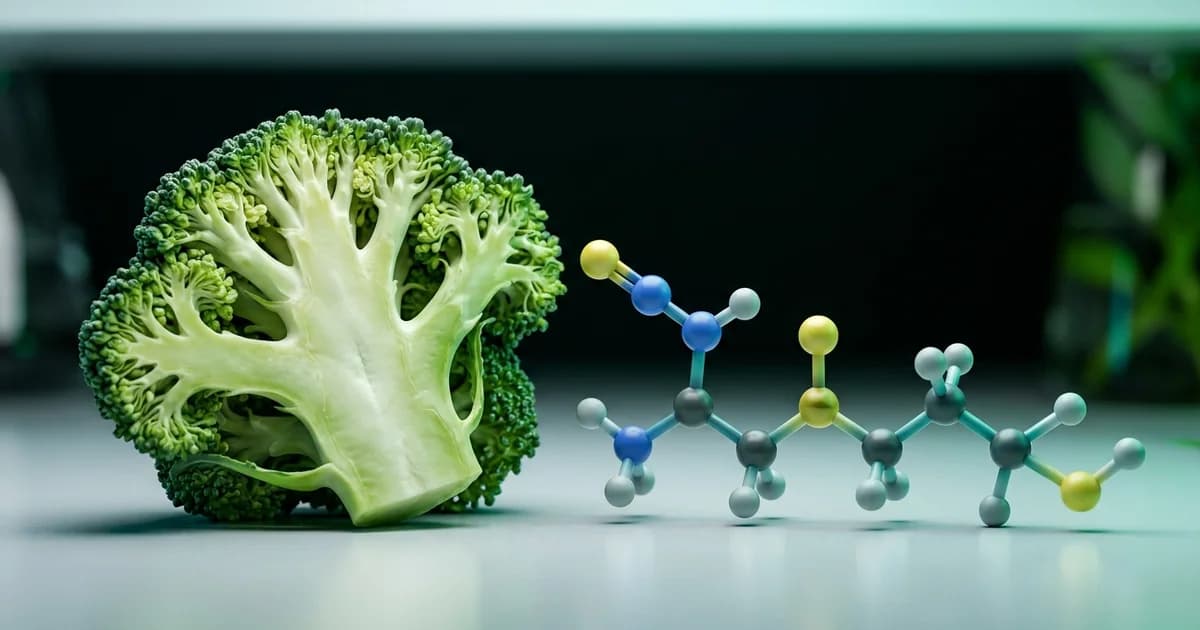
Sulforaphane is a sulfur compound made when you chew raw broccoli, and especially broccoli sprouts. It does not work like a typical antioxidant that neutralizes one free radical at a time. Instead, it flips a master switch inside your cells called Nrf2, which turns on your body's own defense genes.
That distinction matters. One molecule, hundreds of downstream protective effects. Here is what the science actually says, and where the hype runs ahead of the evidence.
Key Takeaways
- Sulforaphane activates Nrf2, a transcription factor that switches on dozens of antioxidant and anti-inflammatory genes at once.
- It comes from a precursor called glucoraphanin, which only becomes active sulforaphane when an enzyme called myrosinase is present. Broccoli sprouts are the richest source.
- Human trials in older adults link sulforaphane intake to better processing speed and lower negative mood, though sample sizes are still small.
- Sulforaphane is a slow, foundational protector. It is not an acute focus aid and will not sharpen your next two hours of work.
What Sulforaphane Actually Is
Sulforaphane is an isothiocyanate, a reactive sulfur molecule found in cruciferous vegetables like broccoli, kale, and cabbage. You do not eat sulforaphane directly. You eat its dormant precursor, glucoraphanin, and your body converts it.
That conversion needs an enzyme. When you crush or chew the plant, an enzyme called myrosinase contacts glucoraphanin and turns it into active sulforaphane. No myrosinase, no sulforaphane.
This is why preparation changes everything. Boiling broccoli destroys myrosinase, which is why heavily cooked broccoli delivers far less of the compound than raw or lightly steamed broccoli. Broccoli sprouts, harvested a few days after germination, carry the most concentrated supply of the precursor.
The Sulforaphane Brain Connection Runs Through Nrf2
Sulforaphane works by activating Nrf2, a protein that controls your cells' antioxidant defense system. Under normal conditions, Nrf2 sits trapped in the cytoplasm, held down by a partner protein called KEAP1. Sulforaphane modifies KEAP1, releasing Nrf2 to travel into the nucleus and switch on protective genes.
A 2025 review in Frontiers in Cellular Neuroscience describes how sulforaphane alters the KEAP1-Nrf2 interaction, triggering transcription of antioxidant and anti-inflammatory genes. The same review notes that Nrf2 activation suppresses NF-κB, the pathway that drives pro-inflammatory signals like TNF-α, IL-1β, and IL-6.
This is the core of sulforaphane Nrf2 biology. One compound, dozens of protective outputs. Instead of mopping up a single free radical, sulforaphane tells your cells to build their own cleanup crew, including enzymes like glutathione and heme oxygenase-1 that keep working long after the sulforaphane itself is gone.
The brain angle is direct. That same Frontiers review reports that Nrf2 activation was accompanied by increased transcription of brain-derived neurotrophic factor (BDNF), a protein tied to learning, memory, and neuron survival.
The Case for Sulforaphane Neuroprotection
Your brain is uniquely vulnerable to oxidative stress, and Nrf2 activation is one of the few mechanisms that addresses the source rather than the symptoms. Neurons are rich in fats, hungry for oxygen, and slow to regenerate, which makes them prime targets for oxidative damage over decades.
Most neurodegenerative conditions share two features: chronic oxidative stress and chronic inflammation. Sulforaphane targets both upstream by raising Nrf2 and lowering NF-κB activity at the same time. That dual action is why researchers keep studying it for sulforaphane neuroprotection.
Animal data is consistent. According to a report from the Alzheimer's Drug Discovery Foundation's Cognitive Vitality program, sulforaphane given to an Alzheimer's animal model reduced amyloid and tau levels while improving cognition. Encouraging, but animal models do not automatically translate to humans.
The honest read: the mechanism is well mapped, the preclinical signal is strong, and human confirmation is still building.
Sulforaphane and Cognition: What Human Trials Show
In healthy older adults, sulforaphane intake has been linked to faster processing speed and improved mood, but the trials remain small. This is the most relevant evidence for anyone curious about sulforaphane cognition in everyday life rather than disease states.
A randomized controlled trial published in Frontiers in Aging Neuroscience examined sulforaphane's effects on processing speed and negative moods in healthy older adults, measuring markers like HO-1, GST, TNF-α, and BDNF alongside cognitive performance. A separate summary from Life Extension reports that in a trial of healthy older adults, sulforaphane intake led to improved cognitive function and a decrease in negative mood.
The momentum continues. In early 2026, NutraIngredients covered a trial using glucoraphanin capsules paired with mustard-derived myrosinase to boost conversion, assessing cognitive function in seniors with an MCI screening tool.
Beyond healthy aging, much of the clinical work comes out of Johns Hopkins. A 2025 clinical trial review in PMC catalogs sulforaphane studies across conditions including autism and schizophrenia, then offers a sober conclusion: published results show therapeutic potential, but limited sample sizes and inconsistent outcomes mean larger, stratified trials are needed.
So the picture is promising rather than proven. Sulforaphane is not a treatment for any cognitive condition, and the strongest claims today belong in the "supports" category, not the "cures" category.
The Bioavailability Problem
Sulforaphane is notoriously hard to absorb consistently, and the difference between sources can be three- to fourfold. This is the detail most articles skip, and it explains why two people eating "broccoli" can get wildly different results.
The issue traces back to myrosinase. According to a bioavailability study published in PLOS One, sulforaphane from preparations with active plant myrosinase is three to four times more bioavailable than sulforaphane from glucoraphanin delivered without it.
The same line of research found that when you take glucoraphanin alone, conversion to sulforaphane by your gut bacteria is highly variable, ranging anywhere from 1% to 40% between individuals. Your microbiome essentially decides your dose.
Practical takeaways:
- Eat broccoli raw or lightly steamed. Heavy cooking kills myrosinase.
- Chew thoroughly. Mechanical disruption is what starts the conversion.
- Broccoli sprouts win on density, carrying far more precursor per gram than mature broccoli.
- If using a supplement, look for one that includes active myrosinase or mustard seed powder to drive conversion.
Broccoli vs. Broccoli Sprouts: Source Comparison
| Source | Glucoraphanin density | Myrosinase intact? | Practical note |
|---|---|---|---|
| Raw broccoli sprouts | Highest | Yes | Most concentrated dietary source for the brain |
| Raw mature broccoli | Moderate | Yes | Solid if chewed well |
| Steamed broccoli (light) | Moderate | Partially | Brief steaming preserves some enzyme activity |
| Boiled broccoli | Low effective | No | Heat destroys myrosinase, slashing yield |
| Glucoraphanin supplement, no myrosinase | Variable | No | Relies on gut bacteria; 1 to 40% conversion |
Where Sulforaphane Fits, and Where It Doesn't
Sulforaphane is a long game. It does not produce a sensation you can feel in 20 minutes. It works quietly, day after day, by keeping your cellular defense genes switched on and your inflammatory signals turned down.
That makes it a foundation, not a stimulant. Think of it alongside sleep, exercise, and a vegetable-heavy diet: the slow inputs that compound over years. The broccoli sprout brain benefit is real, but it is preventive maintenance, not a performance lever.
If you want both, you stack two different categories. Foundational protectors for the long arc, and acute tools for the work in front of you right now.
Conclusion
Sulforaphane earns its reputation for a reason. By activating Nrf2 and quieting NF-κB, it addresses the two engines of brain aging, oxidative stress and inflammation, from upstream rather than chasing symptoms. The mechanism is well mapped, the animal data is strong, and early human trials in older adults point in a hopeful direction.
The caveats are just as real. Human trials are small, bioavailability is inconsistent, and conversion depends heavily on how you prepare your food and what lives in your gut. Treat sulforaphane as a slow, foundational input, the kind that protects your brain over decades rather than sharpening your afternoon. Eat your sprouts raw, chew them well, and let the biology compound.
Frequently Asked Questions
What is the best food source of sulforaphane?
Broccoli sprouts are the richest practical source, carrying far more of the glucoraphanin precursor than mature broccoli. The catch is preparation. Sulforaphane only forms when the enzyme myrosinase contacts glucoraphanin, which happens when you chew or crush the raw plant. Eat sprouts raw or very lightly steamed, since heavy cooking destroys the enzyme and sharply lowers how much active sulforaphane you actually get.
How does sulforaphane protect the brain?
It activates Nrf2, a transcription factor that switches on dozens of antioxidant and anti-inflammatory genes at once. A 2025 Frontiers review describes how sulforaphane releases Nrf2 from its partner protein KEAP1, then suppresses the inflammatory NF-κB pathway. This dual action targets the two main drivers of brain aging, oxidative stress and inflammation, at the source rather than neutralizing free radicals one by one.
Does sulforaphane improve cognition in humans?
Early evidence is encouraging but limited. A randomized controlled trial in healthy older adults linked sulforaphane intake to better processing speed and lower negative mood. A 2025 clinical trial review out of Johns Hopkins found real therapeutic potential across several conditions, while noting that small sample sizes and inconsistent results mean larger trials are still needed. It supports brain health; it does not treat any condition.
Why is sulforaphane hard to absorb?
Absorption hinges on myrosinase, the enzyme that converts inactive glucoraphanin into active sulforaphane. Research in PLOS One found that preparations with active plant myrosinase are three to four times more bioavailable than glucoraphanin taken without it. When you rely on gut bacteria to do the conversion, the rate varies wildly between people, from roughly 1% to 40%, which is why results differ so much.
Should I take a sulforaphane supplement or just eat broccoli?
Both can work, but quality and conversion matter more than the format. Whole broccoli sprouts, eaten raw, give you the precursor and the enzyme together. If you choose a supplement, look for one that includes active myrosinase or mustard seed powder, since glucoraphanin alone depends on your microbiome to activate. There is no single dose that fits everyone, so consistency over time matters more than any one serving.
Is sulforaphane a stimulant or focus aid?
No. Sulforaphane produces no acute, felt effect. It works slowly by keeping your cellular defense genes active and inflammation low, which is preventive rather than performance-driven. If you want immediate, in-the-moment focus, that comes from a different category of compounds entirely, such as caffeine paired with L-theanine. Sulforaphane is the long-term foundation underneath that.
How long does it take to see benefits from sulforaphane?
There is no instant signal. Because sulforaphane works through gene expression and cumulative protection rather than a quick chemical hit, its benefits are measured in weeks, months, and years, not minutes. Human trials run for weeks at a minimum. The practical mindset is the same as exercise or sleep: small, consistent inputs that compound, with no dramatic single dose to chase.
The Slow Foundation, Not the Fast Lever
Sulforaphane and acute focus live in two different worlds, and confusing them is the most common mistake people make with brain nutrition. Sulforaphane is the slow antioxidant and anti-inflammatory base layer. It protects neurons over decades by keeping Nrf2 active. It will never sharpen the next two hours of your work, and it was never meant to.
That fast lever is what Roon is built for. Roon is a zero-nicotine sublingual pouch with a focused 4-ingredient stack: 80 mg caffeine, 60 mg L-theanine, 25 mg methylliberine (Dynamine), and 5 mg theacrine (TeaCrine). It absorbs in 5 to 10 minutes and is designed for 6 to 8 hours of steady focus with no jitters, no crash, and no tolerance buildup.
The two are complementary, not interchangeable. Keep eating your sprouts for the long arc of brain protection, and reach for Roon when you need clean, immediate focus on demand. Different mechanisms, different timelines, same goal.
Written by Roon Team