NMN and Brain Blood Flow: Breaking Down the Neurovascular Coupling Study
Your brain has no fuel reserves. It cannot store oxygen or glucose, so it depends on a steady, second-by-second delivery from your bloodstream. The question of how NMN affects brain blood flow sits at the center of one of the most cited experiments in aging neuroscience, and the answer is more specific than the supplement headlines suggest.
The study in question is a 2019 paper from the University of Oklahoma. It looked at a single, measurable mechanism: how quickly blood vessels in an aging brain respond when neurons start firing.
That mechanism has a name. It is called neurovascular coupling, and it may be one of the first things to break as a brain gets older.
Key Takeaways
- Neurovascular coupling is the process that routes fresh blood to active brain regions on demand. It weakens with age.
- In a 2019 mouse study, NMN restored neurovascular coupling responses in 24-month-old animals and improved their memory and gait.
- The repair worked through NAD+, nitric oxide signaling, and healthier mitochondria inside blood vessel cells.
- This is a slow vascular-aging lever measured over weeks, not an acute focus tool you feel the same afternoon.
- Human data on NMN and the brain is still thin, so treat the findings as promising biology, not a finished story.
What Neurovascular Coupling Actually Is
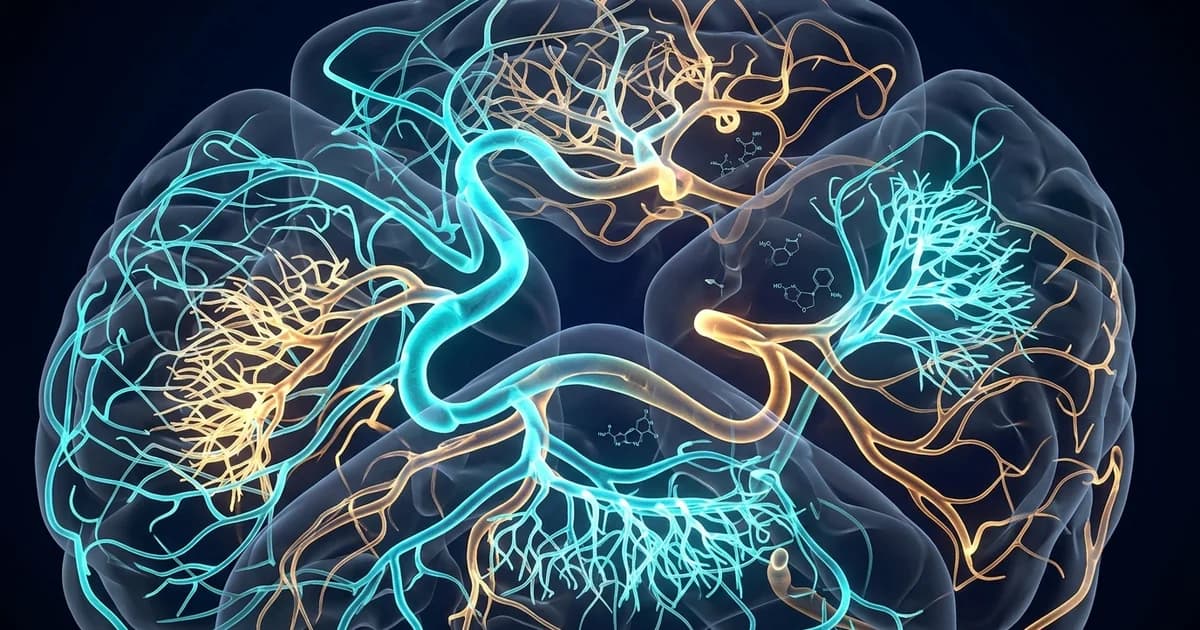
Neurovascular coupling is your brain's supply-on-demand system. When a cluster of neurons activates, the small blood vessels feeding them widen within a second or two to deliver more oxygen and glucose to exactly that spot.
Get this right and your brain stays fed during hard thinking. Get it wrong and active regions run short on fuel.
According to research published in Acta Neuropathologica, this matters enormously in humans. The authors note that a sustained drop in cerebral blood flow beyond 20% in people leads to a loss of the ability to sustain attention, and reduced flow shows up as an early feature in Alzheimer's disease.
So the link between NAD+, cerebral blood flow, and cognition is not a fringe idea. It is a recognized part of how brains decline.
The 2019 NMN Neurovascular Coupling Study, Explained
The headline result: in aged mice, NMN supplementation restored neurovascular coupling responses, and that restoration tracked with better memory and steadier movement.
Here is how the team set it up. The work, led by Stefano Tarantini and colleagues and published in Redox Biology, used 24-month-old mice, which is roughly an elderly human equivalent. The researchers gave them NMN, an NAD+ precursor, for two weeks.
To measure neurovascular coupling, they stimulated the animals' whiskers and used laser Doppler flowmetry to watch how fast blood flow rose in the matching part of the brain. A young, healthy brain answers that signal quickly. The aged brains did not.
The aged mice showed clearly impaired neurovascular coupling at the start. After NMN, those responses came back up.
What Improved, and By How Much
The study tied the vascular repair to real behavior, which is what makes it more than a plumbing measurement.
| Outcome measured | Finding in aged mice after NMN |
|---|---|
| Neurovascular coupling response | Restored toward youthful levels |
| Endothelial vasodilation | Increased via nitric oxide signaling |
| Spatial working memory | Improved |
| Gait coordination | Improved |
| Mitochondrial function in vessel cells | Protected, with less reactive oxygen species |
As the authors summarize it, NMN supplementation rescued neurovascular coupling responses by increasing endothelial nitric oxide-mediated vasodilation, which was associated with markedly improved spatial working memory and gait coordination. The same paper found these effects were paralleled by protective changes in mitochondrial energy production inside vessel cells taken from aged animals.
Why NAD+ Sits at the Center of Brain Aging
The mechanism behind these results points back to one molecule. NAD+ is a coenzyme your cells use for energy production and DNA repair, and the working theory is that falling NAD+ drives a chain of failures in the brain's blood vessels.
Less NAD+ means stressed mitochondria. Stressed mitochondria in the cells lining your blood vessels, the endothelium, produce more reactive oxygen species. That oxidative stress blunts the nitric oxide signal vessels need to dilate. Weak dilation means weak neurovascular coupling.
NMN supplementation appears to break that chain at the top by topping up NAD+. This is the core argument for studying NMN and endothelial function in the brain specifically, rather than just the body at large.
There is a live debate worth flagging. A 2026 paper in Nature Metabolism reported that whole-blood NAD+ levels stay surprisingly stable across age in humans, which complicates the simple "NAD+ always falls" narrative. Tissue-level data from the brain still points to age-related declines, so the picture depends heavily on where you measure.
The Honest Limits of This Study
Lead with the obvious one: these were mice, not people.
A two-week intervention in a 24-month-old mouse is a clean way to test a mechanism. It is not proof that a human will get the same brain benefit from a daily capsule. Mouse vascular biology and human vascular biology overlap, but they are not identical.
Human NMN research exists, and most of it has stayed below the neck. Trials have shown NMN can raise blood NAD+ and produce modest effects on things like aerobic capacity and muscle function. A study in npj Aging found that NMN raised blood NAD+ and altered muscle function in healthy older men.
What we do not yet have is a large, well-controlled human trial showing NMN improves neurovascular coupling or cognition the way it did in those aged mice. The NAD+ and brain aging model is compelling, but it is still mostly a preclinical story.
How NMN Fits Into a Real Cognitive Strategy
Here is the framing that keeps this honest. NMN and brain blood flow is a long-game lever. You are investing in the health of your cerebral microvasculature over months and years, hoping to slow a decline you cannot feel happening.
That is a worthy goal. It is also a completely different timescale from the focus you need at 2 p.m. on a deadline.
If you want a deeper read on the molecule itself, our breakdown of how NAD+ precursors support cellular energy covers the basics, and our guide to caffeine and L-theanine for same-day focus covers the acute side of the equation. They solve different problems.
The Bottom Line on NMN and Neurovascular Coupling
The 2019 neurovascular coupling study is strong, specific, and mechanistically clean. It shows that in aged mice, restoring NAD+ with NMN repaired the brain's ability to route blood to working neurons, and that repair came with better memory and movement.
Read it for what it is. This is some of the best preclinical evidence that NAD+ matters for how an aging brain feeds itself, and a solid reason to take cerebral blood flow seriously as you age.
Just hold the timeline in your head. This is vascular maintenance measured in weeks and months, not a lever you pull for a sharper afternoon. The two goals are real, and they are not the same.
Frequently Asked Questions
Does NMN increase brain blood flow in humans?
There is no strong human evidence yet. The clearest data comes from a 2019 mouse study where NMN restored neurovascular coupling, the system that routes blood to active brain regions. Human NMN trials have mostly measured muscle, metabolism, and aerobic capacity rather than cerebral blood flow. The brain mechanism is promising biology, but it has not been confirmed in a controlled human cognition trial.
What is neurovascular coupling in simple terms?
Neurovascular coupling is your brain's supply-on-demand system. When a group of neurons fires, nearby blood vessels widen within a second or two to deliver more oxygen and glucose to that exact region. When this process weakens with age, active brain areas can run short on fuel during demanding tasks, which research links to attention problems and cognitive decline.
How does NAD+ relate to cerebral blood flow?
NAD+ powers mitochondria inside the cells that line your blood vessels. When NAD+ falls, those cells make more reactive oxygen species, which blunts the nitric oxide signal vessels need to dilate. Weak dilation means weaker neurovascular coupling and reduced on-demand blood flow. NMN raises NAD+, which is the proposed reason it restored vascular responses in the aged mouse study.
Is NMN the same as a focus supplement?
No. NMN targets slow vascular and cellular aging over weeks and months, and you do not feel an acute effect. Same-day focus comes from fast-acting compounds like caffeine and L-theanine that work within minutes. They address different timescales, so comparing NMN to a focus product is comparing long-term maintenance to short-term performance.
Did the NMN study show improved memory?
Yes, in mice. The aged animals treated with NMN showed improved spatial working memory and better gait coordination, and those gains tracked with the restored neurovascular coupling responses. That behavioral link is what makes the study notable. It connected a vascular repair to actual cognitive and motor performance rather than measuring blood flow in isolation.
Does NAD+ definitely decline with age?
It depends on where you measure. Tissue data from brain, muscle, and other organs supports an age-related decline. A 2026 Nature Metabolism paper, however, reported that whole-blood NAD+ stays fairly stable with age, which challenges the simplest version of the story. The brain-tissue evidence still supports targeting NAD+ for cerebrovascular health.
Where NMN Ends and Acute Focus Begins
If this study sold you on protecting your brain's blood supply, good. That is a long-term vascular project, and NMN is one of the more interesting tools for it. Nothing about that work promises you a sharper afternoon, and we would not pretend otherwise.
Roon plays on the other end of the timescale. It is a sublingual cognitive pouch built for same-day focus, with 80 mg caffeine, 60 mg L-theanine, 25 mg methylliberine (Dynamine), and 5 mg theacrine (TeaCrine). It works in 5 to 10 minutes and is designed for 6 to 8 hours of steady focus with no jitters, no crash, and no tolerance buildup.
Roon is not an anti-aging supplement, and it will not rebuild neurovascular coupling. It is for the hours when you need to perform now. If that is the problem in front of you, try Roon and keep the long-game vascular work separate.
Written by Roon Team