Sage for Memory: The Cholinesterase-Inhibiting Herb Hiding in Your Spice Rack
Roon Team
Sage for Memory: The Cholinesterase-Inhibiting Herb Hiding in Your Spice Rack
The herb sitting next to your roast chicken has a 400-year reputation as a memory tonic. British herbalists wrote about sage for memory long before anyone could measure brain chemistry. Turns out they were onto something specific.
Sage works on the same enzyme that modern Alzheimer's drugs target. That is not folklore. It is pharmacology, and a small stack of human trials has tested it directly.
This article unpacks what the science actually shows, where the evidence is strong, and where it gets thin.
Key Takeaways
- Sage compounds inhibit acetylcholinesterase, the enzyme that breaks down a memory-critical neurotransmitter. This is the same broad mechanism behind donepezil.
- Human trials on both Salvia officinalis (common sage) and Salvia lavandulaefolia (Spanish sage) have reported improvements in memory and attention.
- A 2003 trial tested sage extract in people with mild to moderate Alzheimer's and saw measurable cognitive benefit over four months.
- The effective doses in studies are concentrated extracts, not the pinch you sprinkle on dinner.
What "Sage for Memory" Actually Means
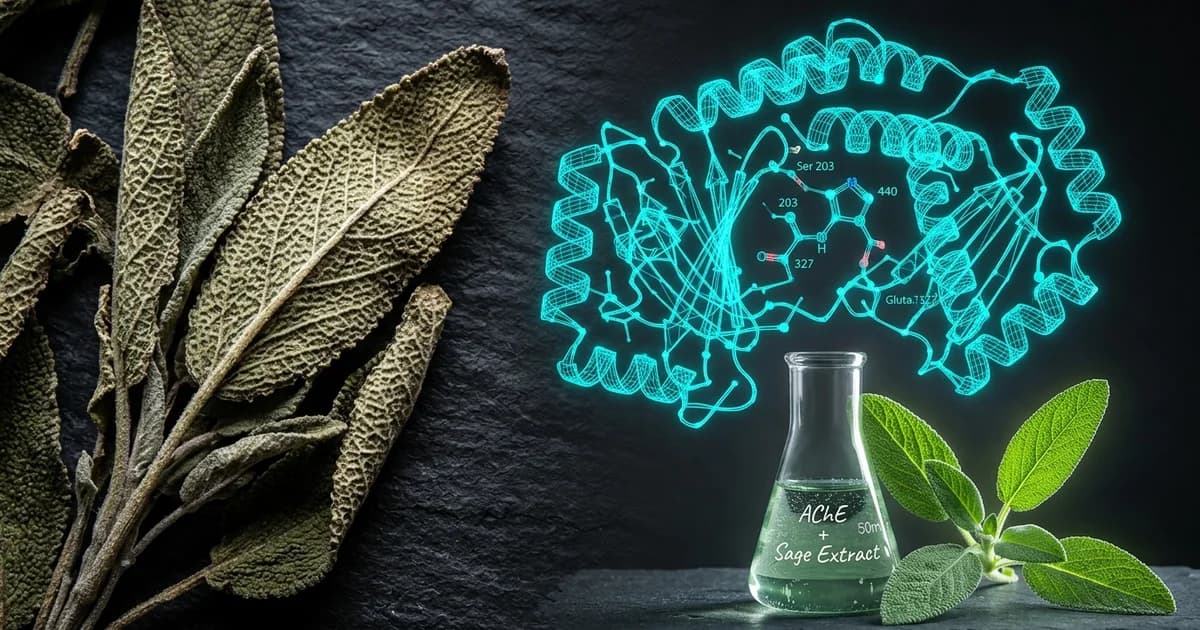
Sage supports memory mainly by slowing the breakdown of acetylcholine, a neurotransmitter your brain uses to encode and retrieve information. The herb does this by inhibiting an enzyme called acetylcholinesterase.
Think of acetylcholine as the chemical signal that helps you form and recall memories. An enzyme constantly clears it out of the synapse. Sage compounds slow that cleanup, so more acetylcholine stays available.
This is the cholinergic hypothesis of memory in a sentence. It is also why sage keeps showing up in serious neuroscience papers rather than just wellness blogs.
The two species that get studied most are common sage (Salvia officinalis) and Spanish sage (Salvia lavandulaefolia). Both contain aromatic monoterpenoid compounds that act on the same enzyme.
The Acetylcholinesterase Mechanism, Explained
Sage's effect on sage acetylcholinesterase activity is the core of the story, so it is worth getting right.
Your neurons release acetylcholine to pass signals across the synapse. Once the message lands, acetylcholinesterase swoops in and breaks the acetylcholine down so the synapse resets. Useful for everyday function, less useful when your acetylcholine levels are already low.
In Alzheimer's disease, the brain loses cholinergic neurons and acetylcholine drops. The standard drug class, including donepezil and rivastigmine, treats this by inhibiting acetylcholinesterase to preserve what acetylcholine remains.
Sage essential oils contain compounds like 1,8-cineole and others that inhibit the same enzyme in lab studies. Researchers identified this property and then asked the obvious question: does it translate to human memory? That question drove the clinical trials below.
If you want the full breakdown of how this enzyme governs learning, see our deeper explainer on the acetylcholinesterase mechanism behind memory.
What the Human Trials Found
Several controlled human studies have tested sage extract memory effects, and the pattern is reasonably consistent for an herbal compound.
In a study of healthy young volunteers, oral doses of Spanish sage essential oil improved performance on memory tasks. The authors described it as the first systematic evidence that Salvia lavandulaefolia can acutely modulate cognition in healthy young adults.
A separate trial led by Scholey and colleagues tested a Salvia extract in healthy older volunteers. It reported improvements in memory and attention with an extract that had anticholinesterase properties.
The most clinically meaningful result came from a 2003 double-blind, placebo-controlled trial in patients with mild to moderate Alzheimer's. Researchers used a fixed dose of Salvia officinalis extract over four months and concluded the herb showed efficacy in managing mild to moderate Alzheimer's disease.
That said, the trials are small and the doses vary a lot between studies. Sage is a promising research compound, not a finished therapy. Anyone with a diagnosed condition should work with a clinician rather than self-medicate with extract drops.
Salvia officinalis vs Salvia lavandulaefolia
Both species earn a place in the salvia officinalis cognition literature, but they are not identical. Here is how the research compares them and where a focus stack like Roon fits the picture.
| Compound | Primary mechanism | Best-studied population | Onset | Notes |
|---|---|---|---|---|
| Salvia officinalis (common sage) | Acetylcholinesterase inhibition | Older adults, Alzheimer's patients | Slow, builds over weeks | The species in the four-month Alzheimer's trial |
| Salvia lavandulaefolia (Spanish sage) | Acetylcholinesterase inhibition | Healthy young and older adults | Acute, same-day effects reported | Lower thujone content than common sage |
| Roon pouch (caffeine + L-theanine + Dynamine + TeaCrine) | Adenosine blockade and attention support | Healthy adults seeking same-day focus | 5 to 10 minutes | Different pathway: alertness and attention, not cholinergic memory |
The key takeaway: sage and a caffeine-based focus stack are not competitors. They nudge different systems. One supports the cholinergic memory pathway over time. The other supports attention and alertness in minutes.
How Much Sage, and in What Form?
The doses that moved cognition in trials came from concentrated extracts and essential oils, not culinary sage. Cooking with sage is pleasant and may offer mild antioxidant value, but it will not deliver study-level compound amounts.
Standardized sage extracts and essential oil capsules are the formats used in research. Quality varies widely between brands, and standardization to active monoterpenoids matters more than raw milligrams.
One caution worth flagging. Common sage contains thujone, a compound that can be problematic in high doses, which is part of why Spanish sage gets studied as a lower-thujone alternative. Stick to label doses and avoid sage essential oil in pregnancy.
Where Sage Fits in the Bigger Picture of Sage Brain Benefits
Sage brain benefits go beyond the cholinergic story. Sage is rich in rosmarinic acid and other polyphenols with antioxidant and anti-inflammatory activity, which researchers think may add a neuroprotective layer over time.
So the herb may help on two fronts. It supports available acetylcholine in the short term, and its polyphenols may protect neurons over the longer term.
Neither effect is instant. Sage is a slow-build compound, closer to a daily nutrition habit than a same-day performance tool. Set your expectations accordingly.
Conclusion
Sage earned its old reputation honestly. The herb inhibits acetylcholinesterase, the same enzyme targeted by modern memory drugs, and a handful of controlled human trials back up real effects on memory and attention. The strongest signal came from a four-month Alzheimer's study, with supporting evidence in healthy young and older adults.
The catch is that the trials are small, the doses are concentrated extracts rather than dinner seasoning, and the effects build slowly. Sage belongs in the category of evidence-backed, long-game cognitive support, not quick fixes.
If you care about memory, sage is one of the more credible herbal compounds to research further with a clinician. Just keep the mechanism and the timeline in mind.
Frequently Asked Questions
Does sage actually improve memory?
Controlled human trials suggest it can. Studies on both common sage and Spanish sage have reported better performance on memory and attention tasks, and a 2003 trial found cognitive benefit in Alzheimer's patients over four months. The effects are real but modest, the trials are small, and the doses came from concentrated extracts rather than culinary sage.
How does sage work in the brain?
Sage inhibits acetylcholinesterase, the enzyme that breaks down acetylcholine, a neurotransmitter central to memory. By slowing that breakdown, more acetylcholine stays available in the synapse. This is the same broad mechanism behind Alzheimer's drugs like donepezil, which is why sage attracts genuine neuroscience research rather than just marketing claims.
Which sage is best for cognition, officinalis or lavandulaefolia?
Both work on acetylcholinesterase. Salvia officinalis is the species used in the four-month Alzheimer's trial, while Salvia lavandulaefolia (Spanish sage) has shown acute, same-day memory effects in healthy volunteers and contains less thujone. For general cognitive research, Spanish sage is often preferred for its safety profile, but both have supporting human data.
Can I just cook with sage to get the benefits?
Not at study levels. The trials used concentrated extracts and essential oils that deliver far more active monoterpenoids than the pinch you add to food. Culinary sage offers flavor and some antioxidant value, but it will not reach the compound amounts that moved cognition in research. Standardized extracts are the format that matches the science.
Is sage extract safe to take daily?
For most healthy adults at label doses, sage extracts are generally well tolerated in studies. The main caution is thujone, found in higher amounts in common sage, which can be problematic at high doses. Avoid sage essential oil during pregnancy, and talk to a clinician before using sage extract if you take medication or have a diagnosed condition.
How long does sage take to work for memory?
It depends on the species and study. Spanish sage produced acute, same-day effects in some trials, while the Alzheimer's benefit emerged over four months of daily use. As a rule, treat sage as a slow-build compound for cognitive support rather than a same-day focus tool. Consistency matters more than any single dose.
Is sage the same as a caffeine-based focus supplement?
No. Sage works on the cholinergic memory pathway by preserving acetylcholine. Caffeine-based stacks work on the adenosine system to support alertness and attention, usually within minutes. They target different problems, so some people interested in both long-term memory support and same-day focus look at them as separate tools rather than substitutes.
Two Pathways, Not One: Sage for Memory, Roon for Same-Day Focus
Sage and a focus pouch solve different problems, and that is the honest framing. Sage nudges the cholinergic system, slowly preserving the acetylcholine your brain uses to encode memory. It is a long-game compound you research with a clinician, not a same-day performance lever.
Roon works on a different axis entirely. Its sublingual pouch pairs 80 mg caffeine with 60 mg L-theanine, plus 25 mg methylliberine (Dynamine) and 5 mg theacrine (TeaCrine), to support attention and alertness through the adenosine system. You feel it in 5 to 10 minutes, and it is built for 6 to 8 hours of focus with no jitters, no crash, and no tolerance buildup.
Roon is not a memory drug and not a replacement for sage, sleep, or medical care. If you want clean same-day focus while you do the slower work of supporting long-term memory, try Roon as the attention layer and let sage handle the cholinergic side.
Written by Roon Team