Reishi, Stress, and the Calm-Focus Connection
Roon Team
Reishi, Stress, and the Calm-Focus Connection: An Adaptogen Deep Dive
Most "calming" supplements work by sedating you. Reishi does something more interesting. The reishi benefits people actually feel tend to show up as a softer stress response and steadier sleep, not a chemical off-switch for your brain.
That distinction matters if you care about focus. A nervous system stuck in fight-or-flight does not concentrate well. So the path to sharper thinking sometimes runs through a calmer baseline, and reishi is one of the oldest tools we have for nudging that baseline.
Below is a clear look at what the mushroom is, what it does, and where the evidence is strong versus thin.
Key Takeaways
- Reishi (Ganoderma lucidum) is an adaptogenic mushroom used for centuries to support calm, sleep, and resilience to stress.
- Its two main active groups are triterpenes (bitter compounds tied to calming and liver effects) and polysaccharides (beta-glucans tied to immune support).
- Reishi is best understood as a slow, baseline tool, not an acute focus booster you feel in minutes.
- For same-day, calm-but-alert focus, an ingredient like L-theanine works on a different timescale and complements a nighttime reishi routine.
What Reishi Actually Is
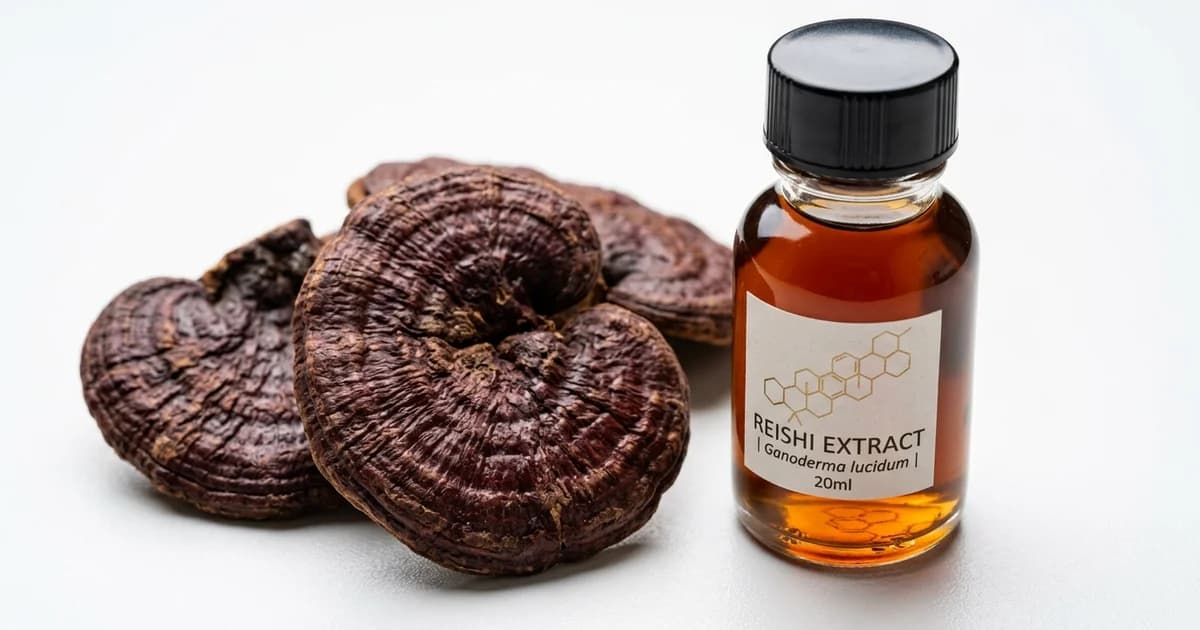
Reishi is the common name for Ganoderma lucidum, a hard, woody, fan-shaped fungus that grows on hardwood trees. In Chinese medicine it carries the name lingzhi, often translated as the "mushroom of immortality." You do not eat it like a portobello. It is far too tough, so it gets brewed, extracted, or powdered.
The plant has a long history as a tonic for stress, fatigue, and poor sleep. Modern interest tracks the same themes, which is rare for a traditional remedy. The folklore and the lab work point in roughly the same direction.
Its reputation rests on two families of compounds.
Triterpenes: the bitter, calming fraction
The reishi triterpenes (including ganoderic and lucidenic acids) are responsible for the mushroom's intense bitterness. They are the compounds most often linked to reishi's calming and liver-supportive activity in lab research. A good extract is usually standardized to a triterpene percentage for this reason.
Polysaccharides: the immune fraction
The other headline group is the beta-glucan polysaccharides. These are tied to immune modulation and are the focus of much of reishi's research in immune and recovery contexts. A quality product reports both fractions, not just a vague "mushroom powder" weight.
Reishi for Stress: How an Adaptogen Works
An adaptogen helps your body hold a steadier line under pressure rather than overreacting to it. That is the core promise behind reishi for stress: not numbness, but a smaller swing.
The stress system runs on a feedback loop called the HPA axis, which governs cortisol, your main stress hormone. Adaptogens are studied for their ability to keep that loop from running hot. Several consumer-science explainers, including one from Biology Insights, describe reishi's proposed role in supporting a more balanced cortisol response rather than forcing levels up or down.
The honest summary is this. Human data on reishi and cortisol is still limited, and much of the mechanism work comes from animal and cell studies. Treat the calming effect as plausible and traditionally supported, not as a settled clinical fact.
What you are unlikely to get is a stimulant-style lift. Reishi as an adaptogen is a slow-build ingredient. People who do well on it usually report a gradual change in how they handle stress over weeks, not a noticeable hit within the hour.
Reishi and Sleep: The Calm Side of Focus
Reishi's clearest traditional use is sleep, and that connects directly to daytime focus. You cannot think clearly on a wrecked night.
In traditional practice, reishi for sleep is a wind-down tonic taken in the evening. The triterpene fraction is the part most associated with this calming, pre-sleep quality. Animal studies have explored these effects directly: a Ganoderma lucidum rat study reported shorter sleep latency and longer total sleep time after several days of extract dosing.
Here is the focus link. Better sleep lowers next-day stress reactivity and protects working memory. So reishi's contribution to cognition is mostly indirect. It is not a daytime sharpener. It is a recovery tool that clears the runway for the next day.
Reishi and Cognition: Separating Hope From Evidence
Direct evidence for reishi cognition benefits in healthy adults is thin, and you should be skeptical of anyone selling it as a brain-on-demand nootropic.
Most of the cognitive case is mechanistic. Lab research on reishi triterpenes points to antioxidant and anti-inflammatory activity, both of which matter for long-term brain health. Ingredient explainers like Happy Mind summarize these neuroprotective themes, while being clear that strong human trials in healthy people are scarce.
Note who often gets paired with reishi for "brain" formulas: lion's mane. They do different jobs. Lion's mane is the one studied for nerve and cognitive support, while reishi is the calm-and-recovery partner. Several brain-health writeups, including one from Try Substance, describe this division of labor.
The takeaway: reishi supports the conditions for clear thinking. It does not deliver acute focus the way caffeine or L-theanine can.
Reishi vs. Other Calm-Focus Tools
Reishi solves a different problem than the ingredients people reach for during a work sprint. The table below maps where each one fits. This is a comparison of mechanisms and timing, not a ranking of "best."
| Tool | Primary job | Onset | Best time | Acute focus? |
|---|---|---|---|---|
| Reishi (Ganoderma lucidum) | Stress resilience, sleep, baseline calm | Slow (weeks) | Evening | No |
| L-theanine | Calm-but-alert state, smooths caffeine | 30-60 min | Daytime | Yes |
| Caffeine | Alertness, drive | 15-45 min | Daytime | Yes |
| Caffeine + L-theanine | Clean focus without the edge | Fast | Daytime | Yes |
| Roon pouch (80mg caffeine, 60mg L-theanine, 25mg Dynamine, 5mg TeaCrine) | Sustained, no-crash daytime focus | 5-10 min, 6-8 hr window | Daytime | Yes |
The pattern is simple. Reishi owns the night and the long game. The caffeine-plus-L-theanine family owns the work session. They are not competitors. They are different shifts on the same clock.
How to Use Reishi Well
If you want to test reishi, set the right expectations and the right protocol.
- Buy on extract quality, not weight. Look for a dual-extract that reports triterpene and beta-glucan percentages. A big milligram number on raw powder tells you little.
- Take it in the evening. Its calming profile fits a wind-down better than a morning sprint.
- Give it weeks, not days. Adaptogens build. Judge it after three to four weeks of consistent use.
- Keep it separate from your focus stack. Use reishi for recovery and a daytime tool for active concentration.
A quick safety note. Reishi is generally well tolerated, but it can interact with blood-thinning and blood-pressure medications, and high doses have been linked to liver concerns in rare reports. Check with a doctor if you take prescriptions or are pregnant. This article is education, not medical advice.
The Bottom Line on Reishi and Calm Focus
Reishi is not a focus pill, and treating it like one sets you up to be disappointed. Its real strengths sit upstream of focus: a steadier stress response, better sleep, and the slow build of resilience that good thinking depends on.
The evidence is strongest for its traditional calming role and its triterpene and polysaccharide chemistry. It is weaker, and mostly mechanistic, for direct cognitive gains in healthy adults. Hold both truths at once.
Think of attention as a two-shift system. One shift is recovery, where reishi belongs. The other is performance, where fast-acting, alertness ingredients belong. The smartest routines respect that split instead of asking one ingredient to do everything.
Frequently Asked Questions
What are the main reishi benefits?
The most supported reishi benefits are calming, stress resilience, and sleep support, rooted in centuries of traditional use and backed by lab research on its triterpenes and polysaccharides. It is also studied for immune modulation. Direct cognitive and acute-focus benefits in healthy adults are far less proven. Reishi is best treated as a slow, baseline wellness tool rather than a same-day performance booster.
Does reishi lower cortisol?
Possibly, but the human evidence is limited. Reishi is classified as an adaptogen, meaning it is studied for helping the body keep a steadier stress response rather than spiking or crashing cortisol. Most mechanism data comes from animal and cell research, with consumer-science explainers describing a balancing role. Treat the cortisol claim as plausible and traditionally supported, not as a confirmed clinical outcome.
Can reishi help me focus?
Not directly, and not quickly. Reishi does not work like caffeine or L-theanine, so you should not expect an acute focus lift. Its contribution to clear thinking is indirect, through better sleep and a calmer stress baseline. If you want same-day concentration, a fast-acting focus ingredient is the right tool, and reishi is the nighttime recovery partner that supports it.
Is reishi better than lion's mane for the brain?
They do different jobs. Lion's mane is the mushroom studied for nerve and cognitive support, so it is the more direct "brain" choice. Reishi is the calm-and-recovery partner, focused on stress and sleep. Many brain-health formulas pair them precisely because their strengths do not overlap. Choose based on your goal: cognitive support points to lion's mane, while stress and sleep point to reishi.
When should I take reishi?
Evening, in most cases. Reishi's calming profile fits a wind-down routine better than a morning energy window. Consistency matters more than timing, though. Adaptogens build over weeks, so take it daily and judge the effect after three to four weeks rather than after a single dose.
How long does reishi take to work?
Plan on weeks, not minutes. Unlike a stimulant, reishi does not produce a noticeable acute effect. People who respond to it usually describe a gradual shift in stress tolerance and sleep quality over three to four weeks of consistent use. If you feel nothing on day one, that is normal and expected.
Is reishi safe to take daily?
For most healthy adults, reishi is generally well tolerated for daily use. It can interact with blood-thinning and blood-pressure medications, and rare reports link very high doses to liver concerns. Talk to a doctor before starting if you take prescriptions, have a medical condition, or are pregnant or breastfeeding. This is educational information, not medical advice.
Where Reishi Ends and Daytime Focus Begins
Reishi is a night-shift ingredient. It supports the recovery that makes the next day's focus possible. But it was never built to power an actual work session, and pretending otherwise is how people end up frustrated with adaptogens.
That gap is exactly where the daytime side of the clock lives. Roon is a sublingual pouch built for that window, with 80 mg caffeine, 60 mg L-theanine, 25 mg methylliberine (Dynamine), and 5 mg theacrine (TeaCrine). The L-theanine is the bridge to reishi's world: it supports a calm-but-alert state, taking the edge off caffeine so focus feels smooth instead of wired. Onset lands in 5 to 10 minutes and holds for 6 to 8 hours with no jitters, no crash, and no tolerance buildup.
To be clear about what it is not: Roon is not a sleep aid, an adaptogen, or a replacement for a real wind-down routine. Reishi can own your evening. Roon is the complementary tool for the hours you actually need to perform. Try Roon when you want calm, sustained daytime focus to match a calmer night.
Written by Roon Team