PQQ (Pyrroloquinoline Quinone): Mitochondrial Biogenesis
Roon Team
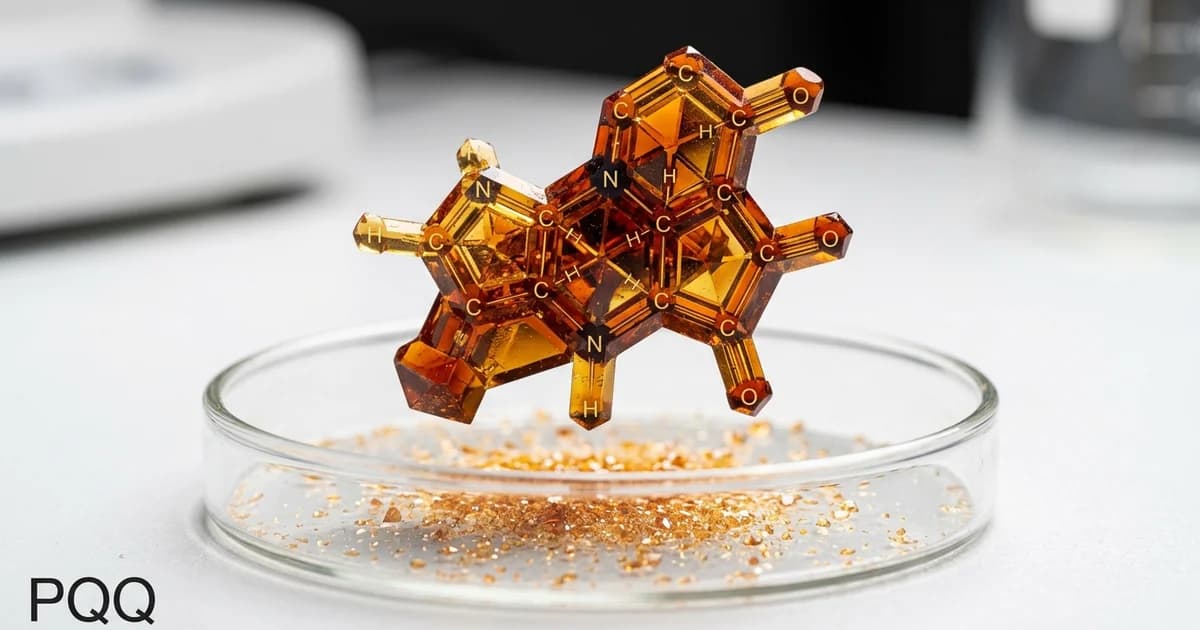
PQQ (Pyrroloquinoline Quinone): Mitochondrial Biogenesis and Brain Energy
Most nootropics work on the brain's wiring. They push neurotransmitters, block adenosine, or nudge receptors. A PQQ supplement does something stranger and slower: it targets the tiny power plants inside your cells.
Pyrroloquinoline quinone, or PQQ, is one of the few compounds shown to help your cells build more mitochondria, not just run the ones you already have. That matters for the brain, which is the most energy-hungry organ you own. Neurons burn roughly 20% of your daily calories while making up about 2% of your body weight.
This is not a quick-hit stimulant. PQQ is a long-game investment in how much energy your cells can produce. Here is what the science actually says.
Key Takeaways
- PQQ supports mitochondrial biogenesis, the growth of new mitochondria, by activating the PGC-1α signaling pathway.
- The effect is slow and cumulative, not a same-day energy spike like caffeine.
- Typical research doses sit around 20 mg per day, often using the standardized BioPQQ form.
- PQQ is found in trace amounts in foods like fermented soy, green tea, parsley, and human breast milk.
- Think of PQQ as mitochondrial capacity building, paired with acute focus tools for day-to-day output.
What Is Pyrroloquinoline Quinone?
PQQ is a small redox-active compound first identified in bacteria, where it works as a cofactor for certain enzymes. In humans it does not appear to be a vitamin, but it behaves like a powerful signaling molecule and antioxidant.
You get tiny amounts from your diet. It shows up in fermented soybeans (natto), green tea, parsley, green peppers, kiwi, and in human breast milk, which hints at a role in early development.
The form used in most studies is a disodium salt sold as BioPQQ. European regulators reviewed this version through the EFSA Journal, which assessed PQQ disodium salt as a novel food and examined its safety profile at supplemental doses.
PQQ and Mitochondria: How It Actually Works
PQQ's signature effect is mitochondrial biogenesis, the process of growing new mitochondria inside your cells. This is what separates it from ingredients that simply borrow energy from existing reserves.
The mechanism was mapped in a frequently cited paper. According to research published in the Journal of Biological Chemistry by Chowanadisai and colleagues, PQQ stimulates mitochondrial biogenesis through CREB phosphorylation and increased PGC-1α expression.
Here is the cascade in plain terms. PQQ switches on a protein called CREB. CREB then ramps up PGC-1α, often described as the master regulator of mitochondrial production. PGC-1α tells the cell to build more mitochondria.
That same study found PQQ activated downstream factors (NRF-1, NRF-2, and Tfam) tied to mitochondrial replication, and it protected cells against mitochondrial toxins. When researchers silenced PGC-1α or CREB, the biogenesis effect disappeared, which is strong evidence the pathway is real and specific.
More mitochondria means more capacity to produce ATP, the fuel your cells run on. For high-demand tissue like the brain, that capacity is the ceiling on sustained performance.
PQQ Brain Energy: Why Neurons Care About Mitochondria
Your brain's performance is limited by how much energy your neurons can generate, and that energy comes almost entirely from mitochondria. This is why PQQ brain energy claims center on cellular power rather than direct stimulation.
Neurons are metabolically expensive. They fire constantly, pump ions across membranes, and maintain connections, all of which demand a steady ATP supply. When mitochondrial function declines, so does cognitive output.
A 2025 review in Neural Regeneration Research examined PQQ as a potential neuroprotective agent, looking at its antioxidant action and its support for mitochondrial health in neural tissue.
PQQ also acts as a redox-active antioxidant. It can cycle through thousands of reactions without breaking down, which helps it manage the oxidative stress that mitochondria naturally produce during energy generation.
BioPQQ Cognition: What the Human Studies Show
Human trials on BioPQQ cognition are small but suggest support for memory and attention, particularly in older adults. The evidence base is younger than for caffeine or L-theanine, so read it as promising rather than settled.
Japanese research groups, including teams reviewed by Keio University, have studied PQQ disodium salt for effects on cognitive function. A separate review from Tokushima University summarized trials examining higher brain function and memory measures with PQQ supplementation.
The general pattern: doses around 20 mg per day, taken over weeks to months, with outcomes measured on memory, attention, and processing tasks. The improvements tend to be modest and show up most clearly in people whose baseline was already declining.
The honest read is this. PQQ is not going to feel like a double espresso. Its benefits build quietly, the way strength builds from training rather than from a single workout.
PQQ vs Other Brain Energy Ingredients
PQQ sits in a different category from acute focus compounds. The table below shows where it fits among ingredients people stack for cognitive performance.
| Ingredient | Primary Mechanism | Onset | Best For |
|---|---|---|---|
| PQQ | Mitochondrial biogenesis (PGC-1α) | Weeks (cumulative) | Long-term cellular energy capacity |
| NMN / NAD+ precursors | Raises cellular NAD+ levels | Weeks (cumulative) | Mitochondrial fuel and repair |
| Caffeine | Blocks adenosine receptors | 30-45 min | Acute alertness |
| L-theanine | Promotes alpha brain waves | 30-60 min | Calm, smooth focus |
| Roon pouch | Caffeine + L-theanine + Dynamine + TeaCrine, sublingual | 5-10 min | On-demand focus, 6-8 hrs, no crash |
PQQ and NAD+ precursors work on the same broad goal, your cells' ability to make and use energy. If you want to go deeper on the fuel side of that equation, our breakdown of NMN and NAD+ for brain energy covers how those molecules feed the mitochondria PQQ helps build.
Caffeine, L-theanine, and the Roon pouch live on the other end of the timeline. They deliver focus you can feel within minutes, which is a different job entirely.
How Much PQQ Should You Take?
Most studies use 20 mg of PQQ per day, typically as the BioPQQ disodium salt. Some protocols go up to 40 mg, though more is not clearly better.
PQQ is fat-friendly in absorption terms and is often taken with a meal. Because its effects accumulate, consistency over weeks matters far more than timing on any single day.
Standard safety caveats apply. PQQ is a dietary supplement, not a treatment for any condition, and you should talk to your doctor before starting it if you are pregnant, nursing, or on medication. The EFSA review supports its use as a novel food at supplemental levels, but it does not replace medical advice.
The Bottom Line on PQQ and Cellular Energy
PQQ is a rare supplement that targets the machinery of energy production itself. By activating the PGC-1α pathway, it supports the growth of new mitochondria, and more mitochondria means more capacity to power demanding tissue like the brain.
The trade-off is patience. PQQ rewards consistent use over weeks, not minutes. It builds a foundation rather than flipping a switch.
For anyone serious about cognitive performance, that makes PQQ a base layer. It raises your ceiling slowly while leaving room for faster tools to handle the work in front of you today.
Frequently Asked Questions
What does a PQQ supplement do?
A PQQ supplement supports mitochondrial biogenesis, the process of growing new mitochondria inside your cells. Research in the Journal of Biological Chemistry showed PQQ activates the PGC-1α pathway, which the body uses to build new mitochondria. Because mitochondria generate the ATP that powers your cells, more of them can support energy capacity in high-demand tissue like the brain. The effect builds over weeks rather than producing an immediate lift.
How long does PQQ take to work?
PQQ works on a slow, cumulative timeline. Unlike caffeine, which you feel in under an hour, PQQ's benefits depend on building mitochondrial capacity over time. Most human studies run for several weeks to a few months at around 20 mg per day before measuring changes in memory or attention. Treat it like a training effect, where consistency over weeks produces results, not a single dose.
Is PQQ the same as CoQ10?
No, though they are often paired. CoQ10 helps shuttle electrons inside the mitochondria you already have, supporting current energy production. PQQ instead signals the cell to build new mitochondria through the PGC-1α pathway. One optimizes existing power plants, the other helps add more. Some people stack them, but they play different roles in mitochondrial health.
What is BioPQQ?
BioPQQ is a standardized, fermentation-derived form of PQQ disodium salt used in most clinical research. When you see studies on BioPQQ cognition, they typically use this version at doses near 20 mg per day. European regulators reviewed PQQ disodium salt through the EFSA Journal as a novel food, which assessed its safety at supplemental levels.
Does PQQ give you energy like caffeine?
No. PQQ does not stimulate the nervous system the way caffeine does, so you will not feel an acute buzz. Its role is to support your cells' long-term ability to produce energy by helping build mitochondria. If you want energy you can feel within minutes, a stimulant like caffeine, ideally paired with L-theanine, fits that need. PQQ works underneath, on capacity.
What foods contain PQQ?
PQQ appears in trace amounts across several foods. Fermented soybeans (natto), green tea, parsley, green peppers, and kiwi all contain small quantities. It is also present in human breast milk, which suggests a role in early development. Dietary amounts are far lower than the roughly 20 mg used in studies, which is why supplementation is common for those targeting mitochondrial support.
Is PQQ safe to take daily?
PQQ has a favorable safety profile at typical supplemental doses, and most research uses around 20 mg per day. The EFSA Journal reviewed PQQ disodium salt as a novel food and examined its safety at these levels. That said, PQQ is a dietary supplement, not a medical treatment, and long-term human data is still limited. Check with your doctor before daily use, especially if you are pregnant, nursing, or taking medication.
PQQ Builds the Engine. Roon Drives It Today.
PQQ plays a slow game. It helps your cells build mitochondrial capacity over weeks, raising the ceiling on how much energy your brain can produce. That is a worthwhile base layer, and it pairs naturally with NAD+ support, which you can read about in our piece on NMN and NAD+ for brain energy.
But capacity building does nothing for the deadline in front of you this afternoon. That is a different problem, and it needs a different tool.
Roon is built for acute, on-demand focus. Each sublingual pouch combines 80 mg caffeine, 60 mg L-theanine, 25 mg methylliberine (Dynamine), and 5 mg theacrine (TeaCrine), with a 5 to 10 minute onset and 6 to 8 hours of steady focus, no jitters and no crash. It is not a mitochondrial supplement and will not build new mitochondria the way PQQ does. It does the opposite job: it turns the energy you have into focus you can use right now. If you are building capacity with PQQ, try Roon for the hours that actually count.
Written by Roon Team