The Real Cost of Open-Office Noise: How Long It Actually Takes to Recover Your Focus
Someone two desks over takes a phone call. A colleague stops by with a "quick question." Each open office noise distraction feels small, maybe 30 seconds of actual interruption. But the real cost is not the interruption itself. It is the 23 minutes and 15 seconds it takes, on average, to fully recover your depth of focus afterward, according to research from Gloria Mark at UC Irvine.
That figure reframes the entire open-plan productivity conversation. The problem was never that your coworker's call is loud. The problem is that your brain needs nearly half an hour to get back to where it was before you heard it.
Roughly 70% of U.S. office workers sit in some form of open-plan layout, per an estimate cited in SAGE Open (Congdon et al., 2014). With return-to-office mandates accelerating through 2025 and 2026, millions of knowledge workers are re-encountering a problem that remote work temporarily masked: the acoustic environment of the shared floor plan.
Key Takeaways
- Recovery, not interruption, is the real cost. Gloria Mark's research puts the average refocus time at 23 minutes 15 seconds per interruption, not the seconds the interruption itself takes.
- Open-plan offices amplify the problem by design. Peer-reviewed acoustics research shows that speech intelligibility (how far a conversation carries before becoming unintelligible) predicts how often workers report being disturbed.
- Industry estimates put the daily toll at 86 minutes of lost productivity per employee, though that figure comes from a workplace survey, not a controlled experiment.
- Practical fixes exist, but they require deliberate systems: headphones as a social signal, batched interruptible hours, and seating choices when you have any say.
What Gloria Mark's Interruption Recovery Research Actually Found
Every interruption costs you roughly 23 minutes of recovery time, not because you are slow, but because deep focus is a state your brain builds into gradually. Gloria Mark's research program, "The Cost of Interrupted Work," found the average worker needs 23 minutes and 15 seconds to fully return to the original task after a single interruption.
That number includes everything after the interruption: checking email, opening a different tab, losing the thread, slowly climbing back. It is not a clean pause-and-resume. It is a cascade.
Mark's broader research makes the picture worse. In 2004, the average time a person spent on a single screen before switching was about 2.5 minutes. By her more recent measurements, that number had dropped to roughly 47 seconds. Shorter baseline attention spans mean the climb back after an interruption is steeper than it was 20 years ago.
The Math on a Typical Day
If you experience just four interruptions during a focused work block (a conservative count for most open-plan offices), the recovery math looks like this:
| Interruptions per block | Recovery time per interruption | Total recovery time lost |
|---|---|---|
| 2 | 23 min 15 sec | ~46 min |
| 4 | 23 min 15 sec | ~93 min |
| 6 | 23 min 15 sec | ~139 min |
Four interruptions and you have lost more than an hour and a half, not to the interruptions themselves, but to the invisible tax of getting back on track. That is before you count the interruptions you cause yourself.
Why Open-Plan Offices Make This Worse by Design
Open office noise distraction is not a user error. It is a structural feature of the environment. The acoustics research on this is specific and well-documented.
A 2017 study in the Journal of the Acoustical Society of America analyzed 21 open-plan offices and introduced the concept of "distraction distance": how far a conversation carries before it becomes unintelligible enough to stop pulling your attention. Haapakangas et al. found this metric directly predicted how often workers reported being disturbed. The takeaway is not about volume. It is about intelligibility: your brain involuntarily processes speech it can understand, even when you are trying to ignore it.
A separate field study published in the Journal of Environmental Psychology confirmed the pattern from a different angle: noise is "one of the most recurrent reasons for complaints in open-plan office environments," and variations in sound absorption directly affected worker outcomes. Cardiff University research has similarly documented that noise and distraction negatively affect both wellbeing and productivity in open-plan layouts.
The common thread: open-plan layouts, by minimizing barriers between workers, maximize the distraction distance. Every conversation within earshot becomes a potential 23-minute recovery event.
The 86-Minute Daily Toll: What the Industry Numbers Say
A 2014 study by Steelcase and Ipsos, surveying more than 10,500 workers across Europe, North America, and Asia, found that workers lost as much as 86 minutes per day due to noise distractions, roughly 18% of an 8-hour workday. That figure circulates widely in workspace-design literature, including Acousplan's productivity analysis.
A necessary caveat: this is a survey-based industry estimate, not a controlled laboratory measurement. The 86-minute number reflects a mix of noise-related interruptions and self-reported distraction. Treat it as directional, not precise.
Even discounting it by half, 43 minutes lost per employee per day across a team of 20 adds up to more than 14 hours of collective focus lost daily. Nearly two full workdays, every day.
Practical Fixes That Actually Work in Open-Plan Offices
You probably cannot redesign your office floor plan. But you can build systems that reduce the number and impact of interruptions hitting your focus blocks.
1. Headphones as a Social Signal, Not Just Sound Blocking
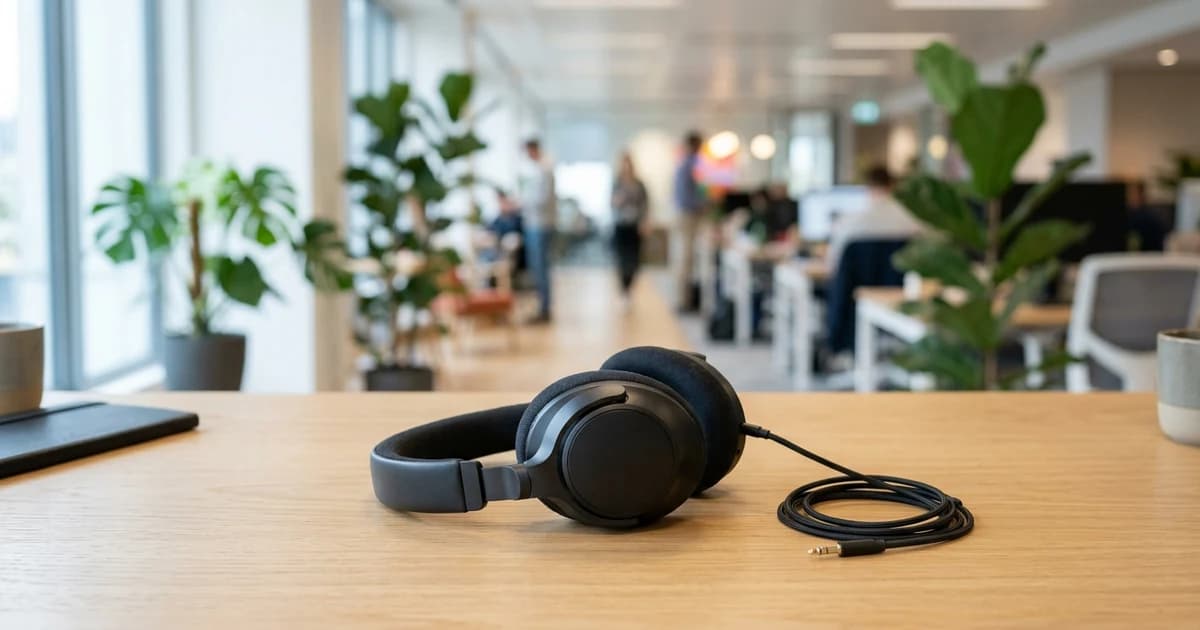
Noise-canceling headphones serve two functions in an open office. The obvious one is acoustic. The less obvious one is social. In offices where this system works, the cultural code is clear: no earbuds means interruptible; earbuds suggest caution; over-ear headphones mean do not disturb.
This only works if your team agrees on the signal. Without that shared understanding, headphones become a source of resentment rather than a productivity tool. Have the explicit conversation with your team about what headphones mean.
2. Batch Your "Interruptible" Hours
Most open-plan interruptions are not emergencies. They are questions that could wait 90 minutes. Block your calendar into two modes:
- Focus blocks (2 to 3 hours, headphones on, status set to busy): no walk-by questions.
- Open blocks (1 to 2 hours, headphones off, physically available): batch collaborative work here.
When colleagues know you will be available at 2 PM, they stop ambushing you at 10:30 AM.
3. Choose Your Seat Strategically
If your office allows any flexibility in seating, proximity to high-traffic zones (kitchens, meeting rooms, main walkways) is the single biggest predictor of interruption frequency. When you need deep focus:
- Sit facing a wall or window, not the room.
- Avoid seats near printers, coffee machines, or entry doors.
- If hot-desking is available, book the quietest corner on focus days.
4. Communicate Focus Blocks, Not Just Calendar Blocks
A blocked calendar only works if people check it. For open-plan offices, you need a visible, physical signal: a small sign or a sticky note that says "Deep work until 1 PM." Pair it with a Slack message. The goal is to shift the default so coworkers assume you are focused and check before interrupting, rather than assuming you are always available.
The Recovery Problem No Floor Plan Can Fully Solve
The core challenge with open office noise distraction is not that offices are loud. It is that the human brain requires an extended ramp-up to reach deep focus, and every interruption resets that ramp. Gloria Mark's 23-minute-15-second recovery figure is an average, meaning some interruptions cost even more.
No acoustic panel, white-noise machine, or seating strategy eliminates this entirely. They reduce the frequency of interruptions and shorten the distraction distance. But the fundamental biology of attention recovery remains: once concentration breaks, rebuilding it takes time. That time is the real cost of the open-plan office. The goal is not silence. It is fewer resets.
Frequently Asked Questions
How long does it take to regain focus after an interruption in an open office?
Research from Gloria Mark at UC Irvine found the average recovery time is 23 minutes and 15 seconds per interruption. That is the time to fully return to the same depth of focus, not just the time to look back at your screen. In open-plan offices, where interruptions are more frequent, this cost compounds across the day.
How much productivity do open-plan offices cost per day?
A 2014 Steelcase/Ipsos survey of more than 10,500 workers estimated 86 minutes of lost productivity per employee per day due to noise distractions. This is a survey-based industry figure, not a controlled experiment, so treat it as directional. Even at half that number, the cumulative cost across a team is substantial.
Why is speech more distracting than other office noises?
Your brain involuntarily processes intelligible speech. A 2017 acoustics study found that "distraction distance," the radius at which conversations remain understandable, directly predicts how disturbed workers feel. Mechanical noise (fans, HVAC) is easier to tune out because it carries no semantic content your brain tries to decode.
Do noise-canceling headphones actually help with open-office focus?
Yes, but their biggest value may be social, not acoustic. Active noise cancellation handles low-frequency ambient noise well but is less effective against nearby speech. The larger benefit is that visible headphones signal "do not interrupt," reducing walk-by interruptions. This only works if your team shares an explicit understanding of what headphones mean.
Is white noise or background music better for open-office focus?
Both help by masking intelligible speech, the primary distractor. Cardiff University research found that music in open-plan offices can improve wellbeing and productivity. White or pink noise raises the ambient floor so nearby conversations become less intelligible. Music with lyrics can interfere with writing and reading; instrumental music or steady noise works better for language-heavy tasks.
What is "distraction distance" and why does it matter?
Distraction distance is an acoustics metric based on the Speech Transmission Index. It measures how far from a speaker you need to be before their words become unintelligible enough to stop pulling your attention. In open-plan offices with hard surfaces and few barriers, distraction distance can extend across an entire floor. Acoustic treatments like ceiling panels, soft partitions, and carpet reduce it.
When 23 Minutes Is What You Actually Lose
Headphones, batched schedules, and seating strategy reduce how often the 23-minute recovery tax gets charged. They are the structural fixes, and they matter most.
But there are moments where the interruption already happened. You are back at your desk with 90 minutes before the next call, and you need to be productive now, not in 23 minutes.
Roon was built for that window. Each sublingual pouch delivers 80 mg caffeine, 60 mg L-theanine, 25 mg methylliberine (Dynamine), and 5 mg theacrine (TeaCrine), absorbed in 5 to 10 minutes without leaving your desk or drawing attention. The methylliberine slows caffeine's clearance: a randomized crossover PK study (n=12) found co-administration cut caffeine's oral clearance from 41.9 to 17.1 L/hr and extended its half-life from 7.2 to 15 hours, with no increase in peak concentration. That is why the felt window is 6 to 8 hours on a small-coffee dose, not the 3 to 4 you get from a cup. The trade-off: do not take it within 8 hours of bedtime.
Roon is not an acoustics solution. It will not quiet your office or stop walk-by interruptions. What it does is support faster re-engagement when focus has already been broken. One pouch, one tin in your pocket, no trip to the kitchen. Try Roon on your next open-plan focus block.
Written by Roon Team