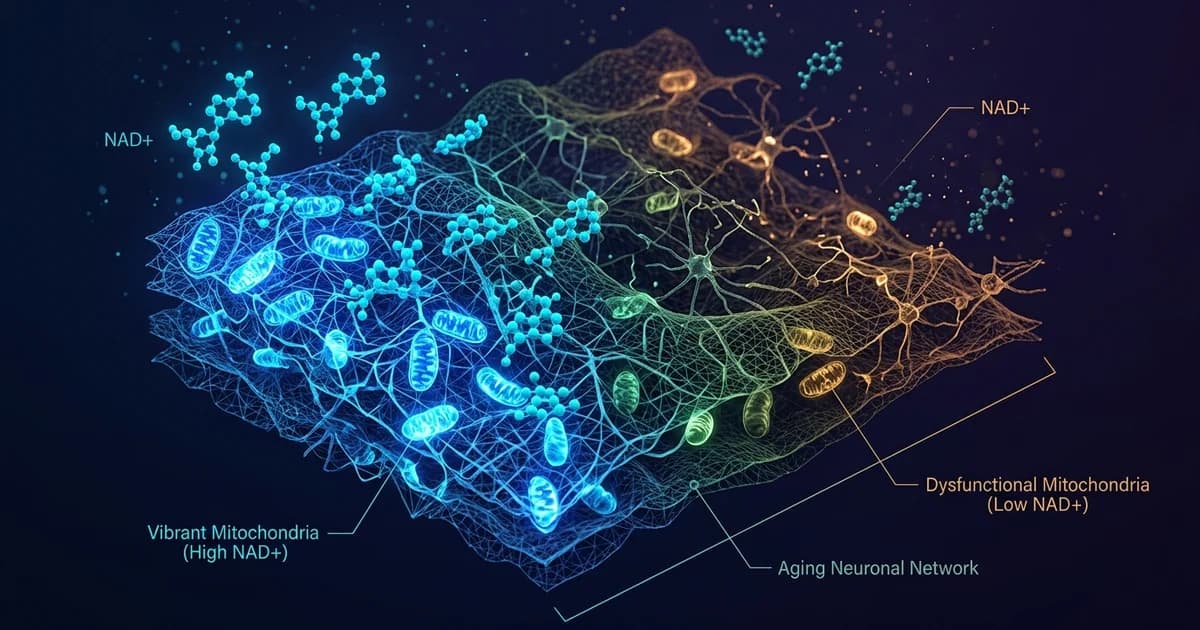
NAD+ and the Aging Brain: Why Cellular Energy Declines With Age
Your neurons burn through an absurd amount of fuel. The brain is roughly 2% of your body weight, yet it consumes about 20% of your resting energy. Every thought, every memory you form, every signal that crosses a synapse runs on a steady supply of cellular energy.
The molecule sitting at the center of that energy economy is NAD+, and NAD+ brain aging is one of the more interesting stories in modern neuroscience. NAD+ stands for nicotinamide adenine dinucleotide, and your levels of it fall as you get older. When NAD+ drops, the machinery that keeps neurons powered starts to slip.
This article explains the mechanism. What NAD+ does, why it declines, and what that decline means for the aging brain.
Key Takeaways
- NAD+ is a coenzyme that powers energy production in every cell, including neurons, by helping convert food into ATP.
- NAD+ levels fall with age, driven partly by enzymes like CD38 that consume it faster than the body can rebuild it.
- Low NAD+ weakens mitochondria and silences sirtuins, two systems neurons depend on for repair and resilience.
- NAD+ biology runs on a long timescale. It is about cellular maintenance over years, not the acute alertness you feel from caffeine in minutes.
What NAD+ Actually Does in a Neuron
NAD+ is the molecule that lets your cells turn food into usable energy. It shuttles electrons through the reactions that produce ATP, the fuel that runs everything from muscle contraction to neuron firing.
Think of it as a rechargeable carrier. NAD+ picks up electrons, becomes NADH, drops them off at the mitochondria, and resets to NAD+ again. That cycle repeats millions of times a second across your body.
For neurons, this matters more than for almost any other cell. Brain tissue has enormous, nonstop energy demands and very little capacity to store fuel. A neuron that loses its energy supply cannot simply pause and wait. The link between NAD+ and mitochondria in the brain is direct: no NAD+, no efficient ATP, no stable neuron.
NAD+ does more than fuel metabolism, though. It is also a substrate, meaning other enzymes consume it to do their jobs. Two families of those enzymes, sirtuins and PARPs, sit at the heart of why NAD+ matters for aging.
Why NAD+ Declines With Age
NAD+ falls as you age because your cells consume it faster while making it less efficiently. It is a supply-and-demand problem that tips the wrong way over decades.
One of the main culprits is an enzyme called CD38. A 2025 review in Frontiers in Immunology examined CD38's role in aging and age-related disease, describing it as an NAD-consuming glycohydrolase that rises with inflammation and age. As CD38 activity climbs, it eats into the NAD+ pool that neurons and other cells rely on.
The decline shows up in the blood, too. Research published in the NAD+ metabolome study on normal aging found that the plasma NAD+ metabolome is dysregulated even in healthy older adults, not just in people with disease. Aging itself shifts the balance.
So you have two forces working against you. Consumption goes up, partly from chronic low-grade inflammation. Synthesis and salvage struggle to keep pace. The net result is a smaller NAD+ pool feeding cells that never stop needing it.
The Inflammation Loop
Inflammation and NAD decline in the brain feed each other. Inflammatory signals push CD38 activity higher, which drains NAD+, which weakens the very repair systems that would otherwise keep inflammation in check. The loop reinforces itself, and the brain is a sensitive place for it to happen.
NAD+, Sirtuins, and the Aging Brain
Sirtuins are repair enzymes that cannot function without NAD+, which is why falling NAD+ levels quietly disable one of the brain's key maintenance crews. Sirtuins in the brain depend on NAD+ as fuel for their activity, so when the supply shrinks, their output shrinks with it.
Sirtuins help manage how mitochondria are built and maintained. Research in the Journal of Neuroinflammation showed that in a model of reduced brain blood flow, raising NAD+ improved cognitive function and reduced neuroinflammation by easing mitochondrial damage and lowering reactive oxygen species, acting through the Sirt1/PGC-1α pathway.
That pathway is worth understanding in plain terms. SIRT1 is a sirtuin. PGC-1α is a master regulator of mitochondrial production. When NAD+ feeds SIRT1, SIRT1 activates PGC-1α, and the cell builds more healthy mitochondria. When NAD+ runs low, that chain breaks down.
This is the core of why NAD+ and cognitive function are linked at the cellular level. Sirtuins need NAD+ to protect mitochondria, mitochondria produce the energy neurons run on, and neurons need that energy to think, signal, and survive.
How Low NAD+ Damages Neurons
When NAD+ falls inside a neuron, the cell loses both its energy buffer and its self-defense system. The damage shows up in two clear ways.
First, energy production stumbles. Mitochondria become less efficient and leak more reactive oxygen species, the byproducts that damage cellular structures over time. The relationship between NAD+ and neurons is tight here, because a neuron with failing mitochondria cannot sustain the constant electrical activity its job requires.
Second, there is the axon. The long projections that carry signals between neurons are unusually dependent on local NAD+ levels. Work published in eLife showed that axon degeneration is driven by SARM1-mediated NAD+ depletion, and that blocking that depletion protects the axon from breaking down.
A related study in PMC found that SARM1 acts as a metabolic sensor activated by a rising NMN/NAD+ ratio, and that boosting NAD+ levels beforehand kept injured axons from degenerating. In other words, NAD+ is not just fuel. It is also a survival signal that tells an axon to hold itself together.
Can You Raise NAD+? What the Research Shows
You can raise NAD+ levels with precursors like nicotinamide riboside, but the cognitive payoff in humans is still being worked out. Researchers feed the body building blocks rather than NAD+ directly, because the molecule itself does not absorb well whole.
A randomized controlled trial published in eClinicalMedicine tested nicotinamide riboside in people with long COVID and measured its effects on NAD+ levels, cognition, and symptom recovery. Studies like this are how the field is moving from promising biology in animals toward measured outcomes in people.
Here is the honest read. The cellular mechanism is well established. Whether raising NAD+ reliably sharpens memory or slows brain aging in healthy adults is still an open question that careful trials are working through.
Lifestyle does influence NAD+, too. Exercise, fasting, and sleep all interact with the enzymes that make and consume it. None of these is a shortcut, but together they shape the supply your neurons get.
NAD+ vs. Acute Brain Energy: Two Different Timescales
NAD+ is a long-horizon story about cellular maintenance, not something you feel kick in over an afternoon. This distinction confuses a lot of people who shop for "energy" and "focus" support.
There are two separate layers of brain energy. One is structural and slow. The other is functional and fast.
| Energy Layer | What It Involves | Timescale | What You Notice |
|---|---|---|---|
| NAD+ / mitochondrial | Cellular fuel production, sirtuin repair, mitochondrial health | Months to years | No acute sensation; a maintenance process |
| Acute alertness | Caffeine blocking adenosine, faster signaling | Minutes to hours | Sharper focus, reduced fatigue, same-day effect |
NAD+ is plumbing. Caffeine is a light switch. Both relate to "energy," but they operate on completely different clocks, and one does not replace the other.
Conclusion
NAD+ is the quiet workhorse of cellular energy, and your supply of it shrinks as you age. Enzymes like CD38 consume more of it, inflammation accelerates the drain, and the sirtuins that protect your mitochondria lose the fuel they need to do their jobs.
For neurons, the stakes are high. They run on a nonstop energy budget with no room to coast, and the research on axon degeneration shows that NAD+ is both fuel and a signal that keeps cells intact.
The biology is convincing. The human payoff from raising NAD+ is still being measured, and the smartest position is to respect the mechanism while waiting for the outcome trials to mature. Either way, NAD+ is a slow, structural story about keeping your cells running for the long haul.
Frequently Asked Questions
Does NAD+ decline cause memory loss?
NAD+ decline is linked to weaker mitochondrial function and reduced sirtuin activity, both of which neurons rely on. Research connects low NAD+ to impaired cellular energy and increased neuroinflammation in animal models. That said, no one should treat NAD+ decline as a direct cause of memory loss in humans. It is one contributing factor among many in a complex aging process, and the human evidence is still developing.
At what age does NAD+ start to drop?
NAD+ levels begin falling gradually through adulthood rather than at one specific birthday. Research on the plasma NAD+ metabolome found dysregulation even in healthy older adults, suggesting the shift is part of normal aging. The decline is driven by rising consumption from enzymes like CD38 combined with less efficient production over time, so it builds slowly across decades rather than appearing suddenly.
What is the connection between NAD+ and mitochondria in the brain?
NAD+ carries electrons through the reactions that produce ATP, the fuel mitochondria generate for neurons. It also feeds sirtuins like SIRT1, which activate PGC-1α to build new, healthy mitochondria. When NAD+ runs low, both processes falter. Mitochondria become less efficient and leak more reactive oxygen species, which is why the link between NAD+ and mitochondria sits at the center of brain energy.
Do NAD+ supplements improve cognitive function?
The cellular mechanism is well supported, but human cognitive benefits are still being tested. Precursors like nicotinamide riboside can raise NAD+ levels, and trials such as one published in eClinicalMedicine have measured cognition alongside NAD+ in specific populations. The honest answer is that raising NAD+ reliably improves memory or focus in healthy adults remains an open question that ongoing research is working to answer.
What are sirtuins and why do they need NAD+?
Sirtuins are a family of repair enzymes that help maintain mitochondria, manage cellular stress, and regulate inflammation. They cannot work without NAD+, which they consume as fuel for their activity. When NAD+ levels fall with age, sirtuin output falls too. This is one reason NAD+ decline matters so much for the aging brain, because it quietly disables a key maintenance system.
Will caffeine raise my NAD+ levels?
No. Caffeine works on a completely different system. It blocks adenosine receptors to reduce the feeling of fatigue and sharpen alertness, an effect you notice within minutes. NAD+ is a slow, structural form of cellular energy measured over months and years. The two relate to "energy" in name only and operate on entirely separate timescales, which is why one cannot stand in for the other.
NAD+ Is the Slow Layer. Roon Is the Fast One.
If this article makes one thing clear, it is that brain energy is not a single thing. NAD+ is the long-horizon, cellular-maintenance layer, the slow plumbing that keeps your mitochondria and sirtuins running over years. You do not feel it working, and no pouch or pill switches it on by lunchtime.
Roon lives in the other layer entirely: acute, same-day alertness. Each sublingual pouch pairs 80 mg caffeine, 60 mg L-theanine, 25 mg methylliberine (Dynamine), and 5 mg theacrine (TeaCrine) for a fast onset and a 6 to 8 hour focus window without the jitters or crash. That is functional energy you feel in 5 to 10 minutes, not a fix for cellular aging.
So be clear about what Roon is and isn't. It is not an NAD+ booster, and it is not a substitute for the sleep, exercise, and long-term habits that shape your cellular health. It is built for the hours when you need to focus right now. Try Roon for the day in front of you, and treat your NAD+ as the longer game it is.
Written by Roon Team