L-Tyrosine: The Complete Science Behind the Catecholamine Precursor for Focus Under Pressure
Roon Team
L-Tyrosine: The Complete Science Behind the Catecholamine Precursor for Focus Under Pressure
Most nootropic ingredients promise to add something to your brain. L-tyrosine does the opposite. It restocks what stress, sleep loss, and heavy cognitive load have already drained.
That distinction is the whole story, and it explains why the l-tyrosine benefits people rave about online are real for some users and invisible for others. Tyrosine is the raw material your brain uses to build dopamine and norepinephrine. When those chemicals run low, your thinking gets slow, scattered, and reactive. Refill the precursor, and performance under pressure tends to hold.
This is a substrate strategy, not a stimulant. Understanding that difference is the key to using it well.
Key Takeaways
- L-tyrosine is the direct precursor to dopamine and norepinephrine, two chemicals your brain burns through during stress and demanding mental work.
- It tends to help most in short-term, high-stress, high-demand situations, not as an everyday baseline boost.
- The research is strongest for cognitive performance under stressors like sleep deprivation, cold, noise, and multitasking.
- It is not a stimulant, so the experience is subtle. No buzz, no crash, no onset you can feel in five minutes.
- Typical research doses are high (often 100 to 150 mg per kg of body weight), and timing relative to food and stress matters.
What Does L-Tyrosine Do in the Brain?
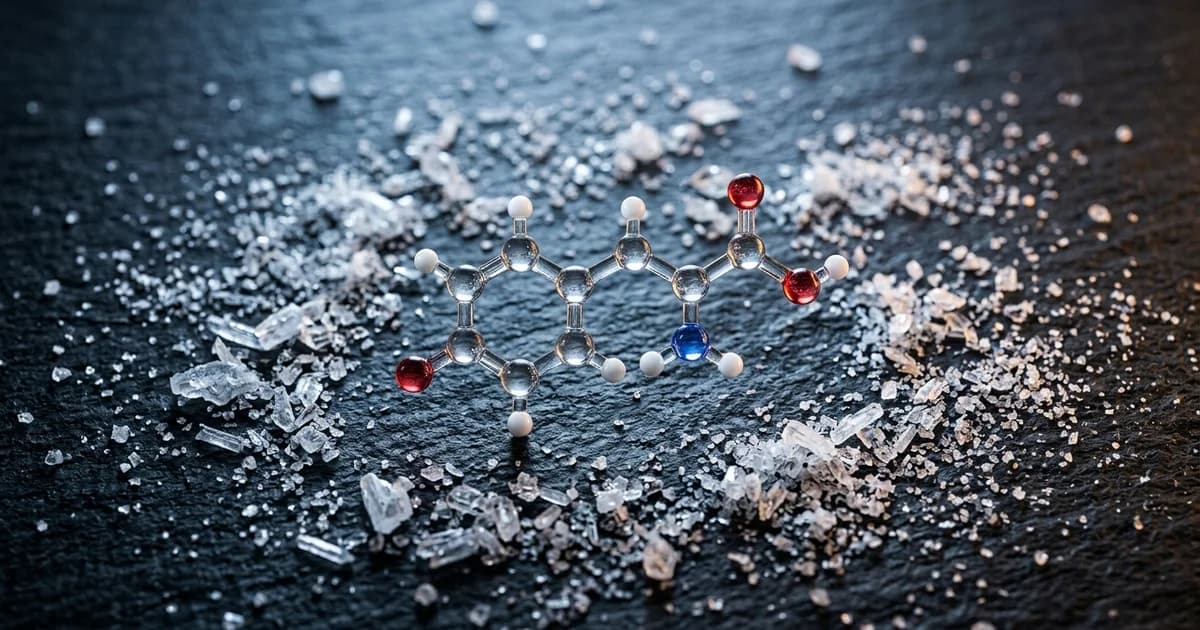
L-tyrosine is the biochemical building block your body converts into dopamine and norepinephrine. That single fact drives every other benefit on this list.
Here is the pathway in plain terms. Tyrosine becomes L-DOPA, L-DOPA becomes dopamine, and dopamine converts into norepinephrine. Dopamine governs motivation, reward, and the ability to stay locked on a goal. Norepinephrine sharpens alertness and the stress response. Together they form the catecholamine system that powers focus when the pressure climbs.
Your brain regulates catecholamine production tightly, so swallowing tyrosine does not flood your system with dopamine. According to a review on Gowing Life, tyrosine likely acts as a "safety buffer" of building blocks that slows the depletion of these chemicals during stress rather than spiking them outright.
That is why tyrosine is not a feel-it-now compound. It works at the supply level. When demand outpaces production, the extra substrate keeps the assembly line running.
L-Tyrosine and Dopamine: Why the Effect Is Conditional
The l-tyrosine dopamine connection is real, but it only matters under specific conditions. This is the most misunderstood part of the science.
A widely cited review published in the Journal of Psychiatric Research reached a precise conclusion. The authors found that tyrosine is an effective enhancer of cognition, but only when neurotransmitter function is intact and dopamine or norepinephrine has been temporarily depleted.
Read that twice. If your dopamine is already humming along at baseline, extra tyrosine has nothing to fix. The factory has enough raw material. You will likely feel nothing.
But push the system into deficit through stress or fatigue, and the picture changes. The same review noted that the potential for treating clinical disorders is limited, because the benefit depends on having a working but temporarily strained system. Tyrosine refills a tank that stress has emptied. It does not build a bigger tank.
L-Tyrosine for Focus Under Stress: What the Research Shows
The case for l-tyrosine for focus is strongest under acute stress, and the data spans some unusually harsh conditions.
A military-focused rapid evidence assessment pooled 10 randomized and 4 non-randomized controlled trials. Every study showed a positive effect for mitigating cognitive stress, leading the authors to a cautious recommendation in tyrosine's favor.
What kinds of stress? The same body of work found that tyrosine reduced the impact of sleep deprivation, noise, extreme climates, and military training on memory and reasoning. These are exactly the moments when catecholamines drain fastest.
Working Memory in a Multitasking Environment
Multitasking is a precise stressor for the dopamine system, and tyrosine appears to help. In a study indexed on PubMed, tyrosine improved accuracy and reduced the frequency of list retrieval on a working-memory task during a demanding multiple-task battery, compared to placebo.
In other words, when subjects were juggling several jobs at once, the precursor helped them keep more in mind and lean less on crutches.
Cognitive Flexibility and Task Switching
Switching between tasks taxes the prefrontal cortex, which runs on dopamine. A task-switching study on PubMed tested tyrosine's effect on proactive versus reactive control, a standard measure of mental flexibility, and found that supplementation supported better switching performance in a double-blind, placebo-controlled design.
The pattern across all of this research is consistent. Tyrosine helps most when your brain is working hard enough to run its catecholamines low. This is tyrosine cognitive performance in its honest form: a tool for the hard days, not a daily lift.
L-Tyrosine and Stress Resilience
Beyond raw cognition, tyrosine shows promise for l-tyrosine stress outcomes, including how stressed you feel and how your body's stress markers respond.
A 2024 study on a virtual-reality active shooter drill examined L-theanine and L-tyrosine during an intense mental stress challenge. The researchers noted that these ingredients have been shown to reduce salivary stress biomarkers and support aspects of cognitive performance under stress.
The mechanism fits the theory. Norepinephrine drives the acute stress response, and tyrosine keeps its supply line stocked so the system does not crater mid-crisis. Some research outside the main reviews has also linked tyrosine to lower perceived stress during acute stressors.
This is the use case worth remembering. A high-stakes presentation, a night shift, a brutal exam block, a cold-weather event. These are tyrosine's home turf.
How L-Tyrosine Compares to Other Focus Ingredients
Tyrosine sits in a different lane from the stimulants and amino acids people usually compare it to. It is a substrate, not an accelerator. The table below maps where each common focus ingredient actually acts.
| Ingredient | How it works | Onset | Best for | The catch |
|---|---|---|---|---|
| L-Tyrosine | Refills dopamine and norepinephrine precursors | Slow, builds over 30 to 60 min | Cognitive load under acute stress | No effect if you are not depleted |
| Caffeine | Blocks adenosine, raises alertness | 30 to 45 min oral | Energy, vigilance, mood | Tolerance and crash potential |
| L-Theanine | Promotes calm focus, smooths caffeine | 30 to 60 min | Taking the edge off stimulants | Subtle on its own |
| Methylliberine (Dynamine) | Fast-acting purine alkaloid, supports energy and focus | Fast | Quick, clean lift | Best stacked, not solo |
| Theacrine (TeaCrine) | Longer-acting purine alkaloid, resists tolerance | Slow and sustained | Extended focus windows | Subtle alone |
| Roon (4-ingredient sublingual pouch) | Caffeine, L-theanine, Dynamine, and TeaCrine absorbed under the tongue | 5 to 10 min | 6 to 8 hours of sustained focus, no jitters, no crash | Works on the adenosine axis, not the precursor axis |
The honest takeaway: tyrosine and a caffeine-based stack solve different problems. One refills depleted raw materials. The other works on the adenosine system that governs alertness. They are not rivals. They are tools for different failure modes.
If you want a deeper look at the fast-onset side of that equation, our breakdowns of how caffeine and L-theanine work together and why sublingual absorption changes onset speed cover the other half of the focus puzzle.
How to Use L-Tyrosine (Dosing and Timing)
Research doses are high, and that surprises most first-time users. Many of the strongest studies used 100 to 150 mg per kg of body weight, which works out to several grams for an average adult.
Per Healthline's review of the evidence, tyrosine has been used safely at around 150 mg per kg of body weight per day for up to three months. Lower doses in the 500 mg to 2 g range are common in real-world use and may still support alertness for some people.
Timing matters more than with most ingredients. Take it on a relatively empty stomach, since other amino acids compete with tyrosine for transport into the brain. Roughly 30 to 60 minutes before a known stressor is the standard window.
A few practical notes:
- Match the dose to the demand. Save it for genuinely hard sessions, not casual focus.
- Skip it on easy days. If you are not depleted, you are unlikely to feel anything.
- Mind the interactions. Tyrosine affects catecholamines, so anyone on MAOIs, thyroid medication, or stimulant prescriptions should talk to a doctor first.
Conclusion
L-tyrosine is one of the few focus ingredients with an honest, specific job description. It refills the dopamine and norepinephrine precursors your brain burns through when stress, fatigue, and heavy cognitive load stack up.
That precision is its strength and its limit. The research consistently shows benefits during short-term, high-demand, high-stress situations, and little to nothing when your neurotransmitter supply is already topped off. It is a substrate, not a stimulant, so the experience is quiet by design.
Used at the right moment, before a hard exam block, a night shift, or a high-pressure performance, tyrosine helps the system hold its line. Used as a daily pick-me-up, it mostly does nothing. Match the tool to the problem and the science works for you.
Frequently Asked Questions
What is the main benefit of L-tyrosine?
The primary benefit is supporting cognitive performance during acute stress. Tyrosine is the precursor your brain uses to make dopamine and norepinephrine, and a Journal of Psychiatric Research review concluded it enhances cognition specifically when those chemicals have been temporarily depleted by stress or heavy mental load. On a calm, well-rested day, you likely will not notice much, because your brain already has enough raw material.
Does L-tyrosine actually increase dopamine?
It provides the raw material for dopamine, but it does not force a spike. Your brain regulates catecholamine production tightly, so tyrosine acts more like a stocked supply shelf than an accelerator. The effect on dopamine becomes meaningful mainly when demand is high and supply is running low, such as during sleep deprivation, multitasking, or intense stress.
How long does L-tyrosine take to work?
Tyrosine is not a fast-onset compound you can feel in minutes. It needs to be absorbed and converted, so most people take it 30 to 60 minutes before a demanding task or stressor. Because it works at the supply level rather than as a stimulant, the effect is subtle and shows up as steadier performance rather than a noticeable rush.
What is the right dose of L-tyrosine?
Many of the strongest studies used high doses around 100 to 150 mg per kg of body weight, which is several grams for an average adult. Healthline reports it has been used safely at roughly 150 mg per kg per day for up to three months. Smaller real-world doses of 500 mg to 2 g are common and may still support alertness. Take it on a relatively empty stomach for best absorption.
Is L-tyrosine a stimulant?
No. Tyrosine does not block adenosine or directly raise alertness the way caffeine does. It is an amino acid that supplies the precursors for dopamine and norepinephrine. That makes its effect quiet and conditional, which is why people expecting a stimulant-style buzz are often underwhelmed. It supports the system rather than overriding it.
Can I take L-tyrosine with caffeine?
Many people do, and they target different systems. Tyrosine refills neurotransmitter precursors, while caffeine works on the adenosine pathway that governs alertness. Because they act on separate mechanisms, they can complement each other. If you take prescription stimulants, thyroid medication, or MAOIs, check with a doctor first, since tyrosine influences catecholamine activity.
Who benefits most from L-tyrosine?
People facing short-term, high-stress, high-demand situations see the clearest benefit. Think night-shift workers, students in exam season, and anyone performing under cold, noise, sleep loss, or time pressure. The research showed tyrosine reduced the cognitive impact of exactly these stressors. People living low-stress, well-rested lives tend to notice little because their precursor levels are not depleted.
Where Tyrosine Ends and a Fast Focus Stack Begins
Tyrosine is an "under stress" tool. It refills depleted dopamine and norepinephrine precursors so your thinking holds during the hard hours. That is a substrate strategy, and it is genuinely useful for night shifts, exam blocks, and high-pressure events. It is also slow, conditional, and silent when you are already rested.
Roon solves the other half of the focus problem. Instead of working on the precursor supply, it works on the adenosine and caffeine axis with a fast sublingual onset. Each pouch carries 80 mg caffeine, 60 mg L-theanine, 25 mg methylliberine (Dynamine), and 5 mg theacrine (TeaCrine), absorbed under the tongue for a 5 to 10 minute onset and 6 to 8 hours of sustained focus with no jitters, no crash, and no tolerance buildup.
To be clear, Roon does not contain tyrosine and is not a substitute for it. If your problem is precursor depletion under stress, tyrosine is the right lever. If your problem is getting locked in fast and staying there for a long session, try Roon as the front end of that stack.
Written by Roon Team