L-Theanine vs L-Threonate
Roon Team
L-Theanine vs L-Threonate: Which One Actually Improves Your Brain?
They sound almost identical. They show up in the same supplement aisles. And if you've ever Googled "l theanine vs l threonate," you've probably walked away more confused than when you started. That's because most comparison articles treat these two compounds like interchangeable brain pills. They aren't.
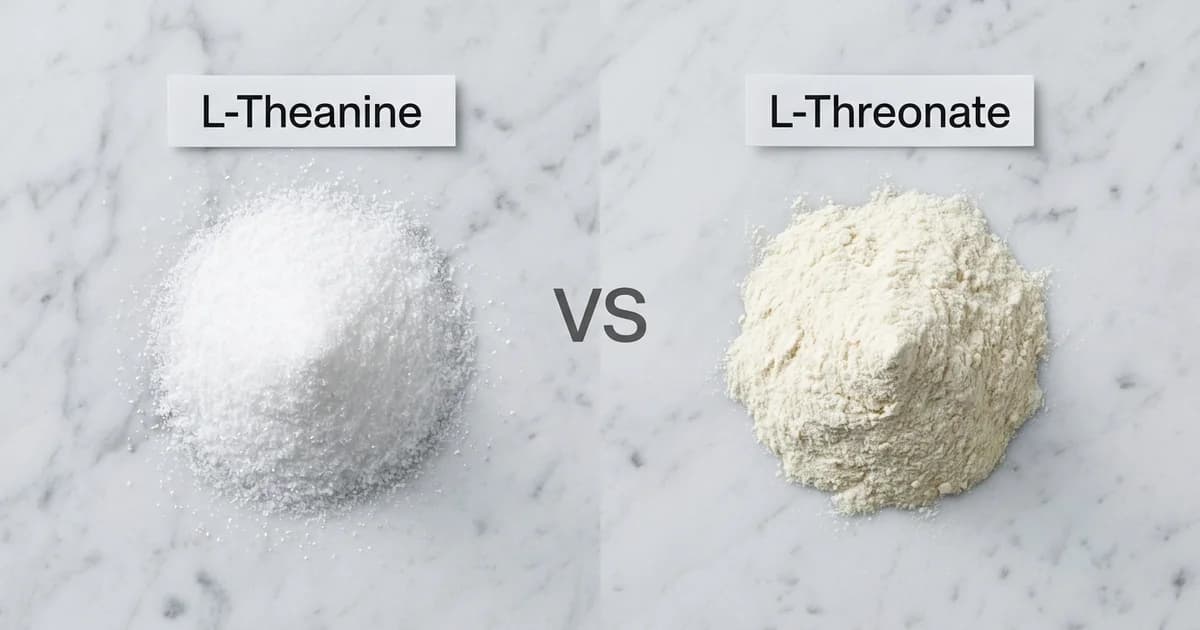
L-Theanine is an amino acid from tea leaves. L-Threonate is a metabolite of vitamin C that's bonded to magnesium. They work through entirely different mechanisms, target different neurotransmitter systems, and serve different purposes. Choosing between them in the l theanine vs l threonate debate depends on what you actually need your brain to do.
Here's the breakdown.
Key Takeaways for L Theanine vs L Threonate
- L-Theanine promotes calm focus by boosting alpha brain waves and modulating GABA, dopamine, and serotonin. L-Theanine works within 30 to 60 minutes.
- Magnesium L-Threonate raises magnesium levels in the brain to support synaptic density and long-term memory. L-Threonate takes weeks of consistent dosing.
- They solve different problems: L-Theanine is for daily focus and stress resilience. L-Threonate is for long-term cognitive maintenance.
- They can be stacked together without conflict, but they are not substitutes for each other.
What Is L-Theanine?
L-Theanine (gamma-glutamylethylamide) is an amino acid found almost exclusively in Camellia sinensis, the tea plant. L-Theanine is the reason green tea can contain caffeine yet still feel calming. The compound crosses the blood-brain barrier and starts affecting brain chemistry within about 30 minutes of ingestion.
The mechanism is well documented. L-Theanine increases brain levels of serotonin, dopamine, and GABA, an inhibitory neurotransmitter with calming effects. L-Theanine also has affinity for glutamate receptors, which means it can modulate excitatory signaling without shutting it down entirely.
The result is a mental state that neuroscientists describe as "relaxed alertness." L-Theanine increases alpha brain wave activity, which is associated with a state of wakeful relaxation. Alpha waves are the electrical signature of a brain that's focused but not stressed. Think of the difference between frantically cramming for an exam and calmly working through a problem you understand. That's the alpha wave shift.
What the Research Says About L-Theanine
The clinical evidence for L-Theanine is broad and consistent. A 2024 systematic review and meta-analysis in the Journal of Clinical Medicine examined randomized placebo-controlled trials and found that L-Theanine in its pure form at a daily dose of 200 to 400mg reduced stress and anxiety in people under acute stress.
A 2019 randomized controlled trial published in Nutrients tested 200mg of L-Theanine daily for four weeks in healthy adults. The results showed decreased scores on the Self-rating Depression Scale, State-Trait Anxiety Inventory, and Pittsburgh Sleep Quality Index after L-Theanine administration. Sleep got better. Stress responses dropped. And this was at a modest dose.
The focus angle in the l theanine vs l threonate comparison gets even more interesting when you pair L-Theanine with caffeine. A study published in Nutritional Neuroscience found that 97mg of L-Theanine in combination with 40mg of caffeine helped participants focus attention during a demanding cognitive task. That's not a megadose of either compound. It's roughly what you'd get from two cups of green tea, concentrated.
A 2025 crossover study in PMC took things further, testing a high-dose L-Theanine and caffeine combination in sleep-deprived young adults. The evidence suggests that the L-Theanine and caffeine combination enhances attentional focus by suppressing mind wandering and deviation of attention to distracters.
The pattern across the literature is consistent, reflecting the strong L-Theanine nootropic evidence base: L-Theanine boosts alpha-wave activity and improves attention-switching accuracy while preserving (and often enhancing) the cognitive benefits of stimulation.
What Is Magnesium L-Threonate?
Magnesium L-Threonate is a chelated form of magnesium, meaning elemental magnesium is bonded to L-threonic acid, a metabolite of vitamin C. The compound was developed specifically to raise magnesium concentrations in the brain.
Most magnesium supplements (citrate, oxide, glycinate) do a fine job of raising serum magnesium levels. But the brain is picky about what it lets through the blood-brain barrier. Magnesium L-Threonate is a unique compound that is efficiently absorbed due to the bonding of threonic acid, a sugar compound derived from vitamin C. The threonic acid component appears to use glucose transporters to ferry magnesium into neural tissue.
Once inside the brain, the extra magnesium supports synaptic plasticity. L-Threonate modulates intraneuronal magnesium concentration, which regulates structural and functional synapse density. In plain terms: more available magnesium in neurons means better communication between brain cells, which matters for learning and memory formation.
What the Research Says About Magnesium L-Threonate
A 2022 double-blind, placebo-controlled study published in Nutrients tested a Magtein (magnesium L-Threonate) based formula in 109 healthy Chinese adults aged 18 to 65. After 30 days, the scores for portrait feature memory and memory quotient in the Magtein group were higher compared to the placebo group (p < 0.001). The effect was dose-dependent with age: older participants saw the largest improvements.
A 2024 randomized controlled trial published in Sleep Medicine X examined magnesium L-Threonate supplementation in adults with self-reported sleep problems. Magnesium L-Threonate is a promising intervention due to its brain bioavailability and effects on cognition, memory, and mood. The researchers investigated its supplementation on sleep quality and daily function in eighty adults aged 35 to 55.
Research in animal models has gone further. A 2024 paper in Neural Regeneration Research found that magnesium L-Threonate treatment improved cognition and reduced oxidative stress and inflammation in a double-transgenic Alzheimer's disease mouse model. Human trials for neurodegenerative applications are still in early stages, but the preclinical data is compelling.
L Theanine vs L Threonate: A Direct Comparison
Here's where the confusion clears up. These two compounds operate on completely different timescales, through different mechanisms, for different goals.
| Feature | L-Theanine | Magnesium L-Threonate |
|---|---|---|
| Source | Amino acid from tea leaves | Magnesium bonded to threonic acid (vitamin C metabolite) |
| Primary mechanism | Modulates GABA, dopamine, serotonin; boosts alpha waves | Raises brain magnesium; supports synaptic density |
| Onset | 30 to 60 minutes | 2 to 4 weeks of consistent dosing |
| Best for | Focus, calm alertness, stress resilience | Long-term memory, learning, cognitive maintenance |
| Typical dose | 100 to 200mg per day | 1,500 to 2,000mg per day (yielding ~144mg elemental Mg) |
| Works acutely? | Yes | No |
| Pairs well with caffeine? | Yes, extensively studied | No direct pairing studied |
| Side effects | Rare; mild at typical doses | Possible drowsiness, headaches, GI discomfort |
When to Choose L-Theanine in the L Theanine vs L Threonate Decision
Pick L-Theanine if your primary goal is daily cognitive performance. If you need to focus during a work session, stay composed during a high-pressure meeting, or take the edge off caffeine without losing the energy, L-Theanine is the better tool. L-Theanine works fast, it's well-tolerated, and the research on its pairing with caffeine is strong.
L-Theanine is also the better option if you're sensitive to stimulants. L-Theanine doesn't sedate you. It recalibrates the stress response so your brain can operate in the zone between "wired" and "tired." The fact that L-Theanine modulates multiple neurotransmitter systems (GABA, dopamine, serotonin) without directly agonizing any single receptor is what makes it so well-tolerated across different body types and sensitivities.
Typical effective doses range from 100 to 200mg. You'll feel it within 30 to 60 minutes, and the effects last a few hours. No loading phase required. No cycling necessary.
When to Choose Magnesium L-Threonate
Pick Magnesium L-Threonate if you're playing the long game. If your concern is age-related cognitive decline, memory maintenance, or you suspect your magnesium levels are low (and statistically, there's a good chance they are), L-Threonate addresses a structural deficit. L-Threonate is not something you take before a meeting. It's something you take every day for months to build a stronger foundation.
The dosing is also different. Most Magnesium L-Threonate supplements recommend 1,500 to 2,000mg per day, which delivers roughly 144mg of elemental magnesium. That's a meaningful contribution to your daily magnesium needs, but the real value isn't the magnesium quantity. It's where that magnesium ends up: inside your neurons, supporting the synaptic connections that form and retrieve memories.
One practical note: many people take Magnesium L-Threonate in the evening because of its potential sleep-supporting effects. This makes L-Threonate a natural complement to a morning L-Theanine and caffeine stack.
The two aren't competitors in the l theanine vs l threonate comparison. They're addressing different layers of the same system. One tunes the signal. The other strengthens the hardware.
Can You Take Both?
Yes. There's no known interaction between L-Theanine and Magnesium L-Threonate, and their mechanisms don't overlap in ways that would cause problems. Some people stack both: L-Theanine daily for acute focus and stress management, Magnesium L-Threonate nightly for sleep quality and long-term brain health.
The only consideration is cost. Magnesium L-Threonate supplements tend to run more expensive than other magnesium forms because the chelation process is patented (sold under the brand name Magtein). L-Theanine is widely available and affordable.
The Bottom Line on L Theanine vs L Threonate
The "which is better" framing misses the point. L-Theanine and Magnesium L-Threonate solve different problems, operate on different timescales, and target different parts of your neurochemistry.
If you want sharper focus today, L-Theanine wins the l theanine vs l threonate matchup. The research is strong, the onset is fast, and the pairing with caffeine has been validated across multiple controlled trials. If you want to protect your memory over the next decade, Magnesium L-Threonate has a stronger case, with growing evidence for its ability to raise brain magnesium and support synaptic health. If you can do both, do both.
But for most people weighing l theanine vs l threonate, the immediate bottleneck isn't long-term synaptic density. It's getting through the afternoon without losing focus, reaching for another espresso, or crashing into brain fog. That's the problem L-Theanine was built for, especially when it's paired with a low dose of caffeine.
Roon puts that pairing into a single sublingual pouch: 80mg of caffeine paired with 60mg of L-Theanine, plus theacrine and methylliberine for sustained energy without the crash. No nicotine. No jitters. Just 6 to 8 hours of clean, even focus. If L-Theanine is the compound that fits your needs, Roon is one of the simplest ways to get it into your daily routine.