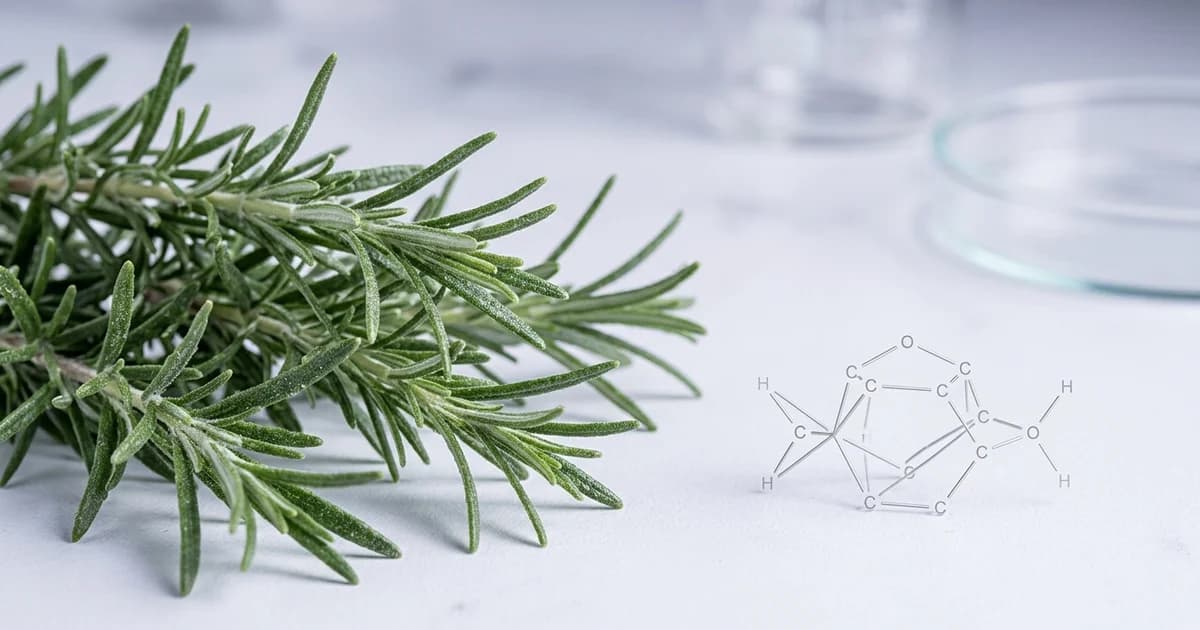
Rosemary and 1,8-Cineole: Can the Smell of an Herb Sharpen Your Mind?
The idea that rosemary for memory is more than folklore has a surprisingly clean evidence trail. Greek scholars wore rosemary sprigs in their hair while studying. Shakespeare's Ophelia called it the herb "for remembrance." Centuries later, a team of psychologists put that tradition on a lab bench and watched people's test scores move.
The herb itself is not the active part of this story. The molecule is. A compound called 1,8-cineole appears to cross from your nose into your blood, and the more of it people absorb, the better they tend to perform on certain mental tasks.
That is a strong claim, so let's look at what the data actually shows, where the hype outruns the science, and why the route the molecule takes matters as much as the molecule.
Key Takeaways
- Rosemary aroma's cognitive effect is linked to 1,8-cineole, a compound whose share of rosemary essential oil varies widely by chemotype, from roughly 15% to over 50%.
- In a controlled study, higher blood levels of 1,8-cineole correlated with faster and more accurate cognitive performance.
- Real-world effects are modest, in the range of a few percent, not the viral "75% memory boost" you may have seen online.
- One proposed mechanism: 1,8-cineole may slow the breakdown of acetylcholine, a neurotransmitter tied to memory.
- The aroma route works because inhaled molecules reach the blood directly, skipping the gut.
What "Rosemary for Memory" Actually Means
Most of the credible research here comes from one lab. Dr. Mark Moss and colleagues at Northumbria University in England ran a series of studies on rosemary aroma and cognition through the 2010s.
Their setup was deliberately simple. They diffused rosemary essential oil into a testing room, then had volunteers complete memory and attention tasks. A control group did the same tasks in an unscented room.
The headline result was not that rosemary makes you smarter. It was narrower and more interesting: the effect tracked a specific chemical in the bloodstream.
1,8-Cineole: The Molecule Doing the Work
1,8-cineole, also known as eucalyptol, is the compound most likely responsible for rosemary's effect on cognition. It is a volatile terpene, the same family of aromatic molecules that gives many plants their scent, and it evaporates readily into the air you breathe.
In the key 2012 paper, Moss and Lorraine Oliver measured 1,8-cineole directly in the blood of 20 participants after rosemary exposure. Performance on cognitive tasks was markedly related to the concentration of absorbed 1,8-cineole following exposure to rosemary aroma, with improved performance at higher concentrations.
The detail that makes this hard to dismiss is the speed-accuracy question. These effects were found for both speed and accuracy outcomes, indicating that the relationship is not describing a speed-accuracy trade off. In plain terms, people did not get faster by getting sloppier. They got both faster and more correct.
There was a smaller effect on mood, too. The relationships between 1,8-cineole levels and mood were less pronounced, but did reveal a marked negative correlation between change in contentment and plasma 1,8-cineole levels.
How Could a Smell Change a Blood Test?
This is the part people skip, and it matters. When you inhale rosemary aroma, you are not just smelling it. You are dosing yourself.
Volatile compounds like 1,8-cineole are small and fat-soluble. They pass across the thin tissue of the nasal passages and lungs and enter the bloodstream directly. From there they can reach the brain.
The Moss lab was careful not to overclaim the mechanism. Why and how rosemary has this effect is still up for debate; it could be that aromas affect electrical activity in the brain, or that pharmacologically active compounds can be absorbed when people are exposed.
The Acetylcholine Hypothesis
One leading explanation connects cineole to acetylcholinesterase, an enzyme that breaks down the neurotransmitter acetylcholine. Acetylcholine is central to learning and memory, and many memory-supporting drugs work by slowing its breakdown.
If 1,8-cineole inhibits that enzyme even mildly, more acetylcholine stays available in the synapse. That is a plausible biochemical route from "smelled an herb" to "remembered more words," and it lines up with the dose-dependent pattern in the blood data. It remains a hypothesis, not a settled fact.
How Big Is the Effect, Really?
Here is where you should turn down the volume on the internet. You have probably seen a post claiming rosemary boosts memory by 75%. That number is fiction.
Fact-checkers traced the viral claim and found no study supporting it. The lead researcher, Mark Moss, said a newspaper had dropped a decimal point: the real figure was 7.5%, not 75%. The 2013 study with 66 adults showed only about 7% improvement in the rosemary-scented room, far below the viral claim, and that research was presented at a conference, not in a peer-reviewed journal.
The children's data lands in a similar range. In a 2017 study of 40 children, those exposed to rosemary had, on average, an improvement of five to seven percent in test scores. A few percent is a real, measurable nudge. It is not a personality transplant.
The honest summary: rosemary aroma appears to give a small, reproducible lift to working and prospective memory, with the strongest signal coming from how much 1,8-cineole gets into your blood.
Rosemary Aroma vs. Other Cognitive Approaches
Aroma is one delivery method among several. Here is how rosemary essential oil for the brain stacks up against more familiar focus tools, judged honestly on what each one does and does not do.
| Approach | Active compound | Onset | Effect size / duration | Best for |
|---|---|---|---|---|
| Rosemary aroma | 1,8-cineole | Minutes (inhaled) | Small (a few %), lasts during exposure | A passive, ambient memory nudge |
| Coffee | Caffeine | 30-45 min (oral) | Moderate, 3-5 hrs, possible crash | A quick stimulant hit |
| L-theanine + caffeine | Both | 30-45 min (oral) | Moderate, smoother focus | Calm, sustained attention |
| Roon pouch | 80mg caffeine, 60mg L-theanine, 25mg Dynamine, 5mg TeaCrine | 5-10 min (sublingual) | Sustained, 6-8 hrs, no crash | Deep work without jitters |
The point of the table is not that one wins. Rosemary aroma and an engineered focus stack are answering different questions. One is a gentle environmental cue. The other is a dosed, fast-onset tool for a work block.
Should You Actually Diffuse Rosemary While You Work?
If you enjoy the scent, there is little downside and a plausible small upside. Add a few drops of rosemary essential oil to a diffuser before a study session or a desk-heavy afternoon and see how you respond.
Two caveats. The effect is subtle, so do not expect to feel it the way you feel a coffee. And essential oils are concentrated, so keep diffusion sensible, especially around kids, pets, or anyone with respiratory sensitivity.
Treat it as a low-cost experiment on your own attention. The science says the upside is modest but real.
Conclusion
Rosemary's reputation as the herb of remembrance turns out to have a molecule behind it. 1,8-cineole crosses from breath to blood, and the amount that gets there tracks with how well people perform on memory and attention tasks, in both speed and accuracy.
The real lesson is bigger than one herb. How a compound enters your body shapes how fast and how reliably it acts. Inhaled aromatics reach the bloodstream in minutes because they never pass through the digestive tract, where the liver can break a large share of a compound down before it ever does anything.
Rosemary is a small, pleasant example of a serious pharmacological principle. The delivery route is part of the dose.
Frequently Asked Questions
Does smelling rosemary really improve memory?
The evidence points to a small, real effect. In controlled work from Northumbria University, higher blood levels of 1,8-cineole after rosemary exposure correlated with better and faster cognitive performance. The improvement in real-world tests was modest, often a few percent, not the dramatic numbers that circulate online. It is a gentle nudge to working and prospective memory, not a substitute for sleep or study.
What is 1,8-cineole?
1,8-cineole, also called eucalyptol, is an aromatic terpene and one of the main components of rosemary essential oil, though its share varies widely by chemotype, from roughly 15% to over 50%. It is small and fat-soluble, so it evaporates into the air and can cross from your nose and lungs into your bloodstream. Researchers consider it the most likely active compound behind rosemary aroma's effect on cognition.
Is the "rosemary boosts memory by 75%" claim true?
No. Fact-checkers traced that viral figure and found no study supporting it. The actual research, presented at a conference, showed roughly a 7% improvement in adults tested in a rosemary-scented room. The 75% number appears to be an internet invention with no basis in the published data.
How does 1,8-cineole affect the brain?
The leading hypothesis involves acetylcholine, a neurotransmitter tied to memory and learning. 1,8-cineole may mildly slow acetylcholinesterase, the enzyme that breaks acetylcholine down, leaving more available in the brain. This mechanism is plausible and consistent with the dose-dependent blood data, but it has not been fully confirmed.
How long does the effect last?
The current evidence is tied to active exposure. Cognitive benefits appear while people are breathing the aroma and 1,8-cineole is present in the blood. There is no good data showing a lasting boost after the scent is gone, so think of it as a real-time ambient effect rather than a permanent change.
Can children use rosemary aroma for studying?
A 2017 study found that children in a rosemary-scented room scored higher on working memory tasks, with an average improvement of five to seven percent. The effect was modest and the aroma is generally well tolerated. Keep diffusion light and ventilated, and check for any respiratory sensitivity before making it a habit.
The Delivery Route Is the Real Headline
Rosemary's quiet trick is not the herb. It is the path the molecule takes. 1,8-cineole works partly because inhaling it sends it straight into the bloodstream, skipping the gut and the first-pass liver metabolism that quietly disposes of so much of what we swallow.
Roon is built on the same principle from a different angle. It is a sublingual pouch, so its four ingredients (80mg caffeine, 60mg L-theanine, 25mg Dynamine, and 5mg TeaCrine) absorb through the tissue under your lip rather than down through your stomach. That is why the onset lands in 5 to 10 minutes and the focus holds for 6 to 8 hours with no jitters and no crash.
To be clear, Roon is not aromatherapy and it is not a replacement for sleep, training, or a diffuser you happen to love. It is a dosed focus tool that respects the same lesson rosemary teaches: the route matters as much as the molecule. If that idea appeals to you, try Roon on your next deep-work block and judge it by the only test that counts, your own attention.
Written by Roon Team