L-Theanine vs Ashwagandha: Which Is Better for Focus, Calm
Roon Team
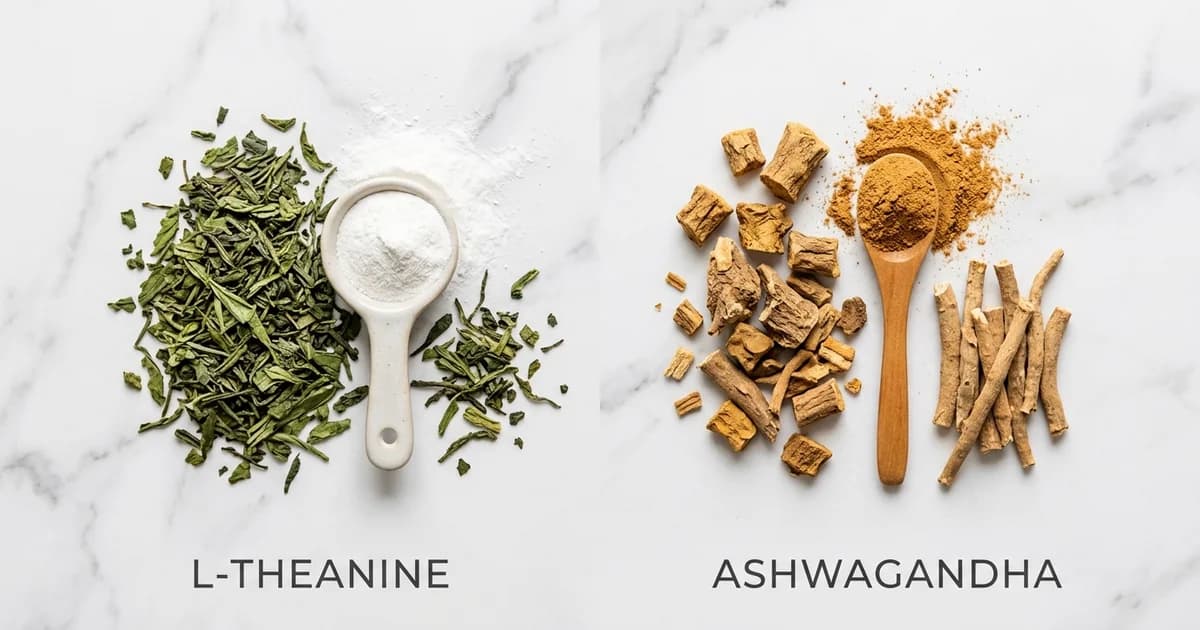
L-Theanine vs Ashwagandha: Which Is Better for Focus, Calm, and Daily Performance?
You're staring at two bottles on the shelf. One says L-theanine. The other says ashwagandha. Both promise some version of "calm focus" and "stress relief." But they work in completely different ways, on completely different timelines, and for completely different use cases. The l theanine vs ashwagandha debate isn't really a debate at all once you understand the science behind each compound.
One is a fast-acting amino acid from tea leaves. The other is a slow-building adaptogenic root from traditional Ayurvedic medicine. Choosing between l theanine vs ashwagandha depends on what you actually need: immediate cognitive clarity or long-term stress resilience.
Here's how they compare, head to head.
Key Takeaways for L Theanine vs Ashwagandha
- L-theanine works in 30 to 60 minutes and promotes calm focus by increasing alpha brain wave activity. Ashwagandha takes 4 to 8 weeks of daily use to show measurable effects.
- L-theanine pairs exceptionally well with caffeine for cognitive performance. Ashwagandha does not.
- Ashwagandha targets the stress hormone cortisol through the HPA axis. L-theanine modulates neurotransmitters like GABA and serotonin directly.
- L-theanine has a cleaner safety profile with FDA GRAS status. Ashwagandha carries potential concerns around thyroid function and liver health.
- For daily performance and on-demand focus, L-theanine is the stronger choice. For chronic, baseline stress, ashwagandha has a role.
What Is L-Theanine?
L-theanine is an amino acid found almost exclusively in tea leaves (Camellia sinensis). L-theanine is the reason a cup of green tea feels different from a shot of espresso, even when the caffeine content is similar. That calm alertness you get from tea? L-theanine is doing most of that work.
At the neurochemical level, L-theanine crosses the blood-brain barrier and influences several neurotransmitter systems. L-theanine increases GABA (your brain's primary inhibitory neurotransmitter), modulates serotonin and dopamine levels, and, most distinctly, boosts alpha brain wave activity.
Alpha waves are the electrical signature of relaxed attention. They show up when you're focused but not stressed, present but not anxious. A 2008 review published on PubMed confirmed that L-theanine increases activity in the alpha frequency band, indicating that l theanine vs ashwagandha differs at the very level of brain wave modulation.
A 2021 randomized, placebo-controlled crossover study published in PMC found that a single dose of L-theanine produced measurable changes in alpha wave activity, reduced salivary cortisol, and lowered self-reported anxiety compared to placebo, all within one hour.
That speed matters. You don't need to take L-theanine for weeks and hope it accumulates. L-theanine works the same day you take it.
What Is Ashwagandha?
Ashwagandha (Withania somnifera) is an adaptogenic herb with roots in Ayurvedic medicine stretching back thousands of years. Its primary claim to fame in modern research is cortisol reduction.
The mechanism centers on the hypothalamus-pituitary-adrenal (HPA) axis, the system your body uses to regulate the stress response. Ashwagandha appears to moderate this axis, lowering the amount of cortisol your body produces under chronic stress.
A 2025 systematic review and meta-analysis published in BJPsych Open analyzed multiple randomized controlled trials and found that ashwagandha supplementation produced a statistically significant reduction in cortisol levels and Perceived Stress Scale scores at 8 weeks of treatment.
A separate 2019 study in PMC also showed cortisol reduction with ashwagandha, noting that the stress-relieving effects likely occur through HPA axis moderation.
But here's the practical reality: those results came after weeks of daily supplementation. Most clinical trials studying ashwagandha use 6 to 8 week protocols. According to the NIH Office of Dietary Supplements, the studies that found benefits for stress and anxiety all used treatment periods of 6 to 8 weeks. You won't feel ashwagandha kick in on a Tuesday morning before a big presentation.
L Theanine vs Ashwagandha: The Full Comparison
Let's break l theanine vs ashwagandha down across the categories that actually matter for daily cognitive performance.
Speed of Action
This is the single biggest practical difference in the l theanine vs ashwagandha comparison.
L-theanine takes effect within 30 to 60 minutes. Multiple sources, including a report from Life Extension, confirm that L-theanine can promote brain waves associated with relaxed wakefulness within hours, while ashwagandha builds stress tolerance over several weeks of consistent use.
If you need focus now, L-theanine delivers. If you're playing a long game with chronic stress management, ashwagandha operates on a different schedule entirely.
Mechanism of Action in L Theanine vs Ashwagandha
| Feature | L-Theanine | Ashwagandha |
|---|---|---|
| Primary Target | Alpha brain waves, GABA, serotonin, dopamine | HPA axis, cortisol |
| Onset | 30-60 minutes | 4-8 weeks |
| Duration per dose | 4-6 hours | Cumulative (daily use required) |
| Type | Amino acid | Adaptogenic herb |
| Source | Tea leaves (Camellia sinensis) | Root of Withania somnifera |
L-theanine works by directly influencing neurotransmitter activity in the brain. L-theanine is a precision tool. Ashwagandha works by recalibrating your hormonal stress response over time. Ashwagandha is more of a systemic adjustment.
The Caffeine Question
This is where L-theanine pulls ahead for anyone who cares about daily performance.
L-theanine and caffeine together form one of the most well-studied nootropic combinations in existence. A study published on PubMed investigated the combination of 97 mg L-theanine and 40 mg caffeine and found improvements in cognitive performance and subjective alertness compared to placebo.
Another study from PubMed showed that the L-theanine and caffeine combination improved both speed and accuracy on attention-switching tasks, while also reducing susceptibility to distracting information during memory tasks.
The pairing works because caffeine provides stimulation while L-theanine promotes alpha-wave activity tied to calm alertness, improving attention accuracy and reducing tiredness beyond what caffeine delivers alone. You get the energy without the side effects.
Ashwagandha doesn't have this relationship with caffeine. There's no comparable body of evidence showing that ashwagandha enhances caffeine's cognitive benefits in real time. In fact, because ashwagandha can have mild sedative properties, pairing ashwagandha with a stimulant creates a muddier effect profile. You're pushing the gas and the brake at the same time, with no clear evidence the combination produces anything useful for acute performance.
If your morning routine involves coffee, an energy drink, or any other caffeine source, L-theanine is the natural complement. Ashwagandha is not.
Safety Profile in L Theanine vs Ashwagandha
L-theanine has FDA GRAS (Generally Recognized as Safe) status. L-theanine has been consumed in tea for centuries. Side effects in clinical research are essentially nonexistent at standard doses.
Ashwagandha's safety picture is more complicated. According to Examine.com, potential drawbacks include thyroid issues, liver toxicity, immune stimulation, and electrolyte imbalances, though large-scale confirmations of these effects are still limited.
The NIH fact sheet on ashwagandha notes that ashwagandha might affect thyroid function, may have adverse effects on the liver, and that experts advise against its use during pregnancy or in men with hormone-sensitive prostate cancer.
That doesn't mean ashwagandha is dangerous for everyone. But the l theanine vs ashwagandha safety gap does mean you should talk to a doctor before adding ashwagandha to your routine, especially if you have thyroid conditions or take medications. L-theanine simply doesn't carry those same flags.
Best Use Cases
Choose L-theanine if you want:
- Immediate calm focus for work, study, or creative tasks
- A daily performance edge without building tolerance
- A clean pairing with caffeine that reduces jitters and crash
- A supplement with minimal safety concerns
Consider ashwagandha if you want:
- Long-term support for chronic, ongoing stress
- Gradual cortisol management over weeks
- An adaptogenic approach to baseline anxiety (with medical guidance)
Tolerance and Long-Term Use
One underrated factor in the l theanine vs ashwagandha comparison: tolerance.
L-theanine does not appear to produce tolerance with regular use. You can take L-theanine daily for months and still get the same effect from the same dose. That's rare for any compound that influences brain chemistry.
Ashwagandha's long-term use profile is less clear. Most clinical trials run for 8 to 12 weeks. Data on what happens after six months or a year of continuous use is thin. Some practitioners recommend cycling ashwagandha (taking breaks every few months), partly because of the thyroid and hormonal concerns mentioned above.
For a compound you want to rely on every day, predictability matters. L-theanine delivers that.
Can You Take L-Theanine and Ashwagandha Together?
Yes. They target different systems, so there's no pharmacological conflict. Some people use L-theanine for daily, on-demand cognitive performance and ashwagandha as a longer-term adaptogenic baseline.
But if you're choosing one, the l theanine vs ashwagandha question comes back to timing and use case. For the person who needs to perform today, not six weeks from now, L-theanine is the obvious pick.
L Theanine vs Ashwagandha: The Bottom Line
The l theanine vs ashwagandha comparison isn't about which compound is "better" in some abstract sense. It's about what problem you're solving.
Ashwagandha is a slow-building, systemic tool for chronic stress. Ashwagandha has real science behind it, but it requires patience, daily commitment, and awareness of potential side effects.
L-theanine is fast, precise, and remarkably well-tolerated. L-theanine works within the hour, pairs beautifully with caffeine, and supports the kind of focused calm that actually translates to better output, whether you're writing code, prepping a pitch, or grinding through a four-hour study block.
For most people weighing l theanine vs ashwagandha, or other amino acid focus comparisons, to perform better on a daily basis, L-theanine is the more practical, more versatile choice.
Get Your L-Theanine the Easy Way
Roon is a zero-nicotine sublingual pouch built around L-theanine, paired with 80 mg of caffeine, theacrine, and methylliberine. Roon delivers the L-theanine and caffeine combination the research supports, in a format that absorbs in minutes, not the 30 to 60 minutes you'd wait with a capsule.
No water. No pills. No waiting around. Just place a pouch, and the focus follows.
Try Roon at takeroon.com.