L-Theanine vs L-Tyrosine
Roon Team
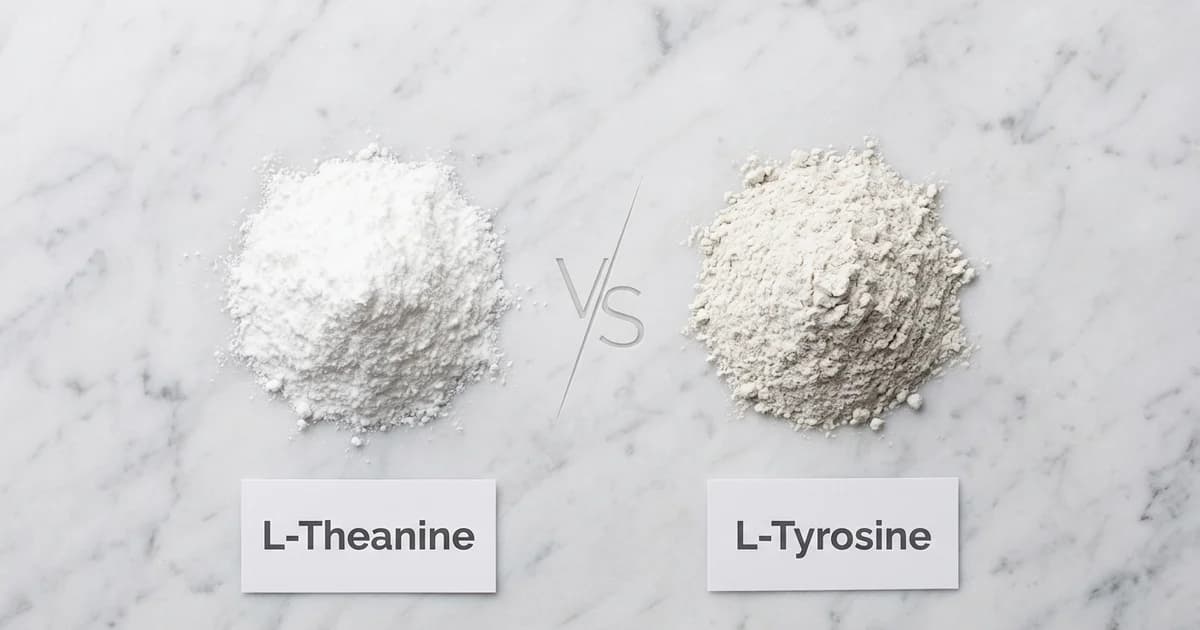
L-Theanine vs L-Tyrosine: Which One Actually Improves Your Focus?
You've narrowed your nootropic search down to two amino acids. Good. The l theanine vs l tyrosine debate is one of the most common in the cognitive performance space, and for good reason: both are well-studied, both are legal and accessible, and both claim to make your brain work better. But they do very different things through very different mechanisms.
Picking the wrong one won't hurt you. But it might waste your money and your time if the amino acid you choose doesn't match the problem you're actually trying to solve.
Here's the short version before we get into the science.
Key Takeaways for L Theanine vs L Tyrosine
- L-theanine promotes calm focus by increasing alpha brain wave activity and modulating GABA. It works well for daily, sustained cognitive performance.
- L-tyrosine is a dopamine and norepinephrine precursor that shines under acute stress, but shows limited benefits under normal conditions.
- A 2024 randomized controlled trial tested both head-to-head and found that L-tyrosine improved accuracy on cognitive tasks under stress, while L-theanine did not outperform placebo in that specific high-stress scenario.
- L-theanine pairs exceptionally well with caffeine. L-tyrosine does not have a comparable pairing partner.
- For most people weighing l theanine vs l tyrosine for reliable, everyday cognitive support, L-theanine is the stronger choice.
What L-Theanine Does to Your Brain
L-theanine is a non-protein amino acid found naturally in green and black tea (Camellia sinensis). It crosses the blood-brain barrier and gets to work within about 30 to 60 minutes.
Its primary mechanism involves increasing alpha brain wave activity, the electrical pattern your brain produces during states of relaxed alertness. Think of the mental state you're in during a good flow session: focused but not tense. That's alpha wave territory. A review published on ScienceDirect confirms that L-theanine increases these alpha waves, which are associated with relaxation and selective attention.
At the neurotransmitter level, L-theanine modulates the balance between GABA (your brain's primary inhibitory neurotransmitter) and glutamate (the primary excitatory one). L-theanine tips the scales slightly toward GABA without suppressing glutamate entirely. The result is reduced mental noise without sedation.
A randomized controlled trial published in PMC found that four weeks of L-theanine administration reduced stress-related symptoms, including improvements in sleep quality and reductions in state anxiety scores, in healthy adults. This wasn't a study on sick people. These were normal, functioning humans who simply performed better with L-theanine on board.
Another placebo-controlled study, also in PMC, showed that even a single dose of L-theanine reduced reaction time on attention tasks and increased correct answers on working memory tests in middle-aged and older subjects. The effect was measurable after a single administration, not weeks of loading.
What makes L-theanine unusual in the l theanine vs l tyrosine comparison is its consistency. L-theanine doesn't require a stressed or depleted state to produce effects. Whether you're having a calm morning or grinding through a deadline, the mechanism stays the same.
The typical effective dose sits between 100 and 200 mg. Doses up to 900 mg daily have been used safely for up to eight weeks in clinical settings, though most people don't need anywhere near that amount.
What L-Tyrosine Does to Your Brain
L-tyrosine is a non-essential amino acid, meaning your body already makes it from phenylalanine. L-tyrosine serves as the biochemical precursor to two catecholamine neurotransmitters: dopamine and norepinephrine.
The logic behind supplementing l-tyrosine is straightforward. When you're under stress, whether physical, psychological, or cognitive, your brain burns through dopamine and norepinephrine faster than usual. If the supply runs low, your focus, working memory, and decision-making degrade. Giving your brain extra tyrosine, the theory goes, keeps the production line running.
And under the right conditions, l-tyrosine works. A review published in the Journal of Psychiatric Research examined the available evidence and concluded that L-tyrosine supplementation can counteract cognitive decline caused by acute stress and neurotransmitter depletion. The key phrase there is "acute stress." Cold exposure, sleep deprivation, military training scenarios: these are the conditions where tyrosine has shown real benefits.
Here's the catch. According to research from PMC, L-tyrosine does not appear to enhance catecholamine release when neurons are firing at their normal, baseline rates. L-tyrosine only helps when your system is already depleted or under heavy demand. If you're sitting at your desk on a regular Tuesday, extra tyrosine may do very little for you.
The dosing is also less convenient. Examine.com notes that studies showing anti-stress benefits typically use 100 to 150 mg per kilogram of body weight, which translates to roughly 7 to 10 grams for an average adult. That's a substantial dose, and it needs to be taken about 60 minutes before the stressor.
Lower doses (500 to 2,000 mg) are more commonly used in consumer supplements, and some studies have tested in this range. But the strongest evidence for cognitive benefits under stress comes from the higher dosing protocols.
L Theanine vs L Tyrosine: The Head-to-Head Data
In 2024, researchers at Texas State University ran one of the few studies that directly compared l theanine vs l tyrosine. Published in the journal Stress, the randomized controlled trial assigned 80 subjects to receive either 200 mg of L-theanine, 2,000 mg of L-tyrosine, or a placebo before a virtual reality active shooter training drill followed by a Stroop challenge and mental arithmetic test.
The results were telling.
The L-tyrosine group showed fewer missed responses on the Stroop challenge compared to placebo, suggesting better sustained attention under acute stress. Neither L-theanine nor L-tyrosine affected physiological stress markers like salivary alpha-amylase, heart rate, or state-anxiety scores in this particular study.
L-theanine did not outperform placebo on the cognitive tests in this high-stress, acute scenario. But that doesn't mean L-theanine failed. It means the study tested a very specific type of stress (simulated active shooter drill) where the dopamine-replenishing properties of tyrosine had a natural advantage.
This is the core distinction in the l theanine vs l tyrosine debate. L-tyrosine is a rescue tool for acute cognitive stress. L-theanine is a daily performance optimizer.
The Caffeine Factor: Where L-Theanine Pulls Ahead in L Theanine vs L Tyrosine
One of L-theanine's most powerful properties has nothing to do with taking it alone. The real advantage appears when you combine L-theanine with caffeine.
A study published in Nutritional Neuroscience (PubMed) tested 97 mg of L-theanine with 40 mg of caffeine and found that the combination improved focus during demanding cognitive tasks in young adults. L-theanine sharpened what caffeine already does well (the alertness, the reaction speed, the sustained attention) while adding a layer of calm focus linked to increased alpha-wave brain activity.
A separate study from PMC found that combining L-theanine and caffeine produced effects on speed, semantic memory, and alertness that were not present when either compound was administered alone. The combination created something neither could achieve individually.
L-tyrosine has no equivalent pairing in the literature. L-tyrosine works, but it works alone, and only under specific conditions.
This matters when evaluating l theanine vs l tyrosine for a daily stack. L-theanine integrates into a routine. L-tyrosine waits on the shelf until you really need it.
L Theanine vs L Tyrosine Side-by-Side Comparison
| Factor | L-Theanine | L-Tyrosine |
|---|---|---|
| Primary mechanism | Increases alpha waves, modulates GABA/glutamate balance | Replenishes dopamine and norepinephrine |
| Best for | Daily calm focus, reducing mental noise, pairing with caffeine | Acute stress recovery, high-demand cognitive scenarios |
| Effective dose | 100–200 mg | 100–150 mg/kg bodyweight (7–10 g for most adults) |
| Onset | 30–60 minutes | 60 minutes |
| Works under normal conditions? | Yes | Limited evidence |
| Caffeine pairing | Strong, well-documented | Not established |
| Side effects | Minimal (mild headache or sleepiness in rare cases) | Generally well-tolerated; may interact with thyroid medications |
| Daily use suitability | Excellent | Situational |
Which One Should You Choose in the L Theanine vs L Tyrosine Debate?
The answer depends on what your day actually looks like.
Choose L-theanine if you want a reliable, low-dose compound that supports focus and calm across a normal workday. If you already drink coffee or use caffeine in any form, L-theanine becomes even more valuable because it directly improves how caffeine works in your brain. In the l theanine vs l tyrosine comparison, L-theanine is the better option for sustained, everyday cognitive performance.
Choose L-tyrosine if you regularly face acute, high-intensity cognitive demands: pulling all-nighters, performing under extreme pressure, or operating in physically and mentally depleting environments. L-tyrosine is a situational tool, not a daily supplement for most people.
Choose both if you want to cover all your bases. There's no known negative interaction between the two, and some people stack them. But if you're picking one in the l theanine vs l tyrosine matchup, L-theanine has the broader evidence base, the easier dosing, the caffeine combination benefits, and the better profile for daily use.
Get Your L-Theanine the Easy Way
Most people who try L-theanine end up taking it every day. The problem is that capsules are inconvenient, dosing loose powder is annoying, and remembering to take a supplement with your morning coffee adds one more step to an already crowded routine.
Roon solves that. Roon is a zero-nicotine sublingual pouch that delivers L-theanine alongside 80 mg of caffeine, theacrine, and methylliberine. You place it under your lip, and the active ingredients absorb directly through the oral mucosa. No water, no pills, no waiting.
The caffeine plus L-theanine combination in Roon reflects the same research-backed pairing shown to improve focus and alertness without jitters. With 80 mg of caffeine, comparable to a cup of coffee, smoothed by L-theanine and extended by methylliberine and theacrine, the pouch delivers 6 to 8 hours of sustained cognitive support with no crash and no tolerance buildup, so Roon fits into your day without you having to think about it.
If the l theanine vs l tyrosine decision has led you to L-theanine (and for most people, it should), Roon is the simplest way to take it.