L-Theanine Liquid: The Complete Guide to Forms, Dosing, and What Actually Works
Roon Team
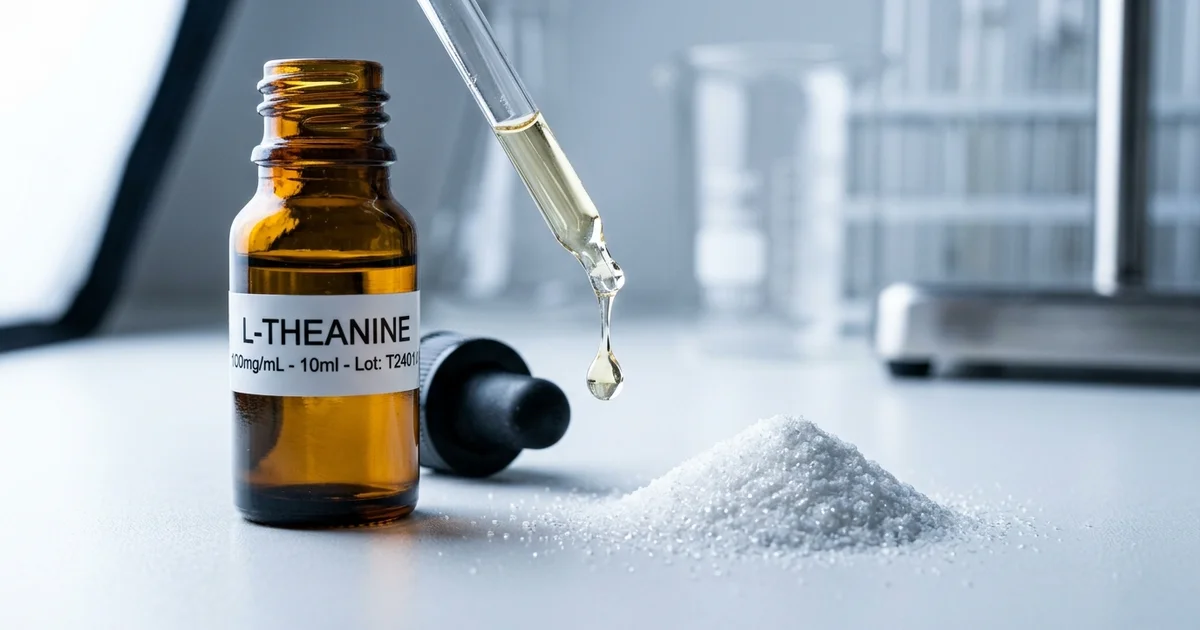
L-Theanine Liquid: The Complete Guide to Forms, Dosing, and What Actually Works
You already know L-theanine works. The amino acid found in green tea has decades of clinical research behind it, from promoting calm focus to smoothing out the rough edges of caffeine. But if you've started shopping for an l theanine liquid supplement, you've probably noticed the options are all over the place: tinctures, drops, liquid shots, flavored syrups. Some cost $10, others cost $40 for the same dose.
This guide breaks down everything you need to know about l theanine liquid, including how it compares to capsules and powder, what dosage the science actually supports, and whether the delivery format even matters as much as brands want you to think.
Key Takeaways:
- L theanine liquid absorbs faster than capsules because it skips the dissolution step, but the total amount absorbed is similar across forms.
- Clinical studies consistently use doses of 200 to 400 mg per day, regardless of format.
- The real advantage of l theanine liquid and sublingual delivery is speed of onset, not potency.
- L-theanine's benefits (alpha brain wave activity, stress reduction, focused calm) are well-documented across dozens of peer-reviewed studies.
What Is L-Theanine, and Why Does the L Theanine Liquid Form Matter?
L-theanine (technically N-ethyl-L-glutamine) is a non-protein amino acid found primarily in the tea plant Camellia sinensis and in some mushroom species. It was first discovered in 1949 as a constituent of green tea and has since become one of the most studied nootropic compounds available.
Here's what makes L-theanine interesting from a neurochemistry perspective. L-theanine crosses the blood-brain barrier and influences several neurotransmitter systems at once. Research published in the Journal of Herbal Pharmacotherapy found that it increases brain levels of serotonin, dopamine, and GABA while also interacting with glutamate receptors (AMPA, kainate, and NMDA). That combination is unusual. Most compounds that promote relaxation do it by sedating you. L-theanine promotes relaxation while maintaining alertness.
The form you take it in, whether that's l theanine liquid, capsule, powder, or something else entirely, determines one thing above all: how fast it reaches your bloodstream.
L Theanine Liquid vs. Capsules vs. Powder: An Honest Comparison
Every supplement brand selling l theanine liquid will tell you their format is superior. The truth is more nuanced than that.
Absorption Speed
Liquid supplements do have a genuine advantage in onset time. According to HealthyCell, L-theanine is water-soluble and absorbs readily in liquid form because there's no capsule shell or tablet matrix to break down first. You skip the dissolution step, which means the active compound reaches your intestinal lining faster.
Capsules, by comparison, need to dissolve in stomach acid before the L-theanine inside becomes available for absorption. This can add 15 to 30 minutes to the onset.
Total Bioavailability
Here's where the marketing gets ahead of the science. A study cited by WebMD (Scheid et al., published in the Journal of Nutrition, 2012) found that the kinetics of L-theanine uptake were comparable whether participants consumed it via capsules or through green tea. The total amount that makes it into your system is roughly the same. The difference is timing, not quantity.
Convenience and Shelf Life
L theanine liquid products typically need refrigeration after opening and have shorter shelf lives than dry forms. Powder and capsule forms of L-theanine remain stable for 2 to 3 years under proper storage conditions. Liquids can degrade faster, especially if they contain added ingredients like fruit extracts or sweeteners.
Here's a quick comparison:
| Factor | Liquid | Capsule | Powder |
|---|---|---|---|
| Absorption Speed | Fastest | Moderate | Fast (if dissolved) |
| Total Bioavailability | Standard | Standard | Standard |
| Convenience | Moderate (measuring required) | High (grab and go) | Low (weighing required) |
| Shelf Life | Shorter (6-12 months opened) | Long (2-3 years) | Long (2-3 years) |
| Taste | Varies (often flavored) | None | Mild umami |
| Cost Per Serving | Higher | Moderate | Lowest |
What Dose of L Theanine Liquid Actually Works?
This is where a lot of people get confused, partly because l theanine liquid products express doses in milliliters rather than milligrams, and partly because brands use wildly different concentrations.
The clinical evidence is clear on dosing. According to Healthline's review of the research, most studies use 200 to 400 mg of L-theanine per day, with 200 mg being the most common single dose in clinical trials. Examine.com confirms this range, noting that clinical studies typically use 100 to 400 mg daily.
When you're buying an l theanine liquid product, you need to check the milligrams per serving, not the volume. A product that delivers 200 mg in 2 mL is functionally identical to one that delivers 200 mg in a full tablespoon. The concentration varies, but the dose that matters is always measured in milligrams.
Dosing by Goal
The research supports slightly different doses depending on what you're after:
- Focused calm and stress reduction: 200 mg is the sweet spot for most people. A 2021 randomized, triple-blind, placebo-controlled study found that a single 200 mg dose of L-theanine produced measurable increases in alpha brain wave power and reduced salivary cortisol levels compared to placebo.
- Sleep support: 200 to 400 mg taken 30 to 60 minutes before bed. Healthline notes that research suggests L-theanine may improve sleep quality, though it works differently than sedatives.
- Pairing with caffeine: 100 to 200 mg of L-theanine combined with caffeine. A study published in the Journal of Nutrition found that the combination of L-theanine and caffeine produced effects on alpha brain wave activity that appeared to be more than just the sum of each compound alone, suggesting the two compounds amplify each other.
The Science Behind L-Theanine: What the Brain Data Shows
Let's get specific about what L-theanine actually does in your brain, because "promotes relaxation" doesn't tell you much.
Alpha Brain Waves
Alpha waves (8 to 13 Hz) are associated with a state of relaxed alertness. You produce them when you're calm but mentally engaged, like during meditation or a flow state. Research published in Asia Pacific Journal of Clinical Nutrition established that L-theanine increases activity in the alpha frequency band without inducing drowsiness. This is the core mechanism behind the "calm focus" effect that L-theanine is known for.
The 2021 AlphaWave study went further, showing that a single 200 mg dose led to increased frontal region alpha power at the 3-hour mark. Frontal alpha activity is specifically linked to attention and cognitive processing.
Neurotransmitter Effects
L-theanine's influence on brain chemistry is broad but targeted. According to a review in Frontiers in Nutrition, L-theanine increases the expression of GABAergic, serotonergic, and glutamatergic receptors. In practical terms, this means it supports both the calming pathways (GABA, serotonin) and the attention pathways (glutamate) simultaneously.
That dual action is why L-theanine doesn't make you sleepy during the day the way something like melatonin or valerian root would. It shifts your neurochemistry toward alert relaxation rather than sedation.
The Caffeine Combination
If you use caffeine (and statistically, you almost certainly do), L-theanine is one of the best-studied compounds to pair with it. The ScienceDirect-published study by Owen et al. demonstrated that L-theanine combined with caffeine affected human cognition as measured by both EEG oscillatory activity and attention task performance. Participants showed lower tonic alpha power on the combined treatment, which the researchers noted was unlikely to be a simple linear sum of each compound's effects.
Translation: L-theanine and caffeine together do something that neither does alone.
Common Mistakes When Buying L Theanine Liquid
A few things to watch for if you're shopping for an l theanine liquid product:
1. Check for fillers and sweeteners. Many l theanine liquid products contain glycerin, natural flavors, citric acid, and preservatives. These aren't harmful, but they can affect taste and shelf stability. Some people find the added sweetness cloying.
2. Verify the dose per serving. Some products advertise "200 mg L-theanine" on the front label but require two full droppers to reach that dose. Read the supplement facts panel, not the marketing copy.
3. Spotting quality L-theanine supplements starts with looking for Suntheanine or other branded forms. Suntheanine is a patented, pure L-isomer form of theanine produced through enzymatic fermentation. It's the form used in many clinical studies. Generic L-theanine can be a racemic mixture of both L and D isomers, and only the L form has demonstrated cognitive benefits.
4. Consider whether l theanine liquid is actually what you need. If your main concern is faster absorption, sublingual delivery (under the tongue) is even faster than swallowing a liquid. Research on sublingual absorption shows that compounds delivered sublingually bypass the digestive tract entirely, entering the bloodstream through the mucous membranes in your mouth. This offers better bioavailability and faster onset than any orally swallowed format.
Beyond L Theanine Liquid: Smarter Ways to Get Your Dose
The conversation about l theanine liquid usually starts because someone wants faster, more convenient delivery. That's a reasonable goal. But l theanine liquid isn't the only way to get there, and it may not even be the best way.
Sublingual formats, where the active compound absorbs directly through the tissue under your tongue, offer the speed advantage of liquid without the measuring, the refrigeration, or the artificial flavors. The compound hits your bloodstream in minutes rather than waiting for gastric processing.
That's the thinking behind Roon. It's a sublingual pouch that delivers L-theanine alongside caffeine (80 mg), theacrine, and methylliberine. The combination is designed to give you 6 to 8 hours of sustained focus without the jitters or crash that come from caffeine alone. No water, no dropper, no measuring. You place it under your lip and let the ingredients absorb.
If you've been researching l theanine liquid because you want faster delivery and cleaner focus, it's worth looking at whether a sublingual format gets you there more efficiently. Check out Roon here.