Kratom (Mitragynine): A Stimulant at Low Doses
Roon Team
Kratom (Mitragynine): A Stimulant at Low Doses, an Opioid at High Doses, and the Honest Risk Picture
Kratom is the rare substance that changes its identity based on how much you take. At a low dose it acts like a mild stimulant. At a high dose it behaves like an opioid. Same leaf, same plant, two completely different drugs in your bloodstream.
That dual personality is exactly why so many people misjudge it. Someone takes a couple of grams for energy and focus, feels great, and assumes the whole plant is harmless. The pharmacology says otherwise.
This article breaks down how kratom actually works in the brain, what the dose curve looks like, and where the real risk lives. No fear-mongering, no marketing spin. Just the mechanism and the data.
Key Takeaways
- Kratom's main alkaloid, mitragynine, makes up roughly two-thirds of the plant's active compounds and drives the low-dose stimulant feel.
- A minor metabolite, 7-hydroxymitragynine (7-OH), is the opioid muscle behind the high-dose effects, and it is far stronger than morphine at the receptor.
- Low doses (about 1 to 5 grams) lean stimulant. Higher doses (6 grams and up) shift toward sedation, pain relief, and opioid-style risk.
- Kratom can produce physical dependence and withdrawal, and U.S. regulators moved against concentrated 7-OH products in 2025.
- People often use kratom as a "natural" energy aid without understanding the opioid mechanism underneath it.
What Kratom Is and Where It Comes From
Kratom is a tree (Mitragyna speciosa) native to Southeast Asia, in the same botanical family as coffee. For centuries, laborers in Thailand and Malaysia chewed the fresh leaves to push through long workdays, and that traditional use is the origin of its reputation as an energy plant.
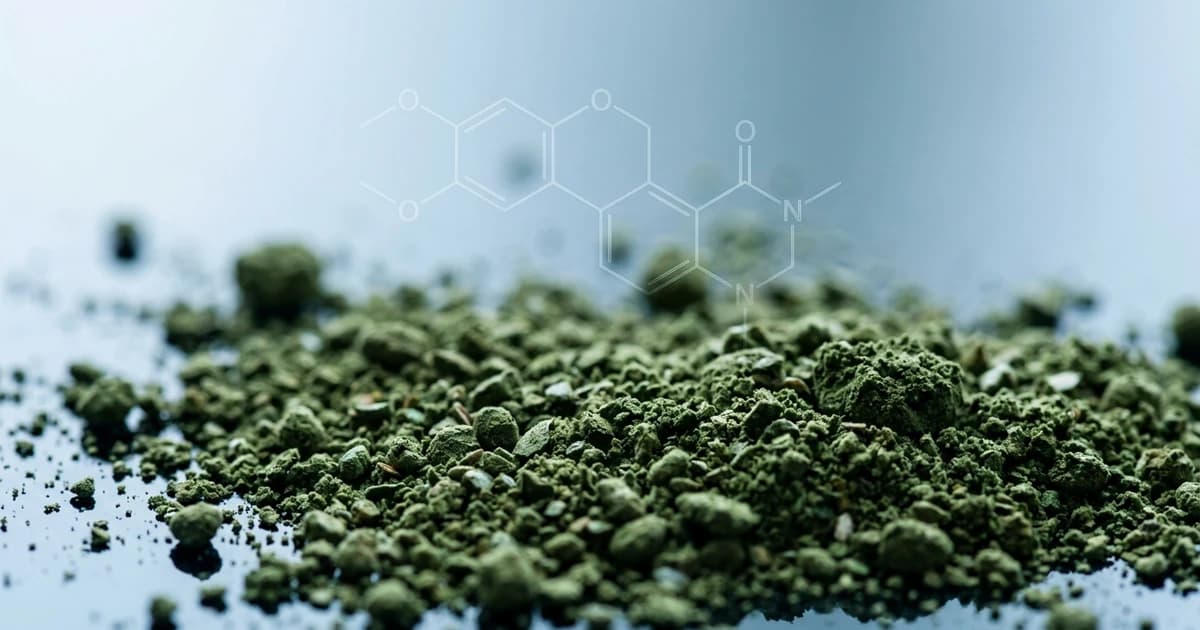
The leaves contain more than 40 alkaloids. Two of them do almost all the heavy lifting: mitragynine and 7-hydroxymitragynine.
According to a pharmacology review on PubMed Central, mitragynine constitutes about 66 percent of the total alkaloid content, while 7-hydroxymitragynine accounts for roughly 2 percent. That ratio matters more than it looks, because the tiny fraction is the dangerous one.
How Kratom Works: Two Molecules, Two Stories
Kratom is a stimulant at low doses and an opioid at high doses because two different alkaloids dominate at different concentrations. Understanding that split is the whole game.
Mitragynine: the stimulant face
Mitragynine is the abundant compound and the one responsible for the "good energy" people chase. At low concentrations it produces alertness, talkativeness, and mild mood lift, behaving more like caffeine than like a painkiller.
Its action is messy in a useful way. It touches opioid receptors weakly but also interacts with adrenergic and serotonergic systems, which is part of why small amounts feel stimulating rather than sedating.
7-Hydroxymitragynine: the opioid face
Here is where it gets serious. Your liver converts some mitragynine into 7-hydroxymitragynine, and that metabolite is a potent activator of the mu-opioid receptor, the same target hit by morphine and oxycodone.
The ACS Central Science paper identifying 7-OH as an active metabolite confirms it is the key driver of kratom's pain-relieving effects. The potency gap is large. Research summarized on PubMed Central reports that 7-hydroxymitragynine has roughly tenfold higher potency at the mu-opioid receptor than mitragynine.
Compared to morphine, the numbers are starker. Research on the compound, summarized by Wikipedia, puts 7-OH at around 13 times more potent than morphine for analgesic effect in animal tissue studies. A tiny molecule, a heavyweight punch.
The Dose Curve: Why Amount Changes Everything
The defining feature of kratom effects is that the dose, not the strain, decides whether you get a stimulant or an opioid. This is the single most important thing to understand before anyone touches it.
Drug-education resource Drugs and Me lays out a rough curve:
| Dose Range | Primary Effect | What It Feels Like |
|---|---|---|
| 1 to 4 grams | Stimulant | Subtle energy, alertness, sociability |
| 4 to 6 grams | Mixed | Stimulant, pain relief, or sedation depending on the person |
| 6 to 8 grams | Sedative / analgesic | Strong pain relief and drowsiness |
| 8+ grams | Heavy opioid-like | Deep sedation, higher risk |
Timing follows a fast curve. According to the recovery resource Recovered.org, kratom's effects typically begin within 5 to 10 minutes and peak 1 to 2 hours later, with low-dose stimulant effects lasting around 2 to 3 hours.
The trouble is that the line between "energizing" and "sedating opioid" is narrow and personal. Body weight, tolerance, leaf potency, and an empty stomach all move it. What gave you focus on Monday can flatten you on Friday.
Kratom for Energy: The Appeal and the Catch
People reach for kratom for energy because the low-dose experience is genuinely pleasant and feels natural. It is a plant, it is legal in much of the U.S., and it sits on gas station shelves next to energy shots. That framing makes it feel benign.
The catch is that the same receptor system delivering pain relief at high doses is being lightly tickled even at low ones. You are not using a clean stimulant. You are using a low dose of something with opioid activity baked in.
That distinction shows up over time. As described by Pathways Recovery, higher doses bind mu-opioid receptors to produce sedation, pain relief, and euphoria, with respiratory depression listed as a serious risk. The stimulant dose and the dangerous dose are made of the same chemistry.
Is Kratom Safe? The Honest Answer
Kratom is not a clean energy supplement, and it carries genuine dependence and overdose risk, especially in concentrated forms. That is the honest version, and it is neither "deadly poison" nor "harmless herb."
Dependence and withdrawal
Because 7-OH activates opioid receptors, regular use can lead to physical dependence. Frequent users describe withdrawal that mirrors mild opioid withdrawal: irritability, muscle aches, runny nose, insomnia, and cravings. The mechanism is the same family, so the dependence is real.
The 7-OH escalation
The bigger modern problem is concentrated products. Manufacturers now isolate and amplify 7-hydroxymitragynine far beyond what raw leaf contains, turning a 2 percent alkaloid into the main event.
Regulators noticed. On July 29, 2025, per a regulatory summary from Perkins Coie, the FDA recommended scheduling 7-hydroxymitragynine under the Controlled Substances Act, citing high abuse potential and no approved medical use.
The harm signal is showing up in real numbers. Newsweek reported that the Texas Poison Center Network logged 192 kratom or 7-OH reports in the first nine months of 2025, up from 107 in all of 2024.
The regulatory status
The FDA has stated it does not consider kratom lawful as a dietary supplement or food additive, because the safety data needed for that classification does not exist. That is a regulatory verdict, not a moral one, but it tells you the evidence base is thin.
Kratom Compared to Common Focus Options
For people who landed on kratom while looking for clean energy and focus, it helps to see where it sits next to other choices. Here is an honest comparison.
| Option | Mechanism | Onset | Dependence Risk | Best Use Case |
|---|---|---|---|---|
| Kratom (low dose) | Mixed alkaloids, weak opioid activity | 5 to 10 min | Moderate to high with regular use | Not recommended as a daily focus aid |
| Caffeine alone | Adenosine blockade | 15 to 45 min | Low to moderate | Quick, short alertness with possible jitters |
| Caffeine + L-theanine | Stimulant plus calming amino acid | 20 to 40 min | Low | Smoother, calmer focus |
| Prescription stimulants | Dopamine and norepinephrine reuptake | Varies | Controlled, medical only | Diagnosed conditions under a doctor |
| Roon sublingual pouch | Caffeine, L-theanine, methylliberine, theacrine | 5 to 10 min | Designed to avoid dependence and tolerance | Sustained focus without opioid mechanics |
The point of the table is not to crown a winner. It is to show that "fast onset" and "natural" can be achieved without touching an opioid pathway at all.
The Bottom Line on a Two-Faced Plant
Kratom earns its reputation honestly on both sides. At low doses it really does feel like energy. At high doses it really does act like an opioid, because chemically it is one.
The danger is not that kratom is uniquely evil. The danger is the gap between how it is marketed and how it works. People buy a stimulant story and slowly walk into opioid pharmacology, often without realizing the dose curve moved underneath them.
If you understand the mechanism, you can make an informed choice. The compound doing the heavy stimulant work is mild and abundant, while the compound doing the risky work is potent and concentrating fast in commercial products. Knowing which is which is the entire point.
Frequently Asked Questions
Is kratom an opioid?
Partly, and that is the confusing part. Kratom is a plant, not a classic opioid like morphine. But one of its alkaloids, 7-hydroxymitragynine, strongly activates the mu-opioid receptor, the same target opioids hit. At low doses the opioid effect is faint and stimulant effects dominate. At higher doses the opioid activity takes over, producing sedation, pain relief, and the dependence risk associated with opioids.
What is the difference between mitragynine and 7-hydroxymitragynine?
Mitragynine is the abundant alkaloid, around two-thirds of kratom's active content, and it drives the mild stimulant feel. 7-hydroxymitragynine is a minor metabolite, roughly 2 percent of the alkaloids, but it is the potent opioid actor. Your liver converts some mitragynine into 7-OH, which research places at about ten times more potent at the mu-opioid receptor than mitragynine itself.
Does kratom work as an energy or focus aid?
At low doses, yes, kratom produces alertness, mood lift, and energy that many users find pleasant. The effects begin within 5 to 10 minutes and last a few hours. The problem is that the same plant carries opioid activity, so using it routinely for energy means lightly engaging an opioid pathway and risking tolerance and dependence over time.
Is kratom safe to take every day?
Daily use is where risk concentrates. Regular dosing can produce physical dependence and an opioid-style withdrawal when you stop. The FDA does not consider kratom lawful as a dietary supplement, citing insufficient safety data. Daily use also raises the odds of escalating dose as tolerance builds, which pushes people toward the heavier, more sedating end of the curve.
Why is 7-OH getting so much attention in 2025?
Because manufacturers started concentrating it. Raw leaf contains only about 2 percent 7-hydroxymitragynine, but new products isolate and amplify it. On July 29, 2025, the FDA recommended scheduling concentrated 7-OH under the Controlled Substances Act, citing high abuse potential and no approved medical use. Poison center reports involving kratom and 7-OH also rose sharply that year.
Can kratom cause an overdose?
Yes, particularly at high doses or with concentrated 7-OH products. Because it activates opioid receptors, it can contribute to respiratory depression, the same mechanism behind opioid overdose deaths. Risk climbs sharply when kratom is combined with other depressants like alcohol or benzodiazepines, or when potent 7-OH concentrates are involved.
What are cleaner alternatives for focus?
If your goal is sustained focus rather than pain relief or sedation, you can get fast, clean energy without opioid mechanics. Caffeine paired with L-theanine is well studied for smooth alertness. Stacks that add methylliberine and theacrine aim to extend that focus without the crash, working through stimulant and signaling pathways rather than opioid receptors.
A Different Category Entirely: Focus Without the Opioid Pathway
If you found this article because you were using kratom for energy and focus, here is the honest reframe. The thing you actually wanted, fast, clean, sustained focus, never required an opioid mechanism in the first place. Kratom just happened to be on the shelf.
Roon sits in a different category. It is a zero-nicotine, non-opioid sublingual pouch with a disclosed four-ingredient formula: 80 mg caffeine, 60 mg L-theanine, 25 mg methylliberine (Dynamine), and 5 mg theacrine (TeaCrine). It works through stimulant and signaling pathways, not the mu-opioid receptor, and it is built for 6 to 8 hours of focus with no jitters, no crash, and no tolerance buildup.
To be clear about what Roon is not: it is not a treatment for pain, opioid withdrawal, or any medical condition, and it is not a kratom replacement for people seeking those effects. It is a focus tool with every dose printed on the label. If you want energy without walking into opioid pharmacology, try Roon and see how a transparent stack feels instead.
Written by Roon Team