Iodine and the Brain: The Thyroid-Cognition Connection
Roon Team
Iodine and the Brain: The Thyroid-Cognition Connection
Your brain runs on thyroid hormone, and your thyroid runs on iodine. Cut the supply at the source, and the whole chain slows down. This is the core of the link between iodine and cognition, and it explains why a trace mineral most people never think about can quietly shape how sharp you feel.
Iodine has no flashy reputation. It is not a focus ingredient you take before a deadline. It works at the foundation, setting the baseline your faster cognitive tools build on. Get it wrong, and no amount of caffeine fully fixes the fog.
Here is what the science actually says, and what it means for your day-to-day mental performance.
Key Takeaways
- Iodine is the raw material your thyroid uses to make hormones that regulate brain metabolism, energy, and signaling.
- Severe iodine deficiency during pregnancy and early childhood is the most preventable cause of intellectual disability worldwide.
- Even mild iodine deficiency in adults has been linked to slower processing and weaker memory, though correcting it helps most in people who are genuinely deficient.
- Iodine fixes the floor. It supports steady baseline brain function, but it is not an acute focus tool you feel within minutes.
Iodine and Cognition: Why a Trace Mineral Steers the Brain
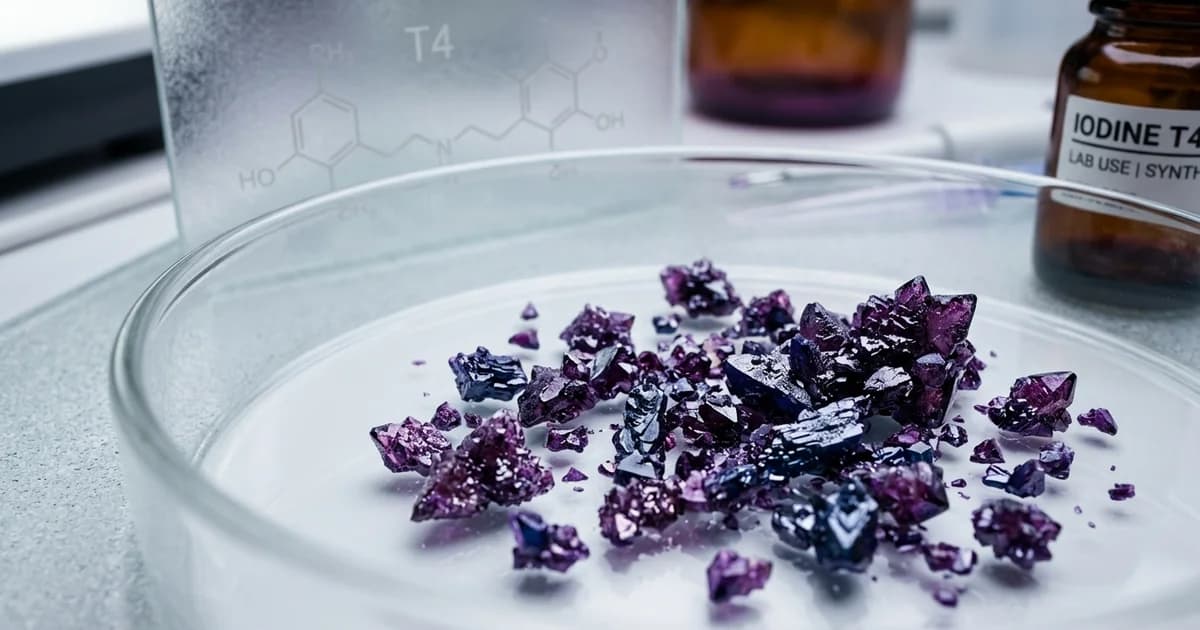
Iodine has one main job in the body, and it is a big one. Your thyroid gland uses it to build thyroxine (T4) and triiodothyronine (T3), the two hormones that set the pace of metabolism in nearly every cell, including neurons.
Brain tissue is especially sensitive to these hormones. According to the Linus Pauling Institute at Oregon State University, thyroid hormones regulate the development and ongoing function of the central nervous system, and iodine deficiency reduces their production. Less iodine means less thyroid hormone, and less thyroid hormone means a slower, less efficient brain.
This is the thyroid-cognition pathway in plain terms. Iodine feeds the thyroid, the thyroid feeds the brain. When the first link weakens, the effects ripple downstream into focus, memory, and mental energy.
The relationship matters most at two points: when the brain is being built, and when it is running short on raw materials as an adult.
Iodine, Brain Development, and the Cost of Deficiency
Iodine deficiency is the leading preventable cause of brain damage during development. That is not marketing language; it is the long-standing position of public health researchers studying the mineral.
During pregnancy and the first years of life, thyroid hormone directs how neurons grow, migrate, and connect. Research indexed on PubMed describes how iodine deficiency disrupts brain development, with the severity depending on the timing and depth of the shortfall. Get too little at the wrong window, and the deficit can be permanent.
This is why iodized salt became one of the most effective public health measures of the last century. It addressed a nutrient gap that was silently lowering cognitive potential across entire populations.
The burden has not disappeared. A Global Burden of Disease analysis published in PMC tracked iodine deficiency in reproductive-age women and found it remains a meaningful global health problem, with projections continuing into the next decade. Salt iodization helped, but it did not erase the issue.
Iodine Brain Function in Adults: Does It Still Matter?
Yes. Iodine still influences brain function long after development is finished, and mild iodine deficiency in adults is more common than most people assume.
The adult brain depends on a steady stream of thyroid hormone to keep its metabolism stable. When iodine intake drops, thyroid output can sag, and cognition tends to follow. The effects are subtler than the developmental ones, but the link still shows up in the data.
The evidence here is nuanced, and worth stating honestly. A randomised, placebo-controlled trial in young adults tested whether correcting mild iodine deficiency would sharpen cognition. It did not: supplementation raised iodine status but did not move cognitive scores. The takeaway is that the clearest gains show up where deficiency is more severe, or where it hits during development.
That pattern is exactly what shows up in younger, more deficient populations. A randomized, double-blind study of iodine-deficient schoolchildren in Albania reported that iodine supplementation improved cognitive outcomes compared with placebo. Correcting a real deficiency moved the needle.
Older adults are part of the picture too. An NHANES-based study published in PMC examined urinary iodine concentration and cognitive function in older adults, adding to evidence that iodine status tracks with brain performance across the lifespan.
What Mild Iodine Deficiency Memory Effects Look Like
You will not feel mild iodine deficiency the way you feel a missed night of sleep. It shows up quietly.
The most reported signs tied to low thyroid output include sluggish thinking, trouble holding details in working memory, and a general sense of mental flatness. These overlap heavily with everyday brain fog, which is exactly why the cause often goes unnoticed.
If you want to understand how thyroid status shapes that foggy feeling, our deep dive on brain fog and thyroid issues walks through the mechanism in more detail.
How Much Iodine You Need, and Where to Get It
Most healthy adults need 150 micrograms of iodine per day, with higher needs during pregnancy and breastfeeding. The good news is that hitting this target is straightforward through food.
Reliable sources include dairy, eggs, seafood, seaweed, and iodized salt. The Linus Pauling Institute notes that iodine content in food varies widely depending on soil, feed, and processing, which is part of why deficiency persists even in developed countries.
Two modern trends quietly raise the risk. Many people have cut back on iodized table salt, and most of the salt in processed food is not iodized. At the same time, plant-based diets that skip dairy and seafood can fall short without a deliberate source.
More is not better. Excessive iodine can disrupt thyroid function just as deficiency does, so the goal is sufficiency, not megadosing.
Iodine vs Acute Focus Tools: A Quick Comparison
Iodine and fast-acting focus ingredients solve different problems. One sets your baseline; the other shapes a single work block. Here is how they compare.
| Approach | What it does | Time to effect | Best role |
|---|---|---|---|
| Iodine | Supports thyroid hormone production and baseline brain metabolism | Days to weeks of consistent intake | Fix the floor (foundational nutrient) |
| Caffeine | Blocks adenosine to raise alertness | 30 to 60 minutes | Acute alertness, with a crash risk |
| L-theanine | Smooths the edge off stimulants, supports calm focus | 30 to 45 minutes | Pairs with caffeine |
| Roon pouch | Sublingual stack of 80 mg caffeine, 60 mg L-theanine, 25 mg Dynamine, 5 mg TeaCrine | 5 to 10 minutes | Acute focus, 6 to 8 hours, no crash |
The takeaway: iodine is a long-game nutrient, not a pre-task tool. You eat for it; you do not feel it kick in.
Conclusion
Iodine is one of the quietest inputs to a sharp mind. It does not deliver a noticeable lift, and that is exactly why it gets ignored. Its work happens upstream, feeding the thyroid hormones that keep brain metabolism running at full pace.
The evidence is consistent across ages. Severe deficiency damages the developing brain, and even mild shortfalls in adults track with slower thinking and weaker memory. Fixing a real deficiency tends to restore lost ground.
So treat iodine as a baseline to secure, not a performance hack. Cover your daily need through food, avoid overdoing it, and recognize that a well-supplied thyroid is part of the foundation everything else stands on.
Frequently Asked Questions
Can iodine improve focus in people who are not deficient?
Probably not in any meaningful way. The research linking iodine to better cognition is strongest in people who start out deficient. In those cases, supplementation tends to restore function rather than push it above normal. If your intake is already adequate, adding more iodine is unlikely to sharpen your focus, and excess intake can actually disrupt thyroid function.
What are the signs of mild iodine deficiency in adults?
Mild deficiency is subtle and easy to miss. The cognitive signs overlap with everyday brain fog: sluggish thinking, weaker working memory, and low mental energy. Physical clues can include fatigue, sensitivity to cold, and changes in thyroid size. Because these symptoms are nonspecific, the only reliable way to assess iodine status is through testing, usually urinary iodine, rather than self-diagnosis.
How does iodine deficiency affect memory?
Iodine deficiency lowers thyroid hormone production, and thyroid hormone regulates brain metabolism and signaling. When levels drop, memory and processing speed can suffer. Controlled trials in iodine-deficient children have shown improvements in cognitive measures after correcting iodine status, which supports the link between iodine, thyroid function, and memory performance.
How much iodine do adults need per day?
Most healthy adults need about 150 micrograms daily, according to standard nutrition guidance. Needs rise during pregnancy and breastfeeding. You can usually meet the target through dairy, eggs, seafood, seaweed, and iodized salt. More is not better, since excessive intake can interfere with thyroid function as much as deficiency does.
Why is iodine deficiency still a problem today?
Salt iodization reduced deficiency dramatically, but it did not end it. Many people now use less iodized table salt, and most salt in processed food is not iodized. Plant-based diets that skip dairy and seafood can also fall short. A global analysis of reproductive-age women found iodine deficiency remains a meaningful health issue worldwide.
Is iodine the same as a nootropic or focus supplement?
No. Iodine is a foundational mineral that supports baseline brain function over time, not a fast-acting focus ingredient you feel within minutes. Acute focus tools like caffeine and L-theanine work on a timescale of minutes to hours. Iodine works on a timescale of days to weeks, by keeping your thyroid supplied. They solve different problems.
Fix the Floor First, Then Sharpen the Block
Iodine is a foundational nutrient. It keeps your thyroid supplied, which keeps your brain's baseline metabolism steady. That is the floor. No fast-acting focus tool can fully compensate for a thyroid running on empty, which is why getting your iodine from food comes first.
Once the foundation is solid, the question shifts to the work block in front of you. That is a different layer, and it is where Roon lives. Roon is a sublingual pouch built for acute focus, with 80 mg caffeine, 60 mg L-theanine, 25 mg methylliberine (Dynamine), and 5 mg theacrine (TeaCrine). It works in 5 to 10 minutes and holds for 6 to 8 hours with no jitters, no crash, and no tolerance buildup.
To be clear, Roon is not a substitute for sound nutrition or a healthy thyroid. Fix the floor with iodine and the rest of your diet. When you want a clean focus layer on top, try Roon for your next deep-work block.
Written by Roon Team