From Egg to Neuron: How Choline Becomes Acetylcholine in Your Brain
You eat an egg. A few hours later, some of that yolk is helping your neurons fire signals that let you remember a phone number. The path in between is one of the most elegant supply chains in your body, and understanding how choline becomes acetylcholine changes how you think about diet, focus, and memory.
Choline is the raw material. Acetylcholine is the finished product, a neurotransmitter that runs memory, attention, and muscle movement. Getting from one to the other takes a transporter, an enzyme, and a molecule borrowed from your mitochondria.
Here is the full route, step by step.
Key Takeaways
- Choline from food travels through your blood, crosses into the brain, and gets pulled into cholinergic neurons.
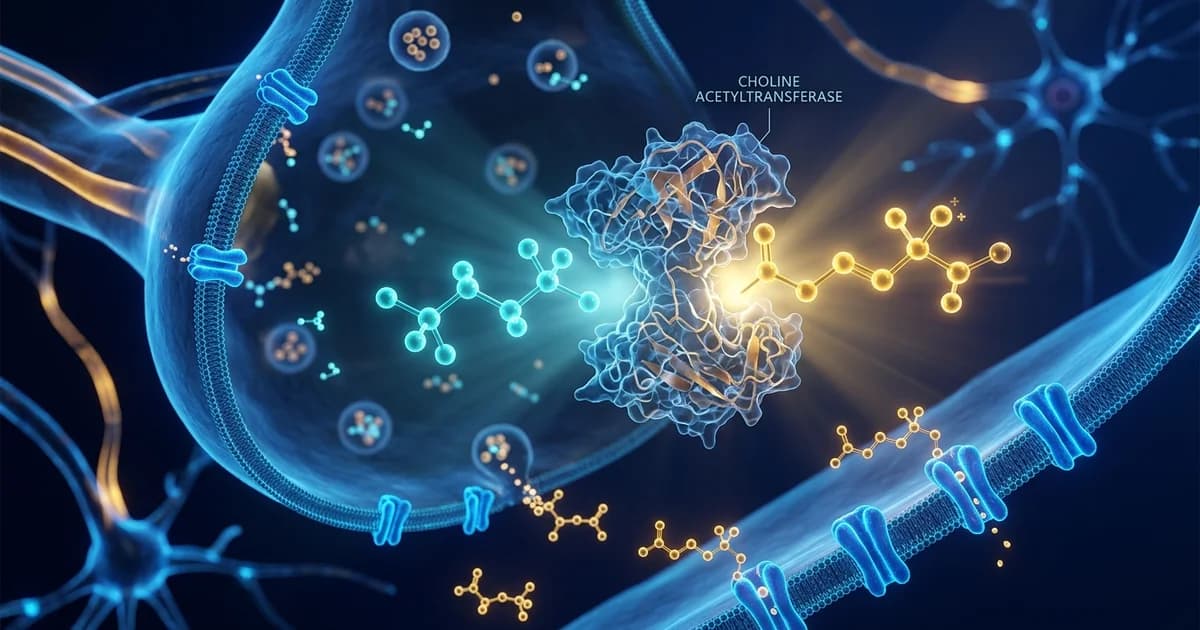
- The enzyme choline acetyltransferase (ChAT) fuses choline with acetyl-CoA to build acetylcholine.
- The slow step is not the enzyme. It is high-affinity choline uptake, the transporter that feeds choline into the neuron.
- Most of your dietary choline goes to building cell membranes, not neurotransmitters, through the Kennedy cycle.
- Acetylcholine and the caffeine-driven arousal system are two separate axes of mental performance.
How Choline Becomes Acetylcholine: The Three-Part Supply Chain
Acetylcholine synthesis is a single chemical reaction, but it depends on three things arriving at the same place at the same time: choline, acetyl-CoA, and the enzyme that joins them. Miss any one and production stalls.
Think of it as a kitchen. You need the ingredient delivered to the door, a second ingredient pulled from the pantry, and a cook to combine them. The cook is rarely the bottleneck. The delivery truck is.
Step 1: Choline Gets Into the Neuron
Choline does not drift casually into brain cells. Cholinergic neurons use a dedicated protein called the high-affinity choline transporter, also known as CHT1 or by its gene name SLC5A7.
Cholinergic neurons are relatively unique in their expression of the choline transporter 1 (CHT1), which exhibits high-affinity for choline and catalyzes its uptake from the extracellular space to the neuron. This transporter is sodium-dependent, meaning it rides the cell's sodium gradient to pull choline inside.
This is the step that controls the pace of the entire process. The enzyme that synthesizes acetylcholine is thought to be present in kinetic excess in cholinergic neurons. The rate-limiting factor in acetylcholine production is the provision of choline to that enzyme. In plain terms, your neurons have more cooks than ingredients, so the speed of the delivery truck sets the speed of the kitchen.
Step 2: Acetyl-CoA Arrives From the Mitochondria
The second ingredient is acetyl-CoA, a carrier molecule that supplies the "acetyl" half of acetylcholine. It comes from your mitochondria, the same energy machinery that processes glucose.
Choline acetyltransferase catalyzes the synthesis of acetylcholine from choline and acetyl coenzyme A in cholinergic nerve terminals, a process that depends on the uptake of choline from the extracellular fluid via a high-affinity transporter and the availability of acetyl-CoA produced in mitochondria. So acetylcholine production is quietly tied to your neuron's energy state. A well-fed, well-oxygenated neuron has acetyl-CoA to spare.
Step 3: ChAT Joins the Two Halves
Now the cook goes to work. Choline acetyltransferase, abbreviated ChAT, is the enzyme that builds the final molecule.
Choline acetyltransferase is a transferase enzyme responsible for the synthesis of the neurotransmitter acetylcholine. ChAT catalyzes the transfer of an acetyl group from the coenzyme acetyl-CoA to choline, yielding acetylcholine. The reaction happens in the cytoplasm of the nerve terminal, right where the neurotransmitter will eventually be released.
At the molecular level, the enzyme is precise. According to a structural study of human ChAT published in The EMBO Journal, an active site histidine is proposed to function as a general base, enhancing the nucleophilicity of the choline hydroxyl for attack on the thioester bond in the forward reaction. That is biochemistry's way of saying the enzyme positions choline perfectly to grab the acetyl group.
Once built, acetylcholine gets packaged into vesicles and waits at the synapse, ready to fire.
Why ChAT Is Not the Bottleneck
People assume the enzyme controls the output. It does not. Measure ChAT in a test tube and it works far faster than the neuron ever actually makes acetylcholine.
ChAT activity measured in vitro is much greater than expected from acetylcholine synthesis rates in vivo, indicating that ChAT is not the rate-limiting step in acetylcholine synthesis. Instead, the rate-limiting step is the uptake of choline into neurons via high-affinity sodium-dependent choline transporters. Factors such as choline availability and transporter activity ultimately determine the rate of acetylcholine synthesis.
This matters for anyone thinking about diet and cognition. If the transporter and choline supply set the ceiling, then keeping your body choline-replete is the lever that actually moves the system. Flooding a neuron with enzyme would do nothing if there is no choline to deliver.
Choline Metabolism in the Brain: Most of It Never Becomes a Neurotransmitter
Here is the part that surprises most people. The majority of the choline you eat never turns into acetylcholine at all. It becomes structural fat.
Choline is a building block for phosphatidylcholine, the most abundant phospholipid in your cell membranes. Your body assembles it through the Kennedy cycle, also called the CDP-choline pathway. This route phosphorylates choline, activates it, and stitches it into membrane lipids.
So choline metabolism in the brain splits into two priorities:
| Choline destination | Pathway | Purpose |
|---|---|---|
| Acetylcholine | ChAT reaction in cholinergic neurons | Neurotransmission, memory, attention |
| Phosphatidylcholine | Kennedy cycle (CDP-choline) | Cell membrane structure and repair |
| Betaine | Oxidation in liver/kidney | Methyl donor for homocysteine metabolism |
Only a small slice of dietary choline reaches the acetylcholine pool. That is why steady, adequate intake matters more than any single large dose. Your neurons compete with every membrane in your body for the same nutrient.
Where Choline Comes From: The Egg Connection
Egg yolk is one of the richest dietary sources of choline, largely as phosphatidylcholine. A couple of eggs can deliver a meaningful share of a day's target.
The NIH Office of Dietary Supplements choline fact sheet lists adequate intake at 550 mg per day for adult men and 425 mg per day for adult women, with eggs, beef liver, soybeans, and chicken among the densest sources. Most people fall short of these targets, which is exactly why the supply chain you just read about can run lean.
Your liver can make some choline on its own, but not enough to cover the body's needs. Diet does the heavy lifting.
Acetylcholine vs. the Arousal System: Two Different Levers
Acetylcholine is one axis of mental performance. It is not the only one. The brain's arousal and alertness system runs on a separate set of chemicals, and the two work in parallel.
Caffeine, for example, does not directly build acetylcholine. It blocks adenosine receptors, which raises arousal and perceived energy. Choline, on the other hand, feeds the cholinergic system that handles fine attention and memory encoding. You can support one without supporting the other.
This is the distinction that gets lost in most supplement marketing. A focus tool that sharpens arousal is doing something real, but it is not refilling your acetylcholine precursor pool. Those are different jobs.
Conclusion
The route from egg to neuron is a controlled, multi-step process. Choline crosses into the brain, gets pulled into cholinergic neurons by a high-affinity transporter, meets acetyl-CoA borrowed from the mitochondria, and gets joined into acetylcholine by ChAT.
The enzyme is never the limiting factor. Choline supply and transporter activity are. And because most dietary choline is diverted to building cell membranes through the Kennedy cycle, your acetylcholine system depends on consistent, adequate intake rather than occasional megadoses.
Understand the supply chain and the practical takeaway is simple. Eat enough choline, and you give your cholinergic neurons the raw material they need to do their work.
Frequently Asked Questions
Is choline acetyltransferase the same as acetylcholinesterase?
No, and the names trip people up constantly. Choline acetyltransferase (ChAT) builds acetylcholine by joining choline and acetyl-CoA. Acetylcholinesterase (AChE) does the opposite, breaking acetylcholine down after it has done its job at the synapse. One is the maker, the other is the recycler. Both are necessary for healthy cholinergic signaling, because acetylcholine has to be cleared quickly so the next signal can fire cleanly.
What is the rate-limiting step in acetylcholine synthesis?
The rate-limiting step is high-affinity choline uptake into the neuron, handled by the CHT1 transporter. The enzyme ChAT works faster than the neuron ever needs, so it is not the bottleneck. The slow link in the chain is getting choline through the transporter and into the cell. This is why choline availability and transporter activity, rather than enzyme levels, determine how much acetylcholine a neuron can produce.
Does eating more eggs raise brain acetylcholine?
Eating choline-rich foods like eggs gives your body the precursor it needs, but most of that choline goes toward building cell membranes through the Kennedy cycle, not directly into acetylcholine. Adequate intake supports the whole cholinergic system over time. It does not produce a sudden neurotransmitter spike. The benefit comes from staying consistently choline-replete rather than from any single meal.
What is the Kennedy cycle?
The Kennedy cycle, also called the CDP-choline pathway, is how your cells turn choline into phosphatidylcholine, the main phospholipid in cell membranes. It phosphorylates choline, activates it with CTP, and attaches it to a lipid backbone. This pathway claims the majority of the choline you eat, which is why only a small fraction is left for acetylcholine synthesis in cholinergic neurons.
Where does the acetyl group in acetylcholine come from?
The acetyl group comes from acetyl-CoA, a molecule produced in your mitochondria from glucose and other fuels. ChAT transfers that acetyl group onto choline to form acetylcholine. Because acetyl-CoA is tied to your cell's energy production, acetylcholine synthesis is indirectly linked to how well-fed and energized your neurons are.
Can your body make its own choline?
Your liver can synthesize a limited amount of choline, mainly through the methylation of phosphatidylethanolamine. The problem is that this internal supply usually falls short of your body's full requirement. Diet has to cover the gap, which is why choline is classified as an essential nutrient and why most people benefit from intentionally including choline-rich foods.
Is acetylcholine the same as the "alertness" chemicals like caffeine targets?
No. Acetylcholine handles attention, memory encoding, and muscle signaling. Caffeine works on a different system, blocking adenosine to raise arousal and reduce perceived fatigue. They are separate axes of mental performance. Supporting one does not automatically support the other, which is worth remembering when you evaluate any focus product.
The Two Axes Worth Feeding Separately
This article drew a line between two systems: the cholinergic pathway you feed with dietary choline, and the arousal axis that drives moment-to-moment alertness. They are not interchangeable, and treating them as one is where a lot of focus strategies go wrong.
Roon works on the arousal side. It is a zero-nicotine sublingual pouch built around four ingredients: 80 mg caffeine, 60 mg L-theanine, 25 mg methylliberine (Dynamine), and 5 mg theacrine (TeaCrine), tuned for a 5 to 10 minute onset and a 6 to 8 hour window of focus without the jitters or the crash. That is the alertness lever, not the acetylcholine one.
Roon is not a choline source and not a substitute for a choline-replete diet. Think of them as complementary. Keep your eggs, liver, and other choline-rich foods on the plate to supply the cholinergic system, and reach for Roon when you want clean arousal on top. Try Roon when you want focus you can feel without the afternoon dropout.
Written by Roon Team