Hot-Desking Broke Your Focus Routine. Here's How to Rebuild One Without a Permanent Desk
Roon Team
Hot-Desking Broke Your Focus Routine. Here's How to Rebuild One Without a Permanent Desk
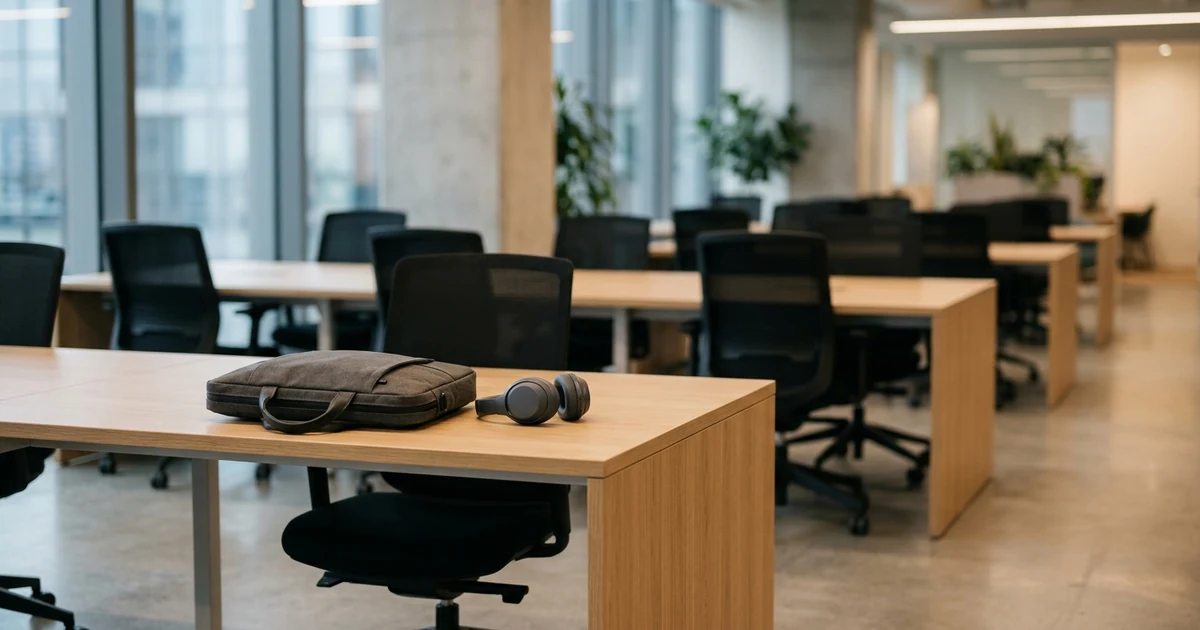
You used to sit down and start working. Same monitor, same chair height, same mug in the same spot. Now you spend the first 15 minutes of every office day hunting for a clean desk, adjusting a stranger's chair, and logging into an unfamiliar monitor. That friction is not minor. It is the quiet death of your hot desking focus routine, and the data says it is happening to nearly half the white-collar workforce.
According to CBRE's 2024-2025 Global Workplace & Occupancy Insights, companies using assigned seating dropped from 83% to 55% in 2024 alone, while hybrid and desk-sharing models jumped from 12% to 36%. Individual dedicated workspace allocation fell from 51% in 2021 to 40% by 2024.
This article covers the specific cognitive cost of desk sharing on productivity, why hot desking in 2026 is accelerating faster than expected, and the portable habits that let you protect deep focus even when your workspace changes every morning.
Key Takeaways
- Desk sharing is spreading fast: assigned seating fell from 83% to 55% of companies in a single year, per CBRE benchmarking data.
- The focus penalty is real: Gensler's 2026 Global Workplace Survey found that only 67% of employees in unassigned seating say the office supports focused work, versus 80% in assigned environments.
- Some firms are already reversing course, offering dedicated desks back as an RTO incentive. The debate is not settled.
- A portable routine beats a permanent desk for protecting focus. The key is building consistency around objects and rituals you carry, not around a location.
The Numbers: How Fast Desk Sharing Is Replacing Assigned Seating
The shift accelerated faster than most workplace analysts expected. Here is what CBRE's benchmarking data shows, as reported by Facilities Dive:
| Metric | Previous Baseline | 2024 Figure | Change |
|---|---|---|---|
| Companies using assigned seating | 83% | 55% | -28 pts |
| Hybrid / desk-sharing models | 12% | 36% | +24 pts |
| Individual dedicated workspace | 51% (2021) | 40% (2024) | -11 pts |
| Large private offices | 16% | 4% | -12 pts |
Those numbers are compressing further. In hybrid office desk sharing models, the math is simple: more people returning to less square footage. A wave of 2026 return-to-office mandates from Microsoft, Fidelity, Instagram, and others is pushing employees back into offices that were downsized during the hybrid era. Desk sharing is the real-estate industry's answer. More than 60% of organizations now report employee-to-seat ratios at or above 1.5:1, per CBRE.
A separate CBRE 2025 Americas Occupier Sentiment Survey found assigned seating dropping further among large employers: only 25% of companies used it by mid-2025, down from 40% in 2024. By 2027, 73% of respondents expect employee-to-seat ratios above 1.5:1.
Why Losing a Permanent Desk Costs You More Than Comfort
The focus penalty of hot-desking is not about preference. It is about the small cognitive costs that stack up before you do any actual work.
Setup friction. Every unfamiliar station requires micro-decisions: which monitor input, which chair lever, where to put your bag, whether the previous occupant left crumbs. None are hard. All consume working memory that could go toward your first real task.
Loss of environmental cues. Your brain associates specific environments with specific modes of work. A permanent desk becomes a focus trigger through repetition. Remove it, and you lose a free cognitive cue.
Belonging erosion. Gensler's 2026 Global Workplace Survey found that nearly 60% of employees in unassigned environments would prefer a dedicated workspace. In assigned settings, 80% said the office supports focused work; in unassigned settings, that drops to 67%.
A 2024 Leesman study sharpened the point: in offices with unassigned seating and no quiet rooms, only 41% of workers felt productive. In offices with a well-designed mix of zones, that rose to 85%. Hot-desking does not automatically kill focus. Bad hot-desking does. But you cannot redesign your employer's office. You can only control the routine you bring with you.
The Counter-Argument: Some Companies Are Already Walking It Back
Hot-desking is spreading fast, but not everyone thinks it should. Workplace design firm Gensler has argued publicly that assigning seats for employees in-office at least three days a week creates a stronger performance foundation than universal desk sharing. Their position: treating seating purely as a cost variable risks eroding culture and focus.
Some companies are acting on this. The Straits Times has reported on firms reversing course and offering assigned desks back specifically as a return-to-office incentive, and Bloomberg has separately covered ending hot-desk systems as an emerging RTO tactic. The trajectory is not one-directional. If your company is currently hot-desking, it may or may not stay that way. Building a portable focus system protects you in both scenarios.
Five Tactics for a Hot Desking Focus Routine That Travels With You
The goal is to detach your focus triggers from a physical location and attach them to objects and rituals you control.
1. Build a Portable "Office Kit" You Carry Every Day
Keep a small pouch or case with the same items every time you go in:
- Noise-canceling earbuds or headphones
- A compact laptop stand or riser (eliminates the neck-crane problem at unfamiliar desks)
- A wireless mouse if you are particular about input devices
- A specific focus cue: a scent, a mint, an object that signals "deep work starts now"
The point is not optimization. The point is consistency. When you open the same kit in the same order every morning, you reconstruct enough familiar routine to trigger focus regardless of where you are sitting.
2. Use Noise-Canceling as a Portable "Wall"
In an assigned-desk environment, your neighbors were predictable. In a hot-desking office, the person next to you might be on calls all day. Noise-canceling headphones create a consistent acoustic environment wherever you sit. Put them on as part of your arrival sequence, not reactively when noise gets bad.
3. Book Strategically, Not Randomly
Most desk-booking systems let you reserve the same zone or desk in advance. Use that deliberately. Consistency does not require a permanent assignment; it requires choosing the same type of spot (corner, window, quiet zone) as often as possible. If your office uses a first-come system, arrive 10 minutes early and claim a consistent area.
4. Front-Load the Setup, Then Protect the First 30 Minutes
When you land at an unfamiliar desk, do all the physical setup at once: monitor, chair, kit contents, headphones. Then protect the first 30 minutes for focused work before you open Slack or email. The setup itself becomes the ritual that signals the shift from commute mode to work mode.
5. Anchor Your Routine to a Sensory Cue, Not a Location
This is the principle behind all four tactics above. Your brain builds habits through cue-routine-reward loops. When the cue was "sit down at my desk," it worked because the desk never changed. Without a consistent desk, you need a consistent portable cue: the click of the same headphones, the taste of the same mint, the act of opening the same kit. Pick one sensory trigger and repeat it every office day. Within a few weeks, that cue replaces the desk as your focus signal.
The Portable Office Is Not Optional Anymore
More people are returning to offices with fewer desks per person, and the gap is widening. Whether hot-desking is a smart space strategy or a false economy (reasonable people disagree, and the evidence supports both readings), the practical reality for millions of workers in 2026 is that a permanent desk is not coming back soon.
The focus routine has to travel. It has to live in objects you carry, rituals you repeat, and sensory cues that work the same at desk 4A on Monday as they do at desk 7C on Thursday.
Frequently Asked Questions
What is hot-desking and why is it increasing in 2026?
Hot-desking means employees claim an available workspace each day instead of sitting at a permanently assigned desk. It is increasing because 2026's wave of return-to-office mandates is pushing more people back into offices that were downsized during the hybrid era. CBRE data shows desk-sharing models rose from 12% to 36% of companies in a single year.
Does hot-desking hurt productivity?
It depends on office design. Gensler's 2026 survey found 80% of employees in assigned seating say the office supports focus, versus 67% in unassigned settings. A 2024 Leesman study found only 41% felt productive in poorly designed unassigned offices, but 85% felt productive in offices with well-designed mixed-use zones.
Can I still get a consistent workspace without an assigned desk?
Yes. Most booking systems let you reserve the same desk or zone in advance. Even in first-come offices, arriving 10 minutes early and targeting the same area creates consistency. The goal is a reliable default, not a permanent assignment.
What should I put in a portable office kit for hot-desking?
At minimum: noise-canceling earbuds, a compact laptop stand, and one consistent sensory cue (a specific mint, drink, or object that signals focus). A portable mouse and a short charging cable are useful additions. Keep everything in the same case so opening it becomes part of your routine.
Are some companies bringing assigned desks back?
Yes. The Straits Times has reported on firms offering assigned desks back as an RTO incentive, reversing earlier hot-desking moves. Gensler has argued that assigning seats for employees in-office three or more days per week provides a stronger foundation for focus and culture. The debate is genuinely two-sided.
How long does it take to build a new focus routine in a hot-desking office?
Habit research suggests consistent cue-routine-reward loops become automatic within two to eight weeks. If you use the same portable kit and sensory trigger every office day, the new routine should feel natural within a month. The key is daily repetition of the same sequence, not perfection on day one.
A Focus Cue That Fits in Your Pocket
When your desk changes every day, you need focus triggers that do not depend on a desk. Headphones, a kit, a booking habit, a sensory anchor. All portable.
Roon fits that model. It is a zero-nicotine sublingual pouch (Cool Mint, 15 per tin) containing 80 mg caffeine, 60 mg L-theanine, 25 mg methylliberine (Dynamine), and 5 mg theacrine (TeaCrine). The tin fits in a jacket pocket. No mug, no hot water, no outlet. Onset is 5 to 10 minutes.
The reason it outlasts coffee: methylliberine slows caffeine's clearance. A randomized crossover PK study (n=12) found co-administration cut caffeine's oral clearance from 41.9 to 17.1 L/hr and extended its half-life from 7.2 to 15 hours, with no increase in peak concentration. Same peak, longer tail. That is why the felt window is 6 to 8 hours on just 80 mg. The trade-off: do not take it late in the day. Roon's own guidance is to stop at least 8 hours before bed.
Roon is not a substitute for good office design or a booking system that works. But if you want one more portable cue to carry between desks, it is worth a look.
Written by Roon Team