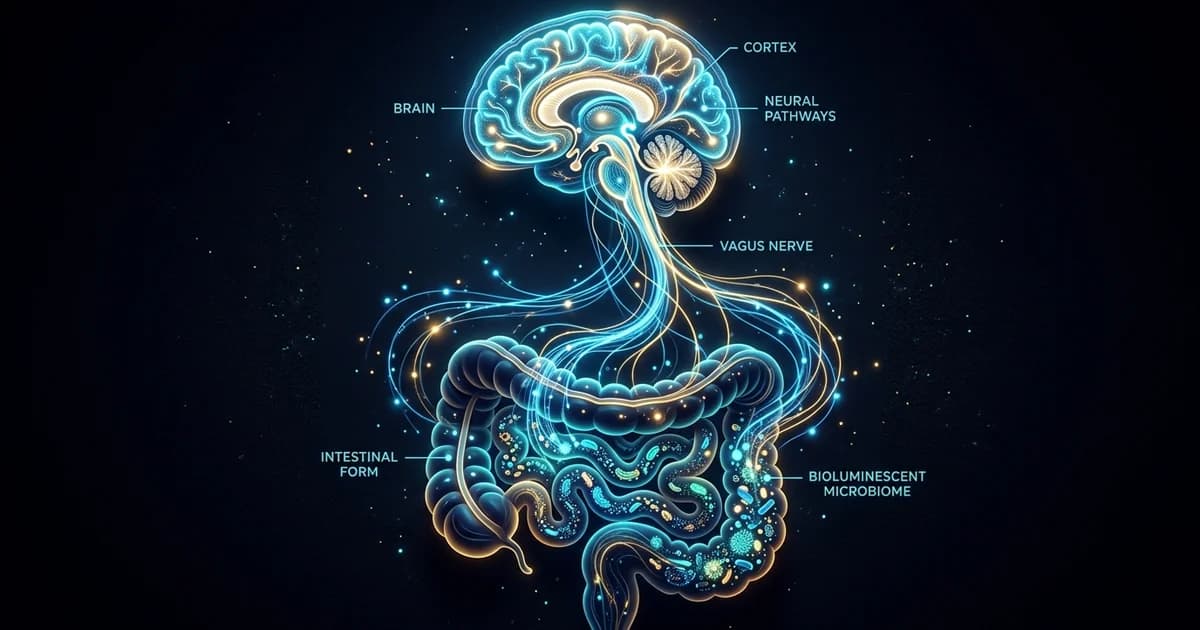
The Gut-Brain Axis and Cognition: How Your Microbiome Talks to Your Brain
Your gut has its own nervous system. It runs without waiting for permission from your skull.
The connection between the gut brain axis and cognition is no longer fringe science. It is one of the most active areas in neuroscience right now, and the findings are blunt: the bacteria in your intestines help shape how clearly you think, how steady your mood stays, and how well your memory holds up over decades. Your microbiome is talking to your brain constantly, in chemical, neural, and immune languages all at once.
This article breaks down the actual wiring. How the signal travels, what your gut bacteria manufacture, and what the 2025 and 2026 research says about focus, memory, and mental clarity.
Key Takeaways
- Your gut contains roughly 500 million neurons, more than your spinal cord, and they can operate independently of the brain.
- The microbiome communicates with the brain through three channels: the vagus nerve, immune signaling, and chemical metabolites.
- Gut bacteria help produce neurotransmitters and short-chain fatty acids that cross into the brain and affect cognition.
- "Psychobiotics," specific strains of bacteria, show early promise for supporting cognitive and emotional processing.
What the Gut-Brain Axis Actually Is
The gut-brain axis is a two-way communication network linking your digestive tract and your central nervous system. It is not a metaphor. It is a physical system of nerves, hormones, immune cells, and microbial chemistry that carries information in both directions, all day.
The numbers behind it are large. The microbiome includes approximately 100 trillion bacterial cells, though more recent measurements have revised the figure. Recent and precise estimates suggest that the total number of bacteria in the human body, primarily located in the gut, is approximately 38 trillion, which is roughly equal to the number of human cells.
That means you are, by cell count, about half microbial. Those cells are not passengers. They metabolize your food, train your immune system, and produce signaling molecules that reach your brain.
The "Second Brain" in Your Gut
The gut runs its own neural network, called the enteric nervous system. It is dense enough that researchers gave it a nickname. The deepest part of the human gut contains a peripheral nervous system of about 500 million neurons, more than the spinal cord, operating with enough independence that researchers sometimes call it the "second brain."
This is why a sense of dread can hit your stomach before your conscious mind catches up. The body's emotional responses are frequently well underway in the gut before the conscious mind has been informed about whatever it is responding to.
The enteric nervous system does not need constant orders from above. The system consists of approximately 500 million neurons, distributed throughout two layers of gut tissue, organized into local networks that handle local processing without requiring input from the brain.
How Your Microbiome and Brain Communicate: Three Channels
The link between the microbiome and brain runs along three main routes. Each one is distinct, and they often work at the same time.
1. The Vagus Nerve
The vagus nerve is the fastest line between your gut and your head. It is the longest cranial nerve in the body, and it carries signals in both directions, though most of its fibers send information upward, from gut to brain.
For years the vagus nerve gut brain link was assumed more than proven. That changed recently. While the vagus nerve has long been thought to facilitate communication between the gut microbiome and the brain, direct evidence for this process has been limited. A 2025 study reported in Medical Xpress provided that direct evidence in an animal model.
The takeaway is simple. Bacteria in your gut can trigger nerve signals that reach the brain in near real time, not over hours.
2. Chemical Metabolites
Your gut bacteria are tiny chemical factories. When they ferment the fiber you eat, they produce short-chain fatty acids (SCFAs), including butyrate, acetate, and propionate. These molecules do not stay local.
According to Psychology Today, all three SCFAs enter the bloodstream from the gut, then cross the blood-brain barrier and gain direct access to the brain.
Once there, they influence inflammation and brain chemistry. As OneDayMD explains, butyrate can suppress inflammatory pathways such as NF-κB, a key regulator of immune activation. Lower neuroinflammation tends to track with better cognitive function over time.
3. The Immune System
Your gut houses most of your immune system, and immune signaling is a third route to the brain. When the gut barrier or microbial balance shifts, immune messengers called cytokines can ripple outward and affect brain tissue.
A 2025 review in Frontiers in Immunology lays out the chain. Research indicates that gut bacteria produce metabolites, including short-chain fatty acids, which affect mucosal immunity, antigen presentation, and immune responses, thereby influencing cognitive functions.
The Gut Brain Axis and Cognition: What the Research Shows
Here is the honest state of the evidence: the gut brain axis and cognition are clearly linked, the mechanisms are well mapped, and the human intervention data is promising but still maturing.
Researchers are now studying the gut as a lever for protecting thinking as people age. A clinical trial logged on ClinicalTrials.gov is built around exactly that idea, targeting the gut-brain axis to support cognition in older adults.
Memory clinics are also finding signals. A 2025 study in Frontiers in Cellular Neuroscience examined the association between cognitive functioning and gut-brain axis signaling molecules in a memory clinic population, adding to evidence that these chemical messengers track with cognitive status.
Brain Fog Has a Gut Component
The gut connection helps explain symptoms that used to seem purely neurological. Researchers at Stanford have studied how impaired gut-brain signals during long COVID could cause cognitive problems, such as brain fog and memory lapses.
That work points to serotonin as part of the story, which matters because so much of the body's serotonin is made in the gut. The relationship between gut health and mental clarity is not folk wisdom. It is a measurable signaling problem when the system breaks down.
Psychobiotics: Can Gut Bacteria Improve Focus?
Psychobiotics are live bacteria that, when eaten in adequate amounts, may benefit mental health by way of the gut-brain axis. The term reflects a real research category, not a marketing label.
The early human data is cautiously encouraging. A 2026 review in Frontiers in Microbiology noted that several studies also indicate that psychobiotics may preferentially influence cognitive-affective processing rather than subjective stress ratings.
In other words, the measurable effect may show up in how you process information more than in how stressed you say you feel. That is a useful distinction, and it points toward gut bacteria and focus as a genuine line of inquiry.
A systematic review and meta-analysis published through Springer pooled randomized clinical trials on probiotics and cognition. Searches were conducted across four medical databases from inception to August 2024. The outcomes were cognitive function measured by tools including the Mini-Mental State Examination and the Montreal Cognitive Assessment. The field is moving from "interesting in mice" toward measured human outcomes.
How the Channels Compare
The three communication routes differ in speed, reach, and what they carry. Here is a clean side-by-side.
| Channel | Speed | What It Carries | Main Cognitive Relevance |
|---|---|---|---|
| Vagus nerve | Fast (seconds) | Electrical nerve signals | Real-time mood and arousal signals |
| Metabolites (SCFAs) | Slow (hours) | Butyrate, acetate, propionate | Neuroinflammation, brain chemistry |
| Immune signaling | Variable | Cytokines, immune messengers | Long-term cognitive protection |
No single channel tells the whole story. The microbiome uses all three, often together, which is why a healthy gut tends to support thinking through several routes at once.
Practical Levers That Support the Gut-Brain Axis
You cannot rewire your enteric nervous system on demand. You can feed the bacteria that feed your brain.
- Eat fiber. SCFAs come from bacterial fermentation of dietary fiber. More fiber, more raw material.
- Add fermented foods. Yogurt, kefir, kimchi, and sauerkraut introduce live strains.
- Sleep and manage stress. The vagus nerve carries stress signals in both directions, so chronic stress degrades the line.
- Move regularly. Exercise shifts microbial composition in directions linked to better metabolic and brain health.
None of these are quick fixes. They are inputs to a system that compounds over months.
The Bottom Line on Your Gut and Your Mind
The gut and the brain are not separate systems that occasionally talk. They are one network with two ends, wired through the vagus nerve, fueled by microbial chemistry, and policed by the immune system.
The cognitive stakes are real. Your microbiome helps set the baseline conditions for focus, mood, and memory, and the 2025 and 2026 research keeps confirming the mechanisms in finer detail. The practical message is steady rather than dramatic: what you feed your gut, you partly feed your brain.
This is a long game of biology, not a switch you flip before a meeting. Treat it that way.
Frequently Asked Questions
What is the gut-brain axis in simple terms?
The gut-brain axis is the two-way communication network connecting your digestive system and your brain. It runs through the vagus nerve, immune signaling, and chemical molecules made by gut bacteria. Information travels in both directions all day, which is why your gut state can shape your mood and focus, and your stress can shape your digestion. It is a physical system, not a metaphor.
Does the gut really have its own brain?
Sort of. Your gut contains the enteric nervous system, a network of roughly 500 million neurons, which is more than your spinal cord holds. Researchers call it the "second brain" because it can handle local processing without instructions from your head. It does not think or reason. It manages digestion and contributes to emotional signaling that often starts in the gut before your conscious mind notices.
How do gut bacteria affect focus and mental clarity?
Gut bacteria ferment fiber into short-chain fatty acids that cross into the brain and influence inflammation and brain chemistry. They also help produce neurotransmitters and send signals up the vagus nerve. When this system runs well, it supports the baseline conditions for clear thinking. When it is disrupted, symptoms like brain fog can follow, which is why gut health and mental clarity are linked.
What are psychobiotics?
Psychobiotics are specific live bacteria that may benefit mental health through the gut-brain axis. Early human research suggests they may influence how the brain processes information more than how stressed people report feeling. The category is real and actively studied, but the human evidence is still developing, so treat bold claims about any single product with healthy skepticism.
Can improving my gut health make me smarter?
Not in the sense of raising raw intelligence. A healthier microbiome supports the conditions that thinking depends on, including lower neuroinflammation, steadier mood, and stable neurotransmitter signaling. The research links gut health to cognitive function and protection over time, especially with age. Think of it as maintaining the hardware your mind runs on, not adding new processing power overnight.
How long does it take to change my microbiome?
Diet changes can shift microbial composition within days, but durable change takes consistency over weeks and months. Fiber, fermented foods, regular movement, sleep, and lower chronic stress are the main levers. There is no overnight reset. The gut-brain axis responds to sustained inputs, so the people who benefit most are the ones who hold habits steady rather than chasing a single fix.
A Note from the Roon Science Desk
We cover the gut-brain axis because it sits at the center of how cognition actually works, and because the science is moving fast enough to be worth tracking carefully. The mechanisms here are real, the human data is maturing, and we would rather hand you the wiring diagram than a list of promises.
If you want more deep dives like this one, the kind that respect the difference between a mapped mechanism and a proven outcome, that is what we publish. Roon builds tools for sustained focus, and our science desk exists to explain the neuroscience behind attention, energy, and mental clarity in plain language. No hype, just the research and what it does and does not show.
Subscribe to the newsletter, read the next explainer, and keep asking how the machinery works. That curiosity is the whole point.
Written by Roon Team