Glutamate and GABA: The Brain's Accelerator and Brake
Roon Team
Glutamate and GABA: The Brain's Accelerator and Brake
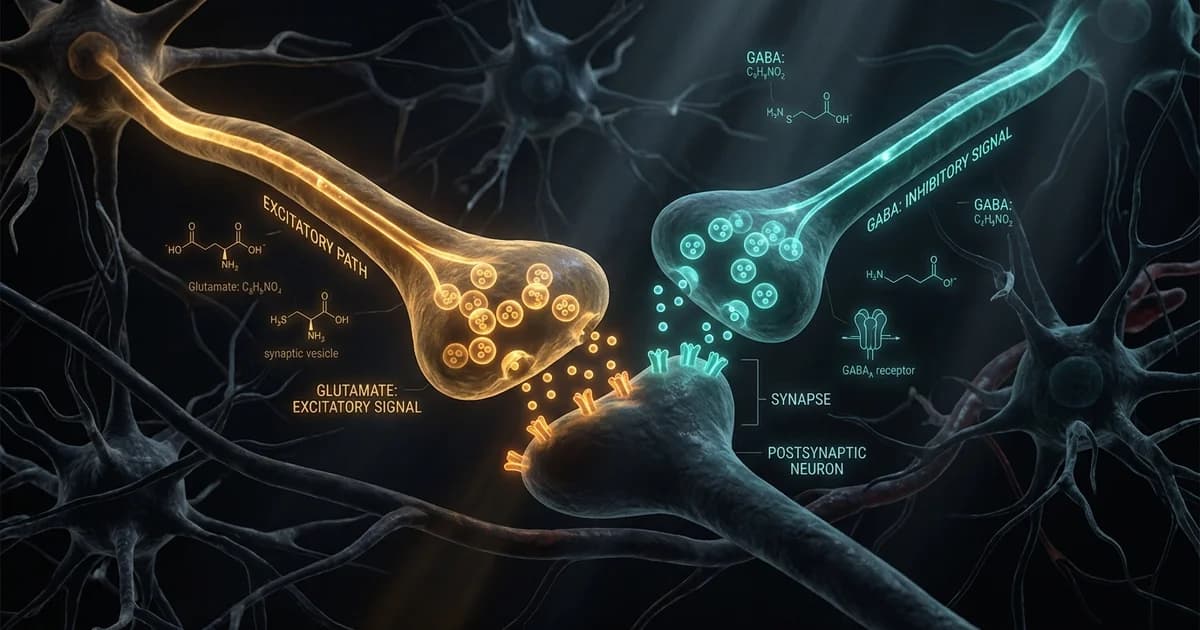
Every thought you have, every word you read right now, runs on a tug-of-war between two molecules. Glutamate and GABA are the brain's accelerator and brake, and the ratio between them decides whether you feel sharp and alert or wired and frazzled.
These two chemical messengers handle the overwhelming majority of signaling in your central nervous system. Glutamate speeds neurons up. GABA slows them down. Get the balance right and you think clearly. Tip it too far in either direction and attention, mood, and sleep all suffer.
Here is how the system actually works, why the ratio matters more than the raw levels, and what nudges it in the right direction.
Key Takeaways
- Glutamate is the brain's main excitatory neurotransmitter; GABA is the main inhibitory one. They act like an on switch and an off switch.
- Your brain's excitation inhibition balance (often called E/I balance) matters more than the absolute level of either chemical.
- GABA is built directly from glutamate, so the two are biochemically linked, not separate systems.
- A tilt toward too much excitation is associated with overstimulation; too much inhibition with sedation.
- Compounds like L-theanine appear to nudge this balance toward a calm but alert state.
What Is Glutamate? The Brain's Accelerator
Glutamate is the most abundant excitatory neurotransmitter in your brain, and it drives the signals behind learning, memory, and moment-to-moment thinking. When a neuron releases glutamate, it makes the next neuron more likely to fire.
That single action, repeated across trillions of connections, is the basis of nearly all fast information processing in the brain. GABA and glutamate act like an "on" and "off" switch, and they work in opposite ways.
Glutamate is so widespread that it sets the baseline tempo of the whole network. GABA occurs in 30 to 40% of all synapses, and only glutamate is more widely distributed.
The catch is that glutamate is powerful enough to be dangerous in excess. Too much glutamate activity can overexcite neurons, which is why the brain keeps a tight rein on it. That rein is GABA.
The GABA Neurotransmitter: The Brain's Brake
GABA is the main inhibitory neurotransmitter in your brain, and its job is to quiet things down. Where glutamate pushes neurons to fire, the GABA neurotransmitter tells them to hold back.
GABA is the main inhibitory neurotransmitter in your brain, stopping the chemical messages from passing from nerve cell to nerve cell, and it is known for producing a calming effect. This is the same system that many sedatives and anti-anxiety medications target.
Mechanically, the effect is precise. Increasing GABA at the neuronal synapse inhibits the generation of the action potential of the neuron, thereby making it less likely to excite nearby neurons, and neurons in every region of the brain use GABA to fine-tune neurotransmission.
Without that braking signal, excitatory activity would run unchecked. GABA is what keeps a busy network from tipping into chaos.
How GABA and Glutamate Are Connected
Here is the part most explanations skip. GABA and glutamate are not two unrelated chemicals. Your body manufactures GABA from glutamate, using an enzyme called glutamate decarboxylase.
That means the brake is literally built from the accelerator. The two pools are interconverted constantly, which is part of why the brain can adjust the ratio so quickly. They are two ends of one tightly managed system.
Glutamate GABA Balance: Why the Ratio Beats the Levels
The single most useful idea in this whole topic is that glutamate gaba balance matters more than how much of either chemical you have. Neuroscientists call this the excitation inhibition balance, or E/I balance brain researchers study across nearly every condition involving cognition and mood.
Think of it like an audio mix. The absolute volume of one track tells you little. What matters is whether the levels sit in proportion. Your brain is doing the same thing across billions of synapses, every second.
When excitation and inhibition stay in proportion, signals stay clear and meaningful. When the ratio drifts, the signal-to-noise of your thinking degrades. A network that is too excited struggles to filter; a network that is too inhibited struggles to engage.
This is why "more GABA" or "more glutamate" is rarely the goal on its own. The target is proportion.
What Tips the Balance
Several everyday inputs shift your E/I ratio without you noticing:
- Sleep loss tends to push the balance toward excitation, leaving the brain harder to settle.
- Chronic stress alters both glutamate and GABA signaling over time.
- Stimulants like caffeine increase arousal and excitatory tone.
- Alcohol boosts GABA activity acutely, which is part of why it sedates.
- Diet and exercise influence the raw materials and enzymes that build both neurotransmitters.
None of these act on a single chemical in isolation. They move the ratio.
A Side-by-Side Look at the Accelerator and the Brake
| Feature | Glutamate | GABA |
|---|---|---|
| Role | Main excitatory neurotransmitter | Main inhibitory neurotransmitter |
| Effect on neurons | Increases likelihood of firing | Decreases likelihood of firing |
| Plain-language analogy | Accelerator | Brake |
| Built from | Glutamine and other precursors | Glutamate (directly) |
| Associated state | Alertness, learning, in excess: overstimulation | Calm, relaxation, in excess: sedation |
| Distribution | Most widely distributed neurotransmitter | Found in roughly 30 to 40% of synapses |
The point of the table is simple. These two are mirror images of one job: controlling how readily neurons pass signals along.
Where L-Theanine Fits Into the Picture
L-theanine, an amino acid found in green tea, is one of the few well-studied compounds that appears to act on this exact balance. It is associated with a calm-but-alert mental state rather than sedation, and that profile is what makes it interesting here.
The working idea is that L-theanine modestly modulates glutamate signaling while supporting GABAergic, or calming, tone. In practice, that nudges the E/I balance gently toward calm-alert instead of pure stimulation or pure relaxation.
This is also why L-theanine pairs so naturally with caffeine. Caffeine raises excitatory arousal; L-theanine appears to smooth the edges, which is the mechanistic reason a caffeine-plus-theanine combination tends to feel focused rather than jittery. For more on that pairing, see how caffeine and L-theanine work together for focus.
Conclusion
Your brain does not run on a single chemical. It runs on a balance. Glutamate presses the accelerator, GABA applies the brake, and the ratio between them shapes how clearly you think, how easily you relax, and how well you sleep.
The practical takeaway is to stop chasing "more" of any one neurotransmitter. The brain optimizes for proportion, not volume. Inputs like sleep, stress, and what you put in your body all move that proportion, and the smartest moves are the ones that keep excitation and inhibition working in step rather than pushing one to its limit.
Frequently Asked Questions
Are glutamate and GABA opposites?
In function, yes. Glutamate is the main excitatory neurotransmitter and GABA is the main inhibitory one, so they act like an on switch and an off switch. But they are biochemically linked rather than truly separate. Your body builds GABA directly from glutamate, so the brake is made from the accelerator. They are two ends of one tightly regulated system, working in opposite directions to keep brain signaling in balance.
What is the excitation inhibition balance?
The excitation inhibition balance, often shortened to E/I balance, is the ratio between excitatory signaling (mostly glutamate) and inhibitory signaling (mostly GABA) in the brain. It matters more than the absolute level of either chemical. When the ratio stays in proportion, neural signals stay clear. When it drifts too far toward excitation or inhibition, attention, mood, and sleep can all be affected.
Is more GABA always better?
No. The goal is balance, not maximum inhibition. Too much inhibitory signaling can leave you sedated and foggy, just as too much excitation can leave you overstimulated. The brain fine-tunes both glutamate and GABA constantly to keep the ratio appropriate for the task at hand. Chasing "more GABA" misses the point. A well-functioning brain optimizes for proportion between excitation and inhibition, not for the highest possible level of either.
Does caffeine affect glutamate and GABA?
Caffeine mainly works by blocking adenosine, which increases arousal and excitatory tone in the brain. That raises alertness, but pushing excitation too hard is part of why high doses can feel jittery. Caffeine does not act on glutamate and GABA directly the way some compounds do, but its net effect tilts the overall excitation inhibition balance toward the excitatory side, which is why pairing it with a calming compound can smooth the experience.
How does L-theanine influence the glutamate GABA balance?
L-theanine appears to modestly modulate glutamate signaling while supporting calming, GABAergic tone. The result is a mental state often described as calm but alert rather than sedated. This is why L-theanine is associated with relaxed focus, and why it pairs well with caffeine: it nudges the E/I balance gently toward calm-alert, helping take the edge off pure stimulation without making you drowsy.
Can you naturally support healthy glutamate and GABA balance?
The everyday inputs that matter most are sleep, stress management, exercise, and diet, since all of them influence how the brain builds and uses both neurotransmitters. Consistent sleep helps the brain settle excitatory tone, while chronic stress tends to disrupt both systems over time. There is no single food or supplement that fixes the ratio. The most reliable approach is supporting the conditions that let your brain regulate the balance on its own.
The Calm-Alert Setting, in a Sublingual Pouch
The whole reason caffeine alone can feel jittery is that it pushes the excitation side of the ledger without a counterweight. That is the problem this article has been circling. The fix is not less stimulation, it is better balance.
That is the thinking behind Roon. Each sublingual pouch pairs 80 mg of caffeine with 60 mg of L-theanine, plus 25 mg of methylliberine (Dynamine) and 5 mg of theacrine (TeaCrine). The theanine is there for a specific reason: it nudges the E/I balance toward calm-alert, which is the mechanistic reason the caffeine in Roon tends to feel like focus instead of buzz, with a 5 to 10 minute onset and a 6 to 8 hour window with no crash.
To be clear about what this is, Roon is a focus aid, not a replacement for sleep, and not a treatment for any condition. If you want clear-headed energy that does not tip into the jitters, try Roon and feel the difference balance makes.
Written by Roon Team