Do SAD Lamps Work? What the Light Therapy Trials Found
Do SAD lamps work for diagnosed winter-pattern seasonal affective disorder? The short answer is yes, modestly. A 2020 meta-analysis of 19 randomized trials found bright light beat placebo on depression scores (18 studies) and response rates (16 studies), and a 96-person trial found 10,000 lux for 30 minutes each morning worked about as well as fluoxetine 20 mg. But the trials were small, the placebo problem is real, and there is little evidence for ordinary winter tiredness.
What the Trials Actually Show
| Study | Design | People | Light dose | Compared with | Result |
|---|---|---|---|---|---|
| Pjrek et al. 2020 | Meta-analysis (19 RCTs total; 18 pooled for scores, 16 for response) | 610 (scores), 559 (response) | 1,000+ lux, box or visor | Dim light (≤400 lux) or sham ion generator | SMD -0.37; response 1.42x as likely |
| Golden et al. 2005 | Meta-analysis of RCTs | 8 SAD bright-light studies | Bright light | Placebo conditions | Effect size 0.84 |
| Eastman et al. 1998 | Randomized, placebo-controlled | 96 | ~6,000 lux, 1.5 h/day, 4 weeks | Sham negative-ion generator | Remission 61% (morning) vs 32% (placebo); took 3+ weeks |
| Lam et al. 2006 (Can-SAD) | Double-blind RCT, 8 weeks | 96 | 10,000 lux, 30 min/morning | 100 lux + fluoxetine 20 mg | Response 67% vs 67%; light faster at week 1 |
| Rohan et al. 2016 | RCT follow-up, two winters | 177 | Light therapy, 6 weeks | CBT for SAD, 6 weeks | Same in year 1; recurrence 45.6% light vs 27.3% CBT |
| Nussbaumer-Streit et al. 2019 (Cochrane) | Prevention review | 1 study, 46 people | 2,500 lux visor | Infrared or no light | RR 0.64, CI included no effect; very low certainty |
A standardized mean difference of -0.37 is a small-to-moderate effect. People exposed to bright light scored meaningfully lower on depression rating scales than those given a placebo and were about 42% more likely to be classified as responders.
The Pjrek meta-analysis authors flag the limits: moderate heterogeneity, moderate-to-high risk of bias, and small-to-medium sample sizes. Larger, higher-quality trials are still needed. That is also why the NHS does not usually offer light therapy: it says there is not enough evidence to tell whether it is effective.
Do SAD Lamps Work Better Than a Placebo?
In the best-controlled trials, yes, but the gap is narrower than many buyers assume. The Eastman 1998 trial randomized 96 patients to morning bright light (~6,000 lux), evening light, or a sham negative-ion generator for 1.5 hours daily over four weeks. Mean depression scores showed no difference among the three groups. Only under a strict remission criterion did morning light separate: 61% vs 32% for placebo.
The effect took at least three weeks of daily use to emerge. The sham generator was a convincing placebo: expectation ratings did not differ among the three groups.
How Does Light Therapy Compare with Antidepressants and Talk Therapy?
The Can-SAD trial (Lam et al. 2006) randomized 96 patients to 10,000 lux for 30 minutes each morning plus a placebo capsule, or 100 lux (sham light) plus fluoxetine 20 mg. After eight weeks, response rates were 67% in both arms. Remission was 50% with light, 54% with fluoxetine. Light produced a faster response, already ahead at week one. Fluoxetine caused more agitation, sleep disturbance, and palpitations. A missing double-placebo arm limits how much credit either treatment can claim over expectation effects alone.
Rohan et al. 2016 compared six weeks of CBT for SAD against six weeks of light therapy in 177 people. Both worked equally well during the first winter. By the second winter, recurrence was 27.3% in the CBT group and 45.6% in the light group. NIMH summarizes it plainly: both were equally effective during treatment, but CBT's effects seemed to last longer.
How to Use a SAD Lamp
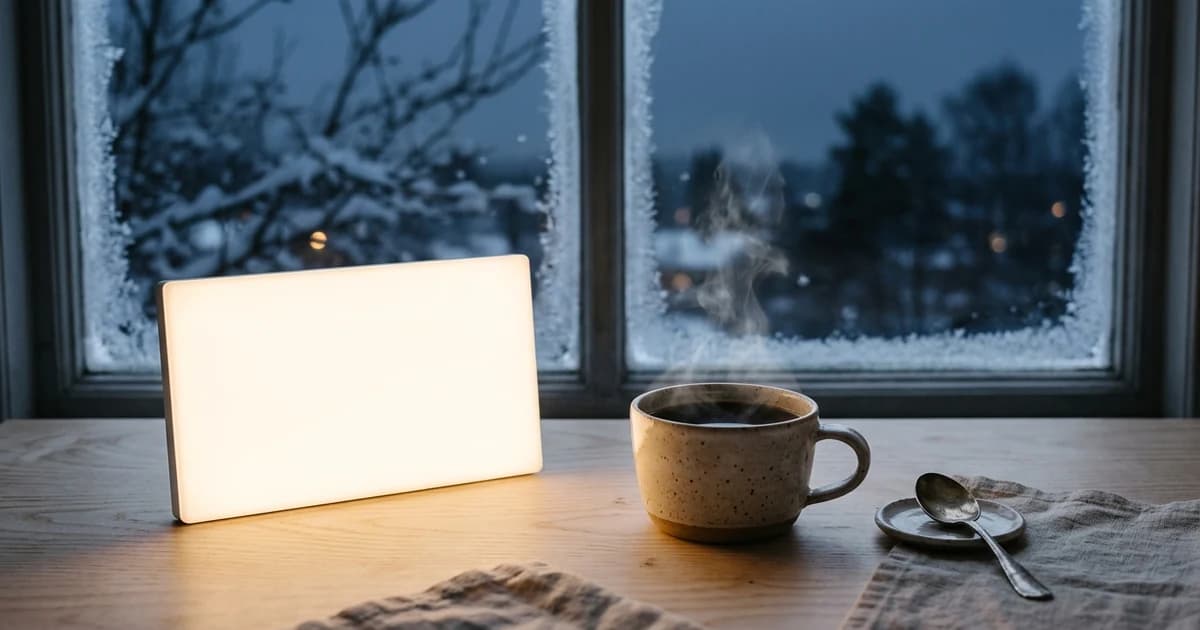
Standard guidance from NIMH and Ohio State Wexner Medical Center:
- 10,000 lux at the distance the manufacturer specifies.
- About 30 to 45 minutes a day, first thing in the morning, from fall through spring.
- UV-filtered. The box should block ultraviolet light.
- Expect results in roughly two weeks of consistent daily use (Ohio State). In the Eastman trial, a significant effect took three or more weeks.
- Talk to a clinician first if you have bipolar disorder, a pre-existing eye condition, or take medications that increase light sensitivity.
Do SAD Lamps Help If You Are Just Tired in Winter?
There is little trial evidence either way for people without a SAD diagnosis. The Cochrane 2019 prevention review found only one eligible study: 46 people, a 2,500-lux visor vs infrared vs no treatment. In the bright-light group, 43% developed SAD vs 67% receiving no light. The confidence interval included no effect, and the authors rated the evidence very low certainty.
If your complaint is afternoon fatigue rather than clinical depression, the evidence on outdoor light, sleep timing, and caffeine placement is more directly relevant.
Who Should Check with a Doctor First
- Bipolar disorder. Light therapy can trigger manic symptoms. Ohio State recommends using it only under clinician guidance, potentially at midday rather than morning.
- Eye conditions. Consult your eye doctor before starting a 10,000-lux routine (Ohio State).
- Light-sensitizing medications. The NHS advises checking with a GP.
- Side effects. Headache and eye strain are the most common side effects, reported in up to 15% of people (Ohio State).
If low mood lasts more than two weeks, affects work or relationships, or includes thoughts of self-harm, contact a doctor. In the US, call or text 988 (Suicide and Crisis Lifeline).
Light in the Morning, Caffeine Before Noon
A SAD lamp targets the morning circadian signal that goes missing in short winter days. The 3 p.m. slump is a separate issue, tied to sleep pressure and your daily circadian rhythm, and there is no trial evidence that a lamp fixes it.
Caffeine is most useful in the first half of the day, timed so it clears well before your sleep window. Roon is an 80 mg caffeine pouch some people use for winter afternoons, but it is not a treatment for SAD or low mood. If morning light alone is not enough, the next step is a clinician, not a supplement.
Related from Roon
- Why winter afternoons feel heavier
- How to reset your circadian rhythm
- The daylight saving time energy dip
Frequently Asked Questions
How long does a SAD lamp take to work?
Ohio State Wexner Medical Center estimates improvement within about two weeks of consistent daily use. The Eastman 1998 trial found that a meaningful separation from placebo required at least three weeks. Consistency matters more than session length: 30 minutes every morning at 10,000 lux is the most studied protocol.
Can you use a SAD lamp at night?
Morning use is standard. NIMH recommends first thing in the morning, from fall to spring. In the Eastman trial, the evening group had a lower remission rate (50%) than the morning group (61%). Evening bright light may also push sleep later.
Is 10,000 lux the same as sunlight?
Not the same, but it is the intensity both NIMH and Ohio State specify for treatment, and it is the dose the Can-SAD trial used for 30 minutes each morning.
Does vitamin D work instead of light therapy?
NIMH notes that studies on vitamin D supplementation for SAD have produced mixed results, so it is not an established substitute. For more, see vitamin D and brain fog.
Do you need a prescription for a SAD lamp?
Light boxes are sold without a prescription in the US. Talk to a clinician before using one for depression; the NHS advises speaking to a GP first. Self-treating a mood disorder with an unmonitored device risks delaying effective care, and people with bipolar disorder face specific risks.
Winter Afternoons Need a Longer Window
Morning light addresses the circadian piece of winter SAD. It does nothing for the separate drag that settles in mid-afternoon when daylight is already fading.
Roon is a zero-nicotine oral pouch carrying 80 mg caffeine, 60 mg L-theanine, 25 mg methylliberine (Dynamine), and 5 mg theacrine (TeaCrine). Methylliberine slows caffeine clearance: a randomized, double-blind crossover PK study (n=12) found co-administration extended caffeine's half-life from 7.2 to 15 hours and cut oral clearance from 41.9 to 17.1 L/hr, with no increase in peak concentration. That study dosed 100 mg methylliberine with 150 mg caffeine, about 4x the methylliberine and 1.9x the caffeine in a Roon pouch, so Roon's 6 to 8 hour felt window follows the same mechanism directionally rather than replicating the study's result. A 15-hour half-life is a clearance measure, not 15 hours of alertness.
Roon is not a treatment for SAD or low mood. It is a longer-lasting caffeine pouch, starting from $9.16 per tin. Place one late morning and keep the last pouch at least eight hours from when you plan to sleep. Try Roon.
Sources
- Pjrek et al. 2020, Psychotherapy and Psychosomatics
- Golden et al. 2005, American Journal of Psychiatry
- Eastman et al. 1998, Archives of General Psychiatry
- Lam et al. 2006 (Can-SAD), American Journal of Psychiatry
- Rohan et al. 2016, American Journal of Psychiatry
- Nussbaumer-Streit et al. 2019, Cochrane Review
- NIMH: Seasonal Affective Disorder
- Ohio State Wexner Medical Center: Light Therapy for SAD
- NHS: Treatment for SAD
- 988 Suicide and Crisis Lifeline
Written by Roon Team