Do Nootropic Mushrooms Actually Work? What the Human Evidence Really Shows
Roon Team
Do Nootropic Mushrooms Actually Work? What the Human Evidence Really Shows
Walk down any supplement aisle and you'll see the same promise printed on tins of powder and bottles of capsules: sharper memory, better focus, a calmer brain. The question buyers rarely ask is whether the human data backs it up.
So, do nootropic mushrooms work? The short answer is "sometimes, slowly, and not the way the marketing implies." Lion's mane has the best human evidence of the bunch, and even that evidence is thin, mixed, and measured in weeks rather than minutes. The other popular species mostly rest on animal studies.
This is a market worth paying attention to. The functional mushroom market was valued at roughly $12 billion in 2025 and is projected to keep growing near 9% a year, driven partly by demand for nootropic benefits. Big money tends to outrun the science. Here's where the research actually stands.
Key Takeaways
- Lion's mane has the strongest human cognition evidence, but it comes from small trials and works gradually over weeks, not acutely.
- Cordyceps, reishi, and chaga are mostly backed by animal models, with little confirmed human cognitive data.
- The effects, where they exist, are chronic-intake effects. Mushrooms are a long-game tool, not a same-day focus switch.
- If you want acute, fast focus, mushrooms are the wrong category. That job belongs to a different class of compounds.
Do Nootropic Mushrooms Work? Sorting Hype From Human Data
The honest answer: lion's mane shows real promise in humans, the rest mostly doesn't have the trials yet. That single sentence cuts through most of the noise around mushroom nootropics science.
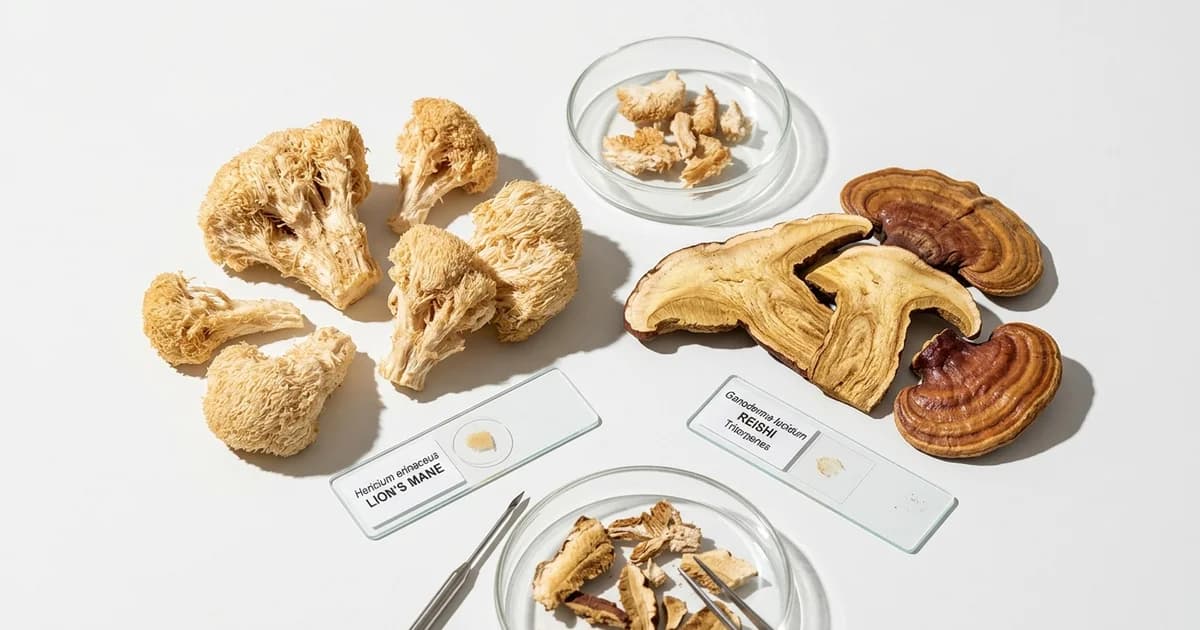
"Nootropic mushroom" is a marketing umbrella, not a scientific category. It usually covers four species: lion's mane (Hericium erinaceus), cordyceps, reishi (Ganoderma lucidum), and chaga. Each gets sold with the same brain-boosting language. Each has a wildly different evidence base.
The gap between them matters. When you evaluate functional mushrooms cognition evidence, you have to separate the one species with controlled human trials from the three riding on rodent studies and tradition. Lumping them together is how a tin of chaga ends up making lion's mane's claims.
Lion's Mane: The One With Actual Human Trials
Lion's mane is the only nootropic mushroom with multiple randomized, placebo-controlled human cognition trials. The results are encouraging and genuinely limited.
The most cited study is a 2009 Japanese trial. Researchers gave 30 older adults with mild cognitive impairment 3 grams of lion's mane daily for 16 weeks, and the active group scored higher on a standard cognitive scale at weeks 8, 12, and 16. There's a catch that rarely makes it onto the label. The improvement faded after participants stopped taking it.
That tells you something important about how this works. The benefit, if you get one, depends on continued daily intake. Stop, and it drifts back.
What the Newer Studies Found
More recent work in healthy young adults paints a murkier picture. A 2023 double-blind pilot study tested both acute and 28-day effects in young adults and reported that lion's mane shows promise for cognition and mood, while calling for larger trials to confirm it.
Then there's a 2025 acute study that deserves attention precisely because it was unflattering. A double-blind, placebo-controlled trial published in Frontiers in Nutrition found no marked effect of a single dose on overall cognitive function or mood. Digging into individual tasks, one measure of performance speed improved at the 90-minute mark, but the headline result was a null.
The pattern across the lion's mane research is consistent. Modest, mostly chronic, sometimes absent, and never the dramatic same-hour lift the packaging suggests.
Cordyceps, Reishi, and Chaga: Mostly Mice
Here's the part the marketing leaves out: cordyceps, reishi, and chaga have almost no human cognition trials at all. Their brain claims rest largely on cell cultures and rodent studies.
Cordyceps is a good example. Reviews note it looks promising for memory and fatigue, but as one analysis of adaptogenic mushrooms put it plainly, those benefits appear in mice and no human trials have confirmed them for cognition.
Reishi has a slightly different story. Some human work suggests it may help well-being and resilience during demanding health conditions, but a review of medicinal mushrooms for cognition and mood found the cognitive signal strongest in lion's mane, with reishi's role tied more to stress and quality of life than raw mental performance. For medicinal mushrooms brain claims specifically, the human cognition data is sparse.
A systematic review of dietary mushroom supplementation for cognitive impairment captured the situation well. Of the human trials it examined, only two found positive results on at least one cognitive measure, across heterogeneous designs, doses, and durations. That is not a strong foundation for a multibillion-dollar brain category.
How Mushroom Nootropics Actually Work (And Why It's Slow)
The proposed mechanism explains why mushrooms are a long-game tool rather than a quick one. Lion's mane contains compounds called hericenones and erinacines that may support nerve growth factor, a protein involved in keeping neurons healthy.
That's a structural, build-over-time process. You don't grow neural support tissue in fifteen minutes. You support it across weeks of consistent intake, which is exactly what the 16-week trials measured.
This is the core insight buyers miss. Mushroom cognition research is about gradual neural support, not acute stimulation. So when someone takes a lion's mane capsule expecting a desk-side focus surge before a meeting, they're using the wrong tool for the job and then concluding the whole category is fake.
It isn't fake. It's just slow, and it's been mismarketed as fast.
Nootropic Mushrooms vs Fast-Acting Focus Tools
Are mushroom supplements legit? Yes, for what they actually do, which is chronic, gradual brain support with the best evidence behind lion's mane. They are not acute focus tools, and judging them as if they were is unfair to both categories.
The table below maps the honest difference between long-game mushroom support and fast-onset focus compounds.
| Tool | Onset | Best Evidence | What It's Good For | What It Won't Do |
|---|---|---|---|---|
| Lion's Mane | Weeks of daily use | Small human RCTs (MCI, mixed in healthy adults) | Gradual neural support over time | Acute, same-day focus |
| Cordyceps / Reishi / Chaga | Weeks (if at all) | Mostly animal models | General wellness, stress resilience | Proven human cognitive lift |
| Caffeine + L-theanine | 30-60 min | Well-studied human trials | Calm, alert focus | Long-term neural remodeling |
| Roon (caffeine, L-theanine, Dynamine, TeaCrine) | 5-10 min sublingual | Studied ingredients, fast onset | Acute 6-8 hr focus, no crash | Replace chronic brain nutrition |
The point isn't that one beats the other. They answer different questions. If you want help with deep work this afternoon, you need fast-onset support. If you want to support your brain over the next year, that's where consistent mushroom intake fits. For more on the acute side of that equation, our breakdown of how caffeine and L-theanine work together for focus covers the fast-acting category in depth.
Frequently Asked Questions
Do nootropic mushrooms work for focus and memory?
Lion's mane has the best human evidence, with small randomized trials showing gradual cognitive gains over weeks, mostly in older adults with mild cognitive impairment. Results in healthy young adults are mixed, and one 2025 acute study found no marked effect from a single dose. Cordyceps, reishi, and chaga rest mainly on animal data. So mushrooms can support cognition over time, but they're not a reliable same-day focus tool.
How long does lion's mane take to work?
Weeks, not minutes. The most cited human trial measured benefits at 8, 12, and 16 weeks of daily 3-gram dosing, and the gains faded after participants stopped. Lion's mane works through gradual neural support, not acute stimulation, so consistency matters more than any single dose. If you take one capsule expecting an immediate lift, you'll likely be disappointed.
Is lion's mane better than cordyceps or reishi for the brain?
For cognition specifically, yes. Lion's mane is the only one of the popular nootropic mushrooms with multiple controlled human cognition trials. Cordyceps shows promise mostly in mice, and reishi's human evidence leans toward stress and well-being rather than raw mental performance. If your goal is brain support backed by human data, lion's mane is the clear pick among the three.
Are mushroom supplements legit or just hype?
They're legit for what they actually do, which is gradual brain and wellness support with the best evidence behind lion's mane. The hype problem comes from marketing that implies fast, dramatic cognitive effects the human trials don't support. Treat mushrooms as a slow, long-game investment and the category makes sense. Expect an instant focus switch and you'll feel misled.
Can I take mushrooms and caffeine together?
Yes, they target different timelines and don't conflict. Mushrooms work on chronic neural support over weeks, while caffeine and L-theanine deliver acute, same-day focus within an hour. Many people use both: a daily mushroom routine for the long game and a fast-acting focus tool for demanding work sessions. They complement each other rather than compete.
What dose of lion's mane did the studies use?
The landmark 2009 trial used 3 grams of dried lion's mane daily, split into doses across the day, for 16 weeks. Newer studies have used standardized extracts at varying doses with less consistent results. There's no settled "optimal" dose for healthy adults yet, which is part of why the evidence remains preliminary.
The Bottom Line on Mushrooms and Your Brain
Nootropic mushrooms are real, useful, and badly oversold. Lion's mane has earned its place as the one species with genuine human cognition trials, even if those trials are small and the effects are gradual. The rest of the category is mostly waiting for the human research to catch up to the marketing.
The single most useful reframe is about time. Mushrooms are a chronic-intake, long-game tool for supporting your brain over weeks and months. They were never built to power a focused afternoon. Judge them on their own timeline and they hold up. Ask them to do an acute job and they fail, which is exactly the mismatch behind most of the disappointment.
When You Need Focus Now, Not in Sixteen Weeks
The honest gap this article keeps pointing to is timing. Mushrooms support the brain slowly, over weeks. They do nothing for the meeting that starts in ten minutes. That's not a flaw in mushrooms, it's just a different job.
Roon is built for the fast side of that divide. It's a sublingual pouch with four ingredients, 80 mg caffeine, 60 mg L-theanine, 25 mg methylliberine (Dynamine), and 5 mg theacrine (TeaCrine), designed to come on in 5 to 10 minutes and hold steady for 6 to 8 hours with no jitters and no crash. It's the acute focus tool, not the chronic brain-nutrition one.
So treat the two as teammates. A daily lion's mane routine is a reasonable long-game bet on neural support, and Roon covers the hours when you need to perform right now. Roon won't grow nerve tissue over four months, and it doesn't pretend to. Try it for the deep-work sessions mushrooms were never designed to handle.
Written by Roon Team