Deer Hunting Checklist: What to Pack, Phase by Phase
A deer hunting checklist has four parts: paperwork (license, tags, landowner permission), clothing in layers with hunter orange where your state requires it, the hunting kit (weapon, ammunition or arrows, knife, drag rope, light, map), and safety gear led by a full-body harness for any tree stand. The Michigan and Indiana DNR checklists below cover all four.
Before you start
Three things matter more than any piece of gear. First, your license and tags: Indiana's DNR lists the license twice because, as the agency puts it, "it's on here twice, it's THAT important" (Indiana DNR). Second, landowner permission. Third, a full-body fall-arrest harness if you hunt from a tree stand. Know your state's hunter orange requirements before buying clothing. Michigan requires it during firearm season (Michigan DNR). Indiana specifies 144 square inches visible from all sides for blinds.
Step 1: A week before the hunt
- Buy your license and tags online or at an agent well before the opener.
- Secure landowner permission and confirm property lines.
- Read the current regulations. Season dates, legal equipment, and check-in procedures change yearly.
- Scout your area. Trails, bedding areas, entry routes that keep you downwind.
- Sight in your firearm or bow at the range.
- Practice climbing the stand with the harness on. The Indiana DNR lists this as its own item: "Practice climbing your tree stand or setting up your blind, practice with safety harness."
- Inspect all equipment. Check tree stand straps, cables, and platform integrity.
Step 2: The night before
- Lay out layers by the forecast. Michigan DNR recommends a moisture-wicking base (not cotton), thinner mid layers, and a wind/waterproof outer. That outer layer can be "very noisy, especially in the cold" (MI DNR).
- Wash hunting clothes with unscented, non-brightening detergent.
- Sharpen the knife.
- Charge phone and headlamp. Pack spare batteries.
- Leave your plan with someone. The Michigan DNR: "always make sure someone knows about your hunting plans, where you'll be hunting and when you're expected to return."
The deer hunting checklist
| Item | When | Source |
|---|---|---|
| License and tags | Week before | Both |
| Landowner permission | Week before | IN DNR |
| Current regulations guide | Week before | IN DNR |
| Ammunition or arrows, sighted in | Week before | Both |
| Tree stand, inspected | Week before | MI DNR |
| Full-body harness and safety rope | Week before / on body | Both |
| Hunter orange vest, hat, or jacket | Night before | MI DNR |
| Base layer (moisture-wicking, not cotton) | Night before | MI DNR |
| Mid layers (multiple thin) | Night before | MI DNR |
| Outer layer (wind/waterproof, quiet) | Night before | MI DNR |
| Wool socks, plus spare pair | Night before | MI DNR |
| Insulated boots (one size up) | Night before | MI DNR |
| Gloves (trigger-compatible) | Night before | MI DNR |
| Unscented detergent wash | Night before | IN DNR |
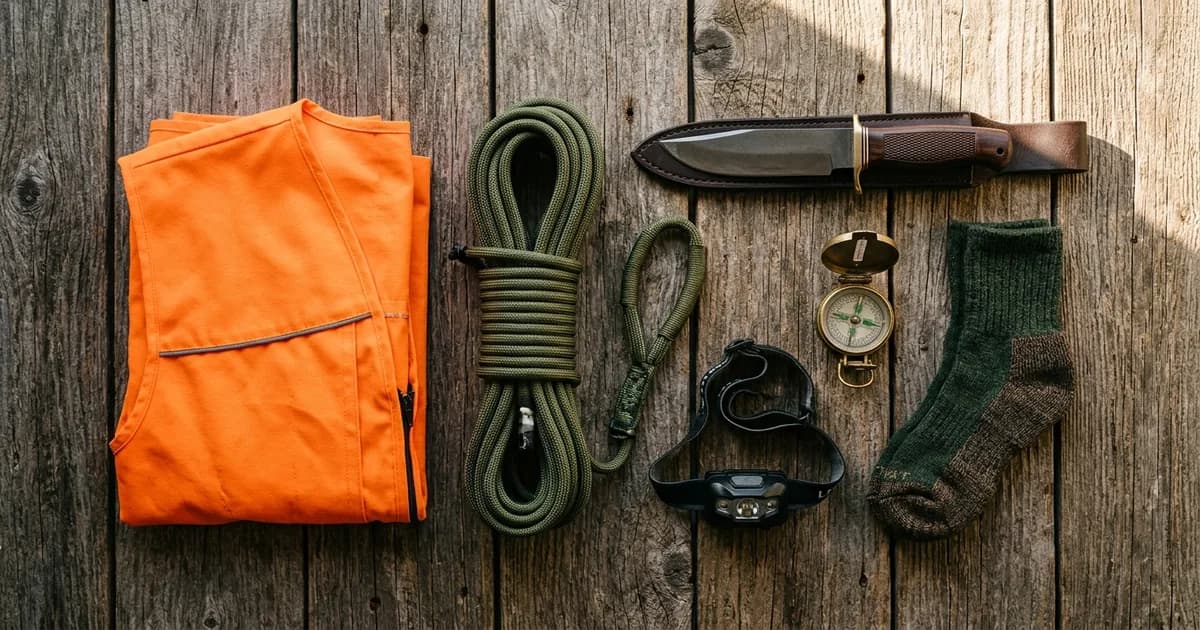
| Field-dressing knife (3-inch blade) | In the pack | MI DNR |
| Surgical gloves | In the pack | MI DNR |
| Drag rope | In the pack | IN DNR |
| Small saw or pruners | In the pack | IN DNR |
| Zip ties or string, pen | In the pack | IN DNR |
| Flashlight/headlamp, spare batteries | In the pack | Both |
| Map, compass, GPS | In the pack | Both |
| First aid kit | In the pack | IN DNR |
| Binoculars or rangefinder | In the pack | IN DNR |
| Backpack (waterproof, quiet) | In the pack | MI DNR |
| Water, thermos, snacks | In the pack | IN DNR |
| Caffeine, if you use it | In the pack | Roon note |
| Cell phone (fully charged) | On your body | Both |
Built from the Michigan DNR and Indiana DNR deer hunting checklists, checked Oct 2026. Check your own state's rules for orange and tagging.
Troubleshooting
- Forgot your harness. Do not climb. Hunt from the ground or a ground blind instead. No shortcut is worth the fall risk documented in the studies below.
- Weather changed overnight. Add or subtract mid layers rather than swapping a single heavy layer. Bring both options in the pack so you can adjust on stand.
- Headlamp or flashlight dead. Use your phone flashlight sparingly to preserve battery for check-in and emergency calls. Pack a backup light or extra batteries next time.
What should you wear deer hunting?
Wear layers you can adjust, boots one size up, wool socks, trigger-friendly gloves and whatever hunter orange your state requires. The Michigan DNR says to buy boots one size larger than your shoe size and suggests two pairs: one with 400 grams of insulation for early fall and one with 800 to 1,600 grams for winter. Pack wool socks and a spare pair.
Gloves: "Make sure you can pull the trigger while wearing them" (MI DNR). Thin liners under insulated shells let you strip down for the shot.
Hunter orange: Michigan requires it in firearm season. Indiana specifies 144 square inches visible from all sides for blinds (IN DNR). Check your state.
Do you need a harness for a tree stand?
Yes. Both DNR checklists list a full-body harness with any tree stand. Michigan calls it "essential" and specifies a safety rope attached to the tree while climbing.
A single-center study of 20 hunters treated for urologic injuries after tree stand falls found 95% wore no fall-arrest harness (Christensen & Brandes, South Med J, 2008). A larger Wisconsin review found 65 of 117 fall patients had spine fractures (Hamilton et al., WMJ, 2017). Those authors recommend keeping stands at 10 feet or less, associated with lower spinal cord injury risk. More on staying safe and alert: staying awake in the deer stand.
Food, water, and caffeine
The Indiana DNR lists "Water bottle/thermos/snacks" as one line. For what to pack: hunting snacks for all-day sits and quiet, low-scent stand snacks. On the thermos, whether deer can smell coffee is worth reading first.
Caffeine ceiling: the FDA says 400 mg a day from all sources is not generally associated with negative effects for most healthy adults; if you are pregnant or have a medical condition, ask your doctor. If you are driving home and sleeping early, land your last dose at least eight hours before bed. A caffeine pouch removes the thermos lid, the pour, and the extra liquid on stand.
After the shot
Indiana DNR's post-harvest sequence:
- Field dress as soon as possible.
- Drag out using your rope.
- Affix the temporary transportation tag with the zip tie and pen you packed.
- Check in at a station or online per your state's rules.
- Process the deer yourself or take it to a processor.
When done: clean gear, thank the landowner, store everything for next year.
Related from Roon
Frequently Asked Questions
What should a beginner bring deer hunting?
Four categories: paperwork (license, tags, landowner permission), layered clothing with hunter orange if required, a hunting kit (weapon, ammunition, knife, drag rope, flashlight, map), and safety gear beginning with a full-body harness for any tree stand. The table above covers 27 items from the Michigan and Indiana DNR checklists.
Do I need to carry my hunting license in the field?
Yes. In Indiana, electronic copies are valid (IN DNR). Other states may still require a physical card. Check your regulations before relying on a digital copy.
What should I not forget for a tree stand?
The harness. Both DNR checklists list it as the lead safety item. Michigan also specifies a safety rope attached to the tree while climbing. Without those two items, do not go up.
How early should I start packing?
A week before: license, tags, landowner permission, sighting in, and a practice climb with the harness. The night before: clothing, knife, headlamp charge, and telling someone your plan. Two sessions keep opener morning simple.
One Less Thing Rattling in the Pack
The checklist puts caffeine on one line: portable, quiet, packable. Roon is an 80 mg caffeine pouch with 60 mg L-theanine, 25 mg methylliberine (Dynamine), and 5 mg theacrine (TeaCrine) that tucks under the lip. Cool Mint, zero nicotine, zero sugar. One tin of 15 pouches fits in a chest pocket with no lid, no liquid, and no thermos clanking against the rail.
The duration comes from methylliberine, which slows caffeine clearance. In a randomized, double-blind crossover PK study (n=12), methylliberine co-administered with caffeine more than doubled caffeine's half-life (from a baseline of 7.2 hours) and cut oral clearance from 41.9 to 17.1 L/hr without raising the peak (study). That study gave 100 mg methylliberine with 150 mg caffeine, about 4x the methylliberine and 1.9x the caffeine in one Roon pouch, so a pouch works by the same mechanism but will not match the study's numbers. A longer half-life is not hours of felt energy either: most people feel a Roon pouch for roughly 6 to 8 hours, enough to cover a dawn-to-noon sit. Because that extended clearance works both ways, keep your last pouch at least eight hours before you plan to sleep.
Roon carries a faint mint scent, so it is not scent-free. Stay at or below 4 pouches a day and 400 mg total caffeine from all sources. Roon costs from $9.16 per tin on a 12-tin subscription.
Sources
- Michigan DNR: Deer Hunting Gear Checklist
- Indiana DNR: Deer Hunting Checklist (PDF)
- Christensen TL, Brandes SB. "Urologic injuries sustained after free falls from hunting tree stands." South Med J. 2008;101(4):383-7. PubMed
- Hamilton K, Rocque B, Brooks N. "Spine and Spinal Cord Injuries After Falls From Tree Stands During the Wisconsin Deer Hunting Season." WMJ. 2017;116(4):201-205. PubMed
- FDA: Spilling the Beans: How Much Caffeine is Too Much?
Written by Roon Team