Cold Brew Ratio: Coffee to Water for Any Batch Size
Roon Team
Cold Brew Ratio: Coffee to Water for Any Batch Size
The ideal cold brew ratio depends on whether you want concentrate or a ready-to-drink batch. For concentrate, use 1 part coffee to 4 or 5 parts water by weight. For ready-to-drink cold brew, use 1:8. Steep coarse grounds 12 to 24 hours in the fridge, strain, and refrigerate. Dilute concentrate 1:1 to 1:2 with water or milk before drinking. The table below gives you exact grams, ounces, and cups for every common container.
Key takeaways:
- Concentrate (1:4 to 1:5) saves fridge space and lets you dial in strength when you dilute. A 1:4 concentrate cut 1:1 lands at about 1:8.
- Ready to drink (1:8) brews at drinking strength and skips the dilution step. Many home brewers and recipe sites use this ratio. (Counter Culture brews at 1:8 but treats it as a concentrate and dilutes further.)
- Weigh your coffee. A "cup" of coarse grounds weighs roughly 85 g, but that swings with grind size and roast. A $15 kitchen scale removes the guesswork.
Cold Brew Ratio Chart: Coffee to Water by Batch Size
Water volume is what you pour in. Grounds absorb liquid, so yield is lower. (The OXO manual: 40 oz water in, 24 to 28 oz concentrate out.) Cup measurements assume roughly 85 g per cup of coarse grounds, consistent with the Takeya (106 g per 1 1/4 cups) and OXO (284 g per 3.5 cups) manuals.
| Container | Water | 1:4 concentrate | 1:5 concentrate | 1:8 ready to drink |
|---|---|---|---|---|
| 16 oz jar (473 mL) | 16 fl oz | 118 g / 4.2 oz / ~1 1/3 cups | 95 g / 3.4 oz / ~1 cup + 2 tbsp | 59 g / 2.1 oz / ~3/4 cup |
| 1 quart (946 mL) | 32 fl oz | 236 g / 8.3 oz / ~2 3/4 cups | 189 g / 6.7 oz / ~2 1/4 cups | 118 g / 4.2 oz / ~1 1/3 cups |
| 2 quarts (1,893 mL) | 64 fl oz | 473 g / 16.7 oz / ~5 1/2 cups | 379 g / 13.4 oz / ~4 1/2 cups | 237 g / 8.4 oz / ~2 3/4 cups |
| 1 gallon (3,785 mL) | 128 fl oz | 946 g / 33.4 oz / ~11 cups | 757 g / 26.7 oz / ~9 cups | 473 g / 16.7 oz / ~5 1/2 cups |
If you are using tablespoons and refuse to buy a scale, one level tablespoon of coarse grounds weighs roughly 5 to 6 g. This is imprecise. Buy the scale.
Cold Brew Concentrate Ratio vs. Ready to Drink
A cold brew concentrate ratio of 1:4 or 1:5 means 1 gram of coffee per 4 or 5 grams (or milliliters) of water. The result is too strong to drink straight. You dilute it afterward with water, milk, or ice.
Why bother with concentrate? It takes up less fridge space, and you control the final strength every pour. Want it lighter for the afternoon? Go 1:2. Want it punchy over ice that will melt? Go 1:1.
A 1:5 concentrate diluted 1:1 gives you roughly a 1:10 drinking strength. A 1:4 concentrate diluted 1:1 gives you roughly 1:8. This is why 1:8 appears as the standard ready-to-drink ratio from Counter Culture and others: it is the math, not a coincidence.
What the Manuals Say: Toddy, OXO, Takeya
If you bought a cold brew maker and lost the manual, here is what each brand actually recommends. Notice that the implied brew ratios span from about 1:4 to 1:9.
| Maker | Coffee | Water | Implied ratio | Steep time | Dilution | Storage |
|---|---|---|---|---|---|---|
| Toddy Cold Brew System (2022 manual) | 12 oz / 340 g | 8 cups / 64 fl oz / 1.9 L | ~1:5.6 | 8 to 24 hours, room temp | 1 part concentrate : 2 parts water | Up to 2 weeks refrigerated |
| OXO Good Grips | 10 oz / 284 g (~3.5 cups) | 40 oz / ~1,180 mL (5 cups) | ~1:4.2 | 12 to 24 hours, room temp | 1:2 to 1:3 concentrate to water | Not specified in manual |
| Takeya (1 qt model) | 1 1/4 cups / ~106 g | Fill to line (~840 mL after filter) | ~1:8 to 1:9 | 24 hours, refrigerated | None (ready to drink) | Up to 2 weeks airtight |
| Counter Culture | 125 g | 1,000 g | 1:8 | 14 hours, refrigerated | 2:1 to 1:1 concentrate to water | Keep refrigerated |
One note on Toddy: many roaster guides (Klatch, Koffee Kult, and others) still print "7 cups of water" and a 1:3 dilution. That matches an older Toddy manual, not the current 2022 version. The updated guide calls for 8 cups and a 1:2 dilution.
How Long to Steep Cold Brew
Manuals say anywhere from 8 hours (Toddy) to 24 hours (Takeya). Counter Culture splits the difference at 14 hours in the fridge. So which is it?
A 2017 study by Fuller and Rao in Scientific Reports measured caffeine and chlorogenic acid extraction across four cold brew samples (dark and medium roast, medium and coarse grind). Caffeine and chlorogenic acid concentrations reached equilibrium between 6 and 7 hours in all samples. After that point, you are extracting flavor compounds, not more caffeine.
A 12-hour steep and a 24-hour steep will have similar caffeine levels, but the longer one may taste woody or astringent from overextracted tannins. Start at 14 to 16 hours in the fridge and adjust by taste.
French Press Cold Brew Ratio
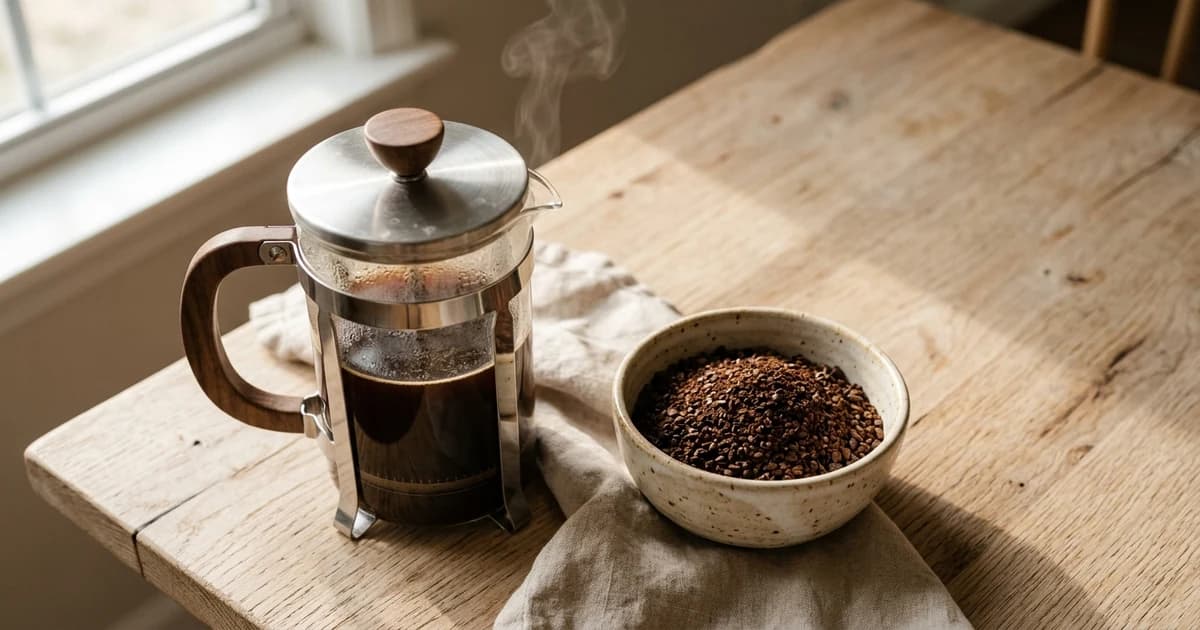
The ratios above work in a French press. Use 1:8 for ready to drink, 1:4 to 1:5 for concentrate. The press plunger replaces a paper or mesh filter.
Method: Add coarse grounds to the press, pour cold water, stir gently, cover with the plunger (do not press down), and refrigerate 14 to 24 hours. Press, pour through a fine-mesh strainer if you want a cleaner cup, and store separately. Do not leave grounds sitting in the press after brewing.
For a deeper breakdown of press ratios for hot and cold methods, see the French press coffee to water ratio guide.
How Long Does Cold Brew Last?
Both Toddy and Takeya say concentrate keeps up to 2 weeks in the refrigerator in an airtight container. The National Coffee Association's 2022 Cold Brew Safety Guide for Retailers notes that cold brew "requires special attention to food safety" because it never sees the high temperatures that kill bacteria during hot brewing.
Rules of thumb:
- Concentrate: up to 2 weeks, sealed and refrigerated.
- Diluted cold brew: use within 2 to 3 days. Water and milk shorten the shelf life.
- Room temperature: do not store cold brew on the counter. Steeping at room temperature is fine (the Toddy manual calls for it); storing the finished product there is not.
- Smell test: if it smells sour or off, pour it out.
How Much Caffeine Does Each Ratio Give You?
No honest answer can give you an exact milligram count for a homemade batch. Caffeine extraction depends on bean variety, roast level, grind size, water temperature, and steep time. A stronger ratio with less dilution puts more caffeine in the glass.
The Fuller and Rao study found that medium roast extracted higher caffeine concentrations than dark roast in cold brew. If you are caffeine-sensitive, going darker is directionally the right move.
Here are some reference points:
| Source | Serving | Caffeine |
|---|---|---|
| Starbucks Cold Brew, grande | 16 fl oz | ~205 mg |
| Brewed drip coffee (USDA avg) | 8 fl oz | ~95 mg |
| FDA daily guideline | per day | up to 400 mg (roughly 2 to 3 twelve-ounce cups) |
| Roon pouch (caffeine pouch, not a drink) | 1 pouch | 80 mg |
The FDA cites 400 mg per day as the amount not generally associated with negative effects for most healthy adults. A Starbucks grande cold brew is already half that ceiling. Two glasses of strong homemade concentrate diluted lightly could push past it. Track your intake. For more context, see is 300 mg of caffeine a lot and caffeine in a cup of coffee by brew and size.
Common Cold Brew Mistakes
Grinding too fine. Cold brew needs coarse grounds, roughly the texture of raw sugar. Fine grounds over-extract, taste bitter, and clog filters. Your yield drops and your patience drops with it.
Measuring by scoops. A "scoop" is not a unit. Coarse grounds pack loosely, and the same scoop can vary by 30% between coffees. Weigh it.
Steeping on a hot counter. If your kitchen sits above 75°F / 24°C in summer, steep in the fridge. Warmer water extracts faster and can push the flavor toward harsh.
Forgetting to dilute. Concentrate is concentrate. If you drink it straight, you are getting roughly double the caffeine per glass of what the recipe intended.
Keeping it too long. Two weeks is the outer edge for sealed concentrate. Once diluted, finish it within a few days.
The Right Ratio Depends on How You Drink It
Pick the ratio that matches your setup: 1:4 or 1:5 for concentrate you will dilute, 1:8 for ready to drink. Weigh your coffee, steep 14 to 24 hours in the fridge, and taste the result before adjusting. The manuals disagree with each other because there is no single correct number. There is only the number that tastes right to you, held consistent with a scale.
Frequently Asked Questions
What is the best cold brew ratio?
For most people, 1:8 by weight (1 g coffee per 8 g water) produces a balanced ready-to-drink cold brew. If you prefer to make a concentrate you dilute later, use 1:4 to 1:5. There is no single "best" because taste is personal, but 1:8 is the ratio most specialty roasters recommend as a starting point.
What is the ratio for cold brew concentrate?
Cold brew concentrate typically uses a 1:4 to 1:5 coffee-to-water ratio by weight. After brewing, dilute it 1:1 to 1:2 with water, milk, or ice. The OXO manual uses roughly 1:4.2, and the Toddy system lands at about 1:5.6. Both are concentrate recipes.
How much coffee for 32 oz of cold brew?
At a 1:8 ready-to-drink ratio, you need about 118 g (4.2 oz, roughly 1 1/3 cups) of coarse grounds for 32 fl oz of water. For a 1:5 concentrate, use about 189 g (6.7 oz, roughly 2 1/4 cups). Check the batch table above for other sizes.
How long should cold brew steep?
14 to 24 hours in the refrigerator is the safe window for good flavor. Research shows caffeine extraction plateaus around 6 to 7 hours (Fuller and Rao, 2017), so longer steeps change flavor more than caffeine content. Start at 14 hours and adjust.
Can you steep cold brew too long?
Yes. Beyond 24 hours, you risk pulling harsh, woody, or bitter compounds from the grounds. The caffeine is done extracting long before that point. If you forget a batch for 36 hours, it will still be safe to drink (assuming refrigeration), but it may taste unpleasant. Strain it and see.
Is cold brew stronger than regular coffee?
It depends on the ratio and dilution. A Starbucks grande cold brew has about 205 mg per 16 oz, while 16 oz of average drip coffee has roughly 190 mg (~95 mg per 8 oz, USDA). Undiluted concentrate is much stronger per ounce. Diluted to drinking strength, it is in the same range as drip.
When the Batch Runs Out: 80 mg That Lasts the Afternoon
Cold brew rewards planning. You measure, steep, wait 14 to 24 hours, strain, and dilute. Some mornings the jar is empty and there is no backup.
Roon is a different format for a different problem. Each pouch delivers a fixed 80 mg of caffeine, paired with 60 mg L-theanine, 25 mg methylliberine (Dynamine), and 5 mg theacrine (TeaCrine). The methylliberine is there for duration: in a randomized, double-blind, crossover PK study (n=12), co-administration of methylliberine with caffeine cut caffeine's oral clearance from 41.9 to 17.1 L/hr and extended its half-life from 7.2 to 15 hours, with no increase in peak concentration (study). That study used 100 mg methylliberine plus 150 mg caffeine, roughly 4x and 1.9x Roon's doses, so the magnitude will differ. The mechanism is directionally the same, and Roon's felt window is 6 to 8 hours. Onset is 5 to 10 minutes, no steeping required. Because of the extended half-life, stop at least 8 hours before bed. For more on caffeine timing, see the latest you can drink coffee and still sleep.
Roon is not a replacement for your cold brew ritual. It is the pouch in the desk drawer for the day you did not plan ahead. From $9.16 per tin (12-tin subscription) or $15.00 per tin one-time. First orders come with a 30-day money-back guarantee.
Related from Roon
- French press coffee to water ratio
- How much caffeine in a cup of coffee
- How long does caffeine stay in your system
- When coffee upsets your stomach
Written by Roon Team