Cheapest Nootropic Pouches per Serving
Cheapest Nootropic Pouches per Serving: What You Actually Pay in 2026
The cheapest nootropic pouches in 2026 cost between $0.28 and $1.00 per pouch at one-time retail, but that number alone is nearly useless. A $0.28 pouch delivering 20mg of caffeine and nothing else is not the same product as a $1.00 pouch stacking 80mg caffeine with three additional nootropic compounds. Cost per serving only means something when the "serving" is doing similar work. This guide prices every major brand on two honest units: raw cost per pouch and cost per 100mg of caffeine equivalent, so you can compare what you actually pay for what you actually get.
Key takeaways:
- Per-tin pricing is misleading because tins range from 15 to 20 pouches and caffeine doses range from 20mg to 80mg.
- Grinds is the cheapest pouch on the market in absolute dollars, but its caffeine per pouch is the lowest at roughly 20 to 25mg.
- Subscription pricing cuts costs 35% to 55% depending on the brand, making it the single biggest variable in your annual spend.
- Cost per active milligram tells a different story than cost per pouch, especially for multi-ingredient stacks.
How Much Do the Major Nootropic Pouches Cost in 2026?
Below is a side-by-side comparison of every major nicotine-free nootropic and caffeine pouch brand in the U.S. market, priced as of early 2026. Prices reflect each brand's own direct-to-consumer store page or verified Amazon listing. Where a price could not be confirmed against a current storefront, the cell says "unverified."
| Brand | Pouches/Tin | Caffeine (mg/pouch) | Key Extras | One-Time $/Pouch | Sub $/Pouch | $/100mg Caffeine (One-Time) | Best For |
|---|---|---|---|---|---|---|---|
| Grinds | ~18 | 20–25 | Taurine, B vitamins | ~$0.28–$0.33 | N/A (bulk discount) | ~$1.32 | Budget dip replacement |
| Nectr Energy | 20 | 50 | None (caffeine only) | ~$0.55 ($10.99 per 20-pouch tin) | ~$0.36 (up to 35% off) | ~$1.10 | Caffeine-only delivery |
| Nectr Focus+ | 20 | 50 | 100mg L-theanine, 85mg alpha-GPC, 85mg L-tyrosine | ~$0.60 ($11.99 per 20-pouch tin) | ~$0.39 (up to 35% off) | ~$1.20 | Multi-ingredient stack |
| NZE Energy | 15 | 50 | Alpha-GPC, L-tyrosine, L-theanine | ~$0.47 | Unverified | ~$0.93 | Costco availability |
| Cyclone Pods Focus | 20 | 50 (guarana) | 5 adaptogen/mushroom blend | ~$0.50 | Unverified | ~$1.00 | Adaptogen-first users |
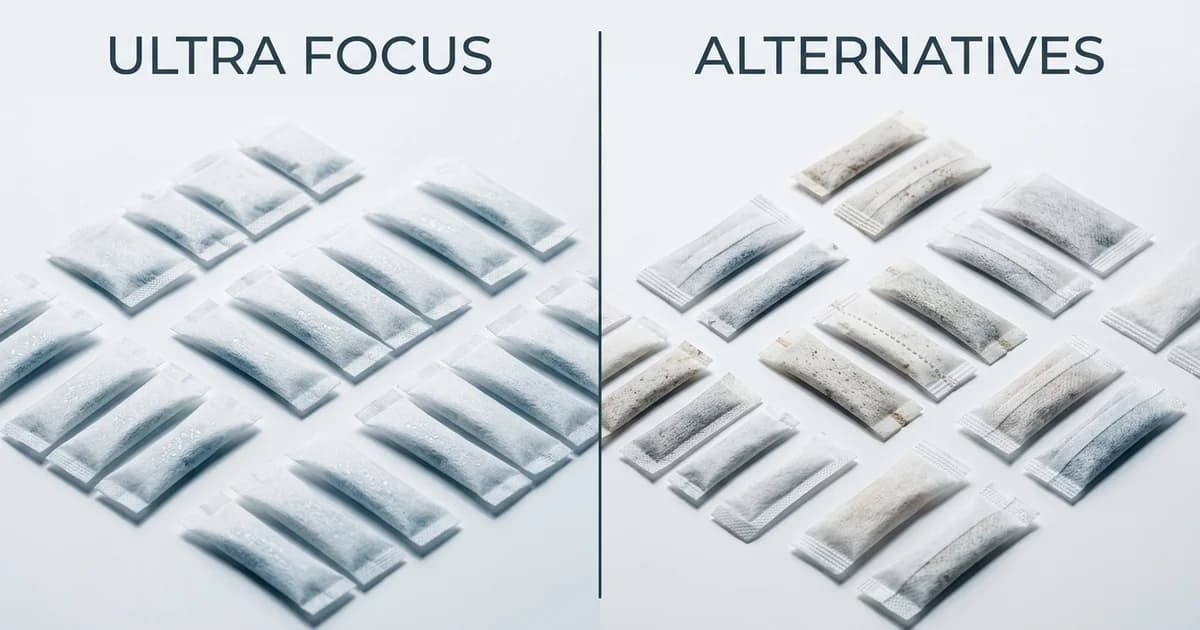
| Ultra Focus | 15 | 0 (100 mg paraxanthine, Amazon label) | L-theanine, alpha-GPC, ginseng, B6, B12 | ~$1.07 | Unverified | N/A (no caffeine) | Caffeine-free stimulation |
| Roon | 15 | 80 | 60mg L-theanine, 25mg Dynamine, 5mg TeaCrine | $1.00 | $0.61 | $1.25 (one-time) / $0.76 (sub) | Sustained 6–8 hr multi-compound focus |
Sources. Grinds pricing from their direct store and Cyclone Pods' review. Nectr from their own site: $8.99 per 20-pouch Zero tin, $10.99 for Energy, $11.99 for Focus+. NZE from their $34.99 five-pack listing (75 pouches total). Ultra per-pouch pricing from Cyclone Pods' comparison. Roon from its product page: $15.00 per tin one-time (4-tin minimum), $9.16 per tin on the cheapest subscription. Unverified cells mean no live storefront price could be confirmed.
Why Is Cost-per-Tin a Misleading Metric?
Cost-per-tin is the number brands put in the biggest font, and it is the least useful number for comparing products. A $10.99 Nectr Energy tin holds 20 pouches at 50mg caffeine each, totaling 1,000mg of caffeine per tin. A $15.00 Roon tin holds 15 pouches at 80mg caffeine each, totaling 1,200mg of caffeine plus 1,350mg of additional nootropic compounds (L-theanine, methylliberine, and theacrine combined). A $5.99 Grinds tin holds roughly 18 pouches at 20 to 25mg caffeine each, totaling about 400mg of caffeine and nothing else beyond B vitamins.
On a per-tin basis, Grinds looks like the cheap option and Nectr now lands just under Roon. On a per-100mg-caffeine basis, the gap shrinks. On a per-total-active-milligram basis, the picture flips for anyone who would otherwise stack separate supplements alongside a basic caffeine pouch. The right question is never "which tin is cheapest?" It is "what does one pouch actually deliver, and how many pouches do I need?"
How Does Subscription Pricing Change the Math?
Most brands advertise the subscribe-and-save number in their marketing, then show the one-time price only at checkout. The gap between the two can be massive.
Roon's subscription discount is the steepest in this category: $0.61 per pouch on the 12-tin plan versus $1.00 one-time, a 39% reduction. That brings Roon's cost per 100mg caffeine from $1.25 down to $0.76, competitive with NZE and Cyclone Pods at one-time retail. Nectr advertises Subscribe and Save at up to 35% off every order. NZE's $34.99 five-pack appears to be a flat rate without a visible recurring discount on their site.
Always compare subscription-to-subscription or one-time-to-one-time. Mixing the two across brands is how comparison sites mislead you.
What Is Cost per 100mg Caffeine, and Why Does It Matter?
Different pouches pack different doses. If you need 80mg of caffeine to focus, you can get that from one Roon pouch, just over one-and-a-half Nectr or NZE pouches, or three to four Grinds pouches. The cost per 100mg of caffeine normalizes these differences into a single comparable unit.
At one-time pricing, here is how the field shakes out:
- NZE Energy: ~$0.93 per 100mg caffeine (cheapest here)
- Cyclone Pods Focus: ~$1.00 per 100mg caffeine
- Grinds: ~$1.32 per 100mg caffeine (low per-pouch price, but you need 4 pouches to match one cup of coffee)
- Roon: $1.25 per 100mg caffeine one-time, $0.76 on subscription
Ultra Focus does not appear on this list because it contains zero caffeine. Its active stimulant is paraxanthine (branded as enfinity), a primary metabolite of caffeine with a different pharmacological profile. Ultra's Amazon label lists 100 mg per pouch, but comparing it milligram-for-milligram against caffeine would not be valid anyway. Ultra's separate Energy pouch does use caffeine.
Nectr Energy works out to roughly $1.10 per 100mg of caffeine, from a $10.99 tin of 20 pouches at 50mg each. That puts it between Cyclone Pods and Roon on one-time pricing rather than at the bottom of the range.
This metric has a blind spot: it treats caffeine as the only thing that matters. For Nectr Energy, that is fine. For a multi-compound stack like Roon (90mg of additional actives per pouch) or Nectr Focus+ (270mg of added nootropics), caffeine-equivalent cost tells only part of the story.
Why Roon uses 80 mg. Cost per 100 mg rewards the biggest dose, but extra milligrams mostly buy a higher peak, not a longer one. Roon spends on the tail: 25 mg methylliberine (Dynamine) slowed caffeine clearance in a randomized crossover PK study (n=12), extending half-life from 7.2 to 15 hours at the same peak, though that study used 4x the methylliberine and about 1.9x the caffeine in a Roon pouch. Over a 6 to 8 hour felt window, $0.61 a pouch is roughly $0.08 to $0.10 per hour. Need more? Double-pouch (160 mg) or add one later, up to 4 a day and 400 mg of caffeine from all sources.
Is the Cheapest Pouch Actually the Best Value?
No. On per-pouch price the cheapest option in this comparison is Grinds, at about $0.28 to $0.33, and cheapest is not the same as best value.
Grinds, often cited as the cheapest caffeine pouch on the market at ~$0.33 per pouch, has a different problem. Each pouch delivers only 20 to 25mg of caffeine per Grinds' own FAQ. Most users need multiple pouches per session, which changes the effective cost.
Higher-priced stacks justify themselves differently. A 2008 study in Nutritional Neuroscience found that caffeine plus L-theanine improved both speed and accuracy on attention tasks better than caffeine alone (PubMed: 18681988). That finding has been replicated across multiple trials. A pouch delivering both compounds in a studied ratio is worth more per milligram than caffeine alone. Cheap caffeine is easy to find. A functional stack that holds up for 6+ hours without redosing is a different product, and it costs more.
How Do You Calculate Your Real Monthly Spend?
Here is the math most buyers skip. Monthly cost depends on three variables: pouches per day, days per month, and whether you subscribe.
Example at 2 pouches per day, 25 days per month:
| Brand | One-Time Monthly | Subscription Monthly |
|---|---|---|
| Nectr Energy | ~$27.48 (2.5 tins at $10.99) | ~$17.86 at 35% off |
| NZE Energy | $23.50 | Unverified |
| Roon | $50.00 | $30.50 |
| Ultra | $53.50 | Unverified |
Roon is not the cheapest option on any version of this table. On subscription, it lands at about a dollar a day for a multi-compound stack. Nectr is still cheaper for caffeine-only delivery, though far less so than it was. The decision point: would you otherwise buy L-theanine, methylliberine, and theacrine as separate supplements ($15 to $40 per month combined)? If so, the bundled pouch format may actually save money.
How Big a Factor Is Caffeine Dose in Total Cost?
Bigger than most people realize. The FDA considers 400mg of caffeine per day generally safe for healthy adults. At 80mg per pouch, Roon's own limit of 4 pouches a day (320mg) stays under that ceiling. At 50mg per pouch, you need eight Nectr pouches. At 20 to 25mg, you could go through 16 to 20 Grinds pouches before reaching the same total.
The lower the dose per pouch, the more pouches you use, and the faster the "cheap" option stops being cheap. Caffeine's half-life is roughly 5 to 6 hours in most adults, so a higher-dose pouch taken once may sustain focus better than two or three low-dose pouches spread across the morning.
Choosing the Right Pouch for Your Budget
The cheapest nootropic pouches are not always the best value, and the most expensive are not automatically superior. Your decision should rest on three factors: how much caffeine you actually need per session, whether you want additional nootropic compounds or just caffeine, and whether you will commit to a subscription. Per-pouch pricing rewards low-dose, caffeine-only products. Per-active-milligram pricing rewards higher-dose, multi-compound stacks. Neither metric alone tells the full story.
Run the monthly math for your actual usage pattern before you buy. Two pouches a day of a "cheap" product can cost the same as one pouch a day of a "premium" one, while delivering less total active payload.
Frequently Asked Questions
What is the cheapest nootropic pouch per serving in 2026?
Grinds holds the lowest per-pouch price at about $0.28 to $0.33, though each pouch delivers only 20 to 25mg of caffeine. Nectr lists $8.99 for a 20-pouch Zero tin, $10.99 for Energy and $11.99 for Focus+, at 50mg caffeine per pouch with no additional nootropic ingredients in the Energy version.
Are nootropic pouches cheaper than energy drinks?
Yes, almost universally. A typical 16oz energy drink costs $2.50 to $4.00 and delivers 150 to 300mg of caffeine. Even Roon, at $1.00 per pouch one-time, delivers 80mg of caffeine plus three additional actives for less than half the cost of a single Monster or Red Bull.
How many pouches per day is normal?
Most brands suggest 1 to 4 pouches per day. The FDA's 400mg daily caffeine guideline equals 8 Nectr pouches or 16+ Grinds pouches. Roon caps use at 4 pouches a day (320mg), which leaves room under that ceiling for other caffeine. Your tolerance, body weight, and sensitivity all matter.
Is subscription pricing worth it for nootropic pouches?
If you use pouches daily, yes. Subscription discounts range from 35% (Nectr) to 54% (Roon). On Roon specifically, subscribing drops the cost from $1.00 to $0.61 per pouch, saving over $284 per year at a rate of two pouches a day.
Why do some pouches cost so much more than others?
Ingredient count and dose. A caffeine-only pouch contains one active compound and costs less to formulate. A multi-ingredient stack with L-theanine, methylliberine, and theacrine requires sourcing branded ingredients (Dynamine, TeaCrine) under license, which adds manufacturing cost. Ultra's paraxanthine (enfinity) is a patent-pending ingredient distributed exclusively by TSI Group, which drives its ~$1.07 per-pouch price point.
Can I just buy caffeine pills instead of pouches?
You can. Bulk caffeine tablets cost as little as $0.03 to $0.05 per 100mg dose. The tradeoff: pills absorb through the GI tract (30 to 60 minute onset), while sublingual and buccal pouches begin absorbing in 5 to 15 minutes. You also lose the oral ritual that many users rely on as a replacement for nicotine or tobacco.
Do nootropic pouches contain nicotine?
The brands in this comparison (Grinds, Nectr, NZE, Cyclone Pods, Ultra, and Roon) are all zero-nicotine. They should not be confused with nicotine pouches like ZYN or VELO, which are an entirely different product category solving a different problem.
Why Roon's Cost Per Hour Changes the Per-Pouch Math
A cost-per-serving comparison only tells you so much. Cost per hour of useful focus is what actually matters, and that is where Roon's formulation earns its price.
The key is methylliberine (Dynamine, 25mg). In a human pharmacokinetic study, co-administering methylliberine with caffeine cut caffeine's oral clearance by more than half and extended its half-life from roughly 7 hours to 15, with no increase in peak concentration. That study used 100mg methylliberine with 150mg caffeine, about 4x and 1.9x Roon's doses, so the direction applies, not the exact numbers. Same peak, longer tail. That is the mechanism behind Roon's 6 to 8 hour felt window versus coffee's typical 3 to 4. A 15-hour half-life is not 15 hours of energy, but it does mean caffeine leaves your system more gradually, stretching one 80mg dose further than a small coffee ever could. L-theanine (60mg) smooths the ride, and theacrine (TeaCrine, 5mg) contributes without building tolerance the way caffeine alone does.
The honest trade-off: a longer tail means you should not use Roon within 8 hours of bedtime. And it is not the cheapest pouch on this list. It contains no adaptogens, no mushroom extracts, and no paraxanthine. What it does is deliver a four-compound stack, sublingually in 5 to 10 minutes, with zero nicotine, for a felt window roughly double that of coffee. On subscription, Roon is $0.61 per pouch. Divide that by 6 to 8 hours and run the comparison yourself.
Written by Roon Team