Cerebral Blood Flow and Cognition: Why Brain Perfusion Drives Focus
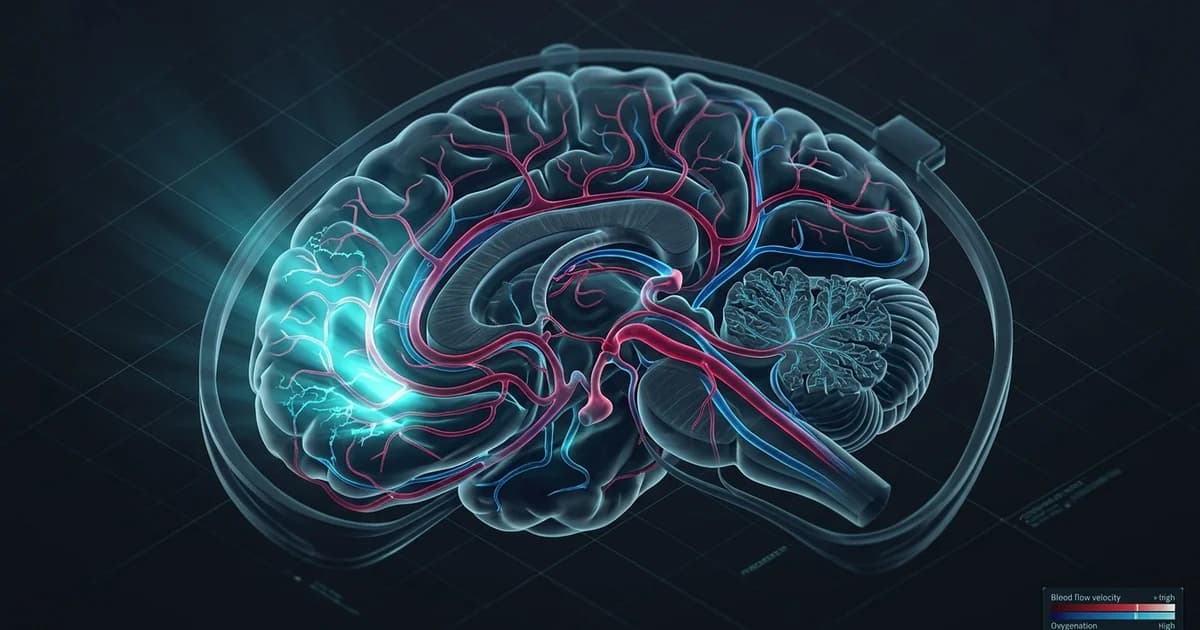
Your brain is roughly 2% of your body weight and burns about 20% of your energy. It stores almost none of that fuel. Every thought you have runs on a delivery system that has to push oxygen and glucose to the exact neurons firing at the exact moment they fire.
That delivery system is cerebral blood flow, and the link between cerebral blood flow and cognition is far tighter than most people assume. When perfusion to a brain region lags behind demand, attention slips, recall gets slower, and mental stamina drains.
This is the mechanism underneath focus. Get it right and the rest of your cognitive performance has a foundation to stand on.
Key Takeaways
- Your brain cannot store fuel, so it relies on second-by-second blood flow to match supply to demand.
- Neurovascular coupling is the process that routes blood to active brain regions on cue.
- When this coupling weakens, cognitive performance declines, a pattern seen clearly in aging and brain injury.
- More blood flow is not automatically better. Perfusion has to be precise and well-timed, not just high.
- Caffeine actually narrows cerebral vessels, so its focus effect comes from a different mechanism entirely.
How Blood Flow Affects the Brain
The brain runs a tight energy budget with no savings account. The brain depends on highly regulated moment-to-moment changes in regional blood supply to support its energetically demanding cognitive function with a limited energy budget. When neurons in one region start working harder, local supply has to rise within seconds or those cells run short.
This is the core reason brain blood flow and focus are connected. A region that cannot get fuel on time cannot sustain the firing that attention demands.
The fix is a rapid, local surge of blood to wherever the work is happening. To efficiently match energetic supply to demand, neural activity rapidly increases regional blood flow. Researchers at Harvard Medical School describe this as a sophisticated form of functional hyperemia unique to the central nervous system.
So the question is not whether your brain has enough blood overall. It is whether the right neurons get the right delivery at the right millisecond.
Neurovascular Coupling: The System Behind Brain Oxygen and Cognition
Neurovascular coupling is the mechanism that matches blood flow to neural activity in real time. Neurovascular coupling is essential for maintaining normal brain function by ensuring that neurons receive adequate nutrients and oxygen to support their activity, with blood vessels, neurons, and glial cells intricately interacting to regulate cerebral blood flow in response to neuronal activation.
It is not one cell type doing the work. Neurons signal demand, astrocytes relay it, and the vessels themselves dilate or constrict to route flow. This three-way conversation is what makes the brain oxygen and cognition relationship work.
You can watch it happen during hard thinking. In one PLOS One study, researchers found that during TCD monitoring, the middle cerebral artery flow was bilaterally increased during the task associated with greater cognitive effort. The harder the mental task, the more blood the prefrontal cortex pulled in.
That is neurovascular coupling doing its job. Demand goes up, supply follows, and you stay sharp through the effort.
What Happens When the System Breaks
When neurovascular coupling fails, cognition declines with it. This is one of the clearest demonstrations that the cerebral blood flow and cognition link is causal, not just correlated.
Aging weakens the coupling response directly. According to research published in a neurobiology journal, aging impairs the increase in cerebral blood flow triggered by neural activation, a critical mechanism that matches oxygen and nutrient delivery with the increased demands in active brain regions. The same line of work notes that studies conducted in rodent models of aging have substantiated these findings showing that neurovascular uncoupling associates with cognitive decline, and experimental studies support a causal link between neurovascular uncoupling and cognitive decline.
Brain injury shows the same pattern. A 2025 study in PMC found that young survivors of severe traumatic brain injury exhibit chronic impairment of neurovascular coupling, which correlates with cognitive deficits, and the regulation of cerebral blood flow is critical for cognitive function.
The pattern repeats across populations. Break the timing between demand and supply, and thinking gets harder.
Cerebral Perfusion and Memory: Why More Is Not Always Better
Here is the counterintuitive part. Cerebral perfusion and memory do not move in a simple straight line where more flow means better recall.
In a study of older adults with healthy brains, researchers found something surprising. When controlling for hippocampal volume, hippocampal perfusion correlated inversely with memory performance despite absent hippocampal tissue atrophy or white matter disease. Higher resting flow tracked with worse memory.
The likely reason is compensation. Cerebral perfusion is a tightly regulated physiological property, coupled to tissue metabolism and function, and abnormal, both raised and reduced, hippocampal perfusion has been reported in a range of cognitive disorders.
The takeaway is precision over volume. A healthy brain does not flood itself with blood. It routes flow exactly where activity demands it and pulls it back when the work is done.
Does Pumping More Blood to the Brain Improve Focus?
Not by itself. Raising total cerebral blood flow is not the same as improving the coupling that delivers fuel to active neurons on schedule.
This distinction matters when you evaluate focus tools. Some ingredients support vascular function and flow. Others sharpen focus through entirely separate pathways in the neurons themselves.
Caffeine is the cleanest example, and it surprises most people.
The Caffeine Paradox
Caffeine is the most used cognitive aid on earth, yet it does not work by increasing brain blood flow. It does the opposite. Caffeine is an adenosine receptor antagonist, and because adenosine helps relax cerebral vessels, blocking it causes mild vasoconstriction and a measurable drop in resting cerebral blood flow.
So how does caffeine sharpen focus while reducing perfusion? Through the neurons, not the plumbing. Adenosine normally builds up across the day and dampens neural firing, which is part of why you feel mentally foggy. Caffeine blocks that signal, so alertness and attention rise even as vessels narrow slightly.
This is the part worth internalizing. A focus benefit and increased blood flow are two different things. A compound can deliver one without the other, and caffeine proves it.
Cerebral Blood Flow vs Neural Mechanisms for Focus
| Mechanism | What it does | Effect on cerebral blood flow | Drives focus how |
|---|---|---|---|
| Neurovascular coupling | Matches blood supply to active regions in real time | Raises flow locally, on demand | Keeps active neurons fueled |
| Healthy vascular function | Supports the vessels that carry out coupling | Maintains baseline perfusion | Indirect, long-term foundation |
| Caffeine (adenosine antagonism) | Blocks the fatigue signal in neurons | Slightly reduces resting flow | Direct neural alertness |
| L-theanine | Smooths overstimulation, supports calm attention | Neutral to mild flow support | Steadies the caffeine response |
The lesson from the table is simple. Blood flow and neural signaling are separate levers. The best cognitive support respects both instead of confusing one for the other.
Frequently Asked Questions
What is cerebral blood flow and why does it matter for cognition?
Cerebral blood flow is the delivery of oxygen and glucose to brain tissue through its vessels. It matters because the brain cannot store fuel and burns about a fifth of your body's energy. When flow fails to match the demand of active neurons, attention, processing speed, and memory all suffer. The relationship between cerebral blood flow and cognition is one of the most direct in neuroscience.
What is neurovascular coupling in simple terms?
Neurovascular coupling is your brain's just-in-time delivery system. When a region starts working, neurons, astrocytes, and blood vessels coordinate to send more blood to that exact spot within seconds. This keeps busy neurons supplied with oxygen and glucose. When the coupling weakens, as it does with aging and brain injury, cognitive performance tends to decline alongside it.
Does more blood flow to the brain mean better thinking?
No. Precision matters more than volume. In healthy older adults, higher resting hippocampal perfusion has actually tracked with worse verbal memory, likely reflecting a compensation response rather than a benefit. A healthy brain routes flow to where it is needed and withdraws it afterward. The goal is well-timed delivery, not maximum flow everywhere.
How does blood flow affect memory specifically?
Memory regions like the hippocampus depend on tightly regulated perfusion. Both too little and too much flow have been linked to cognitive problems. What the hippocampus needs is responsive coupling that supplies fuel when you are encoding or retrieving, then settles back to baseline. Disrupted perfusion is one of the early physiological changes seen before measurable memory decline.
Does caffeine increase blood flow to the brain?
No, caffeine reduces resting cerebral blood flow. It blocks adenosine, a signal that normally relaxes cerebral vessels, which causes mild vasoconstriction. Its focus benefit comes from a separate pathway. By blocking adenosine in neurons, caffeine cuts the fatigue signal and raises alertness. So caffeine sharpens attention through neural signaling, not by improving brain perfusion.
Can I improve neurovascular coupling?
The strongest evidence points to fundamentals rather than quick fixes. Aerobic exercise, quality sleep, cardiovascular health, and avoiding chronic vascular damage all support the vessels and cells that carry out coupling. No pill replaces these. Focus supplements work on different pathways, mostly neural alertness, so think of them as separate from the long-term vascular health that protects coupling itself.
The Brain Runs on Timing, Not Just Supply
The connection between brain perfusion and focus comes down to one idea. Your cognition depends on getting the right fuel to the right neurons at the right moment, not on flooding your head with blood.
Neurovascular coupling is the system that makes this happen, and its breakdown helps explain why thinking gets harder with age and injury. Healthy vessels and a healthy heart protect that system over decades.
But day-to-day focus runs on a second track entirely. Neural signaling, especially the adenosine system, decides how alert you feel right now, independent of how much blood is flowing.
Focus That Works on the Neurons, Not the Plumbing
If you took one thing from the caffeine paradox, let it be this: a real focus benefit does not require raising cerebral blood flow. Caffeine narrows cerebral vessels yet sharpens attention anyway, because it works on the adenosine signal inside your neurons. That is honest neuroscience, and it shapes how Roon is built.
Each Roon pouch delivers 80 mg caffeine, 60 mg L-theanine, 25 mg methylliberine (Dynamine), and 5 mg theacrine (TeaCrine) sublingually, for an onset in 5 to 10 minutes and 6 to 8 hours of steady focus with no jitters and no crash. The point is precise neural alertness, not a vascular flush. The L-theanine smooths the edges so the caffeine reads as clean attention rather than buzz.
Roon is not a substitute for sleep, exercise, or the cardiovascular health that protects neurovascular coupling over a lifetime. Those build the foundation. If you want focus that runs on the neurons rather than the plumbing, try Roon and pair it with the basics that keep your perfusion sharp.
Written by Roon Team