L-Theanine and L-Tyrosine
Roon Team
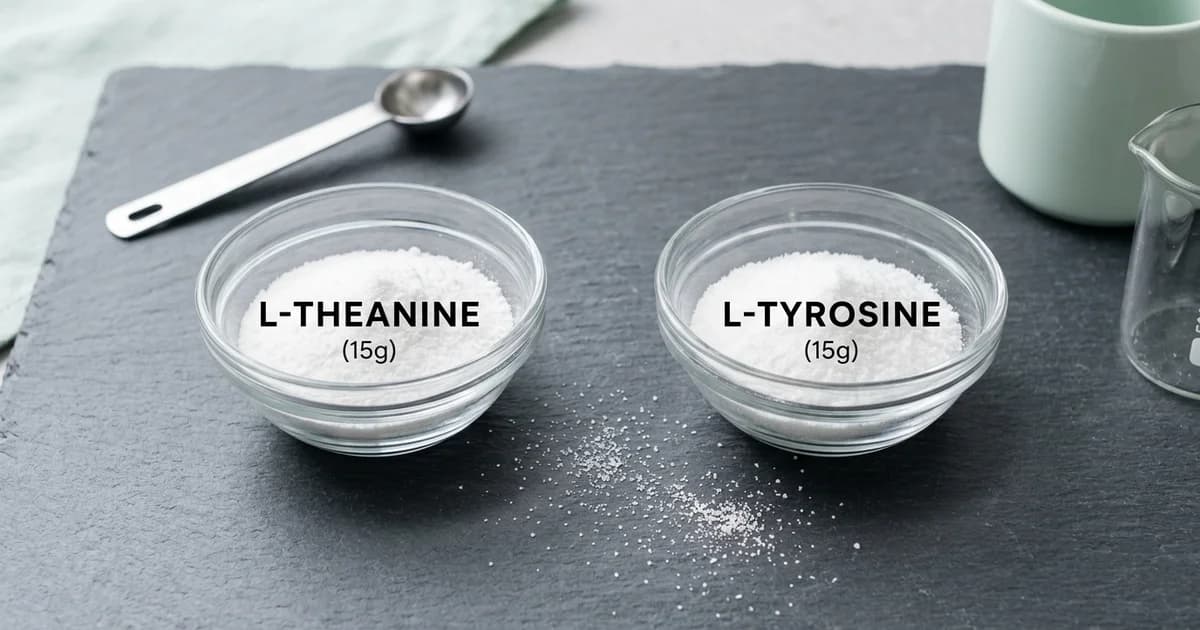
L-Theanine and L-Tyrosine: The Complete Guide to Stacking Two of the Best Nootropic Amino Acids
Two amino acids show up in almost every serious nootropic stack: l theanine l tyrosine. One keeps you calm. The other keeps you sharp. Together, they cover both sides of the cognitive performance equation, promoting relaxed focus without the mental fog that stress brings.
But most guides on this pairing either oversimplify the science or bury you in jargon. This one won't. Below is a clear, evidence-based breakdown of what each compound does, why l theanine l tyrosine complement each other, and how to use them properly.
Key Takeaways
- L-theanine promotes alpha brain wave activity associated with calm, focused attention. Typical effective doses range from 100 to 200 mg.
- L-tyrosine is a precursor to dopamine and norepinephrine, the neurotransmitters most vulnerable to depletion under stress. Effective doses range from 500 to 2,000 mg.
- A 2024 study published in Stress found that both amino acids independently reduced stress biomarkers and improved cognitive performance during a high-pressure simulation.
- Pairing l theanine l tyrosine gives you two distinct mechanisms: one that calms overactive neural signaling and one that replenishes the raw materials your brain burns through during demanding tasks.
What L-Theanine Actually Does in Your Brain
L-theanine is a non-protein amino acid found almost exclusively in tea leaves (Camellia sinensis). It crosses the blood-brain barrier within about 30 minutes of ingestion, and its effects are well-documented across dozens of clinical trials.
The primary mechanism: l-theanine promotes alpha brain wave activity. Alpha waves (8 to 13 Hz) are the electrical signature of a relaxed but alert mental state, the same pattern seen during meditation. According to research reviewed in Nutritional Neuroscience, l-theanine increases alpha waves associated with relaxation and selective attention.
At the neurotransmitter level, l-theanine modulates several systems at once. It influences GABA (the brain's primary inhibitory neurotransmitter), serotonin, and dopamine. A study in Pharmaceutical Biology found that l-theanine, particularly in combination with GABA, increased the expression of GABA receptors and boosted calming delta wave activity during sleep.
What makes l-theanine unusual among calming compounds is that it reduces anxiety without causing sedation. You don't get drowsy. You get focused. That's a rare profile, and it's the main reason l-theanine pairs so well with stimulants like caffeine, and why l theanine l tyrosine stacks are so popular.
L-Theanine and Caffeine: The Most Studied Nootropic Pair
The l-theanine plus caffeine combination has more clinical data behind it than almost any other nootropic stack. A study published in Nutritional Neuroscience found that 97 mg of l-theanine combined with 40 mg of caffeine helped participants focus attention during a demanding cognitive task.
A 2025 meta-analysis in Nutrition Reviews confirmed the pattern across multiple trials: the l-theanine plus caffeine combination produced small-to-moderate improvements in attentional task performance, primarily in the second hour after intake. L-theanine alone also showed benefits for cognitive performance measures during the first and second hours.
The takeaway: caffeine provides raw alertness. L-theanine smooths out the rough edges. Together, they produce a cleaner, more sustained form of focus than either one alone.
What L-Tyrosine Actually Does in Your Brain
L-tyrosine is a non-essential amino acid, meaning your body can produce it from phenylalanine. But "non-essential" doesn't mean unimportant. Tyrosine is the direct precursor to three catecholamine neurotransmitters: dopamine, norepinephrine, and epinephrine.
Here's the key insight: under normal, low-demand conditions, your brain produces enough dopamine and norepinephrine on its own. Supplementing tyrosine in a calm, rested state doesn't do much. But when you're under stress, sleep-deprived, or cognitively overloaded, your neurons fire faster and burn through catecholamines at a higher rate. That's when tyrosine supplementation matters, and why l theanine l tyrosine stacking becomes valuable.
A review published in the Journal of Psychiatric Research examined the full body of evidence and concluded that tyrosine effectively enhances cognition, but only when neurotransmitter function is intact and dopamine or norepinephrine is temporarily depleted. In plain terms: tyrosine helps most when your brain is under the most pressure.
How Tyrosine Gets Converted to Dopamine
The conversion pathway is straightforward:
- L-Tyrosine enters the brain by crossing the blood-brain barrier.
- The enzyme tyrosine hydroxylase converts it into L-DOPA.
- L-DOPA is then converted into dopamine.
- Dopamine can be further converted into norepinephrine and then epinephrine.
According to research on ScienceDirect, tyrosine hydroxylase activity increases upon tyrosine consumption, but the process is regulated by end-product inhibition. This means your brain won't produce runaway levels of dopamine. It takes what it needs and self-regulates. That built-in safety mechanism is part of why tyrosine has such a clean side-effect profile.
The Stress Connection
The research on tyrosine and stress is particularly strong. A study from PMC explains the mechanism clearly: stress and demanding circumstances increase neuronal firing, which accelerates catecholamine metabolism. This makes neurons more sensitive to precursor availability, meaning supplemental tyrosine has a larger effect precisely when you need it most.
This is why tyrosine shows up in military research. High-stress, high-demand environments (cold exposure, sleep deprivation, combat simulations) are where tyrosine's effects become most visible.
L Theanine L Tyrosine Together: Why the Combination Works
Each amino acid solves a different problem. L-theanine addresses the quality of your attention by promoting calm, alpha-wave-dominant focus. L-tyrosine addresses the fuel supply by keeping dopamine and norepinephrine levels topped off under stress.
Think of l theanine l tyrosine this way:
| Factor | L-Theanine | L-Tyrosine |
|---|---|---|
| Primary target | Alpha brain waves, GABA | Dopamine, norepinephrine |
| Main benefit | Calm focus, reduced anxiety | Sustained mental performance under stress |
| When it helps most | During stimulant use, high-anxiety tasks | During cognitive overload, sleep deprivation, high-pressure work |
| Effective dose range | 100 to 200 mg | 500 to 2,000 mg |
| Onset | ~30 minutes | ~30 to 60 minutes |
A 2024 study published in the journal Stress tested both amino acids head-to-head against placebo during a virtual reality active shooter training drill at Texas State University. Eighty subjects were randomly assigned to receive either 2,000 mg of l-tyrosine, 200 mg of l-theanine, or placebo before the high-stress simulation. The l-tyrosine group showed fewer missed responses on a Stroop cognitive test compared to placebo. Both amino acids were associated with changes in salivary stress biomarkers.
This was one of the first studies to examine l theanine l tyrosine concurrently in a realistic, high-stress scenario. The results support what the individual research on each compound already suggested: they target different systems, and both systems matter during demanding cognitive work.
A Note on Stacking All Three: Caffeine, L-Theanine, and L-Tyrosine
A 2019 study in the Journal of the International Society of Sports Nutrition tested the combination of caffeine, theanine, and tyrosine in athletes. The researchers found that this three-compound stack improved movement accuracy surrounding bouts of exhaustive exercise. The study's authors suggested that the combination of caffeine, theanine, and tyrosine was responsible for the performance improvements observed.
This triple stack is becoming the foundation of modern nootropic formulation for a reason. Caffeine drives alertness. L-theanine prevents the jitters and anxiety. L-tyrosine ensures your dopamine supply doesn't crash halfway through a demanding session. Adding caffeine to l theanine l tyrosine covers all three performance axes.
Dosing L Theanine L Tyrosine: What the Research Supports
Getting the dose right matters. Too little and you won't notice anything. Too much tyrosine, in particular, can cause overstimulation.
L-Theanine:
- For l-theanine dosing and forms, most clinical studies use 100 to 200 mg per dose.
- A randomized, triple-blind, placebo-controlled study used a single 200 mg dose and observed measurable effects on stress biomarkers in healthy adults.
- L-theanine is generally considered safe for most people, according to the Cleveland Clinic.
L-Tyrosine:
- Research doses range from 500 to 2,000 mg.
- The 2024 Texas State study used 2,000 mg, which is on the higher end.
- Examine.com notes that l-tyrosine is a precursor for dopamine and norepinephrine synthesis, and supplementation may help alleviate acute stress-induced cognitive decline.
- The Cleveland Clinic recognizes l-tyrosine supplements as generally safe.
Timing: Take l theanine l tyrosine 30 to 60 minutes before the task that demands your focus. Both amino acids work acutely, meaning you don't need to load them for weeks to see effects.
With or without food: L-tyrosine competes with other large neutral amino acids for absorption across the blood-brain barrier. Taking l theanine l tyrosine on an empty stomach, or at least away from high-protein meals, improves uptake.
Who Should Consider This L Theanine L Tyrosine Stack (and Who Should Be Cautious)
The l theanine l tyrosine combination is a strong fit for:
- Knowledge workers dealing with long, cognitively demanding days
- Students preparing for exams or high-stakes testing
- Athletes who need mental clarity alongside physical performance
- Anyone using caffeine who wants smoother, more sustained focus
A few cautions: if you're taking thyroid medication, MAO inhibitors, or levodopa, talk to your doctor before supplementing with l-tyrosine. Because tyrosine feeds into catecholamine and thyroid hormone production pathways, it can interact with medications that affect those systems.
L-theanine has very few known interactions and is well-tolerated across the research literature.
Getting L Theanine L Tyrosine Without the Guesswork
Both of these amino acids work. The research is clear on that. The harder question is building l theanine l tyrosine into a daily routine that doesn't require a handful of capsules and a spreadsheet.
L-theanine, in particular, pairs well with low-dose caffeine for clean, sustained focus. That's the exact combination built into Roon, a sublingual pouch that delivers 80 mg of caffeine alongside 60 mg of l-theanine, theacrine, and methylliberine. The caffeine is comparable to a cup of coffee, but l-theanine smooths it out while theacrine and methylliberine extend it to six to eight hours of sustained focus with no crash or jitters. No pills, no mixing, no waiting for a kettle to boil. Just place it on your gums and get to work.
If you're already sold on what l theanine l tyrosine can do for your focus, Roon is one of the simplest ways to get a clinical dose of l-theanine every day.