Brain Fog Menopause: Why It Happens and What Actually Helps
Roon Team
Brain Fog Menopause: Why It Happens and What Actually Helps
You're mid-sentence in a meeting, and the word you need just... vanishes. You walk into the kitchen and forget why. You read the same paragraph three times and still can't retain it. If you're in your 40s or 50s, this isn't early dementia. It's brain fog menopause, and it affects far more women than most people realize.
Roughly 44% to 62% of women in perimenopause report cognitive difficulties like trouble concentrating, forgetfulness, and slower mental processing, according to Healthline. A 2025 RAND commentary puts that number even higher, noting that up to 60% of women experience brain fog menopause symptoms during the transition. These aren't small numbers. And yet, brain fog menopause is still routinely dismissed as stress or "just getting older."
It's neither. Here's what the science actually says.
Key Takeaways
- Brain fog menopause is driven by hormonal changes, not aging alone. Declining estrogen directly affects memory centers in the brain.
- Verbal memory and processing speed are the cognitive functions most affected during the menopausal transition.
- The fog is usually temporary. Research suggests cognitive function often stabilizes or improves after the transition is complete.
- Targeted lifestyle changes and the right ingredients can support mental clarity during this period.
What Brain Fog Menopause Actually Feels Like
Brain fog isn't a clinical diagnosis. It's a shorthand for a cluster of cognitive symptoms that show up together: difficulty finding words, trouble concentrating, forgetting recent conversations, and a general sense that your mind is running through wet sand.
Women describe brain fog menopause differently. Some say it's like thinking through cotton wool. Others notice they can't multitask the way they used to, or that absorbing new information takes twice the effort.
The frustrating part? Standard cognitive tests often show results within "normal range," which leads some clinicians to wave it off. But longitudinal research tells a different story. A 2022 review published in Climacteric confirmed that research studies validate patients' cognitive complaints at menopause, with difficulties in learning and verbal memory being especially common.
This isn't imagined. It's measurable.
Why Brain Fog Menopause Happens: The Estrogen Connection
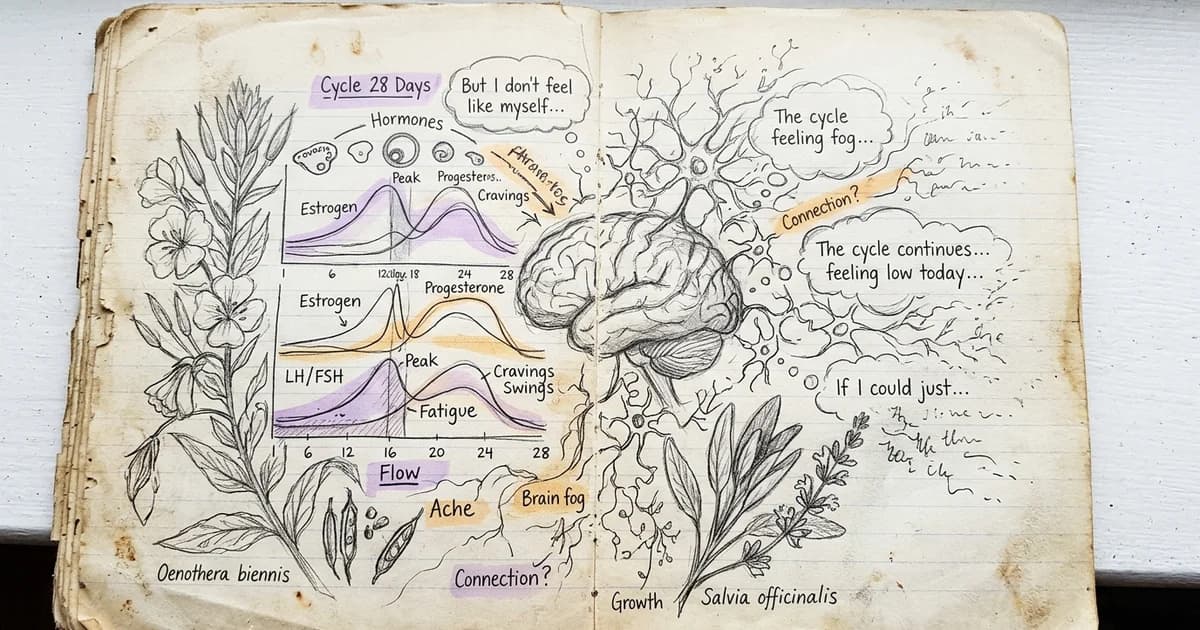
To understand brain fog menopause in perimenopause, you need to understand what estrogen does in your brain, and how hormonal cycle and brain fog are connected more broadly. Estrogen isn't just a reproductive hormone. It's deeply involved in cognition.
Estrogen receptors are concentrated in the hippocampus and prefrontal cortex, the two brain regions most responsible for memory formation, learning, and executive function. When estrogen levels fluctuate and eventually decline during perimenopause, these regions lose a key chemical signal they've relied on for decades.
A 2024 study from Weill Cornell Medicine used brain imaging to show that the transition to menopause is marked by progressively higher density of estrogen receptors on brain cells, essentially the brain trying to compensate for declining estrogen levels. The brain is literally reaching for a signal that's fading.
It's Not Just Estrogen
Estrogen also influences two neurotransmitters that are central to focus and memory: acetylcholine and dopamine. Acetylcholine is critical for forming new memories. Dopamine drives motivation and attention. When estrogen drops, the activity of both neurotransmitter systems can decline with it, according to a review in PMC.
This is why brain fog menopause doesn't just feel like forgetfulness. It feels like a loss of mental sharpness across the board: slower recall, weaker focus, reduced motivation to engage with complex tasks.
The Role of Sleep Disruption
There's a compounding factor that makes brain fog menopause worse: sleep. Hot flashes, night sweats, and hormonal shifts frequently disrupt sleep during perimenopause. And poor sleep is one of the fastest ways to degrade cognitive performance in anyone, regardless of hormonal status.
A piece from The Conversation notes that menopausal symptoms including sleep disturbance, depression, anxiety, and brain fog can span perimenopause and last for up to ten years. When you layer chronic sleep disruption on top of declining estrogen, the cognitive effects compound.
Stress and Mood Changes Add Fuel
Perimenopause often coincides with some of the most demanding years of a woman's life: career peaks, aging parents, teenagers, financial pressures. Chronic stress elevates cortisol, which directly impairs hippocampal function, the same brain region already under strain from falling estrogen. Depression and anxiety, both more common during the menopausal transition, further degrade working memory and attention. Brain fog menopause isn't caused by one thing. It's a pile-up.
What the Research Says About Brain Fog Menopause Duration
Here's the part most women want to know: does it get better?
The answer, based on the best available evidence, is yes.
The SWAN (Study of Women's Health Across the Nation) is one of the longest-running studies tracking women through the menopausal transition. Findings from SWAN, as summarized in Climacteric, suggest that cognitive changes may be largely limited to the perimenopausal window. A 2024 review in PubMed found small but reliable declines in objective memory performance as women transition into perimenopause, and that these declines are not explained by advancing age alone.
The Mayo Clinic reports that brain fog menopause appears to be temporary, with tests showing improvement after the menopause transition is complete.
For most women, the worst of brain fog menopause peaks during perimenopause and eases within one to three years as hormone levels stabilize, according to Northside Hospital. That's not nothing. But it's also not permanent.
Brain Fog Menopause vs. Dementia: Clearing Up the Fear
This is the question that keeps women up at night (sometimes literally). Is this the beginning of Alzheimer's?
For the vast majority of women, the answer is no. Brain fog menopause and dementia are different processes. The cognitive changes during perimenopause tend to be subtle, temporary, and specific to verbal memory and processing speed. Dementia involves progressive, worsening decline across multiple cognitive domains.
A 2024 review in PMC found that verbal learning and verbal memory are the cognitive functions most negatively affected during perimenopause. New research also suggests links to deficits in processing speed, attention, and working memory. But these changes typically stabilize.
That said, if you're experiencing rapid cognitive decline, confusion about time or place, or personality changes, talk to your doctor. Those are different symptoms entirely.
The distinction matters because fear itself becomes a cognitive burden. Women who believe their brain fog menopause signals something catastrophic often experience more anxiety, worse sleep, and, ironically, worse cognitive performance. Knowing the science can break that cycle.
What Actually Helps Brain Fog Menopause
There's no single fix, but several evidence-backed strategies and natural approaches to menopause fog can make a real difference.
1. Prioritize Sleep (Seriously)
Sleep is the single most powerful cognitive recovery tool your body has. If hot flashes or night sweats are wrecking your sleep, address those first. Cooling bedding, keeping your room below 67°F, and talking to your doctor about symptom management can all help.
2. Move Your Body
Aerobic exercise increases blood flow to the brain and promotes the release of brain-derived neurotrophic factor (BDNF), a protein that supports the growth and survival of neurons. You don't need to train for a marathon. Even 30 minutes of brisk walking, four to five times per week, can improve cognitive function. Resistance training also appears to benefit executive function, so a mix of cardio and strength work is ideal.
3. Feed Your Brain
The Mediterranean diet, rich in omega-3 fatty acids, leafy greens, and antioxidants, has been consistently linked to better cognitive outcomes in midlife. Processed foods, excess sugar, and alcohol all worsen inflammation and cognitive fog.
4. Train Your Attention
Cognitive engagement matters. Learning a new skill, reading challenging material, or practicing focused attention exercises can help maintain neural pathways that hormonal shifts might otherwise weaken.
5. Consider Your Stimulant Strategy
This is where most women dealing with brain fog menopause default to coffee. And coffee works, to a point. But caffeine alone has a well-known problem: the spike-and-crash cycle. You get 90 minutes of alertness followed by a dip that can leave you foggier than where you started.
The science points to something more targeted, including top-rated menopause brain fog supplements backed by clinical research.
A Smarter Approach to Focus During Brain Fog Menopause
Research on caffeine combined with L-theanine shows a different pattern than caffeine alone. A study published in Nutritional Neuroscience found that 97 mg of L-theanine combined with 40 mg of caffeine helped participants focus attention during demanding cognitive tasks. A separate study in Psychopharmacology found that the L-theanine and caffeine combination improved both speed and accuracy of attention-switching and reduced susceptibility to distracting information.
L-theanine smooths out caffeine's rough edges: the jitters, the anxiety, the crash. It promotes calm focus instead of wired alertness.
Add theacrine and methylliberine to the mix, and you get something even more interesting. A study published in Cureus found that a combination of caffeine, theacrine, and methylliberine improved cognitive performance and reaction time without interfering with mood. Research published in the Journal of the International Society of Sports Nutrition suggests that co-ingestion of caffeine, methylliberine, and theacrine can improve cognitive performance over a longer period compared to caffeine alone, thanks to their complementary pharmacokinetics.
This is the difference between a blunt instrument and a precise one.
Clear Brain Fog Menopause on Your Terms
Brain fog menopause is real, it's common, and it's rooted in biology, not weakness, sharing many of the same hormone-driven brain fog patterns seen at other life stages. The hormonal shifts of perimenopause affect brain regions that control memory, focus, and processing speed. And while the fog typically lifts as your body adjusts, you don't have to just wait it out.
Smart sleep habits, regular exercise, and proper nutrition form the foundation. But for the moments when you need your mind sharp right now, the right combination of ingredients matters.
Roon was built around exactly this kind of precision. It combines caffeine (80 mg), L-theanine, theacrine, and methylliberine in a zero-nicotine sublingual pouch that delivers 6 to 8 hours of sustained focus without the jitters or crash. No tolerance buildup. No waiting 30 minutes for a pill to kick in.
If brain fog menopause has you feeling like you're operating at 60%, Roon helps you close that gap. Try it at takeroon.com.