Brain Fog Period: Why Your Cycle Hijacks Your Focus
Roon Team
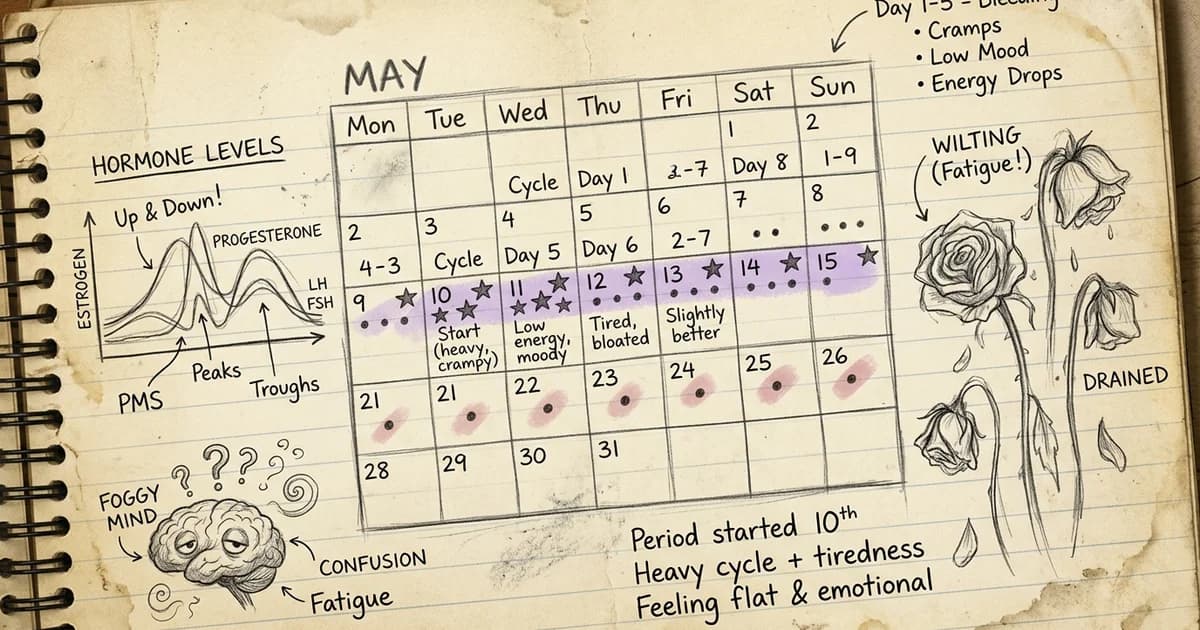
Brain Fog Period: Why Your Cycle Hijacks Your Focus (and What to Do About It)
You're mid-sentence in a meeting and the word you need just... vanishes. Your to-do list looks like hieroglyphics. You can't remember if you already sent that email or just thought about sending it. Then you check your cycle tracker and realize: ah, right. Brain fog period symptoms are not in your head. Well, technically they are. But they're not imaginary.
Nearly 90% of menstruating women report at least one PMS symptom, and for 20-40%, those symptoms actively disrupt daily life, according to the Georgia Chiropractic Neurology Center. Brain fog period haze, that frustrating mix of forgetfulness, slow processing, and scattered attention, is one of the most commonly reported yet least discussed of those symptoms.
Here's what's actually happening inside your brain, and why your hormones are running the show.
Key Takeaways
- Brain fog period symptoms are driven by real hormonal shifts, primarily drops in estrogen and spikes in progesterone.
- Estrogen directly influences serotonin, dopamine, and acetylcholine, all neurotransmitters tied to focus and memory.
- Hormonal birth control can either help or worsen brain fog period episodes depending on the formulation and the individual.
- Targeted strategies (sleep, nutrition, and the right cognitive support stack) can meaningfully reduce cycle-related fog.
What Brain Fog Period Symptoms Actually Feel Like
Brain fog symptoms and causes span well beyond a single clinical diagnosis. It's a shorthand for a cluster of cognitive symptoms: difficulty concentrating, sluggish recall, trouble finding words, and a general sense that your brain is running on 56k dial-up.
Some women experience brain fog period effects before menstruation starts, in the days leading up to bleeding. Others feel the worst brain fog during their period itself. And for a smaller group dealing with PMDD (premenstrual dysphoric disorder), hormone-driven cognitive disruption can be severe enough to interfere with work, relationships, and basic daily functioning.
The timing matters. And the timing points directly at your hormones.
The Hormonal Mechanics Behind Brain Fog Period Episodes
Your menstrual cycle isn't just a reproductive event. It's a 28-ish day neurochemical rollercoaster that reshapes how your brain processes information, regulates mood, and maintains attention.
Estrogen: Your Brain's Performance Fuel
Estrogen does far more than regulate your cycle, and estrogen decline and brain fog are linked across multiple life stages. It directly modulates several neurotransmitter systems that control cognition. Research published in Frontiers in Neuroscience confirms that estradiol (the most active form of estrogen) plays a direct role in regulating serotonin, dopamine, and glutamate signaling in the brain.
A review on ScienceDirect found that estrogen increases cerebral blood flow, acts as an anti-inflammatory agent in neural tissue, enhances synaptic activity, and exerts direct neuroprotective effects on the brain.
During your follicular phase (roughly days 1-14), estrogen climbs steadily. Research published in PubMed shows that rising estrogen levels during this phase increase serotonin synthesis, which enhances mood, cognition, and even pain tolerance. Estrogen also influences dopamine levels, promoting motivation and reward sensitivity. This is why many women feel sharpest, most creative, and most productive in the first half of their cycle.
Then ovulation happens. Estrogen peaks and begins to fall. And your brain notices.
Progesterone: The Sedation Signal
After ovulation, progesterone takes over. Its job is to prepare the uterine lining for potential pregnancy, but it also has powerful effects on your nervous system.
Progesterone's metabolite, allopregnanolone, is a potent enhancer of GABA, your brain's primary inhibitory neurotransmitter. A study in PMC found that progesterone impairs memory for biologically salient stimuli in healthy young women, and that this effect is mediated through allopregnanolone's action on GABA receptors.
Research published in Reproductive Sciences confirms that in the luteal phase, rising progesterone enhances GABAergic neurotransmission, which promotes sedation. Think of it this way: while estrogen is turning up your brain's signal, progesterone is turning up the noise cancellation, sometimes too far.
The result? That foggy, slow, "wading through peanut butter" feeling that defines brain fog period experiences in the late luteal phase and early menstruation.
The Late Luteal Crash
The worst brain fog period symptoms typically hit in the late luteal phase, the few days right before your period. Here's why: both estrogen and progesterone are plummeting simultaneously. Your brain, which has spent two weeks adapting to high progesterone and moderate estrogen, suddenly loses both signals.
Dr. Jolene Brighten notes that brain fog period complaints are most common in the mid to late luteal phase, and that an imbalance between estrogen and progesterone (particularly estrogen dominance) may promote cognitive disruption.
Research from Signos confirms that women with PMDD show impaired executive functioning skills in the late luteal phase as estrogen declines. Executive functioning includes the cognitive processes you rely on for planning, organizing, and monitoring tasks, exactly the skills that feel impossible when brain fog period hits.
Brain Fog Period and Birth Control: It's Complicated
Hormonal birth control works by overriding your natural cycle with synthetic hormones. That means it also overrides the natural fluctuation pattern that causes cyclical brain fog. But whether that's a net positive depends on the person and the formulation.
According to Natural Cycles, hormonal birth control alters estrogen and progesterone levels, which can influence PMS-related brain fog period severity. Some women report clearer thinking on the pill because the hormonal swings are blunted. Others report persistent, low-grade fog that never fully lifts.
A study highlighted by RSNA found that women taking oral contraceptives had a smaller hypothalamus volume compared to women not on the pill. The hypothalamus regulates hormones, sleep, appetite, and emotional responses, all of which feed into cognitive clarity.
A PMC review on hormonal contraceptives and the brain found behavioral effects of hormonal contraception on cognitive tasks including mental rotation and verbal fluency. The takeaway isn't that birth control is "bad for your brain." It's that synthetic hormones interact with your neurochemistry in ways that are individual and not fully understood.
If you started hormonal birth control and noticed a persistent mental haze, that connection is worth discussing with your doctor.
What You Can Actually Do About Brain Fog Period Symptoms
You can't opt out of having a menstrual cycle (unless you're on continuous hormonal contraception, which comes with its own trade-offs). But you can reduce the severity of brain fog period disruption with targeted strategies.
1. Track Your Cycle and Plan Around It
This sounds simple, but it's powerful. If you know your late luteal phase reliably brings brain fog period effects, schedule your most demanding cognitive work for your follicular phase. Save admin tasks, routine work, and lower-stakes meetings for the days when your brain is running on fumes.
2. Prioritize Sleep in the Luteal Phase
Progesterone actually promotes sleep (it's one of the reasons you feel drowsy before your period). Work with it instead of against it. Go to bed earlier in the second half of your cycle. Poor sleep compounds hormonal brain fog into something much worse.
3. Stabilize Blood Sugar
Insulin sensitivity shifts across your cycle. In the luteal phase, you're more prone to blood sugar swings, which amplify brain fog period symptoms. Eat protein and fat with every meal. Cut back on refined carbs and sugar in the week before your period.
4. Move Your Body
Exercise increases BDNF (brain-derived neurotrophic factor) and boosts dopamine and serotonin, partially compensating for the neurotransmitter dip your hormones are creating. Even a 20-minute walk makes a measurable difference.
5. Support Your Neurochemistry Directly
This is where ingredient choice matters. The neurotransmitter disruption behind brain fog period is real, and certain compounds have strong evidence for counteracting exactly that type of cognitive dip.
Caffeine in moderate doses increases alertness and blocks adenosine (the neurotransmitter that makes you feel sleepy). But too much caffeine causes jitters and anxiety, which are already elevated in the premenstrual window.
L-Theanine paired with caffeine is where things get interesting. A study published in PubMed found that 97mg of L-Theanine combined with 40mg of caffeine helped participants focus attention during demanding cognitive tasks. A separate PubMed study confirmed the combination improved both speed and accuracy on attention-switching tasks and reduced susceptibility to distracting information during memory tasks. That's a targeted fix for the exact type of cognitive disruption hormonal shifts create.
Theacrine and Methylliberine extend and smooth out caffeine's effects. Research published on Taylor & Francis found that co-ingestion of caffeine, methylliberine, and theacrine can improve physical and cognitive performance over a longer period compared to caffeine alone, thanks to their different absorption rates and half-lives.
Clearing the Brain Fog Period Without Fighting Your Biology
Brain fog period is not a character flaw or a productivity failure. It's a predictable neurochemical event driven by the same hormones that regulate your entire reproductive system. The science is clear on the mechanism: estrogen and progesterone directly shape how your brain produces and responds to the neurotransmitters responsible for focus, memory, and mental speed.
You can't eliminate hormonal fluctuations. But you can give your brain better raw materials to work with during the phases when it needs them most.
Roon was built around exactly this principle. It combines 80mg of caffeine with L-Theanine, Theacrine, and Methylliberine in a zero-nicotine sublingual pouch, delivering 6-8 hours of sustained focus without the jitters, crash, or tolerance buildup that make most stimulants a bad fit for hormone-sensitive days. When your cycle pulls the neurochemical rug out from under you, Roon helps put it back.