Brain Fog Caffeine: Why Your Coffee Habit Might Be Helping
Roon Team
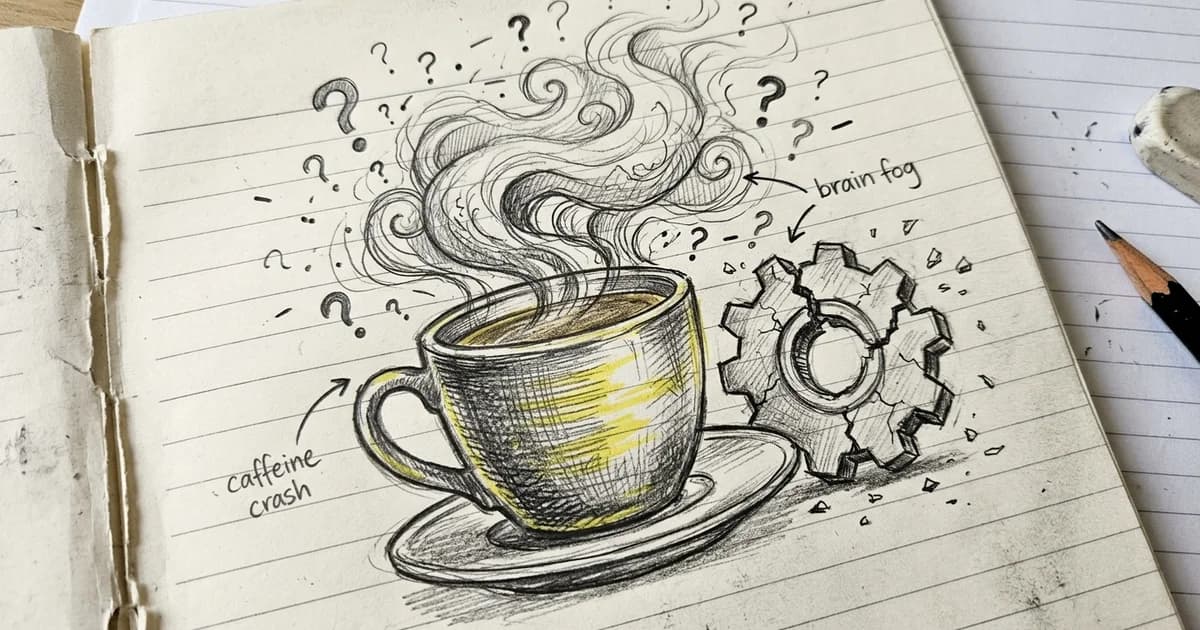
Brain Fog Caffeine: Why Your Coffee Habit Might Be Helping and Hurting at the Same Time
You know the feeling. You sit down to work and the words on your screen blur into meaningless shapes. Your thoughts move like they're wading through wet concrete. You reach for coffee because that's what you've always done.
But here's the problem with the brain fog caffeine relationship: the same molecule that clears the haze at 8 a.m. can thicken it by 2 p.m. Caffeine is the most widely consumed psychoactive compound on the planet, and most people use it wrong.
This guide breaks down exactly how brain fog caffeine dynamics work, why your current approach probably backfires, and what the research says about doing it better.
Key Takeaways
- Caffeine blocks adenosine receptors in the brain, which temporarily reduces the drowsiness and mental sluggishness associated with brain fog.
- Too much caffeine, or poorly timed caffeine, makes brain fog worse through rebound fatigue, sleep disruption, and tolerance buildup.
- Doses as low as 32-40mg can improve reaction time and attention without the jitters and crash of a full espresso.
- Combining caffeine with L-theanine produces better focus than caffeine alone, according to multiple controlled studies.
What Brain Fog Actually Is (And Isn't)
Brain fog isn't a medical diagnosis. It's a cluster of symptoms: difficulty concentrating, slow processing speed, forgetfulness, and that frustrating sensation of losing your train of thought mid-sentence. Cleveland Clinic lists the common symptoms as difficulty focusing, forgetfulness, mental exhaustion, and slow reaction time.
The causes range widely. Sleep deprivation, chronic stress, poor nutrition, hormonal changes, autoimmune conditions, and post-viral syndromes can all trigger brain fog. A 2024 systematic review published in General Hospital Psychiatry found that the combined prevalence of mental health conditions and brain fog in long COVID patients was 20.4%, and that number increased over time rather than decreasing.
A 2024 study in Frontiers in Human Neuroscience that characterized brain fog across nearly 25,800 participants confirmed it is associated with reduced productivity and real functional impairment. This isn't just "feeling tired." It's a measurable cognitive deficit.
How Brain Fog Caffeine Chemistry Works in Your Brain
Caffeine doesn't give you energy. It blocks the signal that tells your brain you're tired.
Throughout the day, a molecule called adenosine builds up in your brain. Adenosine binds to receptors that slow down neural activity, making you feel progressively drowsy. According to research published in the Journal of Neuroscience, caffeine promotes wakefulness by blocking adenosine A2A receptors, particularly in the nucleus accumbens.
Research on PubMed confirms that caffeine antagonizes all types of adenosine receptors (A1, A2A, A3, and A2B) and exerts effects on neurons and glial cells across all brain areas. That's a wide net. It's why brain fog caffeine interactions affect not just alertness, but also mood, reaction time, and working memory.
The result? For a few hours, the fog lifts. You feel sharper. Thoughts connect faster.
Then the caffeine wears off, and all that accumulated adenosine floods back in. The brain fog doesn't just return. It hits harder than before.
Brain Fog Caffeine: The Double-Edged Sword
The Upside: What Caffeine Does Well
The cognitive benefits of moderate caffeine are well-documented. A review on NCBI Bookshelf found that caffeine at doses as low as 32mg can decrease reaction times in both auditory and visual choice tasks. That's less than half a standard cup of coffee.
A review published in Neuroscience & Biobehavioral Reviews examined caffeine's effects on both cognitive and physical function, noting that caffeine exerts its effects by blocking adenosine receptors and improves complex decision-making and motor processing.
For brain fog specifically, caffeine addresses some of the core symptoms: slow processing, poor attention, and reduced alertness. If your fog is caused by sleep deprivation or simple fatigue, a moderate dose of caffeine is one of the fastest interventions available.
The Downside: Where Brain Fog Caffeine Use Fails
The problem starts when you rely on caffeine as your only tool.
Tolerance builds fast. Your brain responds to chronic caffeine use by creating more adenosine receptors. The same dose that used to clear your fog now barely gets you to baseline. So you drink more. And the cycle accelerates.
The crash is real. A breakdown of caffeine and adenosine dynamics from Ultrahuman describes how the rebound effect after caffeine wears off creates "a sharp spike in sleep pressure, leading to a noticeable crash," including fatigue, mental fog, and irritability. The very brain fog caffeine was supposed to fix gets worse.
Sleep disruption compounds the problem. Caffeine has a half-life of roughly 5-6 hours. That afternoon coffee at 2 p.m. still has half its caffeine circulating at 8 p.m. Poor sleep is one of the primary causes of brain fog, and caffeine consumed too late directly sabotages sleep quality.
High doses backfire cognitively. A PubMed review found that while caffeine facilitates working memory performance to a limited extent, it actually hinders performance on tasks that heavily depend on working memory. More caffeine does not equal more clarity.
The Dose Problem: Why Less Caffeine Works Better for Brain Fog
Most people overcaffeinate. A standard coffee shop drip coffee contains 150-250mg of caffeine. A large from most chains pushes past 300mg. Research consistently shows that the brain fog caffeine sweet spot is much lower.
| Caffeine Dose | Typical Effect |
|---|---|
| 20-40mg | Improved reaction time, mild alertness boost, minimal side effects |
| 40-100mg | Enhanced focus and attention, moderate alertness |
| 100-200mg | Strong alertness, potential jitters in sensitive individuals |
| 200-400mg | Anxiety, restlessness, diminished working memory performance |
| 400mg+ | Sleep disruption, elevated heart rate, rebound fatigue |
The research from the NCBI Bookshelf review noted cognitive improvements at doses as low as 32mg. You don't need a triple-shot espresso to clear brain fog. You need a precise, controlled dose.
Why Caffeine Alone Isn't Enough for Brain Fog
If caffeine were the complete answer to brain fog, nobody who drinks coffee would ever experience it. Clearly, something is missing.
Caffeine addresses one mechanism (adenosine blocking) but ignores the others. Brain fog involves disrupted neurotransmitter balance, inflammation, oxidative stress, and impaired cerebral blood flow. Caffeine, by itself, only pulls one lever.
This is where combination approaches for brain fog start to outperform caffeine alone.
The L-Theanine Connection
L-theanine is an amino acid found naturally in tea leaves. On its own, it promotes relaxation without sedation. Paired with caffeine, it does something more interesting.
A study published in Nutritional Neuroscience found that 97mg of L-theanine combined with 40mg of caffeine helped participants focus attention during demanding cognitive tasks. That's a low brain fog caffeine dose producing real results, specifically because of the L-theanine pairing.
A systematic review in PMC confirmed that the caffeine and L-theanine combination improves short-term sustained attention and overall cognition. The review also noted improvements in inhibitory control, which is your brain's ability to filter distractions and stay on task. That's exactly what brain fog disrupts.
A study published in ScienceDirect measuring brain wave activity found that the combined treatment increased target discriminability compared to placebo, while L-theanine alone showed no such effect. The caffeine provides the alertness. The L-theanine smooths out the rough edges and extends focused attention.
Beyond the Basics: Theacrine and Methylliberine
Two lesser-known compounds are showing up in the research: theacrine and methylliberine. Both are structurally related to caffeine and interact with adenosine receptors, but with different pharmacokinetic profiles.
A randomized crossover study published in Cureus tested the combination of caffeine, theacrine, and methylliberine and found it improved cognitive performance and reaction time without interfering with mood. The combination outperformed both placebo and caffeine alone.
A double-blind, placebo-controlled trial published in the Journal of the International Society of Sports Nutrition tested these three compounds in tactical personnel. The researchers noted that co-ingestion of caffeine, methylliberine, and theacrine may improve cognitive performance over a longer period compared to caffeine alone, based on their different peak times and half-lives.
The logic is straightforward. Caffeine peaks fast and drops fast. Theacrine and methylliberine have longer onset curves and extended durations. Stack them together, and you get sustained brain fog caffeine relief instead of a spike-and-crash pattern.
A Smarter Approach to Brain Fog Caffeine Dosing
Based on the research, here's what actually works:
- Keep doses low. 40-100mg of caffeine is the cognitive performance sweet spot. Higher doses increase anxiety and impair complex thinking.
- Pair caffeine with L-theanine. The combination outperforms caffeine alone for sustained attention and focus, with fewer side effects.
- Time it right. Consume caffeine in the first half of your day. Avoid it within 8-10 hours of bedtime to protect sleep quality.
- Don't rely on caffeine alone. Address the root causes of your brain fog: sleep, stress, nutrition, hydration, and movement all matter.
- Consider extended-release combinations. Compounds like theacrine and methylliberine can extend the cognitive benefits without stacking more caffeine.
Clear the Brain Fog Without the Crash
Brain fog is a real problem with real consequences for your work, your decisions, and your quality of life. The brain fog caffeine connection can help, but only when you use the right amount, in the right combination, at the right time.
That's the thinking behind Roon. Roon's nootropic pouch stack is a zero-nicotine sublingual pouch built around the exact stack the research supports: 80mg of caffeine, L-theanine, theacrine, and methylliberine. Caffeine comparable to a cup of coffee for the initial lift. L-theanine to smooth out the jitters. Theacrine and methylliberine to extend the focus window to 6-8 hours without a crash or tolerance buildup.
No coffee breath. No mid-afternoon wall. Just clean, sustained mental clarity when you need it.
Check out Roon and see what focused actually feels like.