Autophagy and the Brain: How Cellular Cleanup Keeps Your Mind Sharp
Your neurons are some of the longest-lived cells in your body. Many of them are as old as you are. They never get replaced, which means they have to maintain themselves for decades without a reset button.
That maintenance has a name. Autophagy is your cells' internal recycling system, and the autophagy brain connection explains a lot about why some minds stay sharp into old age while others fade. The word comes from Greek for "self-eating," which sounds alarming until you understand what it actually does.
It hauls out the garbage so your neurons can keep firing.
Key Takeaways
- Autophagy is the process cells use to break down and recycle their own damaged parts, and it earned its discoverer the 2016 Nobel Prize.
- In neurons, this cleanup clears misfolded proteins and worn-out mitochondria that would otherwise jam up brain function.
- Autophagy tends to slow with age, and that decline tracks closely with the protein buildups seen in Alzheimer's and Parkinson's.
- Fasting, exercise, and quality sleep are the best-supported ways to keep the process running.
What Autophagy Actually Is
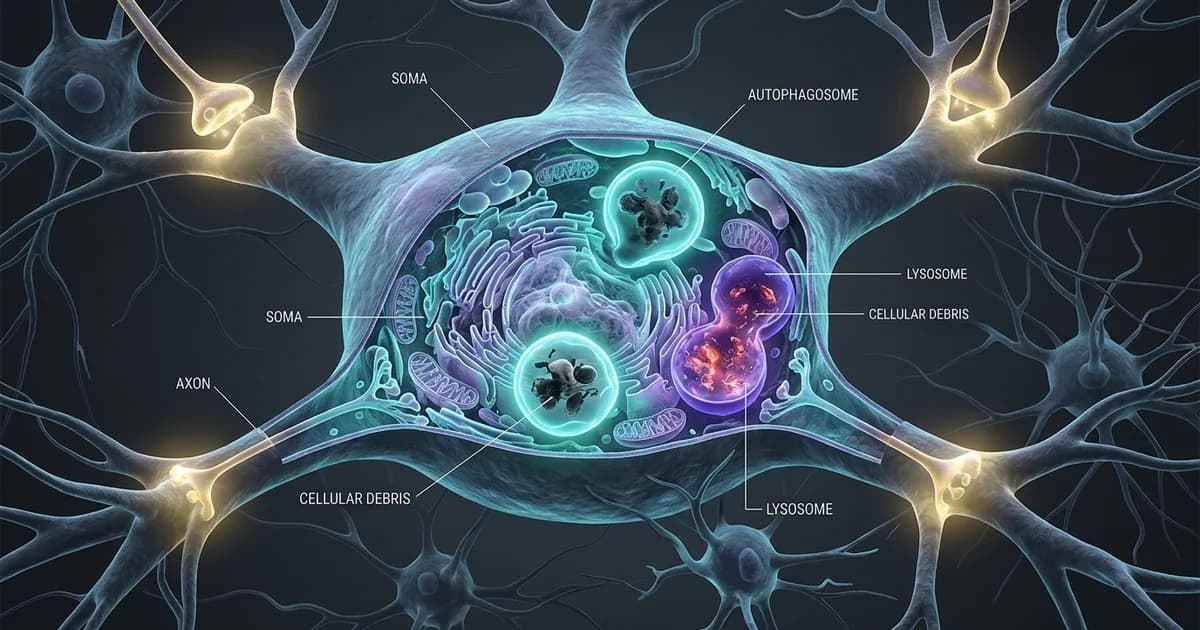
Autophagy is the cellular pathway that captures damaged proteins, aging organelles, and other cellular junk, packages them up, and sends them to be broken down and reused. Think of it as a cell eating its own broken machinery so it can build new parts from the scraps.
The mechanism was mapped by Japanese cell biologist Yoshinori Ohsumi. As described in a PubMed commentary, on 3 October 2016, Ohsumi was awarded the Nobel Prize in Physiology or Medicine for his discoveries of mechanisms for autophagy, an intracellular degradation pathway that helps maintain cytoplasmic homeostasis.
Here is roughly how autophagy works. A double membrane forms inside the cell and wraps around the targeted debris, creating a bubble called an autophagosome. According to C&EN's report on the prize, the cell captures large dysfunctional proteins, aging organelles, and invading pathogens in vesicles and then sends them to the lysosome for degradation. The lysosome is the cell's acid bath. It dissolves the contents into raw building blocks that get shipped back out and reused.
The stakes are high. As the Nobel Committee's chair put it when announcing the prize, "Without autophagy, our cells won't survive."
Why Autophagy Matters So Much in Neurons
Neurons can't dilute their problems. Most of your cells divide, which spreads any accumulated damage across daughter cells and effectively buys time. Neurons mostly don't do this. A bad protein that forms today might still be sitting in the same cell forty years from now unless something removes it.
That something is autophagy. The relationship between autophagy and neurons is tighter than in almost any other tissue, because neurons depend on constant internal housekeeping to survive a human lifespan.
Two jobs stand out. The first is clearing misfolded proteins, the sticky, aggregate-prone clumps that gum up cellular traffic. The second is mitophagy, a specialized form of autophagy that removes worn-out mitochondria before they leak damaging molecules into the cell.
When this system works, neurons stay clean and energetically efficient. When it falters, the trash piles up.
Autophagy, Cognition, and Memory
Autophagy supports cognition by keeping the cellular environment that powers learning and memory free of debris. This isn't a vague wellness claim. It tracks down to the synapse, where the connections behind memory are constantly built, pruned, and remodeled.
A growing body of research ties autophagy to brain plasticity, the brain's ability to rewire itself in response to experience. The same recycling that clears junk also helps turn over the proteins at synapses, which is part of how memories get encoded and consolidated.
There's also a striking overlap with sleep. Per a GymBeam science explainer, sleep supports autophagy as a natural nightly fast that lowers insulin and activates AMPK, and through the glymphatic system, which removes toxic proteins associated with Alzheimer's disease. One study found that disrupting sleep changed autophagy markers across the brain. In research published on PMC, researchers examined mice after five days of sleep fragmentation and investigated autophagy and glial activation across the striatum, hippocampus, and frontal cortex, regions selected for their roles in sleep regulation and sensitivity to sleep disruption.
The practical read: the link between autophagy and memory runs straight through your sleep schedule. Skimp on sleep and you skimp on cellular cleanup. If you want the deeper mechanics, our explainer on how sleep clears the brain through the glymphatic system covers the overnight side of this in detail.
The Autophagy Brain Connection in Aging
Autophagy slows down as you age, and that decline is one of the clearest threads connecting normal aging to neurodegenerative disease. This is where the science gets serious, and where the autophagy aging brain story stops being academic.
When clearance fails, aggregate-prone proteins accumulate. In Alzheimer's that means amyloid beta and tau. According to a review on NCBI, Alzheimer's disease is characterized by extracellular amyloid beta plaque deposition and intracellular neurofibrillary tangles, and impaired autophagy, the cellular pathway for degrading damaged organelles and misfolded proteins, has emerged as a key contributor to its pathogenesis.
A review in Neuron lays out how broad this connection is. The review discusses links between the autophagy pathway, aging, and age-associated neurodegeneration in Alzheimer's, Parkinson's, motor neuron disease, and Huntington's disease. The same paper frames autophagy's reach plainly. Through its removal of aggregate-prone proteins and its effects on cellular metabolism and inflammation, autophagy is emerging as a critical modulator of aging, senescence, and age-related neurodegenerative disease.
Failing mitochondrial cleanup is part of the picture too. Disruption of mitophagy has been shown to mediate aging phenotypes, including senescence in both physiologically aged and progeroid models.
None of this means a slow autophagy reading guarantees disease. It means the process is one of the levers, and one you can actually influence.
How to Support Autophagy: Brain-Friendly Daily Inputs
You don't switch autophagy on with a single hack. It runs on a continuum that responds to how you eat, move, and rest. Three inputs have the strongest evidence behind them.
1. Fasting. Going without food is the most studied trigger. As one fasting science resource explains, the brain increases autophagy modestly during fasting, protecting neurons without disrupting function, while the liver and heart ramp up fastest. Worth knowing: autophagy doesn't switch on exactly at 16 hours, and it isn't a tool for rapid weight loss; it's a continuous process.
2. Exercise. Aerobic activity is a reliable activator. A clinical resource from Harrison Healthcare notes that regular exercise, meditation, a diet high in omega-3 fats, quality sleep, and stress management support BDNF, which in turn stimulates autophagy.
3. Sleep. As above, sleep doubles as a nightly fast and a flushing system. It may be the single most underrated input for brain cleanup.
Here's the honest catch. These levers work over weeks, months, and years. Autophagy is slow infrastructure, not a same-day performance switch.
A quick comparison of autophagy inputs
| Input | Strength of evidence | Timeframe | Brain-specific effect |
|---|---|---|---|
| Intermittent fasting (16+ hrs) | Strong | Hours to days, repeated | Modest, neuron-protective rise |
| Aerobic exercise | Strong | Per session, builds over weeks | Raises BDNF, stimulates autophagy |
| Quality sleep | Strong | Nightly | Nightly fast plus glymphatic clearing |
| Low-carb / ketogenic diet | Moderate | Days to weeks | Ketosis linked to improved autophagy |
Conclusion
Your neurons run on maintenance. They can't be replaced, so they survive by constantly recycling their own damaged parts, and autophagy is the system that makes that possible. When it runs well, the cellular environment behind focus and memory stays clean. When it slows, as it tends to with age, the debris that defines neurodegeneration starts to gather.
The encouraging part is how much of this you can influence with ordinary inputs. Fasting, movement, and sleep all keep the recycling machinery active. None of them are quick fixes, and that's exactly the point. Brain maintenance is a long game played in years, not minutes.
Frequently Asked Questions
What is autophagy in simple terms?
Autophagy is your cells' way of cleaning house. They identify damaged proteins, worn-out organelles, and other internal junk, wrap it in a membrane, and ship it to the lysosome to be broken down and reused. The Greek roots translate to "self-eating." In practice it's closer to self-repair, and it keeps cells functional over long lifespans, which matters most for cells that rarely get replaced.
How does autophagy affect the brain specifically?
Neurons rarely divide, so they can't dilute accumulated damage the way most cells do. Autophagy is their primary cleanup route. It clears misfolded proteins and removes failing mitochondria through a process called mitophagy. This keeps neurons energetically efficient and supports the synaptic remodeling behind learning and memory. When neuronal autophagy declines, aggregate-prone proteins build up, which is a recurring feature of age-related brain disease.
Does autophagy improve memory and focus?
Autophagy supports the cellular conditions that memory and focus depend on, rather than acting as a direct focus switch. By clearing debris and turning over synaptic proteins, it helps maintain brain plasticity, the remodeling that encodes memories. The connection runs heavily through sleep, since sleep doubles as both a nightly fast and a flushing mechanism for the brain. Better sleep means better cleanup.
How long do you have to fast for autophagy?
There's no single magic number. Autophagy is a continuum that ramps up gradually rather than flipping on at a fixed hour. Extending an overnight fast from roughly 12 to 16 hours nudges it upward, and longer fasts produce deeper effects. Fasting beyond 24 hours should involve medical guidance. The brain raises autophagy more modestly than organs like the liver, which protects neuronal function during the fast.
Can exercise trigger autophagy in the brain?
Yes. Aerobic exercise is one of the best-supported activators. It works partly by raising BDNF, a protein tied to brain health that in turn stimulates autophagy. Around 30 minutes of activity per day, combined with good sleep, omega-3 intake, and stress management, supports this pathway. Exercise is also one of the few autophagy inputs that delivers benefits you can feel on the same day.
Why does autophagy decline with age?
Autophagic efficiency drops over time, and mitophagy in particular becomes less effective. As clearance slows, aggregate-prone proteins such as amyloid beta and tau accumulate, and worn mitochondria linger and leak damaging molecules. This decline is one of the threads connecting normal aging to neurodegenerative diseases including Alzheimer's, Parkinson's, and Huntington's. A slow process isn't destiny, but it does make lifestyle inputs more valuable as you get older.
Can supplements replace fasting or sleep for autophagy?
No. The evidence base for boosting autophagy sits squarely with fasting, exercise, and sleep. Some dietary compounds like spermidine show promise, but no pill replaces the foundational behaviors. Autophagy is slow maintenance, and short-term cognitive aids operate on a completely different timescale. Treat them as separate layers of brain care rather than substitutes for one another.
Slow Maintenance vs. Same-Day Focus: Two Different Layers
Autophagy is housekeeping that pays off over years. You support it by fasting, training, and sleeping well, and the returns show up slowly and quietly. That's the right way to think about long-term brain maintenance, and no product short-circuits it.
Acute focus is a different layer entirely. When you need to lock in for a deadline or a hard session, you're working on a timescale of minutes, not seasons. That's the gap Roon is built for. Each sublingual pouch pairs 80 mg caffeine and 60 mg L-theanine with 25 mg methylliberine (Dynamine) and 5 mg theacrine (TeaCrine), formulated for a 5 to 10 minute onset and 6 to 8 hours of steady focus without the jitters or crash.
To be clear about what it isn't: Roon is not a longevity tool, and it won't do the slow cellular cleanup that fasting and sleep handle. Those layers don't compete. If you want sharp focus today while you keep building the habits that protect your brain for decades, try Roon for the acute side and let autophagy handle the long game.
Written by Roon Team