Can You Grow New Brain Cells? Adult Neurogenesis, Explained
Roon Team
Can You Grow New Brain Cells? Adult Neurogenesis, Explained
For about a century, the textbook answer was no. You were born with all the neurons you would ever have, and from there it was a slow downhill slide. That story turns out to be wrong.
Adult neurogenesis, the process of forming new neurons in the mature brain, is real, and the evidence got a lot stronger in 2025. The short version: yes, you can grow new brain cells, but only in specific regions, at modest rates, and the human picture is messier than the headlines suggest.
Here is what the science actually says, and what you can do about it.
Key Takeaways
- Adult neurogenesis happens mainly in the hippocampus, the brain's memory and learning hub.
- A 2025 study in Science found genetic evidence that the cells that produce new neurons exist and divide in adult humans.
- Rodent data is strong and consistent. Human data is real but harder to measure, and rates appear to decline with age.
- The most reliable levers you can pull are exercise, sleep, and stress reduction, not supplements.
What Adult Neurogenesis Actually Means
Adult neurogenesis is the birth of new neurons from neural stem and progenitor cells in the adult brain. It is not the brain rewiring existing connections (that is plasticity) or growing new blood vessels. It is the production of brand-new nerve cells.
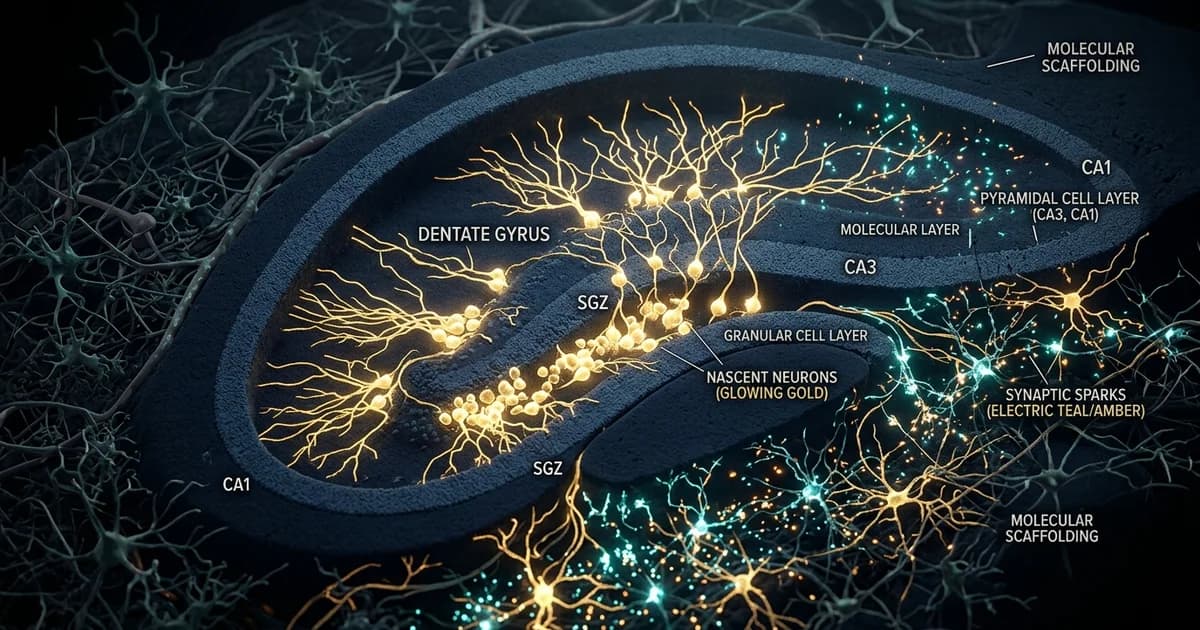
In humans, this happens almost entirely in one spot: the dentate gyrus, a sliver of the hippocampus that handles memory formation and pattern separation. Other mammals show plenty of neurogenesis in the olfactory system, but in us that pathway has largely faded. According to a 2025 review in Frontiers in Neuroscience, hippocampal neurogenesis persists in humans and may play real roles in learning, memory, and emotional regulation.
So when people ask "can you grow new brain cells," the honest answer is yes, in a small but functionally important corner of the brain.
The Debate That Defined the Field
The question of new neurons in the adult brain has been one of neuroscience's longest fights. The trouble has always been measurement. You cannot inject living people with the cell-tracking dyes used in mice, so direct proof in humans stayed elusive for decades.
That changed recently. As the University of Cincinnati reported, research published in Science in the summer of 2025 concluded that neurogenesis does happen in the adult human hippocampus, the part of the brain that handles learning and memory.
The key advance was finding the cells upstream of new neurons. Per ScienceDaily's coverage, the extent and significance of neurogenesis had stayed debated largely because there was no clear evidence that the precursor cells, known as neural progenitor cells, actually exist and divide in adult humans. The 2025 work closed that gap and confirmed the newly formed cells sit in the dentate gyrus.
This does not mean the debate is fully over. The rate of hippocampal neurogenesis in humans, how much it matters for everyday cognition, and how fast it fades with age are all still being worked out.
Why It Matters: Memory, Mood, and Aging
New neurons in the dentate gyrus are not just biological trivia. They appear to support how you encode new memories and tell similar experiences apart.
The clinical stakes are high. Researchers studying how adult-born neurons survive see potential payoffs for treating Alzheimer's and dementia, according to the University of Cincinnati. The same group found something practical about the cells that govern the process: brain immune cells called microglia can regulate neurogenesis in the adult hippocampus.
The factors that push the dial in both directions are fairly well mapped. The Frontiers in Neuroscience review notes that neurogenesis tends to rise with SSRIs and exercise and fall with chronic stress and aging. That last point is worth sitting with. Stress and aging work against you, which means your daily habits are part of the equation.
How to Increase Neurogenesis: What the Evidence Supports
If you want to know how to increase neurogenesis, start with the lever that has the deepest research behind it: movement. The other inputs help, but exercise is the headliner.
Here is how the main interventions stack up.
| Intervention | Strength of Evidence | What It Appears to Do |
|---|---|---|
| Aerobic exercise | Strong (animal), promising (human) | Raises BDNF and new neuron survival |
| Sleep | Strong (animal) | Protects new cell survival; loss suppresses it |
| Stress reduction | Strong | Chronic stress and cortisol lower neurogenesis |
| Antidepressants (SSRIs) | Moderate | Linked to increased neurogenesis in studies |
| Diet and fasting | Moderate (mostly animal) | Caloric restriction and omega-3s linked to support |
| Supplements / nootropics | Weak | No direct human neurogenesis claim holds up |
Exercise: The Strongest Lever
Neurogenesis exercise research is the most replicated body of work in the field. A review in Frontiers in Neuroscience notes that in rodents, hippocampal neurogenesis driven by exercise has been demonstrated and replicated many times over. The foundational experiments were simple: give mice a running wheel and count the new cells.
The mechanism runs partly through a growth factor called BDNF. As Harvard Health describes it, aerobic exercise both induced neurogenesis in mice and raised brain-derived neurotrophic factor, with one researcher comparing BDNF to fertilizer that helps neurons grow and survive.
The effect size in animals is real. Harvard Health cites a study in which adult male rats that did aerobic exercise for eight weeks had two to three times as many hippocampal neurons as rats that did none.
There is even a muscle-to-brain signal. Researchers identified that a muscle-secreted protein called cathepsin B drives part of running's neurogenic benefit, and in humans, changes in cathepsin B tracked with fitness and memory function. Your legs talk to your hippocampus. If you want the deeper mechanism, our explainer on how exercise raises BDNF connects the dots.
Sleep and Stress
Sleep is when the brain consolidates memory and supports the survival of newly born cells. Skimp on it and you blunt the process. Chronic stress does the same through raised cortisol, which is why the evidence consistently ties stress to lower neurogenesis.
These two are unglamorous and free. They are also where most people leak the most performance.
The Honest Caveat: Humans Are Not Mice
The cleanest data comes from rodents, and that is a problem. Most of what we know about how new neurons develop, connect, and survive comes from lab animals.
The human work is real but harder. The Frontiers review flags real discrepancies between rodent and human findings. Timelines differ too. A 2025 review in PMC notes that a new neuron takes 2 to 4 weeks to mature in mice and rats, and longer in primates and humans.
So treat anyone selling you a guaranteed "neurogenesis booster" with skepticism. The reliable inputs are behavioral, and they compound slowly.
The Verdict on Growing New Brain Cells
You can grow new brain cells as an adult. The 2025 genetic evidence settled the biggest open question by confirming that the precursor cells exist and divide in the adult human hippocampus.
What you cannot do is shortcut the process with a single product. The levers that hold up under scrutiny are aerobic exercise, real sleep, and managing chronic stress. They feed the same growth-factor pathways that the animal research keeps pointing to.
New neurons are the raw material. What turns that material into durable memory is the work you do while focused: learning, repetition, and attention held long enough to matter.
Frequently Asked Questions
Can you really grow new brain cells as an adult?
Yes. After a century of doubt, a 2025 study in Science found genetic evidence that neural progenitor cells, the precursors to new neurons, exist and divide in the adult human hippocampus. The new cells form in a region called the dentate gyrus, which supports learning and memory. The rate appears modest and declines with age, but the basic capacity is no longer in serious dispute.
Where in the brain does adult neurogenesis happen?
Almost entirely in the hippocampus, specifically the dentate gyrus. This region handles memory formation and pattern separation, which is your ability to tell similar experiences apart. Other mammals show neurogenesis in olfactory areas, but that pathway is greatly reduced in humans, leaving the hippocampus as the main site for new neurons in the adult brain.
Does exercise actually increase neurogenesis?
In animals, strongly and repeatedly. Aerobic exercise raises BDNF, a growth factor that helps new neurons grow and survive, and one study found exercising rats had two to three times more hippocampal neurons than sedentary ones. Human evidence is more indirect because we cannot directly count new cells in living people, but exercise reliably tracks with better hippocampus-dependent memory.
What lowers neurogenesis?
Chronic stress and aging are the two best-documented suppressors. Raised cortisol from ongoing stress reduces the birth and survival of new neurons, and the natural rate slows as you get older. Poor sleep also works against the process, since sleep supports the survival of newly formed cells.
How long does it take for a new neuron to mature?
Longer than you might expect. In mice and rats, a new neuron takes roughly 2 to 4 weeks to proliferate, differentiate, and mature. In primates and humans the timeline is longer. This is one reason the benefits of habits like exercise show up gradually rather than overnight.
Can supplements increase neurogenesis?
No supplement has solid human evidence for directly increasing neurogenesis. Some compounds influence BDNF or related pathways in animal models, but that is a long way from a proven human neurogenesis claim. The interventions with real support are behavioral: aerobic exercise, sleep, and stress management. Be wary of any product marketed as a neurogenesis pill.
Where Roon Fits: Fuel for the Focused Reps, Not a Neuron Pill
New neurons are raw material. Learning is what wires them into something useful, and learning demands sustained, undistracted attention. That is the part of the equation you can act on every single day.
To be clear, Roon does not grow new brain cells, and no honest brand should claim a product does. The real drivers of neurogenesis are aerobic exercise, sleep, and lower stress. What Roon supports is the focused state you bring to deep work, study sessions, and skill practice, the reps where attention actually does the wiring.
Roon is a sublingual pouch built around four ingredients: 80 mg caffeine, 60 mg L-theanine, 25 mg methylliberine (Dynamine), and 5 mg theacrine (TeaCrine). It hits in 5 to 10 minutes and is designed for 6 to 8 hours of steady focus with no jitters, no crash, and no tolerance buildup. Pair it with a real workout and a full night of sleep, and you are working with the science instead of against it. Try Roon on your next deep-focus block.
Written by Roon Team