Acetylcholine: The Brain's Focus and Memory Chemical
Roon Team
Acetylcholine Explained: The Brain's Focus-and-Memory Neurotransmitter
Every time you lock onto a sentence and the rest of the room goes quiet, a small molecule is doing the heavy lifting. The acetylcholine function behind that moment is part attention spotlight, part memory ink. It decides what your brain bothers to encode and what it lets slide.
Acetylcholine was the first neurotransmitter ever identified, back in the 1920s. A century later, it remains one of the most studied molecules in neuroscience, and for good reason. It sits at the center of how you learn, how you pay attention, and how your muscles move.
This is the working explainer. What acetylcholine is, where it comes from, how it talks to your neurons, and why it matters for focus and memory.
Key Takeaways
- Acetylcholine is a neurotransmitter built from choline (a nutrient in foods like egg yolks) and an acetyl group from glucose metabolism.
- Its two big jobs split cleanly: voluntary muscle movement in the body, and attention, learning, and memory in the brain.
- The cholinergic system in the brain runs largely from the basal forebrain, which projects to the entire cortex.
- Acetylcholine works through two receptor families with different names and different speeds: nicotinic and muscarinic.
- It is closely tied to wakefulness, and its release in the basal forebrain is dialed down by adenosine, the same molecule caffeine blocks.
What Is Acetylcholine?
Acetylcholine is a chemical messenger that nerve cells use to signal muscles, organs, and other neurons. It is an important neurotransmitter that plays a role in brain functions, such as memory, and body functions, such as muscle contractions to move your muscles.
The name tells you the recipe. Acetylcholine gets its name from the two substances that it's made from, an acetyl group (acetyl coenzyme A, which comes from the sugar molecule glucose) and the nutrient choline. An enzyme called choline acetyltransferase fuses the two together inside the neuron.
Where does the choline come from? Mostly your diet, with help from your liver. Choline is naturally present in foods, including egg yolks, soy, liver, seeds of vegetables and legumes, and choline is also made in your liver. No choline, no acetylcholine. That dietary link is part of why nutrition researchers keep an eye on choline intake.
Acetylcholine Function: One Molecule, Two Domains
The cleanest way to understand the acetylcholine function is to split it in two. There is the body job and the brain job, and they look almost nothing alike.
In the body, acetylcholine is the command line for muscle. It plays a major role in voluntary muscle movement all over your body, where nerve cells stimulate muscle nerve cells, causing muscles to contract. It also keeps your autonomic system running. Acetylcholine is released by most neurons in your autonomic nervous system regulating heart rate, blood pressure and gut motility.
In the brain, the role shifts from mechanical to cognitive. It plays an important role in brain nerve cells, in such processes as memory, thinking and learning. Acetylcholine plays a role in muscle contractions, memory, motivation, sexual desire, sleep and learning.
The clinical evidence underlines the point. Low levels of acetylcholine are associated with memory issues and muscle disorders, and cholinesterase inhibitors are used to treat Alzheimer's disease and myasthenia gravis. When the system fails, both the body job and the brain job suffer.
The Cholinergic System and the Basal Forebrain
Your brain does not flood itself evenly with acetylcholine. It pipes it from specific hubs, and the main one for cognition is the basal forebrain.
This region acts as a distribution center for the cortex. Basal forebrain cholinergic neurons influence cortical state, plasticity, learning, and attention, and they collectively innervate the entire cerebral cortex, differentially controlling acetylcholine efflux across different cortical areas and timescales. In plain terms, these neurons reach almost everywhere and adjust the dose region by region.
That precision matters. Newer mapping work shows the system is not one uniform broadcast. Basal forebrain cholinergic neurons influence cognition and emotion through specific acetylcholine release in various brain regions, including the prefrontal cortices and basolateral amygdala. Different subtypes feed different targets, which is how the same molecule can sharpen a math problem and color an emotional memory.
The basal forebrain is also where attention and arousal meet. The cholinergic system can be activated by different inputs, and in particular, by orexin neurons, whose cell bodies are located within the postero-lateral hypothalamus, which promote arousal and attention through their projections to the basal forebrain. When you snap to alertness, this loop is part of the reason.
How Acetylcholine Sharpens Attention and Memory
Acetylcholine is best understood as a contrast knob for the brain. It boosts the signal you care about and quiets the noise around it.
Attention and memory are not separate systems here. They lean on each other, and acetylcholine is a shared input. Researchers describe a real interdependence between the two, with cholinergic signaling shaping both at once (see this review in ScienceDirect). You remember what you attend to, and acetylcholine helps decide what gets attended to.
The mechanics show up in motor learning too. Work in mice found that acetylcholine release from basal forebrain cholinergic neuron terminals rapidly modulates neuronal excitability, circuit dynamics, and cortical coding, all processes required for processing complex sensory information. Skill acquisition needs this modulation running in the background.
So when you describe a state of deep focus, you are partly describing cholinergic tone. The molecule is not creating new thoughts. It is making the right circuits more responsive at the right moment.
Nicotinic and Muscarinic Receptors
Acetylcholine speaks through two receptor families, and the nicotinic muscarinic receptors split is one of the foundations of pharmacology.
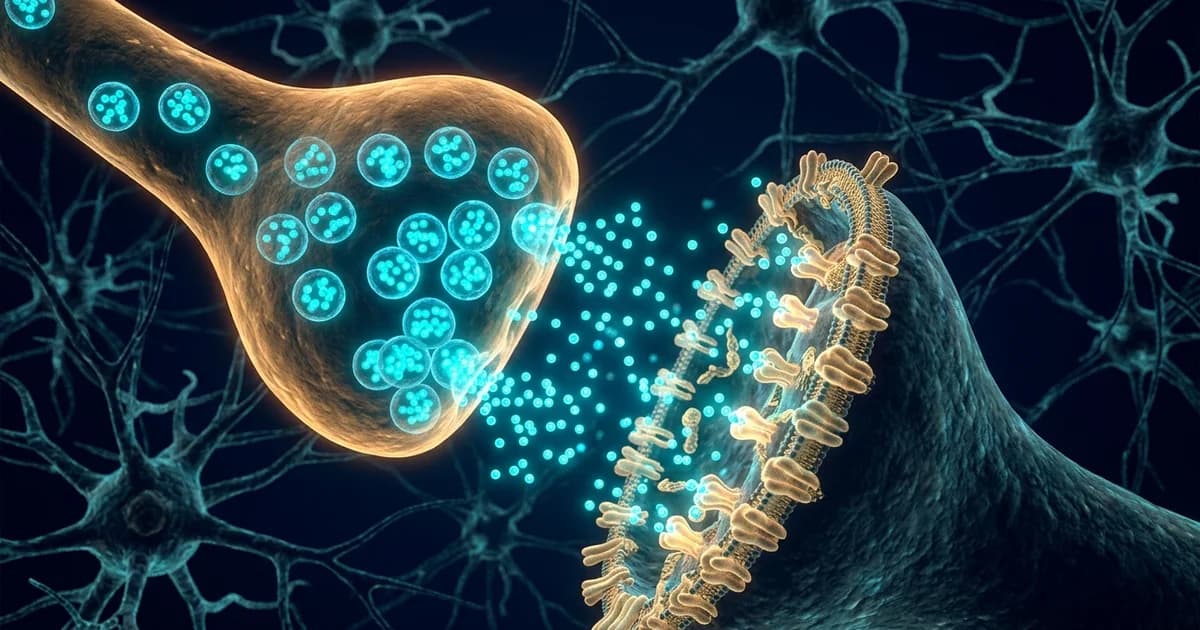
Nicotinic receptors are fast. They are ion channels that open the instant acetylcholine binds, which is why they drive quick events like muscle contraction. They are named for nicotine, which activates them, and they are the receptors at the junction between nerve and muscle.
Muscarinic receptors are slower and more subtle. They work through a chain of internal signaling rather than a direct channel, which makes them well suited to the gradual modulation behind mood, learning, and autonomic control. They are named for muscarine, a compound from certain mushrooms.
Here is the practical contrast.
| Feature | Nicotinic receptors | Muscarinic receptors |
|---|---|---|
| Receptor type | Fast ion channel | Slower signaling receptor |
| Speed of response | Milliseconds | Slower, longer-lasting |
| Named after | Nicotine | Muscarine |
| Classic role | Muscle contraction, fast neuron-to-neuron signals | Memory, autonomic functions, slow modulation |
| Where they matter | Neuromuscular junction, brain | Brain, heart, glands, smooth muscle |
Most of acetylcholine's cognitive work in the cortex runs heavily through muscarinic signaling, while nicotinic receptors handle the rapid jobs. Both families read the same molecule. They just respond on different clocks.
Where Acetylcholine Meets Sleep, Wakefulness, and Adenosine
Acetylcholine is one of the brain's main wakefulness signals, and it is governed by the same chemistry that makes you tired.
The basal forebrain controls this switch. Stimulating the basal forebrain gives rise to acetylcholine release, which induces wakefulness and REM sleep, whereas inhibition of acetylcholine release in the basal forebrain by adenosine causes slow wave sleep. Acetylcholine up means alert. Acetylcholine down means deep sleep.
That single sentence contains a useful bridge. The brake on acetylcholine release here is adenosine, the molecule that builds up the longer you stay awake and pushes you toward sleep. Activating cholinergic, GABAergic or glutamatergic neurons in the basal forebrain promotes wakefulness.
This is where the cholinergic story connects to the more familiar world of caffeine. Caffeine does not touch acetylcholine directly. It blocks adenosine, which means it works on the arousal side of the equation rather than the cholinergic side.
Conclusion
Acetylcholine earns its reputation as the focus-and-memory neurotransmitter because it does both jobs through the same circuitry. Built from dietary choline, distributed from the basal forebrain, and read by two receptor families running on different speeds, it sets the contrast on attention and helps decide what your brain encodes.
It is not a standalone "smart molecule." It is a modulator, a system that makes the right circuits more responsive at the right time, deeply tied to wakefulness and to the adenosine chemistry that governs sleep. Understanding it reframes focus as a state your brain tunes, not a switch you flip.
The cholinergic system is one axis of attention. The arousal system, driven by adenosine, is another. They are different pathways, and that distinction is more than academic once you start thinking about how anything you consume actually works.
Frequently Asked Questions
What is the main function of acetylcholine?
Acetylcholine has two main roles. In the body it drives voluntary muscle movement and regulates autonomic functions like heart rate and digestion. In the brain it supports attention, learning, and memory. It is an important neurotransmitter that plays a role in brain functions, such as memory, and body functions, such as muscle contractions to move your muscles. Think of it as the molecule that connects intention to action and attention to memory.
What foods support acetylcholine production?
Acetylcholine is built partly from choline, which comes mostly from your diet. Choline is naturally present in foods, including egg yolks, soy, liver, seeds of vegetables and legumes. Your liver also produces some choline on its own. Eating choline-rich foods gives your body the raw material it needs, though more choline does not automatically mean more acetylcholine, since production is tightly regulated.
What is the difference between nicotinic and muscarinic receptors?
Both are acetylcholine receptors, but they work on different timescales. Nicotinic receptors are fast ion channels that open immediately and drive quick events like muscle contraction. Muscarinic receptors are slower and work through internal signaling, making them well suited to memory and autonomic control. They are named after nicotine and muscarine, the compounds that activate each type. Most cortical cognition leans heavily on muscarinic signaling.
Where is acetylcholine made in the brain?
The main source for cognition is the basal forebrain. Basal forebrain cholinergic neurons influence cortical state, plasticity, learning, and attention, and they collectively innervate the entire cerebral cortex, differentially controlling acetylcholine efflux across different cortical areas and timescales. From this hub, cholinergic neurons reach almost the entire cortex and adjust acetylcholine levels region by region rather than all at once.
Does caffeine affect acetylcholine?
Not directly. Caffeine works mainly by blocking adenosine, the molecule that builds up during the day and promotes sleep. Acetylcholine sits on a related but separate pathway. Inhibition of acetylcholine release in the basal forebrain by adenosine causes slow wave sleep. Since caffeine blocks adenosine, it influences the same wakefulness system from a different angle, without acting on the cholinergic molecules themselves.
Why is acetylcholine linked to memory disorders?
Because the cholinergic system is central to learning and memory, losing it has clear cognitive costs. Low levels of acetylcholine are associated with memory issues and muscle disorders, and cholinesterase inhibitors are used to treat Alzheimer's disease and myasthenia gravis. These medications slow the breakdown of acetylcholine to keep more of it available. This is also why the cholinergic system is a major target in dementia research.
Is acetylcholine connected to attention as well as memory?
Yes, and the two are hard to separate. Acetylcholine acts as a contrast knob, boosting relevant signals and quieting noise, which serves attention and memory at the same time. The basal forebrain also receives arousal input from orexin neurons. The cholinergic system can be activated by orexin neurons, which promote arousal and attention through their projections to the basal forebrain.
Why Roon Works the Arousal Axis, Not the Cholinergic One
If you took one thing from this article, make it the split between two systems. The cholinergic axis runs from the basal forebrain and tunes attention and memory. The arousal axis runs on adenosine, the brake that builds up across your day. They overlap at wakefulness, but they are not the same lever.
Roon is built for the arousal axis, not the cholinergic one. Each sublingual pouch pairs 80 mg caffeine and 60 mg L-theanine with 25 mg methylliberine (Dynamine) and 5 mg theacrine (TeaCrine). Caffeine, theacrine, and methylliberine act on the adenosine and arousal side, while L-theanine smooths the edges, which is how Roon aims for 6 to 8 hours of steady focus with no jitters, no crash, and no tolerance creep.
To be clear about what it is not: Roon is not a cholinergic supplement, and it does not replace the choline you get from food or the sleep that resets your adenosine. It works one part of the focus equation honestly and well. If you want clean arousal without the afternoon dropoff, try Roon and feel the difference between sharp and wired.
Written by Roon Team