Serotonin, Explained: The Brain Chemical That Governs Mood
Roon Team
Serotonin, Explained: The Brain Chemical That Governs Mood, Patience, and the Gut
Ask ten people what serotonin does and nine will say one word: happiness. It is the most famous molecule in the brain and also the most misunderstood. So what does serotonin do, really? Not what the supplement ads tell you.
Serotonin is a signaling chemical that shapes mood, sleep, digestion, and how long you are willing to wait for something good. It does all of this while spending most of its time nowhere near your brain. The story is stranger and more interesting than the "happiness chemical" label suggests.
This is the mechanism, minus the marketing.
Key Takeaways
- Serotonin (chemically known as 5-HT) is a neurotransmitter built from the amino acid tryptophan.
- Around 90% of your body's serotonin lives in the gut, not the brain.
- The "low serotonin causes depression" idea is not supported by the current evidence.
- Beyond mood, serotonin strongly influences patience and impulse control.
- Serotonin acts through at least 14 different receptor subtypes, which is why it does so many different jobs.
What Does Serotonin Do in the Body?
Serotonin regulates mood, sleep, appetite, digestion, and impulse control, and it does this through a network that spans your brain and your gut. It is a single molecule with a surprisingly long job description.
The chemistry is simple. Serotonin, also known as 5-hydroxytryptamine (5-HT), is a monoamine neurotransmitter made from the essential amino acid tryptophan. You get tryptophan from food, your body converts it, and the result is one of the most widely distributed signaling molecules you have.
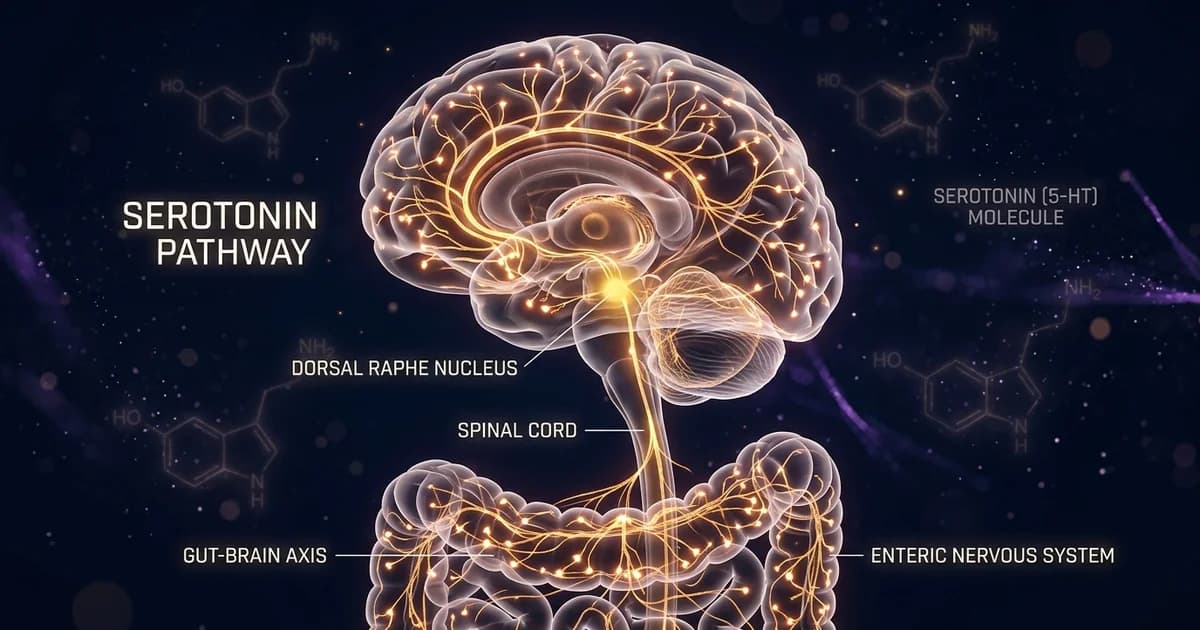
Here is the part that surprises most people. Most of the body's serotonin (around 90%) is produced in the gastrointestinal tract, particularly by enterochromaffin cells in the gut lining. The remaining 10% is synthesized in the brain, specifically in a group of neurons located in the Raphe nuclei, which are clustered in the brainstem.
That 10% does an enormous amount of work. From the Raphe nuclei, serotonergic neurons project throughout the brain, including the limbic system, prefrontal cortex, hippocampus, and basal ganglia, allowing serotonin to influence mood, memory, learning, movement, and more.
Serotonin and Mood: Is Serotonin the Happiness Chemical?
No. Serotonin is not the happiness chemical, and the science does not support the simple "low serotonin equals sadness" story that most people have been told.
This belief is everywhere. Studies have shown that as many as 85% to 90% of the public believes that depression is caused by low serotonin levels or a chemical imbalance. The problem is that the data underneath that belief never held up.
In 2022, a team led by UCL scientists published a major review in Molecular Psychiatry. After decades of study, there remains no clear evidence that serotonin levels or serotonin activity are responsible for depression, according to a major review of prior research led by UCL scientists. You can read the summary at ScienceDaily.
The review went further than just questioning the link. The umbrella review, an overview of existing meta-analyses and systematic reviews, suggests that depression is not likely caused by a chemical imbalance, and calls into question what antidepressants do.
It also looked hard at genetics. Larger studies with tens of thousands of participants examined gene variation, including the gene for the serotonin transporter, and found no difference in these genes between individuals with depression and healthy controls. The same work found that stressful life events carried far more predictive weight, which matters: the more stressful a life event, the more likely a person would become depressed.
So serotonin clearly touches mood. It just does not operate like a simple fuel gauge where higher always means happier. The relationship between serotonin and mood is real, but it is indirect, modulatory, and tangled up with everything else the molecule does.
The Underrated Role: Serotonin, Patience, and Impulse Control
Serotonin helps you wait. One of its most reliable jobs is supporting patience and impulse control, telling your brain that a future reward is worth holding out for.
This is where the research has become genuinely interesting over the last decade. Work summarized by Medical News Today and Big Think points to serotonin neurons firing while an animal waits for an expected payoff, effectively bridging the gap between action now and reward later.
The mechanism behind it is reviewed in depth in a paper hosted on the NCBI archive, titled "The Role of Serotonin in the Regulation of Patience and Impulsivity." When serotonin signaling drops, the willingness to wait tends to drop with it, and impulsive choices become more likely.
Reframe serotonin this way and a lot of its effects click into place. It is less a "feel good" switch and more a "stay the course" signal. That covers patience, mood stability, and your ability to resist the easy short-term option.
Serotonin Gut Brain Connection: Your Second Brain
The serotonin gut brain link is not a metaphor. Your gut produces the vast majority of your body's serotonin, and it uses that serotonin to run digestion and to talk back to your brain.
In the gut, serotonin drives motility, the muscular contractions that move food through your intestines. This is why drugs that affect serotonin so often hit the digestive system, and why low serotonin signaling is associated with conditions like irritable bowel syndrome.
The brain and gut are wired together, partly through the vagus nerve. A 2025 review in the journal IJMS, hosted on the NCBI archive, examines how the vagus nerve and serotonin interact across the gut-brain axis. That two-way line is one reason your stomach and your mood so often move together.
Worth being precise here. The serotonin made in your gut does not simply float up into your brain, because serotonin does not freely cross the blood-brain barrier. The communication is mostly indirect, via nerve signaling and other messengers. The gut and the brain run parallel serotonin systems that influence each other.
Why One Molecule Does So Much: Serotonin Receptors
Serotonin can regulate mood, sleep, gut motility, and patience because it speaks through many different serotonin receptors, each wired to a different outcome. The molecule is the same everywhere. The result depends on which lock it fits.
Scientists have identified at least 14 receptor subtypes, grouped into seven families (5-HT1 through 5-HT7). One subtype might calm a circuit; another might excite it. A useful overview of how these different receptors shape brain function appears in this review in the Journal of Psychopharmacology.
This is why serotonin resists a single tidy headline.
| Serotonin acts on... | Primary effect | Where it matters |
|---|---|---|
| 5-HT1A receptors | Mood and anxiety modulation | Brain (raphe, hippocampus) |
| 5-HT2A receptors | Cognition, perception | Cortex |
| 5-HT3 receptors | Nausea, gut signaling | Gut and brainstem |
| 5-HT4 receptors | Gut motility | Digestive tract |
| 5-HT7 receptors | Sleep, circadian rhythm | Brain |
One transmitter, many receptors, many jobs. That is the entire reason the "happiness chemical" label fails. A molecule that runs your bowels, your sleep cycle, and your willingness to wait for dessert is doing far more than making you happy.
How to Support Healthy Serotonin Function
You do not need a pill to support normal serotonin function. The basics do most of the work, because your body builds serotonin from tryptophan in food and regulates it through daily rhythms.
A few evidence-aligned habits help maintain healthy serotonin signaling:
- Eat enough protein. Tryptophan, the raw material for serotonin, comes from dietary protein.
- Get morning light. Light exposure supports the serotonin and melatonin systems that govern your sleep-wake cycle.
- Move your body. Regular aerobic exercise is associated with healthier serotonin activity.
- Protect your sleep. Serotonin and sleep regulation are tightly linked, and poor sleep degrades both.
- Feed your gut. Since most serotonin is made in the gut, fiber and a varied diet support the system that produces it.
None of this is dramatic. It is just the unglamorous foundation that actually moves the needle.
The Bottom Line on a Misunderstood Molecule
Serotonin is not a happiness dial. It is a wide-ranging signaling molecule that helps regulate mood, sleep, digestion, and your capacity to wait for what matters, working through a dozen-plus receptor types and a gut that makes most of the supply.
The "chemical imbalance" story was always too simple, and the evidence has moved past it. The more accurate picture is a molecule that keeps systems steady and helps you hold the line, in your gut and in your decisions.
Understand serotonin as a stabilizer, not a switch, and the rest of its behavior starts to make sense.
Frequently Asked Questions
Is serotonin the happiness chemical?
Not really. The label is a marketing simplification. Serotonin influences mood, but a large 2022 review found no clear evidence that low serotonin causes depression. Serotonin's job is broader and more about stability: it shapes patience, sleep, digestion, and impulse control. Calling it the "happiness chemical" ignores roughly 90% of what the molecule actually does, most of which happens in the gut rather than the brain.
What does serotonin do in the gut?
Around 90% of your body's serotonin is produced in the gut, where it drives motility, the muscle contractions that move food through your intestines. It also participates in gut-brain signaling. Because gut serotonin is so central to digestion, disruptions in serotonin signaling are linked to digestive conditions such as irritable bowel syndrome. Your gut runs its own large serotonin system, largely separate from the brain's.
Does serotonin from the gut reach the brain?
Not directly. Serotonin does not freely cross the blood-brain barrier, so the serotonin made in your gut mostly stays in your gut. The gut and brain still influence each other through nerve pathways, including the vagus nerve, and through other signaling molecules. So the two systems are connected and communicate, but they are not simply pouring serotonin into one another.
How is serotonin related to patience?
Serotonin supports patience and impulse control. Research suggests serotonin neurons stay active while you wait for an expected reward, helping you tolerate delay rather than grabbing the immediate option. When serotonin signaling falls, impulsive choices become more likely. This reframes serotonin as a "stay the course" signal rather than a feel-good one, which fits its role in mood stability.
What are serotonin receptors?
Serotonin receptors are the docking sites that determine what serotonin actually does in a given location. There are at least 14 subtypes across seven families (5-HT1 through 5-HT7). The same serotonin molecule can calm one circuit and excite another, depending on which receptor it binds. This is why one transmitter can govern mood, sleep, nausea, and gut motility all at once.
Can you increase serotonin naturally?
You can support normal serotonin function through diet and lifestyle. Eating enough protein supplies tryptophan, the building block of serotonin. Morning light, regular exercise, consistent sleep, and a fiber-rich diet all support the systems that produce and regulate serotonin. These habits help maintain healthy function rather than spiking levels, which is the more realistic and sustainable goal.
Where Calm Focus Actually Comes From (and Where It Doesn't)
Here is a clean distinction worth keeping. Serotonin governs mood, patience, and gut signaling, but it is not the system behind sharp, calm focus on demand. Those run on different chemistry. If you are reading about serotonin because you want steadier concentration, you are looking at the wrong molecule.
That separation is why Roon does not pretend to be serotonergic. Roon is a sublingual cognitive performance pouch built on four ingredients: 80 mg caffeine, 60 mg L-theanine, 25 mg methylliberine (Dynamine), and 5 mg theacrine (TeaCrine). It works through adenosine and arousal pathways plus L-theanine's effect on alpha brain waves, designed for a 5 to 10 minute onset and 6 to 8 hours of focus with no jitters, no crash, and no tolerance buildup.
Roon is not an antidepressant, a serotonin booster, or a substitute for the diet, light, and sleep habits that support healthy serotonin function. If you want to go deeper on the mood side, our explainers on serotonin precursors like 5-HTP, tryptophan, and saffron, and on serotonin versus GABA, break down those mechanisms honestly. Want clean focus without touching your serotonin system? That is where Roon fits.
Written by Roon Team