Uridine Monophosphate: Benefits, Dosage, and the Science
Roon Team
Uridine Monophosphate: Benefits, Dosage, and the Science
Most nootropics promise something you can feel in twenty minutes. Uridine monophosphate is not one of them.
The real uridine monophosphate benefits play out over weeks, not minutes, because uridine works at the level of your neurons' physical structure. It feeds the raw materials your brain uses to build new synaptic membrane. That makes it one of the more biologically interesting compounds in the cognitive space, and also one of the most overhyped.
So let's separate the chemistry from the marketing. Here is what uridine actually does, what the evidence supports, how much people take, and where it falls short.
Key Takeaways
- Uridine monophosphate (UMP) is a nucleotide your body uses to build phospholipids, the fatty molecules that make up neuronal membranes.
- Most of the compelling research is preclinical (animal and cell studies) or based on multi-ingredient formulas, not uridine alone in humans.
- It works through the Kennedy cycle, supplying CDP-choline for membrane synthesis when paired with choline and omega-3 DHA.
- Typical uridine dosage in nootropic circles runs 150 to 300 mg per day, often stacked with choline and fish oil.
- Uridine is a slow, structural play. It is not a same-day focus tool.
What Is Uridine Monophosphate?
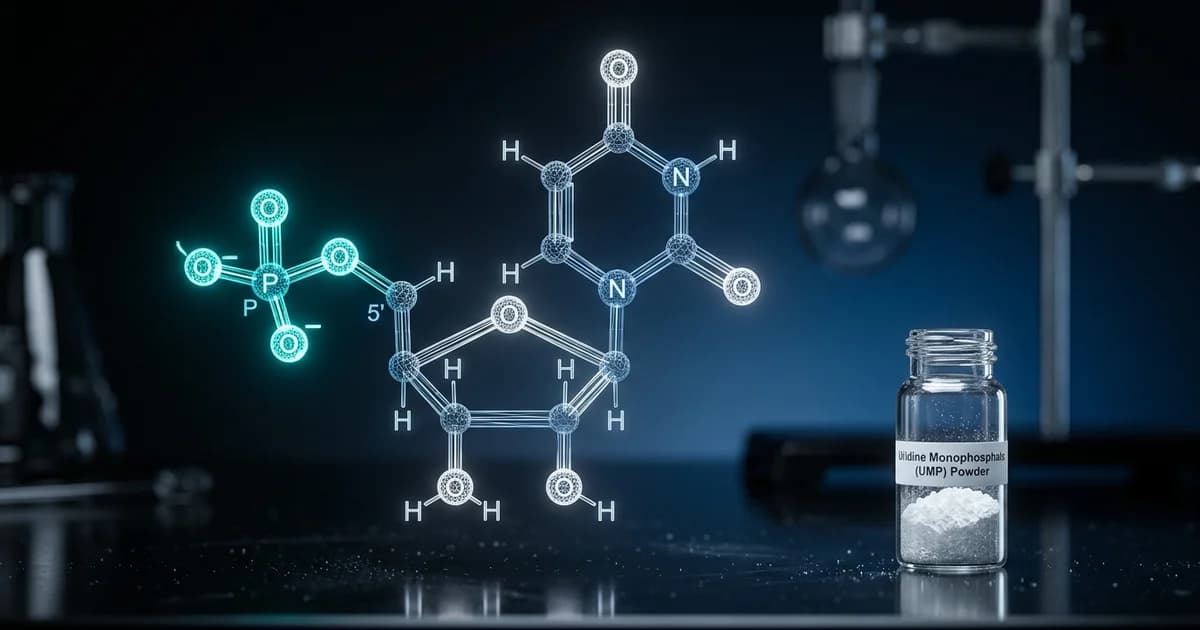
Uridine monophosphate is a nucleotide, one of the building blocks of RNA, and a precursor your body converts into compounds used to construct cell membranes. In supplement form it usually appears as the disodium salt of UMP.
Your liver makes uridine on its own, and you also get it from food. Breast milk is rich in it, and so are foods like organ meats, broccoli, and brewer's yeast. Most circulating uridine in adults comes from the liver, not the diet.
The interest in UMP as an ump nootropic comes from a specific idea: that giving the brain more of this raw material helps it build and maintain the synaptic connections that underlie learning and memory.
How Uridine Works: The Kennedy Cycle and Synapse Building
Uridine's main job in the brain is to fuel phospholipid production through the Kennedy cycle, the metabolic pathway that assembles phosphatidylcholine, the dominant phospholipid in neuronal membranes.
Here is the chain in plain terms. Uridine gets converted to UTP, then to CTP, then to CDP-choline. CDP-choline combines with a fatty acid backbone to form phosphatidylcholine, the membrane material neurons need to grow new dendritic spines and synapses.
That last point matters. The compound does not act like a stimulant. It acts like a supply chain for construction.
Why Uridine, Choline, and DHA Travel Together
Uridine rarely works alone. The strongest research pairs it with two other precursors, and the logic behind uridine choline stacking is straightforward: the Kennedy cycle needs all three inputs running at once.
Choline supplies the head group for phosphatidylcholine. The omega-3 fatty acid DHA supplies the fatty tail. Uridine drives the cycle that links them. Take away any one and the assembly line slows.
This is the basis of the work from MIT researcher Richard Wurtman and colleagues. In a foundational paper on synapse formation published in The Journal of Nutrition, Health and Aging, oral uridine and DHA, the circulating precursors of brain phosphatides, increased synaptic membrane and synaptic protein levels in animal models. That is the uridine synapse mechanism in a sentence: more precursors, more membrane, more synaptic structure.
A later review in Neurology and Therapy examined uridine and choline enriched multinutrient interventions for mild cognitive impairment, framing the combination as a way to support synapse formation in aging brains. The mechanism is well mapped. The human outcomes are where it gets complicated.
Uridine Monophosphate Benefits: What the Evidence Actually Shows
The honest version: uridine monophosphate benefits are mechanistically plausible and strongly supported in animals, but human evidence for UMP taken alone is thin.
Let's break down the claims by how much support each one has.
Memory and Learning
In rodent models, uridine combined with choline and DHA reliably increases synaptic proteins and improves performance on memory tasks. The structural changes are real and measurable in animal brains.
In humans, the picture is murkier. Most positive human data comes from multi-ingredient medical foods like the Fortasyn Connect formula, not isolated uridine. Untangling uridine's specific contribution from a blend of nutrients is difficult.
Brain Phospholipid Levels in Humans
There is one direct human signal worth noting. A 31-phosphorus magnetic resonance spectroscopy study reported that short-term uridine administration increased brain membrane phospholipid precursors in healthy adults.
That is meaningful. It suggests the proposed mechanism does operate in human brains, not just rodent ones. It does not prove a cognitive benefit, but it closes part of the gap.
Mood and Dopamine
Some early work has explored uridine's effects on dopamine signaling and mood, including small studies in young people with bipolar depression. This research is preliminary, the sample sizes are tiny, and uridine is not a treatment for any mood condition. Treat these findings as hypotheses, not conclusions.
Uridine Dosage: How Much People Take
A common uridine dosage in nootropic communities is 150 to 300 mg of uridine monophosphate per day, taken with food. Some protocols go higher, but more is not clearly better, and good human dose-response data is lacking.
Because uridine works alongside choline and DHA, people who use it tend to stack all three.
| Component | Typical daily amount | Role in the stack |
|---|---|---|
| Uridine monophosphate | 150–300 mg | Drives the Kennedy cycle |
| Choline source (e.g., CDP-choline or alpha-GPC) | 250–500 mg | Supplies the choline head group |
| DHA (omega-3) | 500–1,000 mg | Supplies the fatty acid tail |
A few practical notes. Uridine is generally well tolerated, with occasional reports of mild digestive upset or headache. It is not a stimulant, so do not expect an acute lift. And it is sublingual-friendly, since UMP can be absorbed through the mouth, though most people just swallow it with a meal.
If you are pregnant, nursing, on medication, or managing a health condition, talk to a clinician before starting. This article is education, not medical advice.
Uridine vs. Acute Focus Tools: Different Jobs
Uridine and a focus supplement solve different problems, and confusing the two is the most common mistake people make.
Uridine is a structural, long-game compound. Caffeine, L-theanine, and similar agents are acute, same-day performance tools. One builds the hardware over weeks. The other tunes the signal in minutes.
| Approach | Onset | Best for | Evidence base |
|---|---|---|---|
| Uridine + choline + DHA | Weeks | Long-term synaptic support | Strong in animals, limited in humans |
| Caffeine + L-theanine | 30–60 min | Calm, alert focus | Strong human evidence |
| Roon pouch (caffeine, L-theanine, Dynamine, TeaCrine) | 5–10 min | Fast, sustained daily focus | Ingredients clinically studied |
For more on the acute side of this equation, see our breakdowns of how caffeine and L-theanine work together and why a sublingual format speeds onset.
Conclusion
Uridine monophosphate is a genuinely interesting compound with a clear, well-understood mechanism. It feeds the Kennedy cycle, supports phospholipid synthesis, and helps your brain build the membrane it uses to form synapses, especially when paired with choline and DHA.
The catch is the evidence gap. Most of the persuasive data lives in animal studies and multi-ingredient formulas, not in trials of uridine alone in healthy humans. The one strong human signal, raised brain phospholipid precursors on MRS, supports the mechanism without proving a cognitive payoff.
So treat uridine for what it is. A slow, structural investment with promising biology and incomplete human proof. If you try it, set your expectations to weeks, not minutes, and stack it correctly.
Frequently Asked Questions
Does uridine monophosphate work as a nootropic?
Uridine has a strong, well-mapped mechanism: it supplies precursors for building neuronal membranes through the Kennedy cycle. The supporting evidence is strong in animal models and in multi-ingredient human formulas. Direct human trials of uridine alone are limited. So the biology is promising, but you should view it as a long-term structural compound rather than a proven, feel-it-today nootropic.
How long does uridine take to work?
Uridine is not an acute compound. Because it works by supplying raw materials for synaptic membrane synthesis, any effects build gradually over weeks of consistent use. If you are looking for noticeable same-day focus or energy, uridine is the wrong tool. It is closer to a slow nutritional input than a fast-acting stimulant.
What is the best uridine dosage?
Nootropic protocols commonly use 150 to 300 mg of uridine monophosphate per day, taken with food. There is no strong human dose-response data establishing an optimal amount, so higher doses are not clearly better. Most people stack uridine with a choline source and DHA, since the Kennedy cycle needs all three inputs to run efficiently.
Why is uridine taken with choline and DHA?
The three work as a set. Uridine drives the Kennedy cycle, choline supplies the head group for phosphatidylcholine, and DHA supplies the fatty acid tail. Together they provide everything the body needs to assemble synaptic membrane. Take away one input and the pathway slows, which is why most research and supplement protocols pair them.
Is uridine monophosphate safe?
Uridine is generally well tolerated at common supplement doses, with occasional mild reports of digestive upset or headache. It is naturally present in foods and produced by your liver. That said, long-term safety data in humans is limited, and it is not appropriate for everyone. If you are pregnant, nursing, on medication, or have a health condition, check with a clinician first.
Does uridine help with memory in humans?
In animals, uridine plus choline and DHA reliably increases synaptic proteins and improves memory task performance. In humans, most positive memory data comes from multi-ingredient medical foods rather than isolated uridine, which makes its specific contribution hard to isolate. A human MRS study did show that uridine raised brain phospholipid precursors, supporting the mechanism without confirming a memory benefit on its own.
Where Uridine Ends and a Daily Focus Tool Begins
Uridine is a bet on your brain's structure over the long run. It is a slow synaptic building block with promising biology and a real human evidence gap. That is a legitimate reason to take it, but it is not the same job as helping you lock in for the next eight hours.
Roon is built for that second job. It is a sublingual pouch with a four-ingredient stack: 80 mg caffeine, 60 mg L-theanine, 25 mg methylliberine (Dynamine), and 5 mg theacrine (TeaCrine). The format pulls onset down to 5 to 10 minutes and is designed for 6 to 8 hours of sustained focus with no jitters, no crash, and no tolerance buildup. Every ingredient in it has been studied in humans.
Roon is not a replacement for uridine, and it does not build synaptic membrane over weeks. The two serve different timelines. If you want fast, reliable focus on the days you actually need it, try Roon and leave the long-game structural work to compounds like uridine.
Written by Roon Team