Tyrosine Hydroxylase: The Rate-Limiting Enzyme That Controls Your Dopamine
Roon Team
Tyrosine Hydroxylase: The Rate-Limiting Enzyme That Controls Your Dopamine
Your brain does not pull dopamine out of thin air. It builds the molecule, atom by atom, through a precise assembly line. And the single step that decides how fast that line runs is controlled by one enzyme: tyrosine hydroxylase.
This is the rate-limiting enzyme for dopamine, the bottleneck that governs how much of the neurotransmitter your neurons can produce. Speed it up and dopamine synthesis climbs. Slow it down and the whole pathway stalls, no matter how much raw material you supply.
Understanding this enzyme explains a lot. It explains why dopamine "precursor" supplements rarely deliver the dramatic results their labels imply, and why your brain guards its dopamine output far more carefully than most people assume.
Key Takeaways
- Tyrosine hydroxylase (TH) catalyzes the slowest, rate-limiting step in dopamine production: converting the amino acid L-tyrosine into L-DOPA.
- The enzyme needs three partners to work: the BH4 cofactor (tetrahydrobiopterin), iron, and molecular oxygen.
- Dopamine itself shuts the enzyme down through end-product inhibition, a built-in brake that keeps levels stable.
- Because TH is usually near saturation with substrate, simply eating more tyrosine does not reliably flood the brain with dopamine.
What Tyrosine Hydroxylase Actually Does
Tyrosine hydroxylase converts the amino acid L-tyrosine into L-DOPA, and that single reaction sets the pace for your entire dopamine supply.
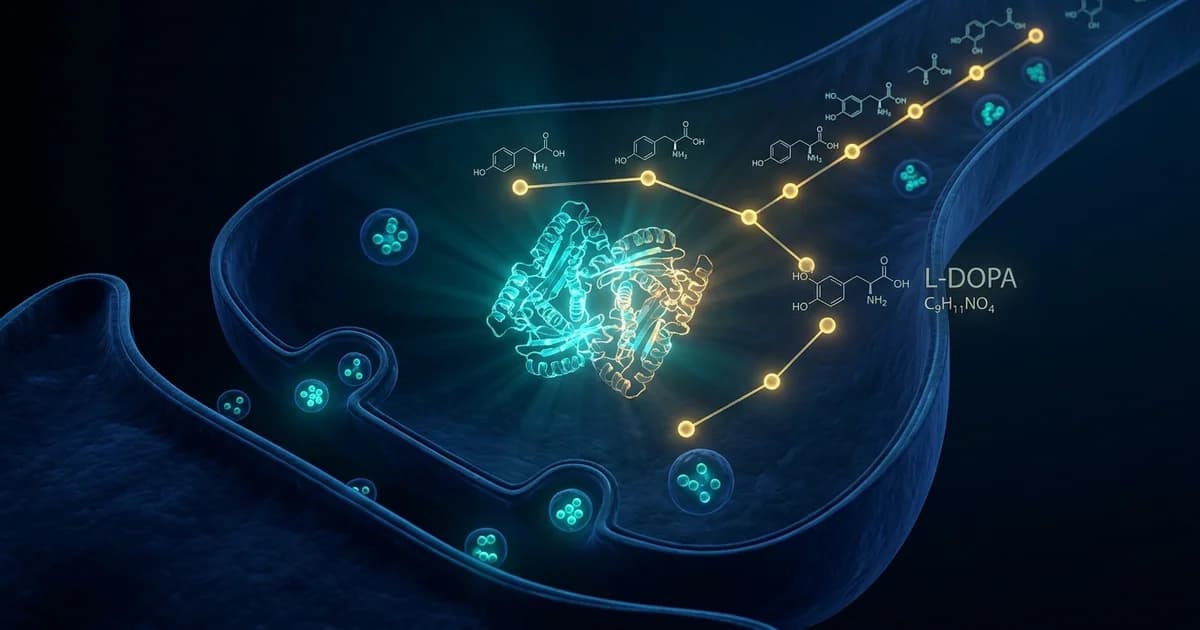
Dopamine synthesis runs on a two-enzyme pathway. Tyrosine hydroxylase adds a hydroxyl group to tyrosine, producing L-DOPA, and this is the slowest step, the bottleneck that governs how much dopamine gets made. Then a second enzyme, aromatic amino acid decarboxylase, takes over. Aromatic amino acid decarboxylase, also called DOPA decarboxylase, rapidly strips a carboxyl group from L-DOPA, yielding dopamine.
The speed difference between these two steps matters. The second reaction happens so fast that L-DOPA barely has time to exist. This conversion happens so quickly that L-DOPA almost never accumulates. So the first enzyme is the one that calls the shots.
That is the textbook definition of a rate-limiting enzyme. When one step in a sequence is far slower than the rest, that step sets the ceiling for the whole process. Tyrosine hydroxylase is the rate-limiting enzyme of catecholamine biosynthesis; it uses tetrahydrobiopterin and molecular oxygen to convert tyrosine to DOPA.
The Dopamine Synthesis Pathway, Step by Step
The full dopamine synthesis pathway starts before tyrosine and ends well past it. Catecholamine biosynthesis is a chain, and dopamine sits in the middle of it.
Here is the sequence the brain follows:
- Phenylalanine to tyrosine. Phenylalanine hydroxylase converts phenylalanine to tyrosine.
- Tyrosine to L-DOPA. Tyrosine hydroxylase hydroxylates tyrosine to L-DOPA. This is the rate-limiting step.
- L-DOPA to dopamine. DOPA is converted to dopamine by aromatic amino acid decarboxylase.
- Dopamine onward. Dopamine-beta-hydroxylase hydroxylates dopamine to norepinephrine, which is methylated to epinephrine by phenylethanolamine N-methyltransferase.
So dopamine is not just an endpoint. It is also a precursor. L-DOPA is a precursor for dopamine, which, in turn, is a precursor for the important neurotransmitters norepinephrine (noradrenaline) and epinephrine (adrenaline). The same enzyme that gates your dopamine also gates your adrenaline.
This explains why TH shows up in more than one cell type. In humans, tyrosine hydroxylase is encoded by the TH gene, and the enzyme is present in the central nervous system, peripheral sympathetic neurons and the adrenal medulla.
The BH4 Cofactor: Why TH Cannot Work Alone
Tyrosine hydroxylase cannot run on willpower. It needs three molecular partners present at the same time, and the most important of these is the BH4 cofactor, tetrahydrobiopterin.
Tyrosine hydroxylase uses molecular oxygen, as well as iron and tetrahydrobiopterin as cofactors. L-DOPA is a precursor for dopamine. The chemistry is specific. The enzyme is an oxygenase, which means it uses molecular oxygen to hydroxylate its substrates. One oxygen atom goes onto tyrosine, the other onto the cofactor.
The iron has to be in the right chemical state too. The nonheme iron must be in the ferrous form for activity. If iron drops or shifts oxidation state, the enzyme loses function. That is one reason iron status connects to so many aspects of brain chemistry.
BH4 does not come for free either. Your body builds it from scratch. BH4 is generated from guanosine 5-triphosphate through a three-step enzymatic reaction, where the first enzyme is GTP cyclohydrolase. When BH4 supply falls, dopamine production falls with it, even when tyrosine is abundant.
| Component | Role in the reaction |
|---|---|
| L-tyrosine | The substrate, the raw material being converted |
| Tyrosine hydroxylase (TH) | The enzyme that catalyzes the rate-limiting step |
| BH4 (tetrahydrobiopterin) | Electron-donating cofactor, gets used up and recycled |
| Iron (Fe2+) | Must be in the ferrous state for catalysis |
| Molecular oxygen | Supplies the oxygen atom added to tyrosine |
How the Brain Controls the Valve
Your brain does not let dopamine production float free. It regulates tyrosine hydroxylase through several overlapping mechanisms, and the most elegant one is a feedback loop.
The first control is end-product inhibition. Dopamine, the thing the pathway makes, switches off the enzyme that makes it. The enzyme is inhibited in feedback fashion by the catecholamine neurotransmitters. Dopamine binds to tyrosine hydroxylase competitively with tetrahydrobiopterin.
The mechanism is physical and direct. The catecholamines trap the active-site iron in the Fe(III) state, inhibiting the enzyme. More dopamine sitting around means more brake applied. Less dopamine means the brake releases. It is a thermostat for neurotransmitter levels.
The second control is phosphorylation, which acts like the gas pedal. Modes of regulation include phosphorylation by multiple kinases at four different serine residues, and dephosphorylation by two phosphatases. When a neuron fires hard, it phosphorylates TH and lifts the brake. Phosphorylation at Ser40 relieves feedback inhibition by the catecholamines dopamine, epinephrine, and norepinephrine.
The result is a system that throttles itself in real time. Demand goes up, the enzyme speeds up. Dopamine pools, the enzyme slows down. The brain is protecting a setpoint.
Why Loading Up on Tyrosine Has Limits
Here is the practical payoff of all this biochemistry: you cannot reliably force more dopamine simply by eating more of its precursor. The rate-limiting enzyme, not the raw material, sets the ceiling.
The reason is saturation. Tyrosine hydroxylation is considered to be the rate-limiting step in catecholamine synthesis, and under usual conditions tyrosine hydroxylase is close to full saturation with its L-tyrosine substrate, so raising the availability of L-tyrosine does not substantially increase DOPA synthesis. An enzyme that is already running near capacity does not speed up just because you hand it more substrate.
Feedback inhibition compounds the limit. The Gatorade Sports Science Institute notes that precursor loading runs into the body's own brakes: receptor-mediated feedback mechanisms are also likely to limit the magnitude and duration of any effect, with larger doses of tyrosine likely to activate this response to a greater degree. The same source draws a clinical conclusion. This would explain the relative lack of efficacy of catecholamine precursors in the treatment of disorders such as attention deficit hyperactivity disorder, narcolepsy and depression.
That does not mean tyrosine is useless. The picture is more situational. Research published on ScienceDirect found that a review on dietary neurotransmitter precursors reported beneficial effects of tyrosine on cognitive task performance, fatigue, and general alertness under various stressful conditions.
The effect also depends on where you start. A study in PMC found that the baseline-dependent effect of L-tyrosine on cognition is consistent with the inverted-U curve relating dopamine activity and working memory. Too little dopamine and tyrosine may help. Already optimal and it may do nothing, or even tip you past the peak.
If you want a deeper look at how this connects to attention and motivation, see our explainers on how dopamine drives focus and motivation and the role of L-theanine in calm, steady attention.
Conclusion
Dopamine is not abundant by accident. It is metered by a single rate-limiting enzyme, tyrosine hydroxylase, that the brain regulates with a thermostat-like feedback loop, a phosphorylation gas pedal, and a strict dependence on the BH4 cofactor, iron, and oxygen.
That design has a clear lesson. The amount of dopamine you make is governed less by how much precursor you consume and more by how that enzyme is regulated at any given moment. Your brain is built to defend a setpoint, not to let any single nutrient override it.
So the smarter question is not "how do I flood my brain with dopamine," but "how do I support the conditions under which my dopamine system already works well." That shifts the focus from brute-force precursor loading to sleep, iron status, stress, and the moment-to-moment signaling that tells these enzymes when to speed up.
Frequently Asked Questions
What is tyrosine hydroxylase in simple terms?
Tyrosine hydroxylase is the enzyme that performs the first and slowest step in making dopamine. It converts the amino acid L-tyrosine into L-DOPA, which a second enzyme then turns into dopamine. Because this first step is the slowest in the chain, tyrosine hydroxylase acts as the main control valve that decides how much dopamine your neurons can produce.
Why is tyrosine hydroxylase called the rate-limiting enzyme for dopamine?
In any multi-step pathway, the slowest step sets the overall pace. Tyrosine hydroxylase catalyzes that slowest step in catecholamine biosynthesis. The reaction after it, L-DOPA to dopamine, runs so fast that L-DOPA barely accumulates. So no matter how quickly the later steps could go, the whole pathway can only move as fast as tyrosine hydroxylase allows.
What is the BH4 cofactor and why does it matter?
BH4, or tetrahydrobiopterin, is a helper molecule that tyrosine hydroxylase needs to function. Along with iron and oxygen, BH4 donates the chemistry required to convert tyrosine into L-DOPA. Your body makes BH4 from GTP in a three-step process. When BH4 levels fall, dopamine production drops even if plenty of tyrosine is available.
Does eating more tyrosine increase dopamine?
Usually not by much. Tyrosine hydroxylase is generally near saturation with its substrate, so adding more tyrosine does not reliably push dopamine higher. Feedback mechanisms also limit any extra production. Tyrosine can help in specific situations, such as acute stress, fatigue, or when baseline dopamine is low, but it is not a dependable way to raise dopamine on demand.
How does dopamine control its own production?
Through end-product inhibition. Dopamine binds directly to tyrosine hydroxylase and competes with the BH4 cofactor, trapping the enzyme's iron in an inactive state. As dopamine builds up, it applies more of this brake. As dopamine falls, the brake releases. Neurons can override the brake temporarily by phosphorylating the enzyme when they fire.
Is tyrosine hydroxylase involved in anything besides dopamine?
Yes. Dopamine is itself a precursor to norepinephrine and epinephrine, so tyrosine hydroxylase sits at the top of the entire catecholamine family. The enzyme is found in the central nervous system, peripheral sympathetic neurons, and the adrenal medulla, which is why it influences both brain signaling and the body's stress response.
Where Enzyme Regulation Beats Brute-Force Loading
This article makes one argument worth sitting with: your dopamine output is gated by enzyme regulation, not by how much raw precursor you swallow. That is why the "just take more tyrosine" approach so often disappoints.
Roon was built with that reality in mind. It is not a dopamine pill and not a precursor megadose. It is a zero-nicotine sublingual pouch with a focused four-ingredient formula: 80 mg caffeine, 60 mg L-theanine, 25 mg methylliberine (Dynamine), and 5 mg theacrine (TeaCrine), designed for a 5 to 10 minute onset and 6 to 8 hours of steady focus with no jitters, no crash, and no tolerance buildup.
To be clear about what it is not: Roon will not rewrite your dopamine setpoint, and it is no substitute for sleep, iron status, or managing stress, the things that actually shape how your enzymes behave. If you want clean, sustained attention without the rollercoaster, try Roon and see how it fits your day.
Written by Roon Team