St. John's Wort: A Real Antidepressant Herb With a Serious Interaction Problem
Roon Team
St. John's Wort: A Real Antidepressant Herb With a Serious Interaction Problem
Most herbal supplements that promise to lift your mood do nothing. St. John's wort is the exception, and that is exactly why it deserves your caution.
This is not a gentle tea with a placebo reputation. St. John's wort is a genuinely active plant medicine with measurable effects on brain chemistry and, more importantly, on how your liver processes nearly every other drug you take. The same potency that makes it work for mild depression is what turns it into one of the most interaction-prone substances on the supplement shelf.
If you take it casually, alongside birth control or an antidepressant, you are not playing it safe. You are running a pharmacology experiment on yourself.
Key Takeaways
- St. John's wort works for mild to moderate depression, with effects comparable to standard antidepressants in some trials and fewer reported side effects.
- The herb is a powerful inducer of the CYP3A4 liver enzyme and the P-glycoprotein transporter, which is why it interferes with so many medications.
- St. John's wort birth control failures are well documented. It speeds up the breakdown of hormones in oral contraceptives and raises the risk of breakthrough bleeding and ovulation.
- Combined with SSRIs, it can push serotonin too high and raise the risk of serotonin syndrome.
- "Natural" does not mean "no interactions." This herb demands the same respect you would give a prescription.
Does St. John's Wort Actually Work for Depression?
Yes, for mild to moderate depression, the evidence behind st johns wort depression claims is stronger than for almost any other botanical.
Decades of randomized trials have tested Hypericum perforatum, the plant's botanical name, against both placebo and prescription antidepressants. The pattern that emerges is consistent: for milder forms of depression, standardized extracts tend to outperform placebo and perform on par with common antidepressants, often with a lower rate of dropouts due to side effects.
That last part matters. People stop taking antidepressants because of weight changes, sexual side effects, and emotional blunting. St. John's wort tends to be better tolerated, which is part of why it became a fixture in European psychiatry, particularly in Germany, where doctors prescribe standardized hypericum extracts.
The caveat is real. For moderate-to-severe or chronic depression, the picture is murkier, and the herb should never be a solo treatment for serious illness. So does st johns wort work? For the right patient and the right severity, yes. For everyone with a low mood, no.
Hyperforin: The Molecule Doing the Work
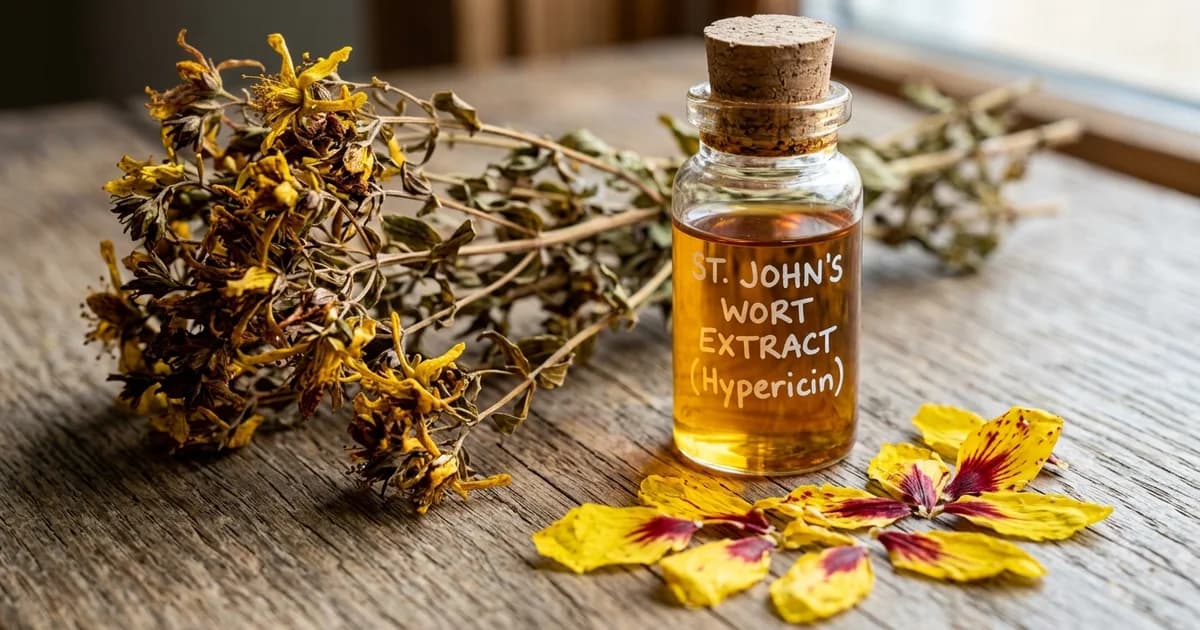
The antidepressant effect of St. John's wort is driven mainly by hyperforin, not the hypericin that older marketing focused on.
The plant contains dozens of compounds, but hyperforin is the one most closely tied to mood effects. It acts on the brain in a way that loosely resembles how conventional antidepressants work, by raising levels of mood-related neurotransmitters such as serotonin, dopamine, and norepinephrine in the synapse.
Here is the twist. Hyperforin is also the troublemaker.
The same molecule that helps your mood is a potent activator of a receptor in your liver and gut called the pregnane X receptor (PXR). When hyperforin switches on PXR, your body ramps up production of drug-metabolizing enzymes. That single mechanism is the root of the interaction problem covered below. The active ingredient and the dangerous ingredient are the same thing.
This is also why extract quality varies wildly. Different products contain different amounts of hyperforin, so two bottles labeled "St. John's wort" can behave very differently in your body.
The Real Problem: St. John's Wort Interactions
St. John's wort interferes with medications because it switches on the body's drug-clearing machinery, causing other drugs to be broken down and flushed out faster than intended.
The two main pathways:
-
CYP3A4 induction. This liver enzyme metabolizes a large share of all prescription drugs. St. John's wort is a well-established inducer of CYP3A enzymes, meaning it speeds their activity. According to research published in Clinical Pharmacology & Therapeutics, the herb increased the oral clearance of a contraceptive hormone, which is exactly the kind of effect that reduces a drug's potency.
-
P-glycoprotein induction. This transporter pumps drugs out of cells and out of the body. Crank it up and blood levels of affected drugs drop.
When a drug clears faster, its concentration falls below the level needed to work. For some medications that means a mild loss of effect. For others it means a transplanted organ gets rejected, a clot forms, or a pregnancy begins.
Drugs With Documented Interactions
The list of affected medications is long. The most clinically serious include:
| Drug or Drug Class | What St. John's Wort Does | Why It Matters |
|---|---|---|
| Oral contraceptives | Speeds hormone breakdown | Breakthrough bleeding, possible ovulation, contraceptive failure |
| SSRIs and other serotonergic drugs | Adds to serotonin load | Raised risk of serotonin syndrome |
| Warfarin (blood thinner) | Lowers blood levels | Reduced anticoagulation, clot risk |
| Immunosuppressants (e.g. cyclosporine) | Lowers blood levels | Organ transplant rejection |
| Certain HIV and antiviral drugs | Lowers blood levels | Loss of viral control |
| Some cancer therapies | Lowers blood levels | Reduced treatment effect |
If you take any prescription medication, talk to a pharmacist before adding this herb. A pharmacist will catch interactions a quick label scan never will.
St. John's Wort and Birth Control: A Documented Failure Point
St. John's wort can reduce the effectiveness of hormonal birth control, and the data on this is not theoretical.
In a controlled study summarized by the Reproductive Health Access Project, women taking low-dose oral contraceptives alongside St. John's wort were far more likely to experience breakthrough bleeding than those on the pill alone, and showed signs of increased follicle growth.
A separate clinical study indexed on PubMed found that St. John's wort was associated with increased metabolism of both norethindrone and ethinyl estradiol, the two hormones in many combined pills, plus breakthrough bleeding, follicle growth, and ovulation. The researchers concluded that women on oral contraceptives should be warned the herb might interfere with contraceptive effectiveness.
The takeaway on st johns wort birth control is blunt. If your contraception depends on hormones and you start this herb, you may no longer be protected. Use a backup method or avoid the combination entirely.
St. John's Wort and SSRIs: The Serotonin Risk
Mixing St. John's wort with an SSRI is a known danger, because both raise serotonin and the combination can tip you into serotonin syndrome.
A 2025 review in European Psychiatry found that St. John's wort can meaningfully alter how SSRIs are metabolized and raise the risk of serotonin syndrome, a condition that ranges from agitation and tremor to dangerous changes in heart rate and body temperature.
The interaction is not uniform across every antidepressant. The same body of research notes that SSRIs broken down by the CYP2C19 enzyme, such as citalopram, escitalopram, and sertraline, are more likely to interact than those handled mainly by CYP2D6, such as paroxetine and fluoxetine.
Regulators have flagged this for years. New Zealand's medicines safety authority, Medsafe, describes the combined use of St. John's wort and SSRIs as not recommended after reports of serotonin-related reactions. If you are already on an antidepressant, do not layer this herb on top of it.
How to Use St. John's Wort Responsibly
If you have mild low mood, no serious medical conditions, and take no other medications, St. John's wort is one of the few supplements with real evidence behind it. The responsible approach is straightforward.
- Confirm the severity. This herb is for mild to moderate symptoms, not a substitute for care in serious depression.
- Check every medication. Run your full list past a pharmacist, including the pill, blood thinners, and any transplant or HIV medication.
- Never stack it with an antidepressant unless a prescriber explicitly guides the process.
- Use a standardized extract so you actually know your hyperforin dose.
- Add a backup contraceptive if you rely on hormonal birth control.
The honest summary is that respect, not fear, is the right posture. The herb works because it is pharmacologically active. Treat it that way.
Conclusion
St. John's wort breaks the usual rule that herbal supplements are weak and harmless. It is genuinely effective for mild to moderate depression, and that effectiveness comes from a single active compound that also revs up the body's drug-clearing enzymes.
That dual nature is the whole story. The same potency that helps your mood is what degrades your birth control, weakens your blood thinner, and stacks dangerously with an SSRI. The interaction problem is not a footnote. It is a direct consequence of how the herb works.
Use it with the same seriousness you would give a prescription, and it can earn its place. Use it casually, and you are gambling with effects you cannot see.
Frequently Asked Questions
Does St. John's Wort really work for depression?
For mild to moderate depression, yes. Multiple randomized trials show standardized extracts of Hypericum perforatum outperform placebo and perform similarly to standard antidepressants in milder cases, often with fewer side effects. The evidence weakens for moderate-to-severe or chronic depression, where it should not be used alone. It is not a treatment for serious mental illness, and anyone with marked symptoms should work with a clinician rather than self-treat.
What is hyperforin and why does it matter?
Hyperforin is the compound in St. John's wort most responsible for its antidepressant effect. It raises levels of mood-related neurotransmitters in the brain. It is also the reason the herb interacts with so many drugs, because it activates a liver receptor that ramps up drug-metabolizing enzymes. The active ingredient and the source of the danger are the same molecule, which is why extract quality and hyperforin content matter so much.
Can St. John's Wort make birth control fail?
Yes. Clinical studies have linked St. John's wort to faster breakdown of the hormones in oral contraceptives, breakthrough bleeding, follicle growth, and ovulation. That combination can reduce contraceptive protection. If you rely on hormonal birth control, either avoid the herb or use a reliable backup method, and talk to your pharmacist or prescriber first.
Is it safe to take St. John's Wort with antidepressants?
No, not without medical supervision. St. John's wort raises serotonin, and combining it with SSRIs or other serotonergic drugs can increase the risk of serotonin syndrome. It can also change how the antidepressant is metabolized. Do not add this herb to an existing antidepressant regimen on your own.
What medications interact with St. John's Wort?
The list is long because the herb induces CYP3A4 and P-glycoprotein, two of the body's main drug-processing systems. The most serious interactions involve oral contraceptives, warfarin, immunosuppressants like cyclosporine, certain HIV and antiviral drugs, some cancer treatments, and SSRIs. Always have a pharmacist review your full medication list before starting.
How long does it take to work?
Like most antidepressant approaches, St. John's wort is not fast. Mood effects typically build over several weeks of consistent daily use rather than hours. It is a slow, cumulative effect, which is a different category from fast-acting focus or energy support.
Is "natural" the same as "safe"?
No. St. John's wort is the clearest example of why that assumption is dangerous. It is natural and effective and one of the most interaction-prone substances you can buy without a prescription. Potency and safety are separate questions, and an active herb deserves the same caution as a pharmaceutical.
Why Evidence and Caution Beat Hype
St. John's wort is a useful reminder that the most effective ingredients are also the ones that demand the most respect. A compound powerful enough to shift your mood is powerful enough to disrupt your other medications. The right response is not fear, it is information: knowing the mechanism, checking the interactions, and choosing ingredients with clear, well-studied effects.
That evidence-first standard is how we think about everything at Roon. Roon is a zero-nicotine sublingual pouch built for sustained focus, not mood treatment, with a transparent four-ingredient formula: 80 mg caffeine, 60 mg L-theanine, 25 mg methylliberine (Dynamine), and 5 mg theacrine (TeaCrine). It is designed for a 5 to 10 minute onset and 6 to 8 hours of clean focus with no jitters, no crash, and no tolerance buildup.
To be clear about what Roon is not: it is not an antidepressant, not a treatment for depression, and not a replacement for care from a clinician. If you want to understand the ingredients you put in your body the way you just dissected this herb, explore how Roon is formulated and see the science behind each compound for yourself.
Written by Roon Team