Sleep Debt: What It Is, How It Adds Up, and What It Actually Costs You

Sleep Debt: What It Is, How It Adds Up, and What It Actually Costs You
Sleep debt is the running total of the difference between the sleep your body needs and the sleep you actually get, accumulated night after night. It is not a metaphor. It is measurable in reaction-time tests, memory tasks, and vigilance scores, and it compounds the way a financial deficit does: miss two hours tonight, two more tomorrow, and by Friday you are carrying ten hours. The arithmetic is simple. The repayment is not.
Key Takeaways
- Sleep debt is cumulative. Each short night adds to a running total that does not reset on its own.
- Two weeks of six-hour nights produces cognitive deficits equivalent to pulling an all-nighter, per a controlled study of 48 adults (Van Dongen et al., 2003).
- The most dangerous feature of chronic sleep debt is that your sense of how impaired you are stops tracking reality. You feel "okay." Your performance says otherwise.
- Most people underestimate how much sleep they actually need by about an hour, which means they carry debt without knowing it.
The Arithmetic of Sleep Debt
The calculation is straightforward. Take the number of hours you need per night, subtract the number you got, and carry the remainder forward.
Say you need eight hours and you slept six last night. That is two hours of debt. Tonight you get six again: now it is four. By Wednesday it is six. By Friday, ten. The total does not care whether any single night was "not that bad." It cares about the sum.
| Night | Hours needed | Hours slept | Nightly shortfall | Running debt |
|---|---|---|---|---|
| Monday | 8 | 6 | 2 | 2 h |
| Tuesday | 8 | 6 | 2 | 4 h |
| Wednesday | 8 | 6 | 2 | 6 h |
| Thursday | 8 | 6 | 2 | 8 h |
| Friday | 8 | 6 | 2 | 10 h |
That table assumes you know your need is eight hours. Most people do not know theirs, which is the first problem.
Where "How Much You Need" Actually Comes From
Sleep need is individual, and the honest answer is that most people have never measured theirs. The standard recommendation is seven to nine hours for adults, but that range is wide enough to hide a full hour of nightly debt for someone on the wrong end of it.
A small but carefully designed 2016 laboratory study (Kitamura et al., Scientific Reports) tried to quantify this gap directly. Fifteen healthy young men spent nine consecutive days with 12 hours of sleep opportunity per night, far more than any of them usually got. Their habitual sleep duration at home averaged 7.37 hours. Their optimal duration, measured when given unlimited opportunity, averaged 8.41 hours. The mean gap: about one hour of unrecognized debt.
Fifteen young men is a small, narrow sample, and the finding should be read that way. But the direction is consistent with a much larger dataset. One large observational study of UK Biobank participants (more than 500,000 people aged 40 to 69 at enrollment) found that the association between self-reported sleep duration and biological aging markers was weakest in a band around 6.4 to 7.8 hours, though the study can only show association, not cause, and long sleep in particular may be a signal of underlying illness rather than a cause of anything.
The practical point: if you have never tested your own need under controlled conditions, you are probably estimating it, and the estimate is probably low. Understanding what it actually takes to repay sleep debt starts with knowing how deep the hole is.
How Sleep Debt Accumulates: The Physiology
One of the mechanisms behind sleep pressure is the molecule adenosine. It accumulates in the brain during waking hours and is cleared during sleep. A shortened night leaves the clearing job incomplete: you start the next day with a higher adenosine baseline, and the pressure stacks.
This is not the entire story of sleep regulation, which involves circadian timing, cortisol rhythms, and other processes. But the adenosine system explains why short nights feel worse on a cumulative basis than any single night would predict. If you want the full mechanism, this explainer on adenosine and sleep pressure covers it in detail.
Caffeine, by the way, works by blocking adenosine receptors. It masks the signal of sleep pressure. It does not clear the backlog. When the caffeine wears off, the adenosine is still there, and so is the debt. If you are calibrating how much caffeine to use after a short night, and when to stop, that distinction matters.
The Study That Makes Sleep Debt Real: Van Dongen 2003
The single most cited experiment on chronic sleep restriction ran for 14 days in a controlled laboratory. Van Dongen, Maislin, Mullington, and Dinges (2003) randomized 48 healthy adults (ages 21 to 38) into groups that spent either 4, 6, or 8 hours in bed each night for two consecutive weeks, with a separate group undergoing total sleep deprivation for comparison.
The results were clean and grim. Chronic restriction to 6 hours in bed for two weeks produced cognitive performance deficits equivalent to one night of total sleep deprivation. Restriction to 4 hours in bed for two weeks matched two nights without sleep.
The deficits did not plateau after a few days. They kept accumulating, night after night, in a dose-dependent pattern across every cognitive test the researchers administered.
This is the study that converts "sleep debt" from a loose metaphor into a quantified, testable claim. Six hours felt manageable to many of those participants on any given night. Over two weeks, it added up to the same measurable impairment as staying awake for an entire night.
Why You Stop Noticing: The Subjective Plateau
The other finding from the same study is arguably more important, and it is the one consumer sleep articles almost never state plainly.
Participants in the 6-hour group rated their own sleepiness at the start, and those ratings rose for the first few days. Then they leveled off. By the second week, subjects reported feeling only mildly sleepy, roughly stable from day to day. They had adapted, subjectively.
Their performance had not adapted at all. Psychomotor vigilance scores kept falling, attention lapses kept increasing, and the gap between self-reported sleepiness and objective impairment widened every day.
This is the defining feature of chronic sleep debt: your sense of how tired you are is the least reliable instrument you own once the debt accumulates. People who say they are "fine on six hours" may genuinely believe it. The Van Dongen data shows that belief tracks nothing measurable after about a week.
What Sleep Debt Actually Costs
The deficits start with attention and reaction time. The psychomotor vigilance test, a simple sustained-attention task, is where sleep restriction shows up first and most reliably. Lapses in attention increase. Response times slow. The effect is cumulative and dose-dependent.
For a sense of scale: a separate study by Dawson and Reid (1997) found that performance after 24 hours of sustained wakefulness was equivalent to a blood alcohol concentration of about 0.10%. Being awake for 17 to 24 hours produced impairment comparable to a BAC of roughly 0.05 to 0.10%. In most jurisdictions, you cannot legally drive at 0.08%.
Beyond attention, sleep debt erodes memory consolidation. Sleep is when the brain moves information from short-term to long-term storage. Cut the process short and the material does not transfer cleanly. The full article on sleep and memory consolidation covers the specific mechanisms.
Mood and impulse control degrade next. Irritability rises. Emotional regulation weakens. The effect is consistent enough across studies that it shows up in self-report data even when cognitive impairment does not, because people can feel that they are more reactive even if they cannot feel that they are slower. For a closer look at the neurological effects of sleep deprivation, see the full explainer.
Symptoms People Actually Report
Sleep debt does not announce itself with a label. It shows up as a collection of familiar, low-grade complaints that most people attribute to something else. Common reports include:
- Needing an alarm every single morning, and never waking before it
- Hitting snooze two or three times as a default
- Micro-lapses of attention in the early afternoon, the "2 p.m. wall"
- Rereading the same paragraph and retaining nothing
- Irritability that feels disproportionate to whatever triggered it
- Falling asleep within a minute or two of lying down (this feels efficient; it is actually a sign of high sleep pressure)
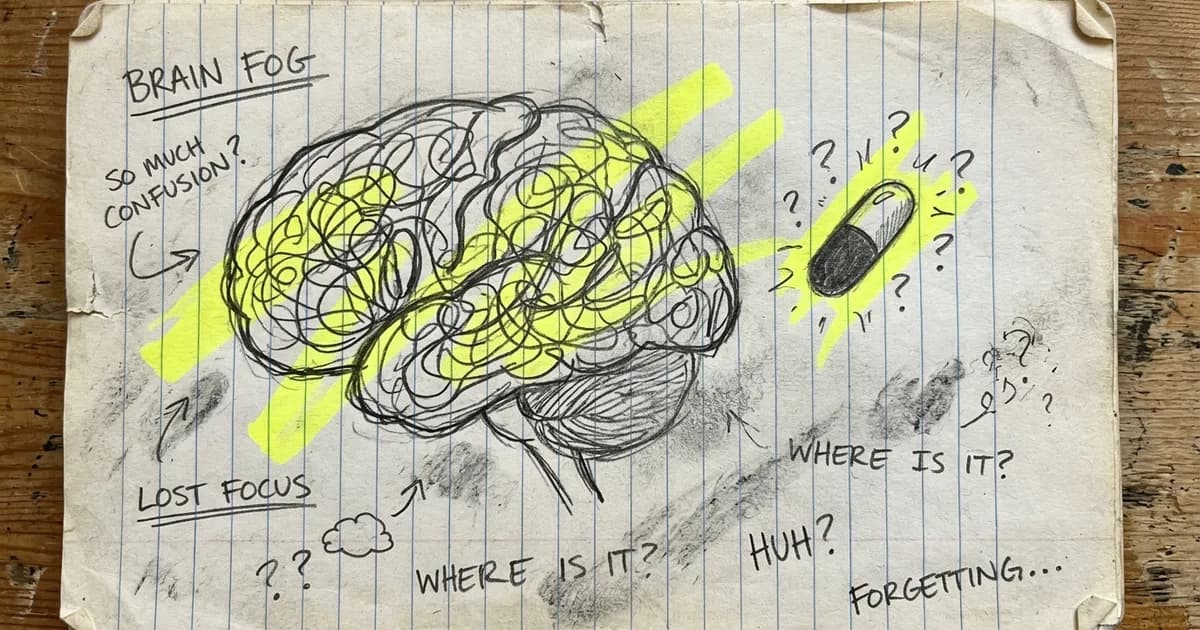
None of these are diagnostic. Every one of them overlaps with other causes. But if several show up together and persist across weeks, the most parsimonious explanation is that you are carrying debt. The fogged-out, blunted feeling many people describe as "brain fog" often traces back here.
Chronic Sleep Debt: What Changes When It Runs for Months
Short-term sleep debt, a bad week or two, is what the Van Dongen study modeled. Chronic sleep debt, running a deficit for months or years, is harder to study in a laboratory because you cannot keep someone in a controlled environment that long.
What the existing evidence does show is that the subjective adaptation described above does not reverse on its own. People who have carried debt for a long time recalibrate their sense of normal. They stop comparing their current state to a rested baseline because they no longer remember what that baseline felt like. Performance deficits do not plateau just because the feeling of sleepiness does.
One clear line: if grogginess or exhaustion persists every day for weeks, or does not shift after several nights of genuinely full sleep, that is worth raising with a clinician. This article names no diagnoses, and neither should you. A professional can sort what is debt from what is something else.
Conclusion
This article defines sleep debt and shows what it costs. It deliberately stops there.
If you want to know how to actually recover, that is a different question with different evidence: what it actually takes to repay sleep debt covers the research on recovery timelines and protocols.
If your question is specifically about weekends, whether sleeping in on Saturday does anything useful, the data on that is mixed and worth its own page: whether weekend catch-up sleep works.
Frequently Asked Questions
Is sleep debt a real thing or just a metaphor?
It is real and measurable. The term borrows from financial language, but the underlying deficit shows up in controlled laboratory tests of reaction time, attention, and memory. The Van Dongen 2003 study quantified it precisely: two weeks of restricted sleep produced cognitive deficits equivalent to total sleep deprivation. The metaphor overpromises on one point, though. Financial debt can be repaid dollar for dollar. Sleep debt does not settle that cleanly.
How do I know how much sleep debt I have?
You need two numbers: how much sleep you need and how much you are actually getting. Most people know the second but guess at the first. The Kitamura 2016 study found that participants underestimated their need by about an hour on average. Without a laboratory measurement, your best proxy is tracking how you feel and perform after several consecutive nights of unrestricted sleep. If you are still tired after nine hours in bed for a week, the debt may be deeper than you thought.
Can you have sleep debt and still feel fine?
Yes, and this is the most dangerous part. In the Van Dongen study, participants restricted to six hours a night stopped reporting worsening sleepiness after a few days, even as their measured performance kept declining. Your subjective sense of tiredness adapts. Your cognitive performance does not.
Does one bad night count as sleep debt?
Technically, yes. If you need eight hours and get five, you are carrying three hours of debt the next day. But a single night is easy to recover from. Sleep debt becomes a problem when shortfalls accumulate across multiple nights without adequate recovery in between.
How much sleep debt is too much?
There is no peer-reviewed threshold for a specific number of hours that crosses from "manageable" to "dangerous." What the research shows is that the relationship between accumulated debt and performance impairment is dose-dependent and cumulative: more debt means worse performance, and the decline does not level off just because you have stopped noticing it.
Does sleep debt ever go away on its own?
Not without additional sleep. The debt represents a physiological deficit, not a mood that passes. Recovery requires sleeping more than your baseline need for a sustained period. How long that takes depends on how deep the debt is. The Kitamura study found that even one hour of debt took four days of extended sleep to resolve. For longer-term strategies, see the full article on how to fix sleep debt.
When Caffeine Masks the Debt, Duration Matters More Than Dose
Van Dongen's subjects stopped noticing their impairment while their performance kept declining. Caffeine can deepen that illusion if it wears off unpredictably. Roon is built around a 6 to 8 hour window of sustained focus from a single sublingual pouch: 80 mg caffeine, 60 mg L-theanine to smooth the response, 25 mg methylliberine (Dynamine), and 5 mg theacrine (TeaCrine). Dynamine slows caffeine's clearance. A randomized double-blind crossover PK study (n=12) found 100 mg methylliberine cut caffeine oral clearance from 41.9 to 17.1 L/hr and extended half-life from 7.2 to 15 hours with no increase in peak concentration, though that study used roughly 4x the methylliberine and 1.9x the caffeine Roon carries, so the mechanism is directionally the same and the study did not measure Roon. The practical upside: one pouch covers an afternoon without re-dosing. The trade-off: a longer tail means you stop at least 8 hours before bed.
Roon is not a substitute for the sleep itself. Masking cumulative debt with stimulants is precisely how the Van Dongen curve gets steeper without you noticing. But if you are actively repaying debt and need reliable, time-bounded alertness during the day, a format with a predictable window beats guessing when your third coffee will clear. Zero sugar, from $9.16 per tin. Try Roon for the waking hours while you fix the sleeping ones.
Written by Roon Team