Schisandra chinensis: The Berry Adaptogen for Mental Endurance
Roon Team
Schisandra chinensis: The Berry Adaptogen for Mental Endurance
Most focus supplements are built for the sprint. They spike your alertness, burn bright for an hour, then leave you foggy. Schisandra chinensis works on a different problem, and the schisandra cognitive benefits people care about have less to do with a jolt and more to do with how long you can hold your edge under stress.
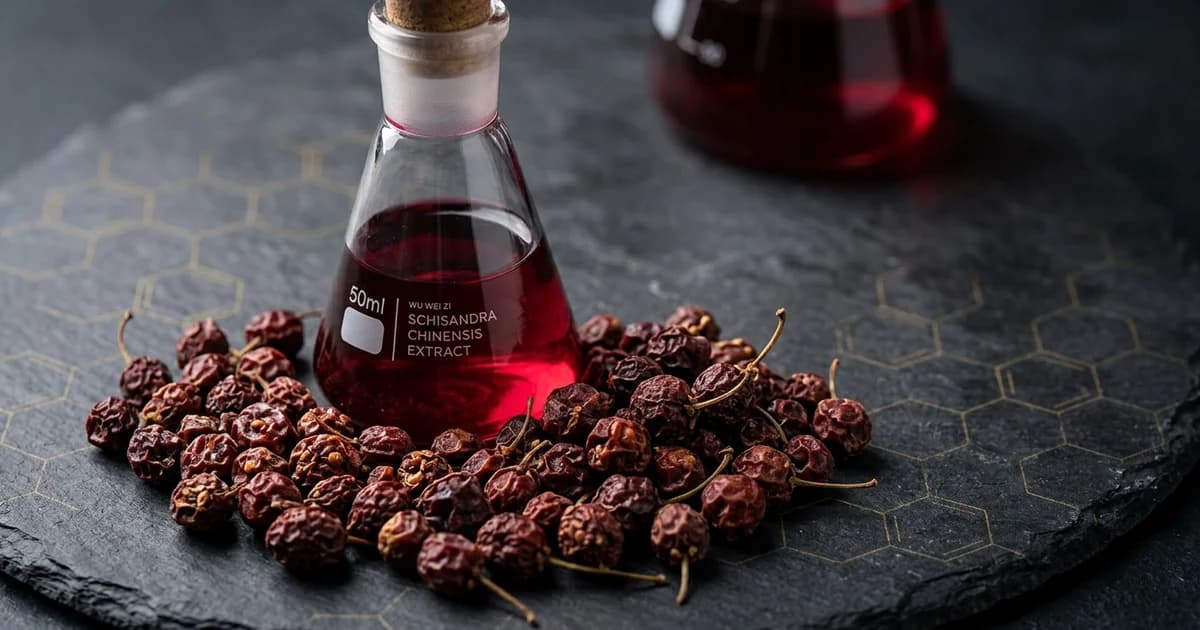
This is a deep red berry from the magnolia family, native to northern China and the Russian Far East. Soviet researchers studied it for decades as a stamina aid for pilots, soldiers, and athletes. The modern question is simpler: does the science hold up, and does it belong in your stack?
Short answer: the mechanism is real and the animal data is strong. The human cognitive data is promising but still thin. Here is what we actually know.
Key Takeaways
- Schisandra chinensis is an adaptogen, a plant studied for its ability to help the body resist physical and mental stress.
- Its active compounds are lignans, mainly schisandrin and schisandrin B, which drive most of its measured effects.
- The strongest human cognitive evidence comes from a combination formula, not schisandra alone.
- For attention and mental performance under fatigue, the early signals are encouraging, but the standalone human trials are limited.
What Schisandra Actually Is
Schisandra chinensis is called the "five flavor berry" because the fruit is said to carry all five classic tastes at once: sour, sweet, salty, bitter, and pungent. In traditional Chinese medicine it is known as wu wei zi, and it has been used for centuries as a tonic for stamina and resilience.
The berry's reputation rests on its chemistry. According to a review in Nutrients (MDPI), roughly 40 compounds have been isolated from the berry, and the most important bioactive lignans are schisandrin (also called schizandrin or schisandrol A), schisandrin B, schisantherin A and B, schisanhenol, deoxyschisandrin, and gomisin A.
When you read about schisandra chinensis brain effects, you are really reading about these lignans. Phytochemical work confirms they are the dominant players. A 2024 LC-HRMS analysis found that schisandra berry extract is rich in dibenzocyclooctadiene lignans, which it describes as the main bioactive constituents of the plant, with schisandrin as the dominant compound.
Why "Adaptogen" Is the Right Word Here
An adaptogen is not a stimulant. The defining idea is stress resistance: helping the body stay steady when demand spikes, rather than forcing one system into overdrive. Schisandra is one of the most studied plants in this category.
The clearest mechanistic evidence comes from stress models. In one controlled animal study, the adaptogens Rhodiola and schisandra changed the response to immobilization stress by suppressing the rise in phosphorylated stress-activated protein kinase, nitric oxide, and cortisol.
That matters for cognition. Chronic stress and raised cortisol are bad for attention, working memory, and mental stamina. A compound that blunts the stress signaling cascade has a plausible path to supporting the brain under pressure, which is exactly the territory the schisandra adaptogen label points to.
The Human Evidence Behind Schisandra Cognitive Benefits
Here is the honest version: the best controlled human data on schisandra for the mind comes from a blend, not the berry by itself.
That formula is ADAPT-232, a fixed combination of Rhodiola rosea, Schisandra chinensis, and Eleutherococcus senticosus. In a randomized, placebo-controlled trial published in Phytomedicine, subjects in the active group, just two hours after taking it, showed improved attention and increased speed and accuracy during stressful cognitive tasks compared to placebo. The trial measured a single dose of the standardized blend on mental performance in tired individuals.
This is a real signal for schisandra mental performance. It is also a careful one. Schisandra was one of three actives, so we cannot cleanly credit the berry alone. The effect was measured as a single acute dose in tired people, not as a long-term outcome.
That gap is the whole story for five flavor berry focus claims. The mechanism is well mapped, the lignans are well characterized, and the combination data is encouraging. The standalone, repeated-dose human cognition trials simply are not there yet at the same quality.
Schisandra vs. Common Focus Ingredients
If you are deciding where schisandra fits, it helps to compare it against ingredients with more direct, fast-acting cognitive data. Roon's stack is included here for an honest reference point on speed and clinical dosing.
| Ingredient | Primary role | Onset | Human cognitive data | Best use |
|---|---|---|---|---|
| Schisandra chinensis | Adaptogen, stress resilience | Slow, builds over time | Promising, mostly as a blend | Sustained endurance under stress |
| Schisandrin (lignans) | Active driver of schisandra effects | Slow | Mechanistic and animal-heavy | The molecule behind the berry |
| Caffeine | Stimulant, alertness | 30 to 45 min | Strong, extensive | Acute alertness |
| L-theanine | Calm focus, smooths caffeine | 30 to 60 min | Strong, especially with caffeine | Steady focus without edge |
| Roon 4-stack (caffeine 80mg, L-theanine 60mg, Dynamine 25mg, TeaCrine 5mg) | Fast, clinically dosed focus | 5 to 10 min sublingual | Trial-backed ingredients | 6 to 8 hr no-crash focus window |
The takeaway is not that one beats the others. It is that schisandra plays a different position. It is an endurance and stress-resilience ingredient, not a fast switch you flip before a meeting.
How People Use It
If you want to try schisandra, set the expectation correctly. This is a slow burn, not a same-day lever.
- As a tonic, not a pre-task hit. Most traditional and modern use treats it as a daily adaptogen taken over weeks.
- In a blend. The strongest cognitive evidence comes from combinations, so a formula with Rhodiola and Eleutherococcus has more human backing than schisandra solo.
- Standardized to lignans. Since schisandrin and schisandrin B do the work, look for extracts that report lignan content rather than raw berry weight.
For more on the difference between fast-acting and slow-building focus ingredients, our guide to caffeine and L-theanine covers the acute side of the equation.
Conclusion
Schisandra chinensis earns its adaptogen reputation. The lignans are well characterized, the stress-signaling mechanism is documented in controlled studies, and a combination formula containing schisandra has shown a measurable boost to attention and accuracy in tired people.
The catch is the gap between mechanism and proof. We have strong reasons to expect a benefit for mental endurance under stress, and limited standalone human cognition data to confirm it at the dose and duration most people would use. Treat schisandra as a long-game endurance ingredient, not an instant focus switch, and the science fits the use.
Frequently Asked Questions
What are the main schisandra cognitive benefits?
Schisandra is studied mainly for stress resilience and mental endurance rather than acute alertness. Its lignans appear to blunt the body's stress response, including cortisol, which is tied to attention and working memory. The strongest human signal comes from a combination formula that improved attention, speed, and accuracy in tired subjects two hours after dosing. Standalone human cognition data is still limited.
What is schisandrin and why does it matter?
Schisandrin, also called schizandrin or schisandrol A, is the dominant lignan in Schisandra chinensis berries. Along with schisandrin B, it drives most of the plant's measured biological activity. When researchers study schisandra's effects on the brain and stress response, they are largely studying these dibenzocyclooctadiene lignans. Good extracts are standardized to lignan content rather than raw berry weight.
Is schisandra a stimulant?
No. Schisandra is an adaptogen, not a stimulant. It does not work by spiking your alertness the way caffeine does. Instead, it is studied for helping the body resist physical and mental stress over time. That means the effect tends to build with repeated use rather than hitting within minutes. If you want fast alertness, caffeine has far more direct evidence.
How long does schisandra take to work?
Schisandra is a slow-building ingredient, so most people use it daily over weeks as a tonic rather than as a pre-task dose. The one notable acute human result came from a combination formula that improved cognitive performance about two hours after a single dose. On its own, schisandra is better thought of as endurance support that accumulates, not a same-day focus switch.
Why is it called the five flavor berry?
Schisandra chinensis is called the five flavor berry, or wu wei zi in Chinese, because the fruit is said to carry all five classic tastes at once: sour, sweet, salty, bitter, and pungent. This is a traditional Chinese medicine description tied to its long history as a stamina and resilience tonic. The name reflects culinary and traditional use, not a measure of its cognitive strength.
Does schisandra help with focus and mental performance?
The early evidence is encouraging but not conclusive. A randomized, placebo-controlled trial of a schisandra-containing blend found improved attention, speed, and accuracy during stressful tasks in tired people. Because schisandra was one of three actives in that formula, the berry alone cannot be cleanly credited. The realistic read is that schisandra supports mental endurance under stress, with the strongest data coming from combinations.
Is schisandra safe?
Schisandra has a long history of traditional use and is generally well tolerated in studies, but it is a dietary supplement, not a medicine. It is not a treatment for any condition. If you are pregnant, taking medication, or managing a health condition, check with a clinician before adding it, since lignans can interact with how the body processes some drugs.
The Endurance Ingredient vs. the Fast Switch
Schisandra answers a specific question: how do you stay sharp when stress and fatigue are wearing you down over the long haul. It is a slow-building adaptogen, and the evidence fits that role. What it does not do is give you focus in the next ten minutes.
That is the line Roon sits on. Roon is not an adaptogen tonic, and it is not a substitute for sleep, training, or the long-term stress work that schisandra targets. It is built for the fast switch: a sublingual pouch with a clinically informed 4-ingredient stack of 80 mg caffeine, 60 mg L-theanine, 25 mg methylliberine (Dynamine), and 5 mg theacrine (TeaCrine), designed for a 5 to 10 minute onset and 6 to 8 hours of focus with no jitters, no crash, and no tolerance buildup.
If you like reading the actual data behind ingredients, that is the same standard we hold ours to. Try Roon when you need focus on demand, and keep schisandra in mind for the slower work of mental endurance.
Written by Roon Team