SAMe (S-Adenosylmethionine): The Methyl Donor Behind Mood
Roon Team
SAMe (S-Adenosylmethionine): The Methyl Donor Behind Mood, Methylation, and a Calmer Brain
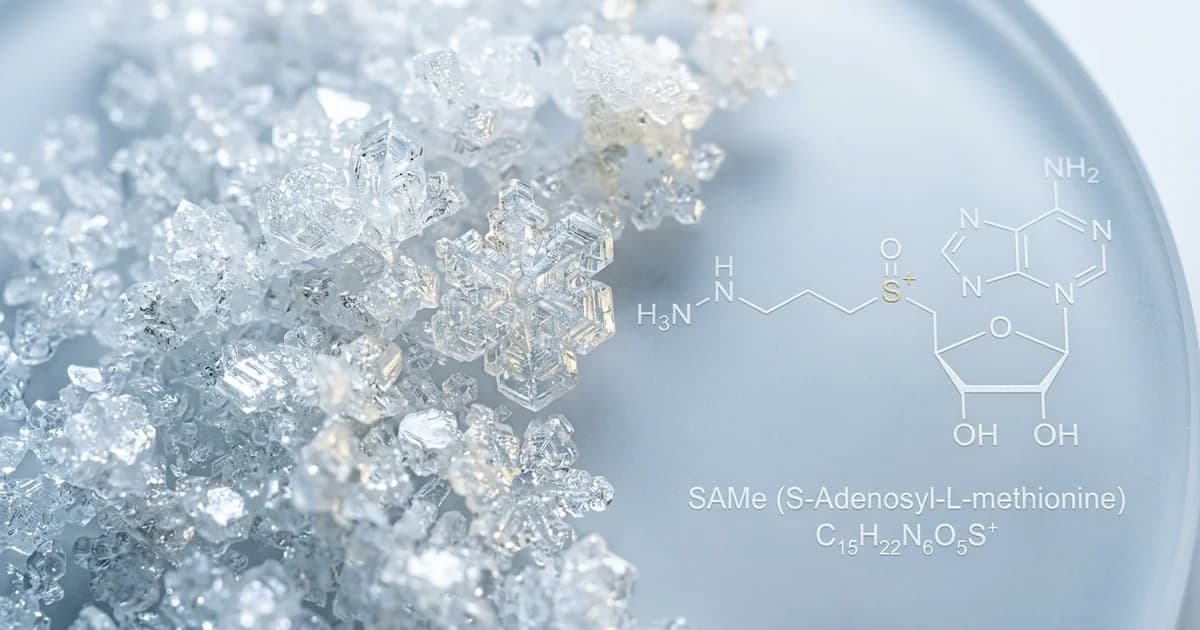
Your brain runs millions of chemical handoffs every second, and a single molecule sits at the center of a huge fraction of them. That molecule is SAMe, short for S-adenosylmethionine. As a same supplement, it has built a reputation as one of the few mood-support compounds with real clinical trial data behind it, not just forum testimonials.
SAMe is not a stimulant. It will not sharpen your focus in ten minutes. It works on a slower timeline, tuning the chemistry your brain uses to build neurotransmitters and maintain cell membranes.
This is a deep look at what s-adenosylmethionine actually does, what the research says about SAMe for depression, how it stacks up against prescription options, and where it fits in the broader methylation picture.
Key Takeaways
- SAMe is your body's main methyl donor, supplying the chemical "tags" used to build neurotransmitters like serotonin and dopamine.
- SAMe is one of the most-studied mood-support supplements, with effects comparable to standard antidepressants, though results versus placebo are mixed.
- Typical SAMe dosage runs 800 to 1600 mg per day, taken in divided doses on an empty stomach.
- SAMe interacts with serotonergic medications and can worsen mania in people with bipolar disorder, so it is not a casual stack-anything supplement.
What Is SAMe (S-Adenosylmethionine)?
SAMe is a compound your body makes from the amino acid methionine and ATP, the cell's energy currency. You produce it constantly in your liver, and it shows up in nearly every tissue, including the brain.
Its job is to hand off a methyl group, a small cluster of one carbon and three hydrogen atoms, to other molecules. That single chemical action drives more than 100 reactions in the body. SAMe is a methyl donor and is involved in the synthesis of various neurotransmitters in the brain. Derived from the amino acid L-methionine, SAMe has been postulated to have antidepressant properties.
When SAMe donates its methyl group, it becomes a molecule called SAH, which then breaks down into homocysteine. Your body recycles that homocysteine back into methionine using B12 and folate, then rebuilds SAMe again. This loop is the methylation cycle, and SAMe is its working currency.
SAMe and Methylation in the Brain
Methylation is how your brain switches chemistry on and off, and SAMe is the switch it uses. Add a methyl group, and an enzyme activates, a neurotransmitter gets built, or a gene gets quieted.
Three things in the brain depend heavily on this:
- Neurotransmitter production. Serotonin, dopamine, and norepinephrine all require methylation steps during synthesis or breakdown.
- Cell membrane health. Methylation builds phospholipids like phosphatidylcholine, which keep neuronal membranes fluid and signaling cleanly.
- Gene regulation. Methyl tags on DNA help decide which genes are read, a quiet background process that shapes brain function over time.
This is the core idea behind the same methylation brain connection. Rather than blocking the reuptake of one neurotransmitter the way an SSRI does, SAMe feeds the raw machinery that produces several of them at once.
That breadth is a strength and a limitation. It supports many pathways, but it also means SAMe is a slow, systemic lever, not a fast cognitive switch.
SAMe for Depression: What the Research Actually Shows
SAMe has more clinical research behind it for depression than almost any other dietary supplement, both as a standalone and as an add-on to antidepressants. This is the headline most people care about, so it is worth being precise.
A 2024 systematic review and meta-analysis on PubMed examined SAMe as a therapy for depression, pooling 14 randomized trials with 1,522 participants at daily doses of 200 to 3,200 mg. It found no statistically significant difference between SAMe and placebo, whether SAMe was taken alone or added to an antidepressant. The authors did note that SAMe may relieve depressive symptoms to a degree similar to the standard antidepressants imipramine and escitalopram.
Older head-to-head data is also notable. According to a clinical summary from Gateway Psychiatric, trials suggest SAMe can match older antidepressants in some patients. A small number of clinical trials with injected or oral SAMe have shown that, at doses of 200-1600 mg/d, SAMe is superior to placebo and is as effective as tricyclic antidepressants in alleviating depression, although some individuals may require higher amounts.
One practical difference gets attention often. SAMe may work faster than conventional antidepressants, with some people noticing improvement within 1–2 weeks. Standard SSRIs usually take four to six weeks to show their full effect.
None of this makes SAMe a replacement for medical care. It is a supplement, and depression is a serious condition that deserves a clinician, not a self-directed experiment.
SAMe vs Antidepressants: An Honest Comparison
The same vs antidepressants question comes up constantly, and the honest answer is that they are not interchangeable tools. They work differently, carry different risks, and suit different situations.
| Factor | SAMe | SSRIs / Standard Antidepressants |
|---|---|---|
| Mechanism | Supplies methyl groups for neurotransmitter synthesis | Blocks reuptake of specific neurotransmitters |
| Typical onset | Often 1 to 2 weeks | Usually 4 to 6 weeks |
| Prescription needed | No (sold as a supplement) | Yes |
| Clinical evidence | Moderate, growing | Large, decades deep |
| Common side effects | Mild GI upset, insomnia, restlessness | Sexual dysfunction, weight changes, fatigue |
| Key risk | Mania in bipolar, serotonin interactions | Withdrawal, variable response |
| Best framed as | A support tool or adjuvant | A primary, monitored treatment |
The takeaway is not "pick one." The strongest evidence for SAMe is often as an adjuvant, meaning it works alongside a prescription under a doctor's guidance, not as a solo swap. That distinction matters, and it leads straight into the safety conversation.
SAMe Dosage and How to Take It
The standard SAMe dosage for mood support is 800 to 1600 mg per day, split into divided doses and taken on an empty stomach. Starting low and ramping up is the usual approach.
A clinical overview in Psychology Today lays out a common protocol clearly. The standard maintenance regimen of oral SAMe for depressed mood is between 800 and 1600 mg/day in two-to-four divided doses. A common strategy is to start SAMe at a dose of 200mg twice daily, and gradually increase to 400mg twice daily, monitoring for side effects and therapeutic response. Absorption is improved when SAMe is taken on an empty stomach.
A few practical notes on the same dosage that come up repeatedly:
- Take it earlier in the day. SAMe can be activating, and late doses sometimes disrupt sleep.
- Use enteric-coated tablets. SAMe is unstable, so quality and packaging matter more than with most supplements.
- Pair it with B vitamins. B12, B6, and folate keep the methylation cycle moving and help manage homocysteine.
That last point connects SAMe to the wider methylation system, which is where the real picture comes together.
How SAMe Fits the Methylation System
SAMe does not work in isolation. It sits inside a recycling loop that depends on several other nutrients, and ignoring them can blunt its benefit or push homocysteine in the wrong direction.
When SAMe donates its methyl group and becomes homocysteine, your body needs folate (especially methylfolate) and vitamin B12 to convert it back to methionine. TMG (betaine) offers a second, parallel route to do the same job. Without these cofactors, the cycle stalls.
This is why methylation is best understood as a team effort rather than a single supplement. If you want the full picture of the supporting cast, our deep dives on methylfolate and the methylation cycle and the role of B vitamins in brain energy round out the system that SAMe runs on.
Safety: Who Should Be Careful With SAMe
SAMe is generally well tolerated, but it carries two interactions serious enough to rule it out for some people. This is not a supplement to add casually if you take psychiatric medication.
The first is mania. According to the NIH's National Center for Complementary and Integrative Health, bipolar disorder is a clear caution. People with bipolar disorder should not take SAMe for their depressive symptoms except under the supervision of a health care provider because SAMe may worsen symptoms of mania.
The second is serotonin. Combining SAMe with serotonergic drugs can stack effects in a risky way. The Mayo Clinic flags this directly, noting that SAMe should not be combined with antidepressants and other agents that raise serotonin without medical oversight. The NCCIH also notes that SAMe may decrease the effects of levodopa, a drug used to treat Parkinson's disease.
Common, milder side effects include stomach upset, nausea, restlessness, and trouble sleeping. If you take any prescription, especially an SSRI, SNRI, or L-dopa, talk to your doctor before starting SAMe. This is non-negotiable.
Conclusion: A Slow Lever, Not a Switch
SAMe earns its reputation because it works upstream. Instead of nudging a single neurotransmitter, it feeds the methylation machinery that builds many of them, which is why the clinical data on mood is more compelling than for most supplements on the shelf.
That same breadth defines its limits. SAMe acts over weeks, depends on B vitamins and folate to recycle cleanly, and interacts with serotonergic drugs in ways that demand real caution. It is a systemic, slow-acting lever for mood and methylation, best used with a clinician when medications are involved.
If you understand it that way, you understand why it is powerful and why it is not a quick fix.
Frequently Asked Questions
How long does SAMe take to work?
SAMe tends to act faster than prescription antidepressants. Some people report mood improvement within one to two weeks, compared with the four to six weeks typical of SSRIs. That said, response varies, and the cleaner data often comes from using SAMe as an add-on rather than a standalone. Give any honest trial several weeks at a consistent dose before judging the result, and track changes rather than relying on memory.
What is the best SAMe dosage for mood?
The common range for mood support is 800 to 1600 mg per day, split into two to four doses and taken on an empty stomach. Many protocols start around 200 mg twice daily and ramp up gradually while watching for side effects. Higher doses are not automatically better, and the activating effect means earlier in the day usually beats evening dosing. Quality matters too, since SAMe degrades easily.
Can I take SAMe with antidepressants?
Only under medical supervision. SAMe and serotonergic drugs like SSRIs can raise serotonin in ways that may be unsafe, and there are case reports of mania when the two are combined. Some clinical research uses SAMe specifically as an adjuvant to antidepressants, but that happens with doctor oversight and monitoring. Never add SAMe to a prescription regimen on your own without talking to the prescriber first.
Is SAMe safe for people with bipolar disorder?
Not without close medical supervision. SAMe can worsen symptoms of mania, which is a serious risk for anyone with bipolar disorder. Because SAMe pushes neurotransmitter chemistry in an activating direction, it can tip someone toward a manic episode. If you have bipolar disorder or a family history of it, treat SAMe as off-limits unless a psychiatrist specifically guides its use.
Does SAMe help with anything besides mood?
SAMe has been studied for joint comfort and liver function alongside mood, reflecting how widely the body uses methylation. Its broad role as a methyl donor touches neurotransmitter synthesis, cell membranes, and gene regulation. That said, the strongest and most discussed evidence centers on depressive symptoms. For other uses, the data is more mixed, and you should keep expectations grounded in what is actually well studied.
Do I need B vitamins to take SAMe?
It helps. When SAMe donates its methyl group it becomes homocysteine, and your body relies on folate (especially methylfolate) and vitamin B12 to recycle that back into methionine. TMG offers a second route. Without adequate cofactors, the methylation cycle can stall and homocysteine can rise. Pairing SAMe with B vitamins keeps the loop turning and supports the system SAMe depends on.
Where SAMe Ends and an Acute Focus Tool Begins
Everything above points to one truth about SAMe: it is a slow, systemic mood and methylation lever. It works over weeks, leans on your B vitamins and folate, and interacts with serotonin drugs in ways that demand caution. It is not something you reach for when you need to lock in for the next eight hours.
That gap is exactly the one Roon was built to fill. Roon is a sublingual cognitive performance pouch designed for acute, same-day focus, with a four-ingredient stack of 80 mg caffeine, 60 mg L-theanine, 25 mg methylliberine (Dynamine), and 5 mg theacrine (TeaCrine). It works in 5 to 10 minutes and holds for 6 to 8 hours with no jitters, no crash, and no tolerance buildup.
To be clear, Roon is not a mood treatment, an antidepressant, or a methylation supplement, and it does not replace anything in this article. SAMe and B vitamins handle the slow chemistry. Roon handles the moment you need to perform. If your stack already covers the long game, try Roon for the focus window itself.
Written by Roon Team