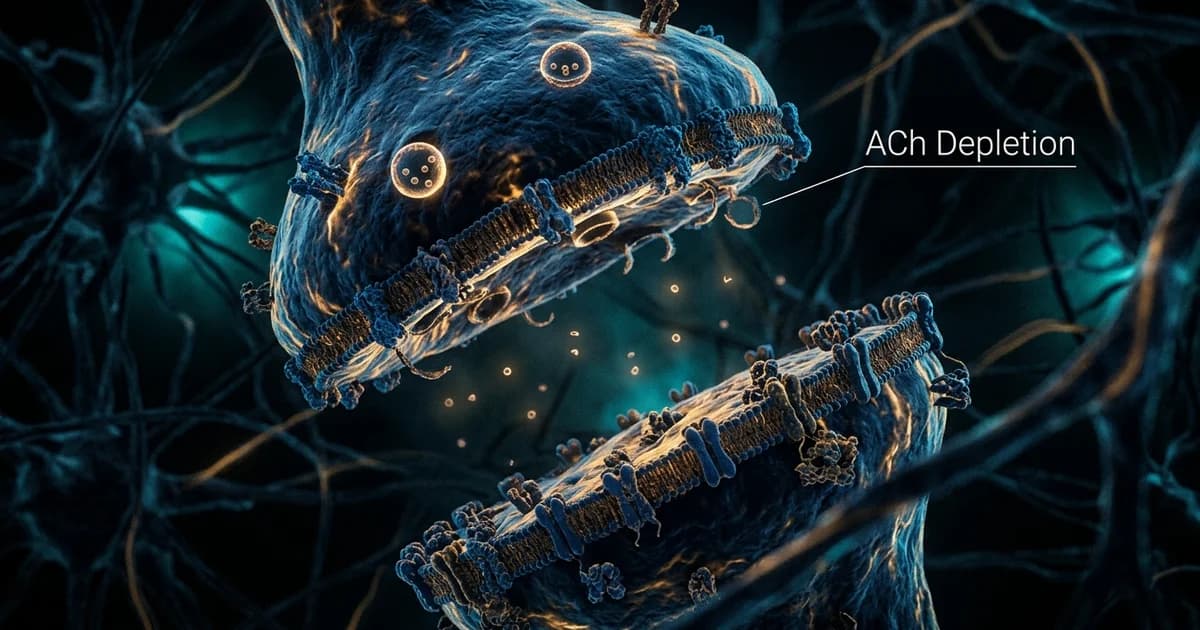
Why Racetams Cause Headaches: The Acetylcholine Depletion Mechanism
The most common complaint among new racetam users is a dull, pressure-like headache that shows up a few hours after dosing. A racetam headache is not a random side effect or a sign of a bad batch. It is a predictable consequence of how these compounds push your brain to burn through a single raw material faster than it can make more.
That material is acetylcholine, your brain's primary memory and attention neurotransmitter.
Understand the supply-and-demand problem underneath it, and the headache stops being mysterious. It becomes a dosing-math problem with a clear cause and a clear fix.
Key Takeaways
- Racetams increase how hard your cholinergic system works, raising demand for acetylcholine.
- When demand outpaces the choline supply your brain uses to build acetylcholine, a headache often follows.
- The standard fix is stacking a choline source (CDP-choline or Alpha-GPC) to refill the raw material.
- The headache is a design tradeoff specific to choline-dependent nootropics, not to every focus aid.
- Compounds that act on adenosine and dopamine instead of acetylcholine do not create this depletion problem.
What a Racetam Actually Does to Your Brain
Racetams are a family of compounds that share a pyrrolidone ring, with piracetam being the original and most studied member. They are best understood as cholinergic amplifiers. They make your acetylcholine system more active without supplying any acetylcholine themselves.
Piracetam appears to increase the density and sensitivity of acetylcholine receptors and to push more signaling through cholinergic pathways. According to Nootropics Expert, racetams boost the demand for acetylcholine in the brain, which is why pairing them with a choline source is standard practice in nootropic stacks.
Think of it like turning up the gain on a system. You get more signal, but you also draw more current. If the power supply cannot keep up, something gives.
Why Racetams Cause Headaches: The Acetylcholine Depletion Mechanism
A racetam headache happens when increased acetylcholine demand drains your available choline faster than your brain can replace it. The result is a temporary acetylcholine shortfall in tissue that depends heavily on cholinergic signaling, including the blood vessels and pathways tied to head pain.
Here is the chain of events, step by step:
- You dose a racetam. Cholinergic activity ramps up. Your neurons fire more acetylcholine to meet the new demand.
- Acetylcholine gets used and broken down. After it crosses a synapse, the enzyme acetylcholinesterase splits it back into choline and acetate.
- Your brain recycles and rebuilds. Choline acetyltransferase recombines choline with acetyl-CoA to make fresh acetylcholine.
- Demand outruns supply. If you do not have enough free choline circulating, step 3 stalls. Acetylcholine levels dip below what the now-overactive system needs.
- The headache shows up. Low acetylcholine availability is the trigger most users feel as a frontal or temple-area ache.
This is why the headache is often described as a "choline headache." It is not the racetam poisoning you. It is the racetam writing checks your choline stores cannot cash.
The Choline Connection
Choline is the rate-limiting ingredient. Your body makes some on its own and pulls the rest from food like eggs, liver, and soy. Most people run on the lower end of adequate intake even before they add a compound that spikes demand.
Acetylcholine is the neurotransmitter most tied to memory, learning, and focus. Be Brain Fit notes that low acetylcholine is associated with memory lapses and difficulty concentrating, which tracks with the brain fog many users report alongside the piracetam headache.
So the symptom is really two symptoms wearing one coat. The ache and the fog both point back to the same empty tank.
Why Nootropics Cause Headaches Beyond Just Racetams
Not every nootropic headache comes from acetylcholine. Understanding the full picture helps you diagnose your own.
The cholinergic depletion route is the main one for racetams. But Cereflex Labs outlines several other common triggers for why nootropics cause headaches, including dehydration, dosing too high too fast, and stimulant-related vascular effects.
For racetams specifically, the acetylcholine mechanism dominates. If your headache reliably appears a few hours after a racetam dose and eases when you add choline, you have your answer.
How People Manage the Racetam Choline Problem
The accepted fix is to stack a choline source with your racetam. This is the entire reason choline with racetams became a default protocol in the nootropics community rather than an optional add-on.
The two most-used sources are CDP-choline (citicoline) and Alpha-GPC, both of which cross into the brain efficiently and raise the free choline your neurons can convert into acetylcholine.
A Practical Comparison
The table below compares the common ways people approach the racetam choline issue, plus where a non-cholinergic option sits.
| Approach | How it addresses the headache | Tradeoffs |
|---|---|---|
| Racetam alone | Does not address it; demand outpaces supply | Headache and brain fog are common |
| Racetam + CDP-choline | Refills choline so acetylcholine synthesis keeps up | Two products to dose and time; added cost |
| Racetam + Alpha-GPC | Higher choline yield per dose | Two products; some report overstimulation |
| Dietary choline (eggs, liver) | Modest support | Hard to hit therapeutic levels through food |
| Non-cholinergic focus aid (e.g., caffeine + L-theanine, like Roon) | Sidesteps the mechanism entirely; no choline to deplete | Different effect profile; not a racetam substitute |
The pattern is clear. With racetams, you are managing a side effect you created. The headache is the cost of admission, and choline is the toll.
The Tradeoff Nobody Mentions Upfront
A focus tool that reliably produces a headache, which you then have to buy a second supplement to fix, is a tradeoff worth naming out loud.
There is nothing wrong with running a racetam-and-choline stack if it works for you. Plenty of people dial it in and do well. But the acetylcholine depletion problem is structural, not incidental, and it means your dosing requires constant balancing between two compounds.
This is the difference between a tool with a managed flaw and a tool built to avoid the flaw. Once you see the mechanism, you can decide which kind you want.
Conclusion
A racetam headache is the visible end of an invisible supply problem. Racetams raise how hard your cholinergic system works, that extra work burns through acetylcholine, and when your choline reserves cannot rebuild it fast enough, your head pays the bill.
The fix the community settled on, stacking choline, works because it targets the exact bottleneck. CDP-choline and Alpha-GPC refill the raw material so synthesis keeps pace with demand.
The deeper takeaway is about mechanism. Any compound that drives one neurotransmitter harder than its supply chain can support will eventually create a deficit. With racetams and acetylcholine, that deficit has a name, a cause, and a predictable feeling in your temples.
Frequently Asked Questions
Why does piracetam give me a headache?
Piracetam increases activity in your cholinergic system, raising how much acetylcholine your brain uses. When that demand exceeds your available choline, acetylcholine synthesis cannot keep up, and the shortfall often presents as a headache. The fix most users rely on is adding a choline source like CDP-choline or Alpha-GPC to refill the raw material your brain needs to rebuild acetylcholine.
How long does a racetam headache last?
It varies by person and dose, but a choline-related racetam headache typically tracks with the compound's active window and eases once acetylcholine levels recover or once you add choline. If a headache is severe, persistent, or unusual for you, stop dosing and talk to a healthcare professional rather than pushing through it.
What is the best choline source to take with racetams?
CDP-choline (citicoline) and Alpha-GPC are the two most-used options because both cross into the brain efficiently and raise free choline. CDP-choline is often described as smoother, while Alpha-GPC delivers more choline per dose. The right choice depends on how your body responds, so many people experiment to find which prevents headaches without overstimulation.
Does taking choline always prevent the headache?
Often, but not always. Choline addresses the acetylcholine depletion mechanism, which is the main racetam headache driver. If your headache comes from dehydration, a dose that is too high, or another trigger, choline will not fix it. Match the solution to the actual cause.
Do all nootropics cause headaches?
No. Headaches are most associated with choline-dependent compounds like racetams, where the acetylcholine mechanism applies. Many focus aids work through entirely different pathways, such as adenosine and dopamine signaling, and do not create a choline deficit. Those compounds carry their own considerations but not this specific headache mechanism.
Is a racetam headache dangerous?
A mild, choline-related headache is usually a sign of a dosing imbalance rather than harm, and it tends to resolve with choline or a lower dose. That said, headaches can have many causes. If yours is intense, frequent, or accompanied by other symptoms, stop and consult a healthcare professional. This article explains a mechanism; it is not medical advice.
Can I avoid the choline problem entirely?
Yes, by choosing a focus aid that does not rely on the cholinergic system. Compounds acting on adenosine and dopamine raise alertness without driving acetylcholine demand, so there is no choline to deplete and no headache to chase. The tradeoff is a different effect profile, since these are not direct racetam substitutes.
Focus Without the Choline Tax
If the racetam model frustrates you, the reason is structural. A focus tool that reliably produces a headache you then have to buy a second supplement to manage is a design flaw, not a feature. You spend your attention balancing two compounds instead of doing your work.
Roon was built to skip that loop. It works through adenosine and dopamine, not acetylcholine, so there is no choline to deplete and no headache to chase. The sublingual pouch pairs 80 mg caffeine with 60 mg L-theanine, plus 25 mg methylliberine (Dynamine) and 5 mg theacrine (TeaCrine), for a 5 to 10 minute onset and 6 to 8 hours of steady focus with no jitters, no crash, and no tolerance buildup.
To be clear, Roon is not a racetam and not a memory-enhancement protocol. It is a clean focus tool for people who want sustained attention without managing a self-inflicted side effect. If that is the tradeoff you would rather make, try Roon and skip the choline math.
Written by Roon Team