Phenylethylamine (PEA): The Brain's "Love Molecule"
Roon Team
Phenylethylamine (PEA): The Brain's "Love Molecule" and Why Its Effects Vanish So Fast
Falling in love feels like a stimulant because, chemically, it partly is one. Your brain releases phenylethylamine during attraction, a small amine that pushes dopamine and norepinephrine into action and produces that flushed, racing, can't-stop-smiling state. People have chased that feeling in pill form ever since, hoping a PEA supplement could bottle infatuation and hand it back on demand.
The chemistry is real. The problem is the clock.
Phenylethylamine is one of the most fragile molecules your brain makes. It appears in a flash, does its job, and disappears before you can register it. That single fact explains why PEA fascinates researchers and frustrates almost everyone who tries to use it.
Key Takeaways
- Phenylethylamine is a natural trace amine that triggers dopamine and norepinephrine release, earning it the "love molecule" nickname.
- Its effects fade in minutes because the enzyme MAO-B breaks it down almost instantly.
- Oral PEA has a half-life of roughly 5 to 10 minutes, and the version your neurons make lasts about 30 seconds.
- Very little swallowed PEA reaches the brain intact, which is why a PEA nootropic rarely matches the hype.
- Sustained focus comes from compounds with predictable, longer half-lives, not from a fast-degraded amine.
What Is Phenylethylamine?
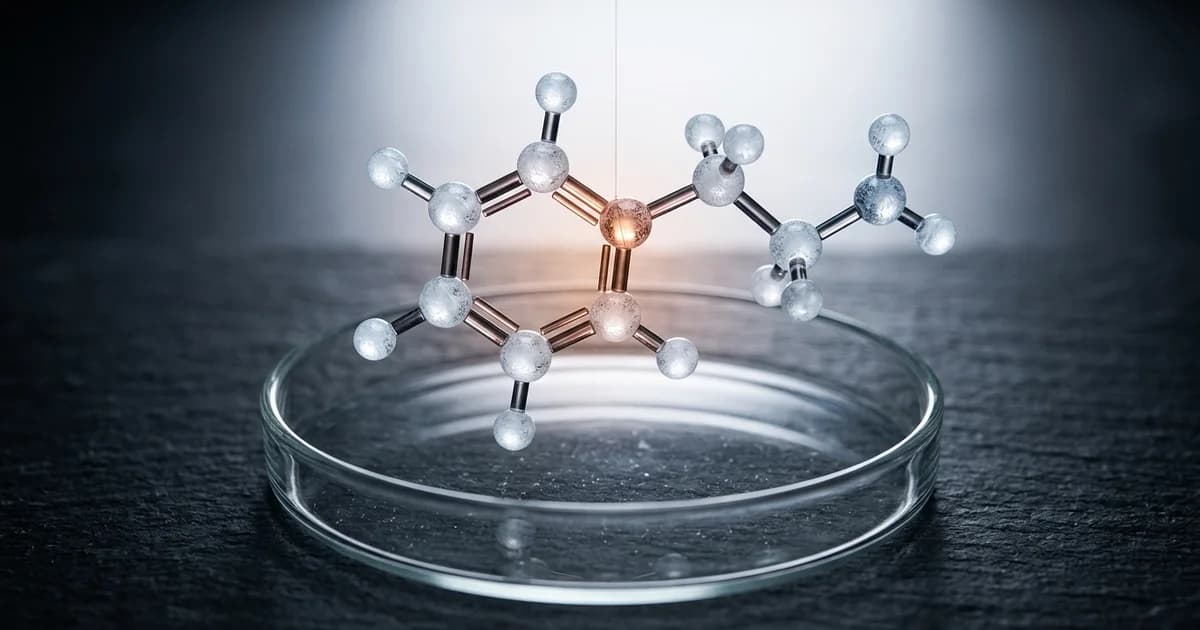
Phenylethylamine is a naturally occurring trace amine built from a benzene ring and an amine group. Your body makes it from the amino acid phenylalanine, and it acts as both a neuromodulator and a chemical cousin to amphetamine, sharing a similar backbone without the same potency or duration.
It belongs to a family of "trace amines," compounds that exist in tiny concentrations in the nervous system but punch above their weight. Rather than acting as a classic neurotransmitter that lingers in the synapse, PEA works in quick bursts. Your brain produces PEA in bursts and degrades it immediately, creating sharp, transient signals rather than sustained neurochemical shifts.
That burst-and-vanish design is the whole story. It is also why deliberate supplementation is so hard to pull off.
PEA and Dopamine: The "Love Molecule" Reputation
The romantic reputation comes from how PEA behaves in the brain's reward circuits. When phenylethylamine rises, it promotes the release of dopamine and norepinephrine, the same messengers tied to motivation, alertness, and pleasure. That cluster of effects produces the buzzy, energized mood people associate with early attraction.
Chocolate gets dragged into this story constantly, because cacao contains measurable phenylethylamine. The romance markets well, but the biology rarely cooperates. Eating a chocolate bar floods your gut with phenethylamine, but almost none of it survives the trip.
So the chocolate-makes-you-fall-in-love claim is mostly folklore. The PEA is there. Getting it to your brain in a meaningful dose is the part that fails.
Why PEA's Effects Vanish So Fast
Phenylethylamine disappears quickly because the enzyme monoamine oxidase B (MAO-B) degrades it almost as soon as it forms. This is the central fact behind every PEA experience, good or disappointing.
The numbers are stark. By oral route, phenethylamine's half-life is 5–10 minutes; endogenously produced PEA in catecholamine neurons has a half-life of roughly 30 seconds. A half-life measured in seconds is almost unheard of for a molecule people try to supplement.
Here is the path it takes. Orally ingested without a MAOI, phenethylamine goes through extensive first-pass metabolism by monoamine oxidase B (MAO-B) and then aldehyde dehydrogenase (ALDH), which metabolize it into phenylacetic acid. In plain terms, your gut and liver dismantle most of the dose before it ever reaches your bloodstream, and what slips through gets cleared in minutes.
The brain-delivery problem makes it worse. Studies in dogs suggest that phenethylamine had a very short half-life (5 to 10 minutes), and phenethylamine injected intravenously in rats was absorbed mainly by the lungs, liver, and kidneys, and less than 1% reached the brain. Less than one percent. That is the ceiling you are fighting against.
The MAO-B Workaround (and Why It Is Risky)
Because PEA and MAO-B are locked in this relationship, some users try to slow the breakdown with a monoamine oxidase B inhibitor, hoping to stretch a few minutes into something usable. Many neurohackers prolong the effects of PEA by using it with a monoamine oxidase-B inhibitor (MAOI).
This is where things get genuinely dangerous. MAO inhibitors interact with tyramine in food and with many medications, and stacking them carelessly can spike blood pressure. Trying to outsmart your own enzymes to rescue a 5-minute molecule is a poor trade. The smarter move is to pick compounds that do not need rescuing.
PEA, Mood, and the Depression Hypothesis
The link between beta-phenylethylamine and mood is the most studied angle in the research. Decades ago, scientists proposed that low PEA activity might contribute to depression, partly because depressed patients showed altered levels of its main breakdown product in urine.
The psychiatrist H.C. Sabelli was central to this work. Mean total plasma phenylacetic acid concentrations were 491.83 ng/ml in 12 healthy volunteers and 300.33 ng/ml in 23 drug-free patients with major depression, according to a study indexed on PubMed. Lower metabolite levels hinted at lower PEA turnover in some patients.
This produced the "phenylethylamine hypothesis" of affective disorder, and even spawned interest in urinary phenylacetic acid as a possible marker, as discussed in Science. The hypothesis is interesting. It is not settled science, and PEA is not a treatment for any mood condition.
One more clue ties PEA to feeling good. PEA increases during physical exercise, during which it is rapidly metabolized due to its short half-life of roughly 30 seconds. The runner's-high mood lift may owe something to a quick PEA surge, which is a far more reliable way to raise it than swallowing a capsule.
PEA as a Nootropic: The Honest Verdict
As a standalone PEA nootropic, phenylethylamine is more famous than effective. Users typically report a sharp, pleasant rush of focus and mood that lasts a handful of minutes, then flattens out completely. The onset is real. The duration is the catch.
Here is how PEA stacks up against the compounds people actually rely on for sustained cognitive performance.
| Compound | Typical onset | Practical duration | Main limitation |
|---|---|---|---|
| Phenylethylamine (PEA) | 5–15 min | 5–15 min | Destroyed by MAO-B; <1% reaches brain |
| Caffeine | 30–60 min | 4–6 hours | Jitters and crash at higher doses |
| L-theanine | 30–45 min | 2–3 hours | Subtle on its own |
| Methylliberine (Dynamine) | 10–20 min | 2–4 hours | Best paired, not solo |
| Theacrine (TeaCrine) | 30–60 min | 6–8 hours | Slow to peak alone |
| Roon pouch (4-compound stack) | 5–10 min | 6–8 hours | Sublingual; not a sedative or sleep aid |
The pattern is clear. A molecule that vanishes in minutes cannot anchor a workday, no matter how good those first few minutes feel.
If you want a deeper look at the building blocks that do last, our breakdowns of how L-theanine smooths out caffeine and why theacrine resists tolerance cover the duration question in detail.
Frequently Asked Questions
Is phenylethylamine the same chemical released when you fall in love?
Partly, yes. Phenylethylamine rises during attraction and promotes dopamine and norepinephrine release, which produces the energized, euphoric feeling tied to early romance. That is why it earned the "love molecule" nickname. It is one piece of a larger chemical picture that also involves dopamine, oxytocin, and norepinephrine, not the sole cause of falling in love.
Why do PEA supplements stop working after a few minutes?
Because the enzyme MAO-B breaks PEA down almost immediately. Oral phenylethylamine has a half-life of only 5 to 10 minutes, and most of a swallowed dose is destroyed in the gut and liver before reaching your brain. The brief rush fades fast because the molecule itself is gone fast.
Does eating chocolate raise brain PEA levels?
Not meaningfully. Chocolate contains phenylethylamine, but your digestive system metabolizes nearly all of it before it can reach the brain. The mood lift from chocolate comes mostly from sugar, fat, and other compounds, not from a PEA surge crossing into your nervous system.
Is PEA safe to combine with an MAO-B inhibitor?
This is risky and not advisable without medical supervision. MAO inhibitors interact dangerously with tyramine-containing foods and many medications, and can cause sharp blood pressure spikes. Using one to extend PEA's short half-life trades a minor benefit for a serious safety risk.
Can PEA treat depression or anxiety?
No. Researchers have studied a possible link between low PEA activity and depression, but the hypothesis remains unproven, and phenylethylamine is not an approved treatment for any condition. If you are dealing with a mood disorder, talk to a qualified clinician rather than experimenting with supplements.
What raises phenylethylamine naturally?
Exercise is the most reliable trigger. PEA levels climb during intense physical activity, which may contribute to the post-workout mood lift, though the molecule is metabolized within seconds. Phenylalanine, the amino acid your body uses to build PEA, is found in protein-rich foods, though dietary intake does not reliably raise brain PEA.
Is PEA a good nootropic for all-day focus?
No. The onset is quick and the mood effect can be pleasant, but PEA's effect typically lasts only minutes. For sustained focus across a workday, compounds with longer, more predictable half-lives are far more practical than a fast-degraded amine.
The Case for Duration Over a 5-Minute Spark
Phenylethylamine is a beautiful demonstration of how the brain uses chemistry. It fires fast, lifts mood, and clears out almost instantly, which is exactly why it works as a fleeting signal and fails as a supplement. The molecule was never built to last, and no amount of marketing changes its half-life.
The lesson is bigger than one amine. Real cognitive performance is an engineering problem of duration, not intensity. A spark that dies in five minutes cannot carry you through a deadline, a long study block, or an afternoon of focused work. What matters is how long a compound stays active and how predictably it leaves.
Built for the Hours PEA Can't Cover
PEA is the opposite of what sustained focus requires. It peaks in minutes and degrades before you can use it, which is fine for a chemical love letter and useless for a workday. That gap, between a quick spark and a steady state, is the entire point of building a stack around duration.
Roon was engineered for the part PEA can't reach: the hours after the first few minutes. Each sublingual pouch pairs 80 mg caffeine, 60 mg L-theanine, 25 mg methylliberine (Dynamine), and 5 mg theacrine (TeaCrine), four compounds chosen for staggered half-lives so the effect builds in 5 to 10 minutes and holds for 6 to 8 hours with no jitters, no crash, and no tolerance buildup.
To be clear, Roon is not a PEA product and makes no "love molecule" claim. It is also not a treatment for any mood or medical condition. It is a focus tool designed to do the one thing PEA structurally cannot: last. If you want clean energy that stays the whole shift, try Roon in place of the spark that fades.
Written by Roon Team