Panax Ginseng (Korean Ginseng)
Roon Team
Panax Ginseng (Korean Ginseng): What the Cognitive Science Actually Shows
Panax ginseng has been sold as a brain tonic for roughly 2,000 years, which is exactly why you should be skeptical of it. Tradition is not data. So here is the honest version: the research on panax ginseng cognitive benefits is real, but it is narrower, slower, and more dose-dependent than the supplement aisle wants you to believe.
This is a root, not a stimulant. It does not hit like coffee, and it was never supposed to.
Below is what controlled human trials show, what the mechanisms suggest, and where the evidence runs thin.
Key Takeaways
- Panax ginseng (also called Korean or Asian ginseng) shows measurable but modest effects on working memory, attention, and mental fatigue in some controlled trials.
- The active compounds are ginsenosides, a family of saponins that interact with neurotransmitter systems and reduce oxidative stress in neural tissue.
- Effects are dose-sensitive and slow to build. This is a daily-use adaptogen, not a same-day focus tool.
- The strongest cognitive signal appears in older adults and people with mild cognitive impairment, not necessarily healthy 25-year-olds.
- Ginseng works on a different timescale than fast-onset stimulant stacks, which matters when you choose a tool for the job.
What Panax Ginseng Actually Is
Panax ginseng is the root of a slow-growing perennial native to Korea and northeastern China. The genus name comes from the Greek panakeia, meaning "all-healing," which tells you more about marketing in antiquity than about pharmacology.
Two things matter for your brain. The first is the species. Panax ginseng (Korean ginseng, Asian ginseng) is chemically distinct from American ginseng (Panax quinquefolius) and from Siberian "ginseng" (Eleutherococcus), which is not real ginseng at all.
The second is processing. Fresh root, white ginseng, and Korean red ginseng (steamed and dried) carry different ginsenoside profiles, and that profile drives the effect.
Ginsenosides: The Compounds Doing the Work
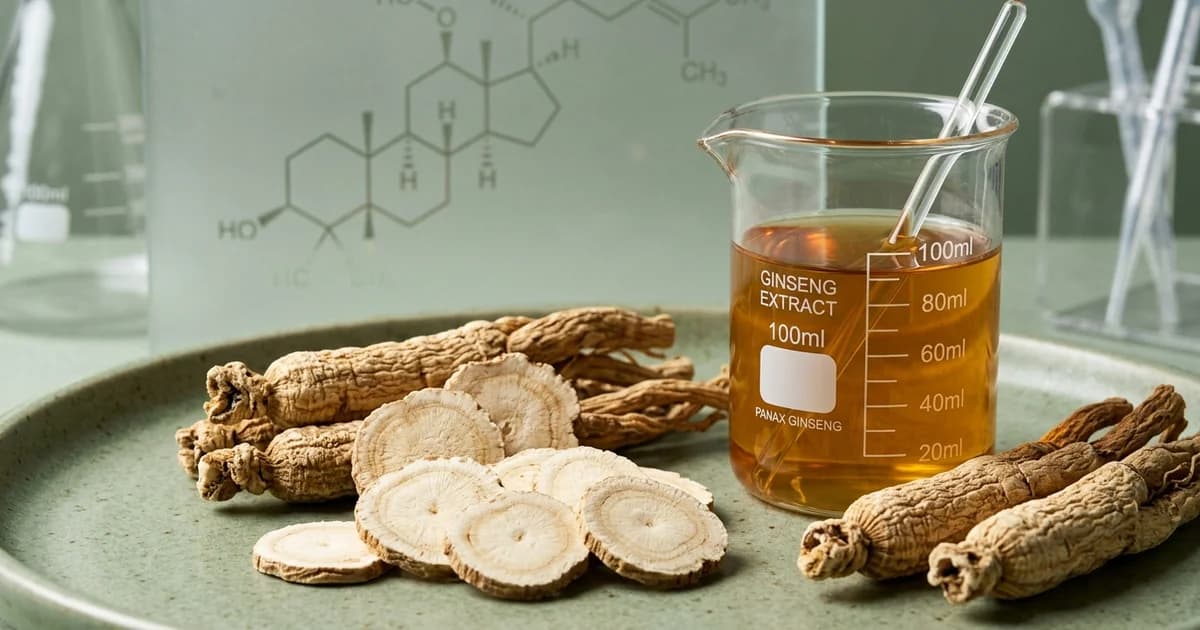
The cognitive activity of Korean ginseng traces back to ginsenosides, a class of triterpenoid saponins. There are more than 100 of them, but a handful do most of the heavy lifting in neural research: Rg1, Rb1, Rg3, and Re.
These molecules are not sedatives or simple stimulants. They modulate signaling. Research summarized by ScienceDirect on the molecular signaling of ginsenosides Rb1, Rg1, and Rg3 describes how these compounds act on multiple cellular pathways rather than a single receptor.
Two mechanisms come up repeatedly in the literature:
- Cholinergic support. Work published in Acta Pharmacologica Sinica via Nature on the anti-amnestic effects of ginsenosides Rg1 and Rb1 points to effects on acetylcholine, the neurotransmitter most tied to memory and learning.
- Neuroprotection. Ginsenosides influence ion channels and receptor activity in the nervous system, as reviewed in this PMC paper, and they reduce oxidative and inflammatory stress in neural tissue.
The takeaway is that ginseng's effect on the brain is indirect and structural. It nudges the systems that support cognition over time rather than spiking alertness in minutes.
Panax Ginseng Cognitive Benefits: What the Human Trials Show
Here is the direct answer: controlled human trials suggest Panax ginseng can produce small improvements in working memory, calmness, and mental fatigue, with the clearest effects in aging brains and the weakest in healthy young adults.
Single-dose effects on mental fatigue
A frequently cited line of research found that single doses of standardized Panax ginseng (the G115 extract) affected cognitive performance and blood glucose during demanding mental tasks. The PubMed record describes single doses reducing blood glucose levels and changing cognitive performance during sustained mental activity.
That glucose finding is interesting. It hints that part of ginseng's acute effect on attention may run through how the brain fuels itself during hard work, not through classic stimulation.
Mild cognitive impairment and aging
The signal gets stronger in older populations. A randomized, double-blind, placebo-controlled trial in Korean volunteers with mild cognitive impairment, published in PMC, reported a cognition-enhancing effect over the study period.
Separate work on Korean red ginseng and cognitive and motor function, also indexed in PMC, used a double-blind, randomized, placebo-controlled design to test effects in this space. And a review in ScienceDirect describes emerging evidence that ginseng components support cognition in subjective memory impairment, mild cognitive impairment, and early-stage dementia.
To be precise about compliance: these are studies of cognitive support, not treatment. Ginseng is a dietary supplement, and nothing here means it cures or prevents any condition.
The honest caveat
Independent reviewers are cautious. The Alzheimer's Drug Discovery Foundation's Cognitive Vitality assessment of Panax ginseng notes that evidence in humans is mixed and that more rigorous, larger trials are needed before strong conclusions.
So the responsible read is this. The Korean ginseng brain story has genuine support, but the effect sizes are modest and the best data clusters in older or cognitively declining adults.
Ginseng for Energy, Focus, and Mood
People reach for ginseng for ginseng for energy and steadier focus, and the mechanism fits that goal better than it fits acute alertness.
As an adaptogen, ginseng is studied for how it affects the body's stress response and fatigue resistance rather than for a caffeine-style kick. Some trials report reduced mental fatigue during long cognitive tasks, which lines up with the sustained-mental-activity research above.
For asian ginseng focus, the realistic expectation is a gentle lift in stamina across a workday after consistent use, not a sharp on-switch. If you want panax ginseng memory support, the literature points toward weeks of daily intake, not a single dose before an exam.
How Much, and How Long
Direct answer: most cognitive trials use roughly 200 to 400 mg of a standardized extract per day, and benefits tend to show up over weeks rather than within an hour.
The ingredient database Examine catalogs the dosing, standardization, and side-effect literature for Panax ginseng and is a good reference for how studies have structured their protocols.
A few practical points:
- Standardization matters. A product standardized to a known ginsenoside percentage is more predictable than raw root powder of unknown potency.
- Timing matters. Ginseng can be stimulating for some people, so dosing earlier in the day reduces the risk of disrupted sleep.
- Consistency matters most. This is a build-up compound. Stopping and starting undercuts the entire point.
Panax Ginseng vs. Fast-Onset Focus Tools
These approaches solve different problems on different clocks. The table below maps the real tradeoffs.
| Factor | Panax Ginseng (Korean Ginseng) | Caffeine + L-Theanine Stack | Roon Sublingual Pouch |
|---|---|---|---|
| Onset | Cumulative, builds over days to weeks | 20 to 45 minutes | 5 to 10 minutes |
| Primary use | Daily adaptogen, fatigue resistance | Acute alertness | Same-day, fast-onset sustained focus |
| Mechanism | Ginsenosides, cholinergic and neuroprotective support | Stimulation balanced by calm | 80 mg caffeine, 60 mg L-theanine, 25 mg methylliberine (Dynamine), 5 mg theacrine (TeaCrine) |
| Crash risk | Low | Moderate | Low, designed for 6 to 8 hours with no crash |
| Best for | Long-term cognitive support | A single focused block | A workday of clean, on-demand focus |
The point is not that one wins. It is that ginseng is a long-game tool, and you should not expect it to behave like a stimulant when you need focus in the next ten minutes.
If you want a deeper comparison of acute focus ingredients, our breakdown of L-theanine and caffeine for focus and our guide to smooth, jitter-free energy cover the fast-onset side of the spectrum.
Safety and Who Should Be Careful
Panax ginseng is generally well tolerated in study settings, but it is not free of interactions. Reported effects include trouble sleeping, headache, and digestive upset, especially at higher doses.
Ginseng can interact with blood thinners, diabetes medication, and stimulants, so the people who most need to check with a clinician are those on prescription drugs. If you are pregnant, nursing, or managing a chronic condition, get medical advice before starting.
None of this is medical guidance. It is a reminder that "natural" and "risk-free" are not the same thing.
The Bottom Line on Ginseng and the Brain
Panax ginseng earns a qualified yes. The ginsenosides in Korean ginseng interact with the cholinergic system and protect neural tissue, and controlled trials show modest support for memory, attention, and mental fatigue, with the clearest results in older adults and people with mild cognitive impairment.
What it is not is a fast switch for focus. The benefits accrue over weeks of consistent, dose-appropriate use, and the effect sizes are real but small.
Treat it as a slow, foundational input. Judge it on a timescale of months, not minutes.
Frequently Asked Questions
Does Panax ginseng actually improve memory?
In controlled trials, Panax ginseng shows modest support for memory and cognition, with the strongest signal in older adults and people with mild cognitive impairment. A placebo-controlled trial indexed in PMC reported a cognition-enhancing effect in that population. In healthy young adults the evidence is weaker. It supports memory rather than dramatically boosting it, and it works best with consistent daily use over weeks.
How long does Panax ginseng take to work?
For cognitive support, plan on weeks, not minutes. Most trials run daily dosing over multiple weeks before measuring outcomes. Some single-dose research, like the work on sustained mental activity, found acute changes during demanding tasks, but the dependable effects build over time. Ginseng is an adaptogen, so consistency is what makes the difference rather than any single serving.
What are ginsenosides?
Ginsenosides are the active saponin compounds in ginseng and the main reason it affects the brain. There are over 100 of them, with Rg1, Rb1, Rg3, and Re drawing the most research attention. As ScienceDirect describes, they act on multiple signaling pathways, including cholinergic activity tied to memory and broad neuroprotective effects, rather than hitting a single receptor like a typical drug.
What is a typical dose for cognitive benefits?
Most cognitive studies use roughly 200 to 400 mg of a standardized extract per day. Standardization to a known ginsenoside percentage matters more than raw weight, because potency varies widely between products. The Examine database catalogs the dosing and standardization used across trials. Taking it earlier in the day reduces the chance of sleep disruption, since ginseng can be mildly stimulating for some people.
Is Korean ginseng the same as American ginseng?
No. Korean ginseng (Panax ginseng), also called Asian ginseng, is a different species from American ginseng (Panax quinquefolius), and the two carry different ginsenoside ratios. Siberian "ginseng" is not ginseng at all. These differences change the effect, so a study on one species does not automatically apply to another. When you read research, check exactly which plant and which extract was tested.
Is Panax ginseng good for energy and focus?
Ginseng supports energy and focus on a slow curve, not as an acute stimulant. As an adaptogen it is studied for fatigue resistance and steadier mental stamina across a workday rather than a sharp lift. Some trials report reduced mental fatigue during long cognitive tasks. If you want immediate, on-demand focus, a fast-onset option fits better, while ginseng suits long-term, foundational support.
Are there side effects?
Panax ginseng is generally well tolerated, but possible effects include insomnia, headache, and digestive upset, especially at higher doses. It can interact with blood thinners, diabetes medication, and stimulants. People on prescription drugs, and anyone pregnant, nursing, or managing a chronic condition, should talk to a clinician before using it. "Natural" does not mean it carries no risk or no interactions.
Why Ginseng and Roon Solve Different Problems
If you read this far, you already see the core tension. Ginseng works on a slow, dose-sensitive curve. You feel it over weeks, and you judge it over months. That is a legitimate way to support your brain, and for long-term foundations it deserves a place.
But some days you need focus now, not next month. That is a different problem, and Roon is built for it. Roon is a zero-nicotine, sublingual pouch with a four-ingredient stack: 80 mg caffeine, 60 mg L-theanine, 25 mg methylliberine (Dynamine), and 5 mg theacrine (TeaCrine). It is designed for a 5 to 10 minute onset and a 6 to 8 hour window of clean focus with no jitters and no crash.
To be clear, Roon contains no ginseng and is not a replacement for the slow, foundational support a daily adaptogen provides. The two answer different questions on different clocks. If you want fast, same-day focus rather than a long build-up, try Roon and keep ginseng for the long game.
Written by Roon Team