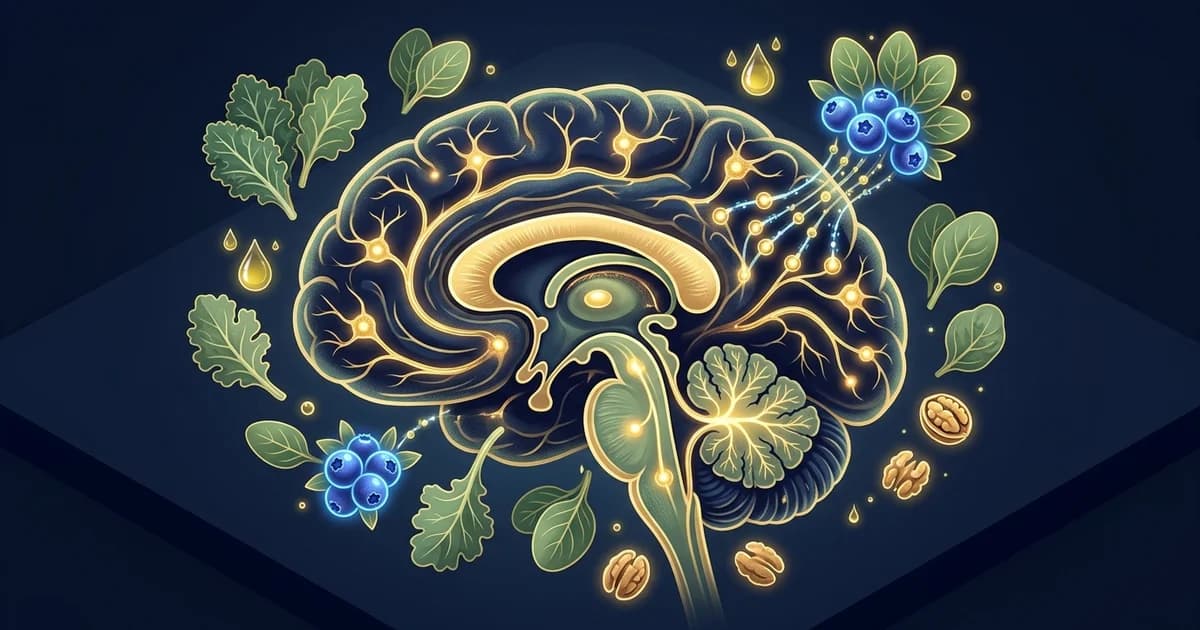
The MIND Diet Study: How Eating Patterns Slowed Brain Aging by 7.5 Years
A salad does not sound like medicine. Yet one of the most cited nutrition findings of the last decade suggests your dinner plate may shape how your brain holds up over the next several decades.
The MIND diet study, led by Rush University epidemiologist Martha Clare Morris, tracked what older adults ate and how their thinking changed over time. The headline number was hard to ignore. People who followed the eating pattern most closely declined cognitively at a rate that looked like being 7.5 years younger than people who followed it least.
That is a big claim. It is also an observational one, which matters more than the headlines admitted. Here is what the research actually found, what a later clinical trial complicated, and how to read all of it without overreaching.
Key Takeaways
- The 2015 MIND diet study followed 960 older adults and found that top adherence tracked with a rate of cognitive decline equivalent to being 7.5 years younger.
- A separate Morris paper linked strong adherence to a 53% lower risk of developing Alzheimer's dementia, and moderate adherence to a 35% lower risk.
- The MIND diet names 10 brain-supporting foods to eat and 5 to limit, borrowing from the Mediterranean and DASH patterns.
- A 2023 randomized trial in the New England Journal of Medicine found no marked cognitive edge over a healthy control diet after three years, which is the honest counterweight to the early excitement.
What the MIND Diet Study Actually Measured
The 2015 MIND diet study was observational, not a controlled experiment. Researchers watched what people ate and how their cognition shifted, then looked for patterns.
Morris and her colleagues built a scoring system that captured foods tied to brain health in the existing literature. They then tracked cognition across an average of 4.7 years. The difference in decline rates for being in the top tertile of MIND diet scores versus the lowest was equivalent to being 7.5 years younger in age, and the findings suggest that the MIND diet substantially slows cognitive decline with age.
The sample was sizable for this kind of work. The team related MIND diet scores to change in cognition over an average 4.7 years among 960 participants of the Memory and Aging Project, with a mean age of 81.4 years.
Read that carefully. The 7.5-year figure describes a rate of decline, not a reversal of aging. People in the top group still aged. They just appeared to lose ground more slowly.
The Morris MIND Diet: 10 Foods In, 5 Foods Out
The Morris MIND diet is a hybrid. It pulls the strongest brain-related parts out of the Mediterranean and DASH diets and drops the rest.
The name spells out the intent. Rush nutritional epidemiologist Martha Clare Morris and colleagues developed the "Mediterranean-DASH Intervention for Neurodegenerative Delay" (MIND) diet.
The structure is simple enough to remember. Wine rounds out a list of 10 "brain healthy" food groups: green leafy vegetables, other vegetables, nuts, berries, beans, whole grains, fish, poultry, olive oil and wine. On the limit side, the plan flags red meat, fast and fried foods, pastries and sweets, cheese, and butter or stick margarine.
Two details set the MIND diet apart from its parents. It singles out berries and leafy greens specifically, rather than treating all produce the same. And it is more forgiving on red meat. Red meat isn't banned in the MIND diet, but the researchers say you should limit consumption to no more than four servings a week, which is more generous than the Mediterranean diet that restricts red meat to just one serving.
Daily and weekly targets
A practical version of the pattern looks like this:
- One green leafy vegetable serving and one other vegetable per day
- Berries at least twice a week
- Nuts most days
- Beans roughly every other day
- Whole grains three times a day
- Fish about once a week, poultry about twice
- Olive oil as the primary cooking fat
MIND Diet and Cognitive Decline: The Alzheimer's Numbers
Beyond the cognitive-decline paper, a companion 2015 study tied the MIND diet to lower dementia risk, and the effect size was the part that grabbed attention.
The risk reduction scaled with how closely people stuck to the plan. The study shows that the MIND diet lowered the risk of Alzheimer's disease by as much as 53 percent in participants who adhered to the diet rigorously, and by about 35 percent in those who followed it moderately well.
That second number is the interesting one. You did not have to be perfect to see a signal. Even people who made modest changes to their diets had a lower risk of developing Alzheimer's, and the longer people followed the MIND diet patterns, the lower their risk.
For context on why this matters, dementia is among the leading causes of death in the United States, driving many people to search for ways to prevent cognitive decline. A dietary pattern that tracks with lower risk, even modestly, is worth understanding.
MIND vs Mediterranean Diet for Brain Health
The MIND vs Mediterranean diet question has a clean answer: they overlap heavily, but the MIND diet was engineered for the brain specifically.
Both the Mediterranean and DASH diets already had cognitive evidence behind them before Morris stepped in. In 2015, Dr. Martha Clare Morris and colleagues at Rush University Medical Center and the Harvard Chan School of Public Health published two papers introducing the MIND diet, and both the Mediterranean and DASH diets had already been associated with preservation of cognitive function, presumably through their protective effects against cardiovascular disease.
The MIND diet's edge is focus. It keeps the brain-relevant foods, adds explicit berry and leafy-green targets, and loosens rules that do not move the cognitive needle.
| Feature | MIND Diet | Mediterranean Diet |
|---|---|---|
| Primary goal | Brain and cognitive health | Heart health, general longevity |
| Berries | Named target, twice weekly | Folded into "fruit" broadly |
| Leafy greens | Daily, explicitly emphasized | Part of general vegetable intake |
| Red meat | Up to ~4 servings/week | About 1 serving/week |
| Built from | Mediterranean + DASH | Traditional regional eating |
For most people, the practical answer is that either pattern is a reasonable foundation, and the MIND diet is essentially a brain-prioritized edit of food you may already enjoy.
The Honest Caveat: What the 2023 Trial Found
Here is the part the viral headlines skipped. When the MIND diet was put through a stricter test, the results cooled off.
Researchers ran a randomized controlled trial, the gold standard that observational studies cannot match. A trial of the MIND diet led by the Rush Alzheimer's Disease Center found no marked improvement after three years compared to a control diet group with mild caloric restriction, in a paper published in the New England Journal of Medicine.
One likely reason is the comparison itself. These individuals were healthy at the start of the trial and had no cognitive impairment, and their cognition got slightly better over time; why there was no difference between the two diet groups could be a result of many factors including that the control group had a relatively healthy diet.
So which version is true, the 7.5-years finding or the null trial? Both, in their own lanes. Observational data found a strong association across a large group followed for years. A shorter trial against an already-healthy control diet did not detect a difference. That tension is normal in nutrition science, and it is the reason serious researchers hedge.
The takeaway is not that diet stopped mattering. It is that the MIND diet is best understood as a sensible, long-game eating pattern with real observational support, rather than a guaranteed shield proven by trial.
The Bottom Line on a Brain-First Plate
The best diet for brain health is not exotic. The MIND diet study made the case that leafy greens, berries, fish, nuts, beans, and olive oil, eaten consistently over years, track with slower cognitive decline and lower dementia risk in large populations.
The strongest claim, a decline rate resembling someone 7.5 years younger, came from observational data. The most rigorous test, a three-year randomized trial, did not confirm a cognitive advantage over a healthy control diet. Hold both facts at once.
The reasonable move is to treat the MIND pattern as a foundation, not a cure. It costs you little, the food is good, and the downside risk is essentially zero. That alone makes it a defensible default for anyone thinking about their brain over the long run.
Frequently Asked Questions
Did the MIND diet really slow brain aging by 7.5 years?
Not exactly as the headline implies. The 2015 study found that people in the highest tier of MIND diet adherence declined cognitively at a rate equivalent to being 7.5 years younger than the lowest tier. It described a slower rate of decline across a group, not a reversal of aging or a guaranteed individual outcome. It was also observational, meaning it shows association rather than proof of cause.
Who created the MIND diet?
The MIND diet was developed by Martha Clare Morris, a nutritional epidemiologist at Rush University Medical Center, working with colleagues including researchers at the Harvard Chan School of Public Health. The acronym stands for Mediterranean-DASH Intervention for Neurodegenerative Delay. Morris published two foundational papers in 2015, one on cognitive decline and one on Alzheimer's risk.
What foods are on the MIND diet?
The MIND diet emphasizes 10 food groups: green leafy vegetables, other vegetables, nuts, berries, beans, whole grains, fish, poultry, olive oil, and wine. It asks you to limit five: red meat, butter and stick margarine, cheese, pastries and sweets, and fried or fast food. Berries and leafy greens get specific, frequent targets, which is part of what distinguishes it from the broader Mediterranean approach.
Is the MIND diet better than the Mediterranean diet for the brain?
The MIND diet is essentially a brain-focused edit of the Mediterranean and DASH diets. It keeps the cognitively relevant foods, adds explicit berry and leafy-green goals, and is more lenient on red meat. Observational data supports both for cognitive health. For brain-specific intent, the MIND diet is more targeted, though a head-to-head winner has not been proven in rigorous trials.
Does the MIND diet prevent Alzheimer's?
No diet prevents Alzheimer's with certainty. A 2015 study associated rigorous MIND adherence with a 53% lower risk of Alzheimer's dementia and moderate adherence with a 35% lower risk. Those are associations from observational research. A 2023 randomized trial did not find a cognitive advantage over a healthy control diet after three years, so the diet is best framed as supportive, not protective in a guaranteed sense.
Why did the 2023 trial show no benefit if the 2015 study did?
The two studies asked different questions in different ways. The 2015 work observed real-world eating over nearly five years in a large group. The 2023 trial randomly assigned a MIND diet against a healthy, mildly calorie-restricted control diet for three years among people who were cognitively healthy at baseline. A short trial against an already-good control diet is a hard place to detect a difference, which the researchers acknowledged.
Diet Is the Long Game. Focus Is the Daily One.
The MIND diet study is a clean example of how to read evidence like an adult: a strong observational signal, a sober randomized follow-up, and a sensible conclusion that lands somewhere between hype and dismissal. Eating well over decades is the foundation for cognitive health, and nothing in a tin or a bottle replaces that.
It also works on a different timescale than your Tuesday afternoon. Diet shapes the long arc. It does nothing for the meeting you have in ten minutes. That gap is the layer Roon was built for: acute, on-demand focus, not lifelong brain maintenance.
Roon is a sublingual pouch with four ingredients, 80 mg caffeine, 60 mg L-theanine, 25 mg methylliberine (Dynamine), and 5 mg theacrine (TeaCrine), designed to come on in 5 to 10 minutes and hold 6 to 8 hours with no jitters, no crash, and no tolerance buildup. It is not a substitute for a brain-supporting diet, sleep, or the kind of cognitive reserve you build over years. Think of it as the focus layer on top of the foundation, not the foundation itself. If you want to see how daily habits compound, our pieces on cognitive reserve and the FINGER study and nutrient deficiencies that quietly drain focus are a good next read. Try Roon when you need the sharp end of the day, and keep eating your greens for everything else.
Written by Roon Team