Mental Block? How to Get Unstuck When Your Brain Won't Cooperate

Mental Block? How to Get Unstuck When Your Brain Won't Cooperate
You sit down to write the email, build the deck, or solve the problem. The cursor blinks. Nothing comes. You read the same sentence four times and retain none of it.
That wall has a name, and learning how to break a mental block starts with understanding that your brain is not broken. It is stuck in a loop, and loops can be interrupted. The fix is rarely "try harder."
This guide breaks down what a mental block actually is, why it happens, and the specific moves that get you moving again, backed by what the research says about attention and the brain.
Key Takeaways
- A mental block is usually a state problem, not a willpower problem. Your attention systems are dysregulated, not absent.
- Interruptions are expensive. Research suggests it takes more than 23 minutes to fully return to a task after a distraction.
- The fastest way to get unstuck is to change your state first: move your body, shift the problem, or reset your environment.
- Focus runs on neurochemistry. Dopamine and norepinephrine drive your ability to lock onto a task.
- Stimulants help when the input is fatigue, but they cannot replace sleep, clear priorities, or a system for deep work.
What a Mental Block Actually Is
A mental block is a temporary state where your brain cannot access the focus, recall, or creativity you need, even when you want to perform. It feels like a locked door with no key.
Most people treat it as a character flaw. It is not. It is a mismatch between the demands of the task and the current state of your attention systems.
Think of focus as a resource with a supply chain. When the supply is disrupted by fatigue, stress, overstimulation, or sheer repetition, the output drops. The solution changes depending on the cause, because you do not fix a tired brain the same way you fix an overstimulated one.
Why You Feel Stuck and Can't Focus
Feeling stuck and can't focus usually traces back to one of four inputs: fatigue, fragmentation, fixation, or fear. Each one jams a different part of the system.
Fatigue is the obvious one. Poor sleep, low blood sugar, or simple end-of-day depletion strips your prefrontal cortex of the fuel it needs to hold a thought.
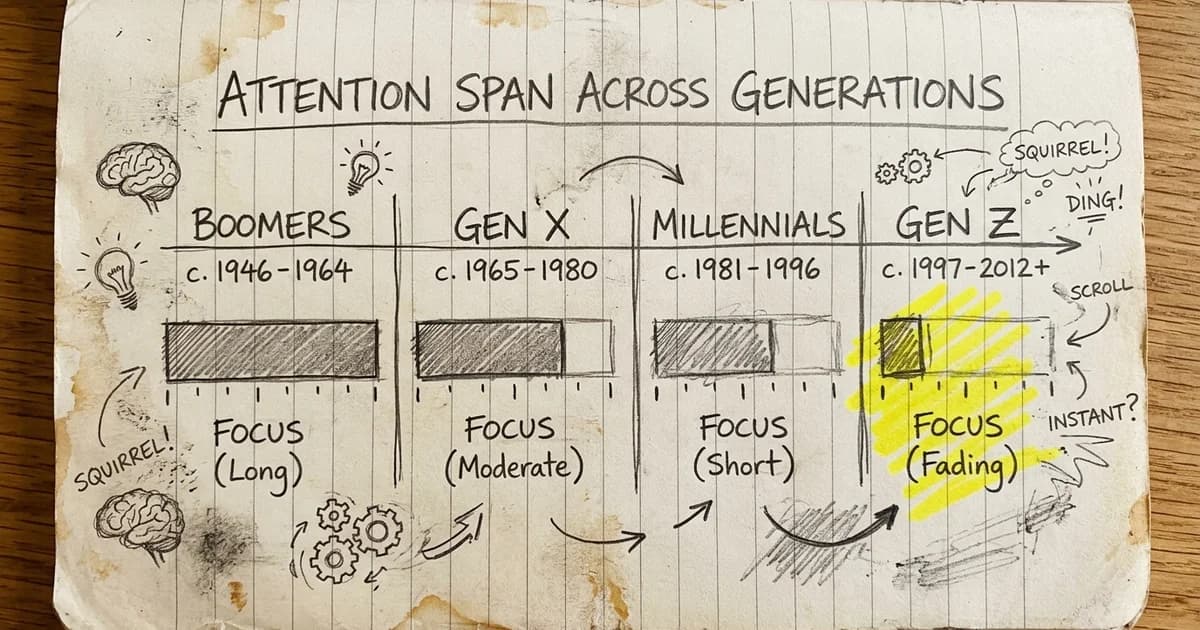
Fragmentation is the modern killer. Every notification splits your attention into smaller and smaller pieces until none of them are big enough to do real work.
Fixation is when you get locked onto one wrong approach and cannot see around it. Your brain keeps returning to the same dead end, a pattern psychologists study as cognitive fixation.
Fear is the quiet one. The pressure to perform triggers a stress response that narrows your thinking exactly when you need it to expand.
The Hidden Cost of a Mental Block at Work
A mental block at work is rarely a single lost moment. It compounds.
The most cited figure on interruptions comes from the research of Dr. Gloria Mark. It takes an average of 23 minutes and 15 seconds for a person to fully regain deep focus after being interrupted during a task.
Now do the math. About 82 percent of all interrupted work is resumed on the same day, but each return carries that reload tax. A few interruptions per hour and your most valuable cognitive hours evaporate.
When you can't focus at work, the cause is often not the work itself. It is the dozen tiny context switches that never let you build momentum in the first place.
How to Break a Mental Block: A Step-by-Step Approach
The fastest way to break a mental block is to change your physical and mental state before you try to force the work. State drives output, not the other way around.
Here is the sequence that actually moves the needle.
1. Stop Trying to Push Through
Staring harder at a problem you are fixated on reinforces the dead end. When you step away, your brain keeps working on the problem in the background, a phenomenon researchers call the incubation effect. Solutions often arrive once you stop chasing them.
The catch: the break has to be a real break. Scrolling your phone swaps one form of mental load for another and blocks the reset.
2. Move Your Body
A short walk does more than clear your head. Physical movement raises levels of the neurochemicals that drive attention, and even a few minutes of brisk walking can shift you out of the stuck loop.
Ten minutes outside beats an hour of self-criticism at your desk. Treat it as a tool, not a reward.
3. Shrink the Task
A mental block often grows from a task that feels too big to start. So make it smaller until it feels almost stupid.
Do not "write the report." Write one ugly sentence. Do not "build the model." Open the file and name three columns. The goal is to break the inertia, because momentum is far easier to maintain than to create.
4. Change Your Inputs
If fragmentation caused the block, the fix is to remove the fragmenting inputs. Close the tabs. Put the phone in another room. Use one screen.
This is the least glamorous step and the most effective one. You cannot focus deeply in an environment engineered to interrupt you. For a deeper system, see our guide on building a deep work routine.
5. Address the Neurochemistry
Focus is a chemical event. Your ability to lock onto a task depends heavily on two neuromodulators in the prefrontal cortex.
According to research published on PubMed, the catecholamine transmitters norepinephrine and dopamine stand out as powerful players in working memory and attention. When those signals are low, focus feels impossible no matter how motivated you are.
This is why a tired brain cannot be reasoned into concentration. The chemistry has to be in range first.
The Tools That Help You Get Unstuck
Learning how to get unstuck is partly behavioral and partly chemical. The table below compares common tools by how fast they work and what they actually fix.
| Tool | Onset | Best For | Limitation |
|---|---|---|---|
| Short walk / break | 5-15 min | Fixation, stress | Temporary if root cause stays |
| Black coffee | 30-45 min | Fatigue, low alertness | Jitters, afternoon crash |
| Energy drinks | 20-40 min | Acute fatigue | Sugar, crash, high caffeine |
| L-theanine + caffeine | 30-45 min | Calm, sustained focus | Capsules are slower to kick in |
| Roon sublingual pouch | 5-10 min | On-demand focus, no crash | Not a fix for poor sleep or no system |
The standout pairing in that list is caffeine combined with L-theanine. On its own, caffeine raises alertness but can bring jitters. Paired with L-theanine, the profile smooths out.
A study indexed on PubMed found that the combination of L-theanine and caffeine improves cognitive performance and increases subjective alertness. That is the calm-but-sharp state most people are chasing when they reach for coffee and miss.
Newer compounds extend the window. According to reporting from NutraIngredients, pairing caffeine with the compounds Dynamine and TeaCrine helped users hold focus and accuracy together, where caffeine can improve reaction time, but focus and accuracy become erratic, and Dynamine and TeaCrine help eliminate that speed-accuracy tradeoff.
How to Prevent the Next Block
Breaking a block is reactive. The real win is building a day where blocks are rare.
Protect your first deep work session before the interruptions start. Batch your shallow tasks instead of letting them slice your day apart. Guard your sleep, because nothing rebuilds attention like rest does.
And stop expecting linear output from a non-linear brain. Some friction is normal. The goal is to get unstuck faster, not to never get stuck at all.
Change the State Before You Change the Effort
A mental block is a state, not a verdict on your ability. When the work stalls, the smart move is to change your inputs before you change your effort.
Step away to let your brain work in the background. Move your body to lift the neurochemistry that drives attention. Shrink the task until starting feels easy, and strip out the interruptions that fragment your day. Most blocks dissolve once the underlying state shifts.
The brain rewards the person who manages their state, not the one who grits their teeth the hardest.
Frequently Asked Questions
How long does a mental block usually last?
It varies by cause. A block driven by stress or fixation can break in minutes once you step away and reset your state. A block driven by fatigue or poor sleep can persist for hours or days until the underlying deficit is addressed. If a block lasts for weeks and affects your daily life, that is worth a conversation with a healthcare professional rather than a productivity hack.
Why can't I focus at work even when the task is simple?
Simple tasks still require attention, and attention is fragile. If you can't focus at work on something easy, the culprit is usually fragmentation from notifications, low energy from poor sleep or skipped meals, or background stress pulling on your mental bandwidth. The task is not the problem. Your current state is. Fix the inputs and the simple task usually flows again.
Does caffeine help break a mental block?
Caffeine helps when fatigue or low alertness is the cause of the block. It raises alertness but can also bring jitters at higher doses. Pairing caffeine with L-theanine produces a calmer, more sustained kind of focus, which research links to better cognitive performance and alertness than caffeine alone. Caffeine will not help if the block stems from stress, fixation, or a task that is simply too big.
Is it better to push through or take a break?
For most blocks, a real break wins. Stepping away lets your brain keep working on the problem in the background through the incubation effect, and solutions often surface when you stop forcing them. The exception is when the only thing missing is momentum. In that case, shrinking the task to something tiny and starting immediately beats waiting for motivation that may never arrive.
What is the fastest way to get unstuck?
Change your state. The single fastest move is usually a short walk, which raises the neurochemicals tied to attention and breaks the fixation loop in under fifteen minutes. Pair that with shrinking the task to its smallest possible first step. If fatigue is the driver, a calm source of caffeine can bring your alertness back into range faster than willpower can.
Can a mental block be a sign of something serious?
Occasional blocks are normal and expected. Persistent, severe difficulty with focus that disrupts work, relationships, or daily life can sometimes point to underlying issues like burnout, a sleep disorder, anxiety, or a diagnosable attention condition. Supplements and productivity tactics support a healthy brain. They do not diagnose or treat medical conditions, so see a qualified professional if the pattern persists.
On-Demand Focus, When the Block Is Fatigue
If you have read this far, you know most mental blocks are state problems. Sometimes that state is a tired brain that needs sleep. Sometimes it is a fragmented day that needs a better system. And sometimes you have done everything right and you still need to be sharp in the next ten minutes.
That last case is where Roon fits. It is a zero-nicotine sublingual pouch built around four ingredients that work on the attention chemistry this article covered: 80 mg caffeine, 60 mg L-theanine, 25 mg methylliberine (Dynamine), and 5 mg theacrine (TeaCrine). Because it absorbs sublingually, it tends to come on in 5 to 10 minutes and holds a 6 to 8 hour window with no jitters, no crash, and no tolerance buildup.
Be clear about what it is not. Roon supports focus, but it does not replace sleep, fix a broken priority list, or build a deep work habit for you. Use it as the cognitive layer on top of good systems, not instead of them. If your block is fatigue and the clock is running, try Roon and get back to work.
Written by Roon Team